


From
StayCurrentMD
Update Course Rewind 2025: Timing of PSARP: Early vs. Delayed—Does It Really Matter?
With Dr. Jamie Harris · hosted by Dr. Jill Knepprath
Chapter 2 of 6 · Surgical Management
Dilation strategy
Initial Management: Dilations
Cued at 0:59 · stops at 1:08 · press play
Expert statements on this page
No expert statements were drawn from this page.
Host summaries · secondary, not cited in answers
Educational content from recorded physician discussions — not medical advice. Talk to your (or your child's) care team about your situation.
Video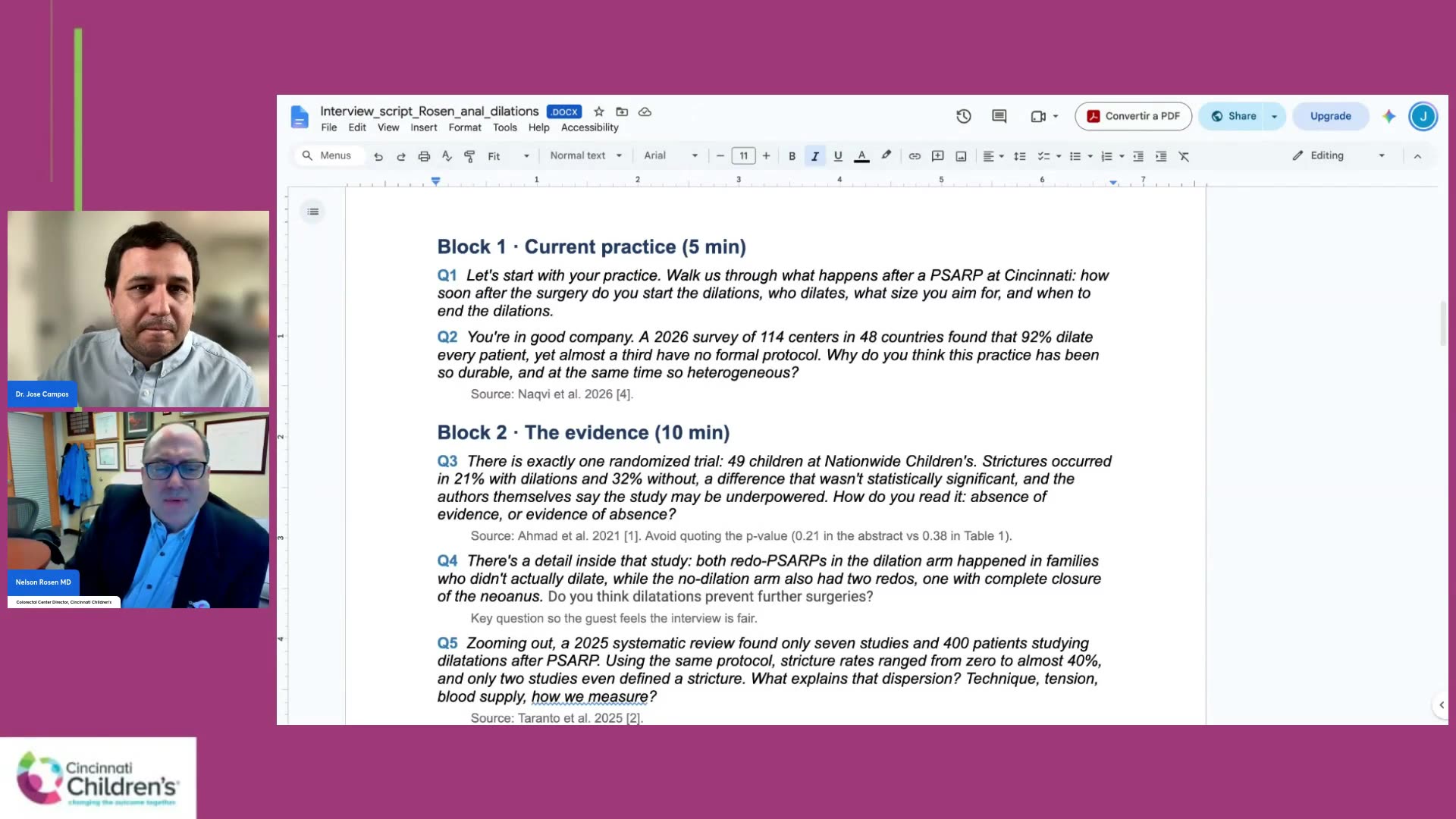
Anal Dilatations After PSARP: Current Practice, Evidence & Future Directions in Pediatric Colorectal Surgery
51 min · Published Nov 2026
Video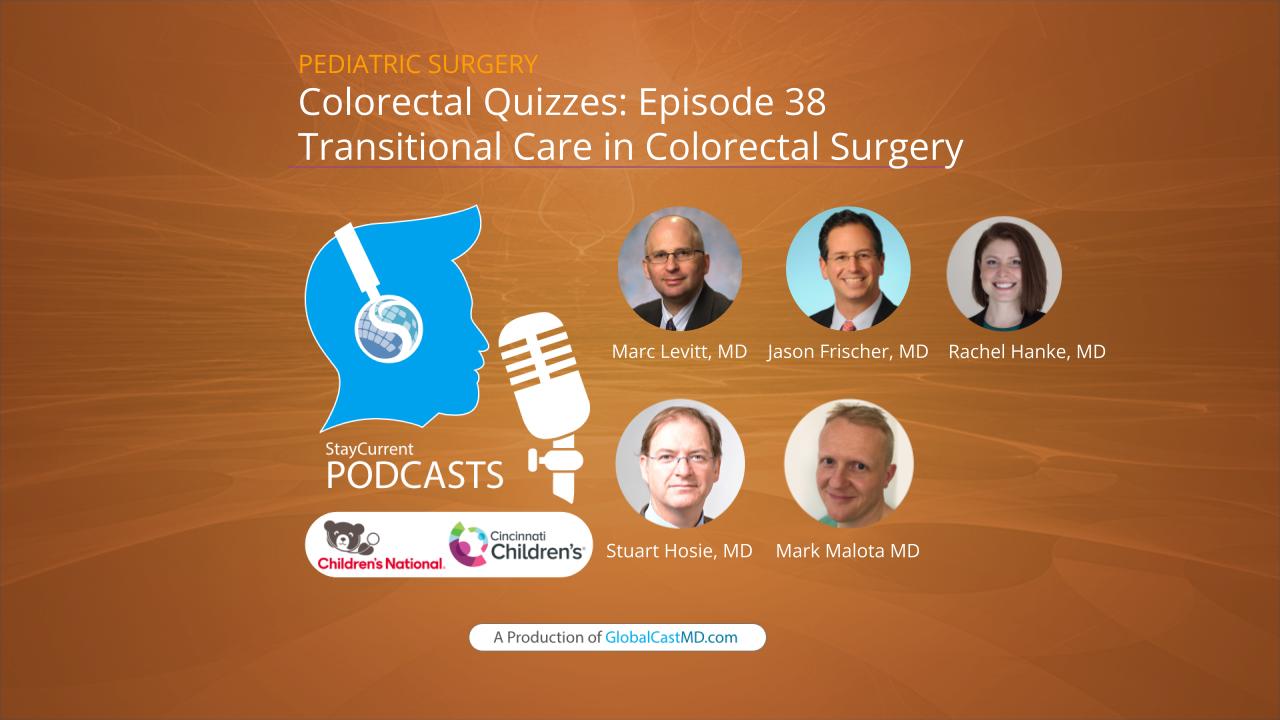
Colorectal Quiz Episode 38: Transitional Care in Colorectal Surgery
25 min · Published Mar 2024
Video
Update Course 2023 - Updates in Colorectal Pathology
27 min · Published Aug 2023
Podcast
Anorectal Malformations with Dr. Andrea Bischoff
47 min · Published Apr 2017
Video
Anorectal Malformations: Introduction and Overview for bowel management
Dr. Todd Ponsky · 26 min · Published May 2013
Video
Validation of an anorectal malformation trainer - Can a high-fidelity model simulate real life?
1 min · Published Jun 2026
Video
Complications and Long-Term Outcomes of Patients With Cloacal Malformation After Bowel Neovagina...
1 min · Published Jun 2026
Video
Safety and utility of long-acting steroid injection for management of post-operative stricture...
1 min · Published Jun 2026
Video
Association Between Social Determinants of Health and Choice of Urinary Reconstruction in Children
1 min · Published Jun 2026
Video
The Perineal Body Preserving PSARP (PPP)
11 min · Published Jun 2026
Video
Update Course Rewind 2025: Hirschsprung + ARM: Rare but Real
1 min · Published May 2026
Podcast
Diaphragm pacing as alternative to mechanical ventilation in pediatric respiratory failure
1 min · Published Nov 2026
Podcast
Fetoscopic endoluminal tracheal occlusion for congenital diaphragmatic hernia
4 min · Published Nov 2026
Podcast
FETO procedure for late-diagnosed severe CDH with liver herniation
4 min · Published Nov 2026
Podcast
Severe CDH case with FETO: unexpected anatomic findings and clinical outcome
3 min · Published Nov 2026
Podcast
Pediatric pancreatitis: diagnosis, causes, and genetic insights with Dr. Juan Gurria
3 min · Published Nov 2026
Podcast
Understanding craniosynostosis: skull sutures, growth patterns, and diagnosis in infants
10 min · Published Nov 2026
What the experts said
Doing dilations alone is probably not the correct management for rectal vestibular fistula for a number of different reasons.
Dilations initially will allow for decompression in rectal vestibular fistula.
It is recommended to dilate only to a 7 Hegar to decrease the potential scarring along the track for future PARPs.
If trying to keep the fistula open, you only need to keep it open enough for soft stool to pass through, with no reason to drive the dilation up big.
One surgeon prefers to do PSARP at one month of age so the baby could grow a little bit bigger.
Nelson and another panelist disagree on timing, with Nelson liking to do repairs up front while the other prefers getting babies a little older and letting them go home.
One surgeon likes to get PSARP done on the neonatal admission, though it doesn't have to be the next day.
Two important studies on PSARP timing both came out in 2021.
Another 2021 study looked at 30-day outcomes comparing neonatal versus delayed anoplasty in a multi-institutional retrospective study through the PCPLC.
The PCPLC study defined early repair as within 14 days versus late as after 14 days.
The PCPLC study concluded the same thing as the NSQIP study regarding safety of early versus delayed repair.
There is discrepancy in the literature regarding the definition of delayed repair, ranging from a couple of months to multiple months of age, with no right timing of delayed repair established.
One drawback to delayed repair is theoretical fibrosis of the fistula tract, making dissection a little bit more difficult on the PSARP.
If the fistula is not completely decompressed, the rectum can get distended and make it technically more difficult to perform the PSARP.
With social determinants of health, it's not always easy for families to make multiple trips for care, as it can be a long distance and expensive.
For patients with rectal vestibular fistulas, some surgeons perform anal rectoplasties immediately while others wait until after discharge.
Dr. Jamie Harris presents a case of a full-term newborn baby girl with rectal vestibular fistula weighing 3 kg with completely negative VACTERL workup.
The panel agreed that it's safe to perform the PSARP either early before discharge or later around 1 to 3 months of age.
The NSQIP study defined early repair as 7 days and delayed repair as between 6 weeks and 8 months.
The NSQIP study found no difference in overall outcomes, including re-operations and readmissions, between early and delayed PSARP.
Wound breakdown and dehiscence was the most common complication for both early and delayed repair groups in the PCPLC study.
There was no significant difference in postoperative complications between early and delayed repair groups in the PCPLC study.
Early repair during the newborn period avoids an additional admission for the surgery.
Both early and delayed PSARP repairs are safe for patients with rectal vestibular fistulas.
What matters most in timing PSARP is the circumstances, family access to care, patient size, and the surgeon's comfort and experience.