


From
Live Event Content
Update Course 2022 - UPDATES IN GASTROSCHISIS FEEDING PROTOCOLS - Jason Fraser, Beth Rymeski, and Steven Lee
With Dr. Jason Fraser & Dr. Beth Rymeski · hosted by Dr. Todd Ponsky
Chapter 2 of 4 · Acute Management
Sedation debate
Sedation Practices for Sutureless Closure
Cued at 5:13 · stops at 5:38 · press play
Expert statements on this page
No expert statements were drawn from this page.
Host summaries · secondary, not cited in answers
Educational content from recorded physician discussions — not medical advice. Talk to your (or your child's) care team about your situation.
Video
91% Decrease in Mortality with Gastroschisis Bundle!
3 min · Published Dec 2018
Video
Journal of Pediatric Surgery Article Review: January 2022 - APSA Issue
Todd Ponsky · 13 min · Published Jul 2026
Video
Quick Literature Updates Episode 11
Published Jul 2023
Podcast
Defectos de la Pared Abdominal en resumen
11 min · Published Mar 2023
Podcast
Revisión de la Biliografía: Gastrosquisis
20 min · Published Feb 2023
Podcast
Journal of Pediatric Surgery Article Review: 3rd Quarter (Jul-Sep) 2024
19 min · Published Oct 2024
Video
Impact of social determinants of health on outcomes in pediatric short bowel syndrome...
43 s · Published Aug 2026
Video
Advancements in Pediatric Intestinal Failure: Innovative Therapies and Improved Outcomes
17 min · Published Aug 2026
Podcast
Update Course Rewind: Omphalocele & Gastroschisis 2020
Miguel Guelfand · 15 min · Published Jul 2026
Video
Update Course Rewind 2025: Updates in NEC Management
11 min · Published Jul 2026
Video
Availability, utilization, and barriers to bowel ultrasound for necrotizing enterocolitis...
55 s · Published Jul 2026
Video
Laparoscopic Ladd Procedure for Midgut Volvulus in a 12-Year-Old Using CoolSeal Trinity
Dr. Steve Rothenberg · 8 min · Published May 2026
Video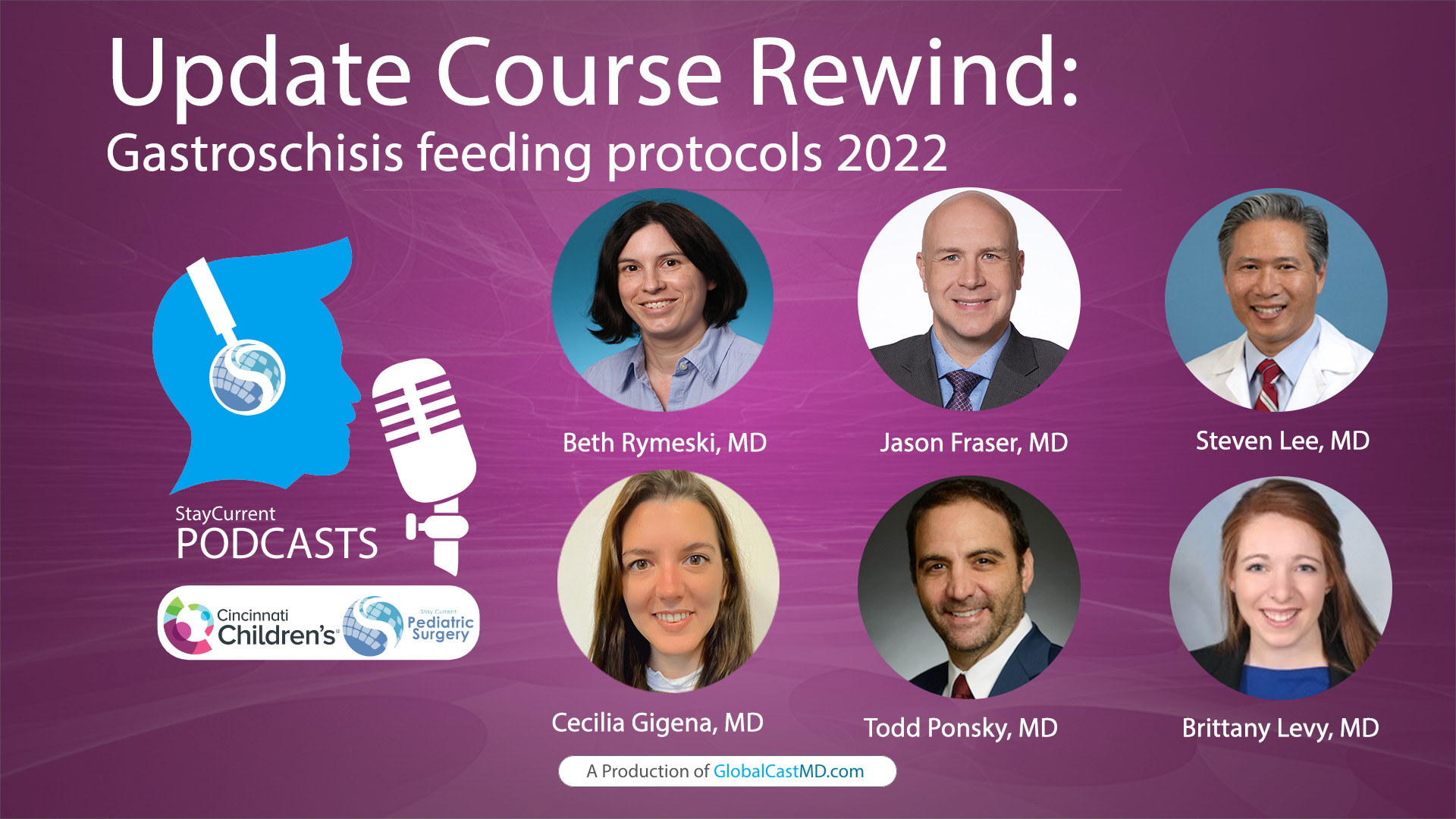
Update Course Rewind: Gastroschisis Feeding protocols 2022
CCHMC Pediatric Surgery · Published Feb 2023
Video
BOB Ped Surg 2023 - Jason Fraser, APSA - Presentation
Published Feb 2023
Podcast
Gastroschisis and sutureless abdominal wall closure
12 min · Published Jan 2021
Video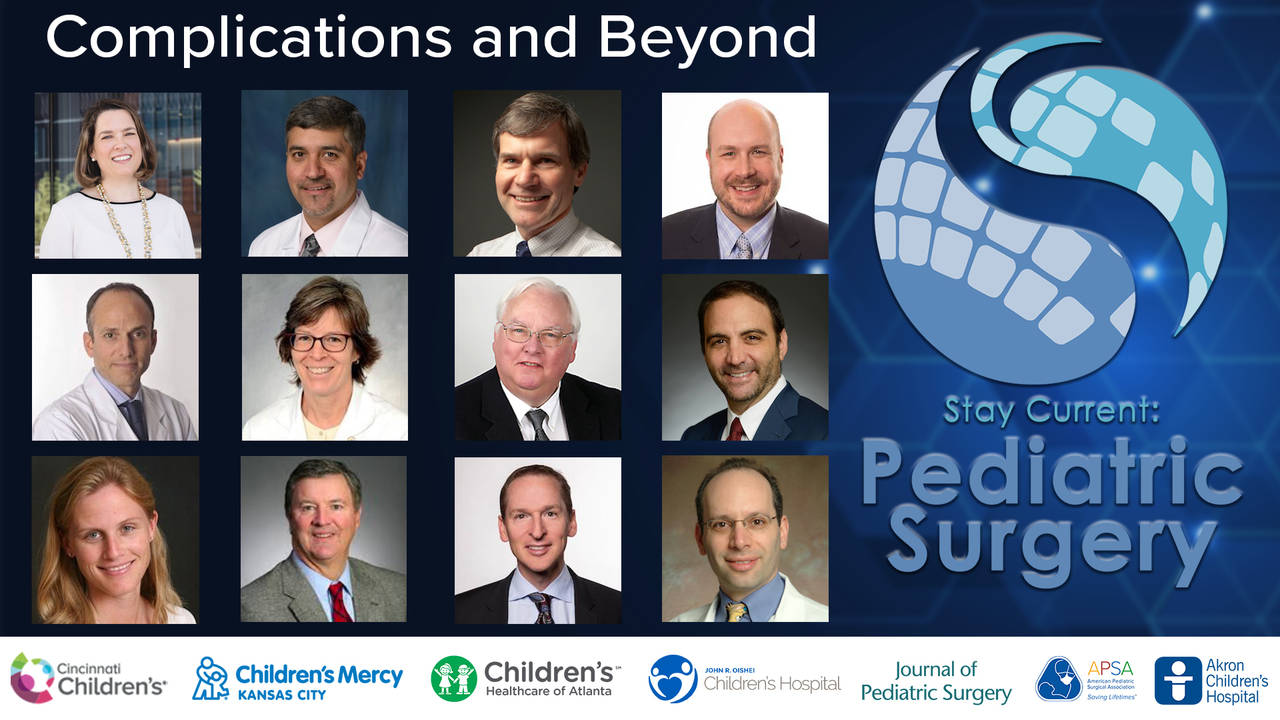
Complications and Beyond
66 min · Published Sep 2020
Video
Clinical & Research Update: Renal Tumors with Drs. Ethan Smith, Lindsay Haacker, Michael Daugherty, and Meera Kotagal
71 min · Published Sep 2026
Video
Clinical & Research Update: Neuroblastoma with Drs. Katherine Somers, Cara Morin, Juan Gurria, and Meera Kotagal
67 min · Published Sep 2026
Video
Clinical & Research Update: Sarcoma w/ Drs. Roshni Dasgupta, Joseph Pressey, Arthur Meyer, Luke Pater
66 min · Published Sep 2026
Video
2026 Laparoscopic Pediatric Hernia Repair
123 min · Published Jun 2026
Video
Beyond the Spectrum: Diagnosis, Myths & Management - Caitlin Couch & Leslie Lopez - APP Conference 2026
50 min · Published May 2026
Video
Dysautonomia: Navigating the Journey - Martha Willis - APP Conference 2026
55 min · Published May 2026
What the experts said
Some institutions start feeds when NG output is less than 20 mL/kg/day.
Jason Fraser's institution starts feeding immediately after dressing placement as long as the baby is not sick, not having horrible output, and not vomiting.
Fraser's institution does not intubate gastroschisis babies for reduction.
Awake reduction can be successful if performed slowly, with stomach emptying, colon decompression, oral sucrose, and gradual abdominal wall stretching.
Some institutions perform gastroschisis reduction under general anesthesia.
Cincinnati Children's feeding protocol is based on patient tolerance and data from resource-limited settings where TPN is unavailable and feeding is mandatory.
Cincinnati Children's protocol includes standardized feed advancement and sham feeding to address poor oral feeding skills in gastroschisis patients.
Cincinnati Children's attempted ad-lib feeding for gastroschisis but abandoned it after one year due to poor results, including delayed NG tube removal and starting feeds too late.
Cincinnati Children's current gastroschisis feeding protocol has been in place for approximately four years.
The reduction in surgical site infections with protocol feeding was likely due to decreased care variability rather than the feeding protocol itself.
The multi-institutional study showed inconclusive results due to significant variation in feeding protocols across institutions.
Cincinnati Children's average gastroschisis length of stay was 49 days before protocol implementation, which was astronomically higher than comparable NICUs in their cooperative network.
After implementing a feeding protocol, Cincinnati Children's reduced gastroschisis length of stay by 10 days over two years.
Cincinnati Children's has seen a decrease in time from first feed to full feeds but has not yet reduced the time from admission to first feed (except in 2020).
Continuous feeds in gastroschisis patients can lead to oral aversion and prolonged length of stay when patients are not taking anything orally.
Cincinnati Children's protocol includes both intermittent feeds and sham feeds, with sham feeds implemented for approximately one year.
Approximately two-thirds of Cincinnati Children's gastroschisis patients are discharged home with an NG tube or G-tube for continued feeding support.
Cincinnati Children's gastroschisis protocol includes prenatal care coordination with obstetricians and neonatologists, with surgery continuing to follow patients throughout hospitalization.
The most important aspects of gastroschisis feeding are defining institutional tolerance criteria, adhering to protocol, and continuously evaluating the infant's condition.
For significant feeding intolerance, Cincinnati Children's protocol calls for stopping feeds for six hours, though this is not clearly evidence-based.
Cincinnati Children's written protocol explicitly states that emesis is expected during gastroschisis feeding to set appropriate expectations for nursing staff and families.
One recent Cincinnati Children's gastroschisis patient who was primarily reduced on day of life zero was discharged at approximately two weeks and remained well at two-week follow-up, though this is an outlier on the faster end.
Cincinnati Children's current average gastroschisis length of stay is 30 to 34 days.
Cincinnati Children's has not seen any aspirations with their early aggressive feeding approach, though they acknowledge they are still early in implementation and continue to monitor data.
Much of the data supporting early feeding in gastroschisis originated from resource-limited countries without TPN access, though implementing this approach in Africa has proven difficult due to poor tolerance.
At Cincinnati Children's, approximately two-thirds of gastroschisis cases cannot be reduced immediately and are placed in a silo for gradual reduction followed by sutureless closure, with feeds started after closure.
Several hospitals have changed their gastroschisis protocols based on recent publications.
In a multi-institutional study, protocol-fed gastroschisis infants had fewer surgical site infections compared to non-protocol-fed infants.
Some institutions ignore bilious emesis or bilious NG residuals completely during gastroschisis feeding advancement.