


Chapter 3 of 11
Diaphragm pacing
Diaphragm Pacing for Ventilator Dependence
Cued at 7:00 · stops at 9:00 · press play
Expert statements on this page
No expert statements were drawn from this page.
Host summaries · secondary, not cited in answers
Educational content from recorded physician discussions — not medical advice. Talk to your (or your child's) care team about your situation.
Podcast
Top Ten Things to Remember from the 2017 Stay Current Annual Update Course...
25 min · Published Oct 2017
Podcast
Managing pancreatic fluid collections and chronic pancreatitis complications in children
2 min · Published Nov 2026
Video
BOB Ped Surg 2023 - Mohamad Qinawy, PAPSA - Presentation
8 min · Published Feb 2023
Video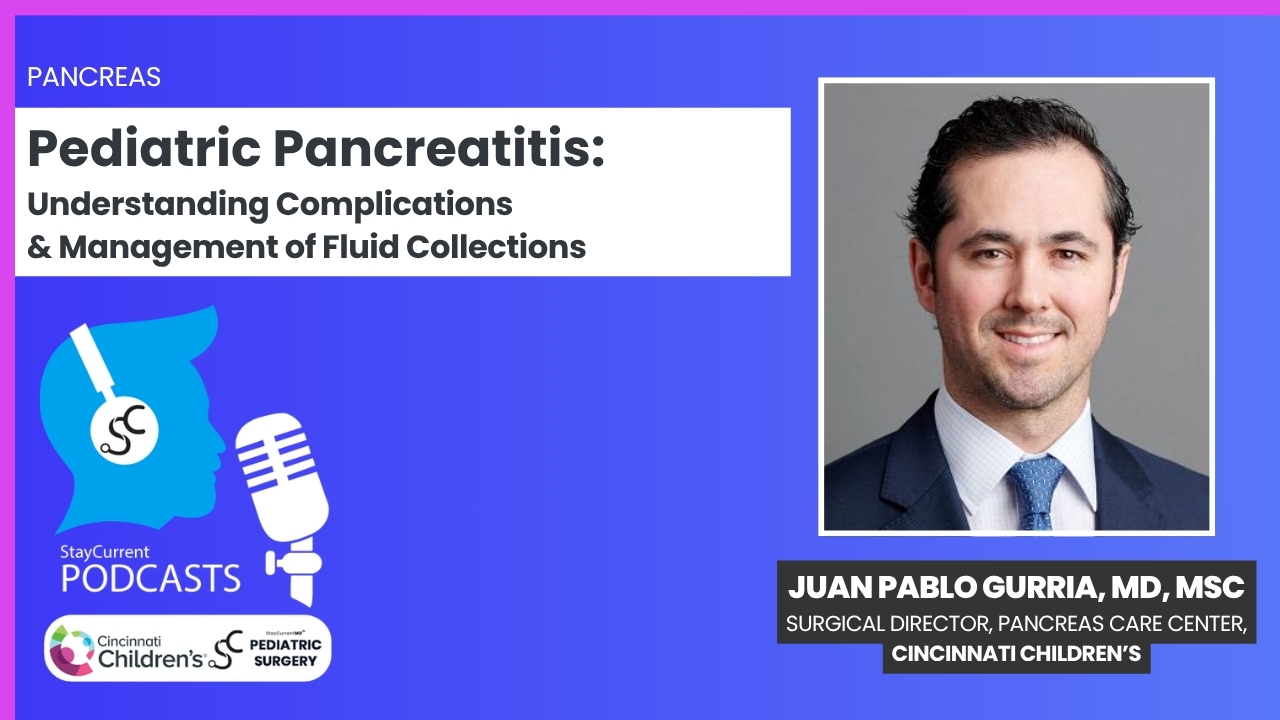
Pancreatitis: Understanding Complications & Management of Fluid Collections w/ Dr. Juan Gurria
2 min · Published Oct 2026
Video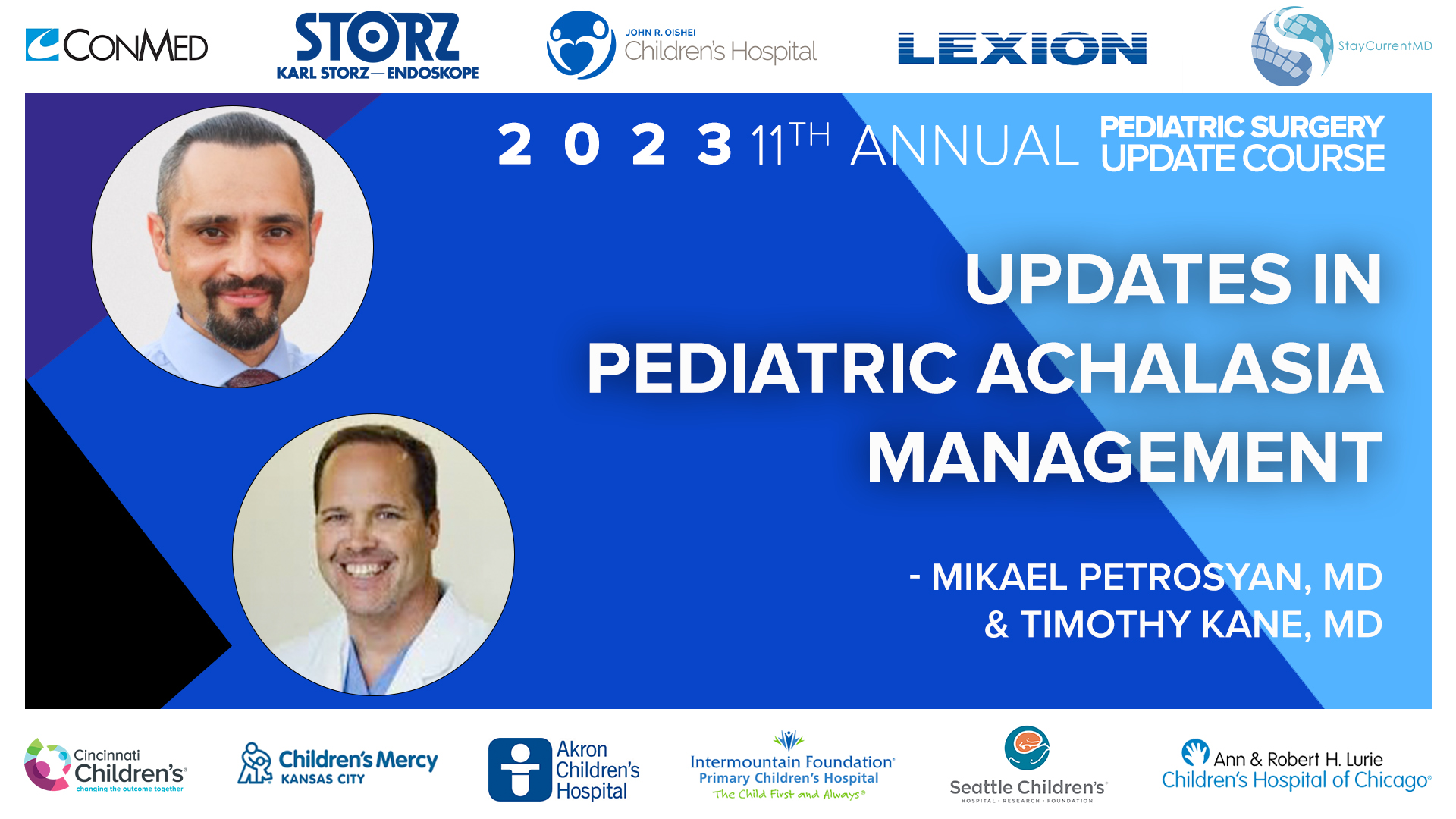
Update Course 2023 - Updates in Pediatric Achalasia Management
26 min · Published Aug 2023
Video
Gastric Neurostimulators: Update Course 2017
35 min · Published Aug 2017
Podcast
Diaphragm pacing as alternative to mechanical ventilation in pediatric respiratory failure
1 min · Published Nov 2026
Podcast
Fetoscopic endoluminal tracheal occlusion for congenital diaphragmatic hernia
4 min · Published Nov 2026
Podcast
FETO procedure for late-diagnosed severe CDH with liver herniation
4 min · Published Nov 2026
Podcast
Severe CDH case with FETO: unexpected anatomic findings and clinical outcome
3 min · Published Nov 2026
Podcast
Pediatric pancreatitis: diagnosis, causes, and genetic insights with Dr. Juan Gurria
3 min · Published Nov 2026
Podcast
Understanding craniosynostosis: skull sutures, growth patterns, and diagnosis in infants
10 min · Published Nov 2026
What the experts said
Gastric stimulation reduces symptoms of gastroparesis in pediatric patients with persistent nausea and vomiting unresponsive to medical therapy
Patients can receive temporary endoscopic gastric stimulation testing; if symptoms improve, they can proceed to permanent laparoscopic or open placement
Thoracoscopic sympathectomy extending to the lower stellate ganglion can reduce arrhythmias in CPVT and hypertrophic cardiomyopathy patients with ICDs
Partial stellate ganglion resection should use clips and scissors; electric cautery may damage the remaining ganglion and cause Horner's syndrome
Sympathectomy provides 100% compliance as patients cannot skip the intervention once performed
Diaphragm pacing is a reasonable option for pediatric patients with spinal cord injury, transverse myelitis, acute flaccid myelitis, or brain stem tumors who can be weaned from mechanical ventilation
The youngest patient to receive diaphragm pacing implantation was one year of age
Diaphragm pacing requires intact phrenic nerve and phrenic motor neurons; diaphragm contraction with neurostimulation must be confirmed prior to implantation
Biologic mesh is not appropriate for bridging gaps in ventral hernia repair; it is only a temporary solution or reinforcement
Macroporous monofilament lightweight polypropylene synthetic mesh (such as Marlex) is the best mesh for bridging gaps and performs well in contaminated fields in the retromuscular space
Retro-rectus repair with mesh is now preferred over laparoscopic underlay for ventral hernia repair
Posterior component separation has less wound morbidity than anterior component separation while providing space for wide mesh overlap and minimal fixation
Gastroesophageal disconnection (dividing esophagus from stomach and creating Roux-en-Y esophagojejunostomy) has good results for severe reflux after failed Nissen fundoplication
Gastroesophageal disconnection may be appropriate as a primary operation for patients at high risk for fundoplication failure
Laparoscopic gastroesophageal disconnection can be a long and difficult operation, taking 6 to 8 hours
Patients who were taking full feeds by mouth preoperatively can continue to do so after gastroesophageal disconnection
A five-variable prediction rule identifies pediatric blunt abdominal trauma patients at very low risk for intra-abdominal injury who can safely avoid CT imaging
Patients with only abdominal pain after blunt trauma have approximately 5% risk of abdominal injury and almost 0% chance of requiring intervention
Children with handlebar injury and abnormal abdominal exam findings have approximately 15% chance of abdominal injury
The low-risk group (no abdominal pain, normal physical exam, normal chest X-ray, normal AST, no abdominal wall trauma, no abnormal pancreatic enzymes) comprises 55% of the trauma population with less than 5% risk of any injury and less than 0.3% risk of injury requiring acute intervention
In solid organ injury management, injury grade is falling by the wayside in favor of clinical predictive factors
Patients who receive 20 cc/kg crystalloid and do not respond should receive 10-20 cc/kg bolus of blood rather than additional crystalloid
If hemoglobin drops below 7 and total blood transfusion reaches 40 cc/kg (4 units), the patient likely cannot be managed non-operatively and should go to the operating room
40 cc/kg of blood or 4 units of blood is the magic number indicating probable failure of non-operative management
Stable solid organ injury patients who never require blood transfusion can be discharged the next day
Chest CT has almost 100% sensitivity for airway foreign body detection, including radiolucent objects
Using chest CT for suspected airway foreign bodies can eliminate unnecessary bronchoscopies in children with unclear history who may have respiratory viral illness
Oral contrast is not needed for suspected bowel obstruction; CT can be read just as well without it, and eliminating it speeds up imaging and prevents nausea and vomiting
Luminal fluid in bowel obstruction serves as the contrast agent on CT
Repeat enema reduction attempts for intussusception are appropriate if there is movement all the way to the ileocecal valve
Modern pediatric CT scans deliver 1-10 millisieverts of radiation, equivalent to living on Earth for one year
The Gips procedure for pilonidal disease involves coring out pits with trephine or punch biopsy, extracting granulation tissue and hair with mosquito forceps, curetting the cavity with a smaller trephine, and flushing with saline then hydrogen peroxide
In the Gips pilonidal procedure, all punch openings are left unpacked and unsutured, drains are not required, and the procedure takes 3-5 minutes
For thoracoscopic lobectomy, the scope should be placed anterior to the tip of the scapula, almost at the mid-axillary line, directly over the major fissure
Operating ports for thoracoscopic lobectomy should be at the anterior axillary line
Placing the thoracoscope posterior to the scapula tip causes the surgeon to look back on themselves when working in the anterior fissure, creating a paradoxical working angle
When sealing blood vessels during thoracoscopic lobectomy, use a sealer (not sealer-divider) to seal proximally and distally, make a small nick between seals to confirm hemostasis, then complete the division
Understanding segmental anatomy helps predict vessel locations during lobectomy; for example, the superior segmental artery comes off the lower lobe with the bronchus directly below it
For incomplete fissures during lobectomy, use a sealing device to proceed layer by layer until structures are identified
Contralateral main-stem intubation is the best and easiest technique for single-lung ventilation during thoracoscopic lobectomy
For pyloric stenosis resuscitation: if chloride is less than 85, give 3 fluid boluses; if chloride is less than 97, give 2 boluses; if chloride is greater than 97 but bicarbonate is less than 33, give 1 bolus
For non-traumatic or traumatic pneumomediastinum, chest X-ray alone is sufficient; no further imaging is needed
In a study of 42 patients with esophageal atresia repair leaks, IV glycopyrrolate (Robinul) resulted in 76% leak resolution compared to 29% in the placebo group
Glycopyrrolate treatment reduced chest tube output to 124 mL compared to 370 mL in the placebo group for TEF repair leaks