


From
Live Event Content
Sutureless Closure of Gastroschisis - APSA Practice Gaps 2019
Chapter 1 of 5 · Case-Based Learning
Case & poll
Case presentation and audience polling on gastroschisis closure techniques
Expert statements on this page
No expert statements were drawn from this page.
Host summaries · secondary, not cited in answers
Educational content from recorded physician discussions — not medical advice. Talk to your (or your child's) care team about your situation.
Podcast
Gastroschisis and sutureless abdominal wall closure
12 min · Published Jan 2021
Video
Abdominal Wall Reconstruction: Update Course 2017
31 min · Published Aug 2017
Podcast
Umbilical Cord Defects with Dr. Kenneth Azarow
30 min · Published Dec 2016
Video
Error Traps and Culture of Safety in Abdominal Wall Defects
CCHMC Pediatric Surgery · Published Oct 2019
Video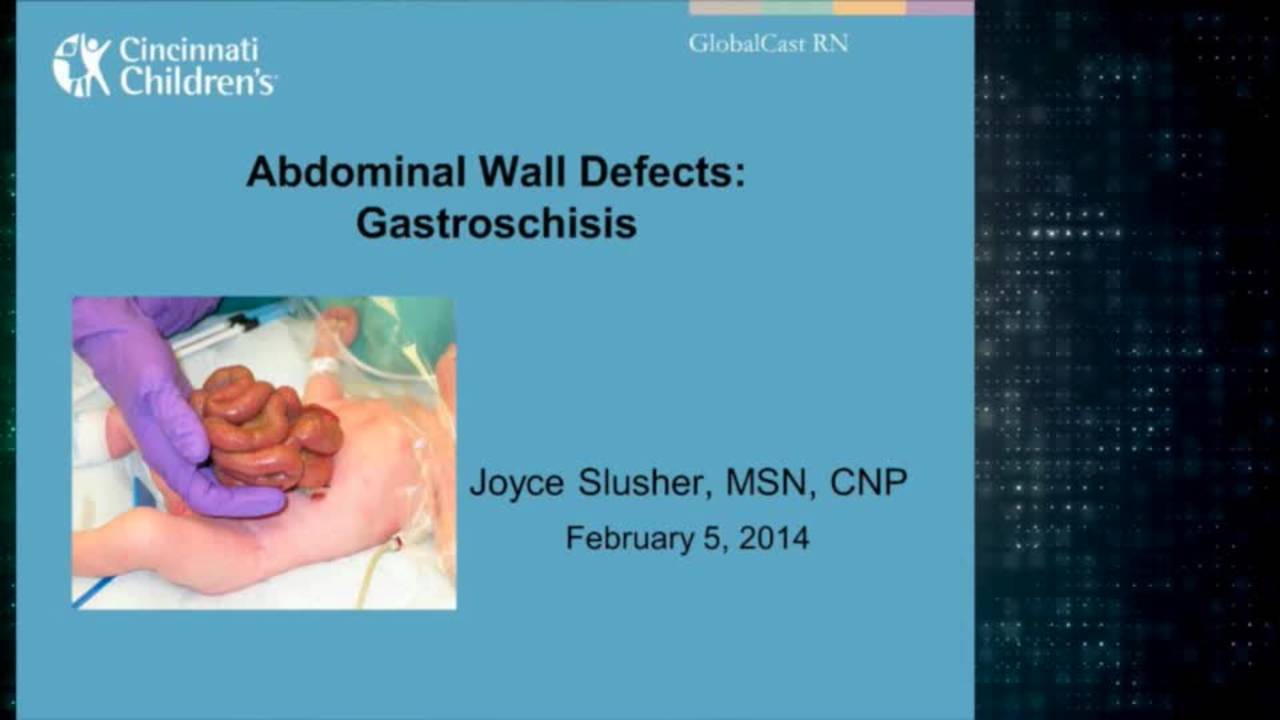
Gastroschisis: Advanced Practice Providers
43 min · Published Feb 2014
Video
Immediate vs Silo Closure for Gastroschisis
Dr. Todd Ponsky · 26 s · Published Dec 2019
Video
Impact of social determinants of health on outcomes in pediatric short bowel syndrome...
43 s · Published Aug 2026
Video
Advancements in Pediatric Intestinal Failure: Innovative Therapies and Improved Outcomes
17 min · Published Aug 2026
Podcast
Update Course Rewind: Omphalocele & Gastroschisis 2020
Miguel Guelfand · 15 min · Published Jul 2026
Video
Update Course Rewind 2025: Updates in NEC Management
11 min · Published Jul 2026
Video
Availability, utilization, and barriers to bowel ultrasound for necrotizing enterocolitis...
55 s · Published Jul 2026
Video
Malrotation and Volvulus with Trinity
Dr. Steve Rothenberg · 8 min · Published May 2026
Video
Clinical & Research Update: Renal Tumors with Drs. Ethan Smith, Lindsay Haacker, Michael Daugherty, and Meera Kotagal
71 min · Published Sep 2026
Video
Clinical & Research Update: Neuroblastoma with Drs. Katherine Somers, Cara Morin, Juan Gurria, and Meera Kotagal
67 min · Published Sep 2026
Video
Clinical & Research Update: Sarcoma w/ Drs. Roshni Dasgupta, Joseph Pressey, Arthur Meyer, Luke Pater
66 min · Published Sep 2026
Video
2026 Laparoscopic Pediatric Hernia Repair
123 min · Published Jun 2026
Video
Beyond the Spectrum: Diagnosis, Myths & Management - Caitlin Couch & Leslie Lopez - APP Conference 2026
50 min · Published May 2026
Video
Dysautonomia: Navigating the Journey - Martha Willis - APP Conference 2026
55 min · Published May 2026
What the experts said
The sutureless gastroschisis closure technique originated when Tony Sandler at Iowa covered a large defect with umbilical cord and tachyderm, intending to return later, but found the wound had closed spontaneously.
Sandler's first series of sutureless closures included about 10 patients and reported that they did not need to go to the OR and closed on their own.
The old adage that you must close the fascia for all gastroschisis babies is probably not true; some version of skin closure is adequate.
Data over five years shows that about 13% of sutureless repair patients will need an umbilical hernia repair, which is higher than babies who got fascial repair.
Fear of feeding after sutureless closure—hesitation to feed because of concern about distension and evisceration—may be driving longer length of stay.
A feeding protocol was instituted at the speaker's NICU: if residual output is less than 20 per kilo, it comes out; if tolerating, advance by 20 per kilo each day.
In prospective trials, natural selection bias may occur if easier cases are chosen for sutureless closure, leading to better outcomes independent of technique.
The heterogeneity of the gastroschisis population—some cases are easy (one or two loops, little Tylenol) while others are complicated (need silo, OR)—makes a huge difference in results and biases non-randomized trials.
Some surgeons put a silo on, reduce with the silo, and then apply tape, so inability to immediately reduce does not preclude sutureless closure.
At UCLA's UC fetal consortium, all gastroschisis cases are attempted without general anesthesia, without intubation, and with minimal narcotics, using standardized antibiotic and feeding protocols.
The UCLA consortium found that length of stay did not decrease with the standardized protocol, but use of antibiotics, intubation days, and opioid use significantly decreased.
At UCLA, one surgeon was able to open the defect, reduce everything, and still do a skin or sutureless closure with great outcomes.
Complicated gastroschisis cases (atresia, perforation) are excluded from the UCLA sutureless closure pathway.
The gastroschisis prognostic score (GPS), which assigned a score based on degree of peel, bowel distension, and matting, did not prove useful in predicting outcomes.
If a gastroschisis case has a very thick peel, very distended bowel, and lots of bowel loops out, immediate closure should not be considered; a silo should be used for reduction.
At the end of silo reduction, a sutureless repair can be performed; immediate closure is not required.
There is no real big need for fascial closure, no matter the size of the gastroschisis defect; skin closure alone is probably adequate.
Matted bowel does not play into the decision for sutureless closure; if it cannot be immediately reduced, a silo is used, and sutureless repair can be done after reduction.
Multiple retrospective studies reported that sutureless repair patients eat quicker, go home faster, and are probably cheaper to manage.
A randomized study by Brisoni et al. published in the Journal of the American College of Surgeons found that sutureless repair patients took longer to eat and had longer hospital length of stay.
A subsequent 98-patient study from UCSF showed a benefit for sutureless repair in terms of time to feeding and length of stay, conflicting with the Brisoni randomized trial.
Robert Baird's paper from McGill showed everything was better about tape closure, including a lower umbilical hernia rate, which was surprising.
The UCSF study with 98 patients published in JAMA Surgery found a 13% rate of umbilical hernia repair over five years of follow-up in sutureless closure patients.
Studies have shown that when fascial closure is attempted without a silo (immediate repair), those patients tend to have a higher incidence of umbilical or ventral hernias requiring repair.
Every single general anesthetic agent in every class (volatile gas, IV, ketamine, NMDA receptor blockers) has been shown in rat, mice, and sheep studies to cause increased apoptosis and pervasive developmental issues.
The GAS trial and PANDA study in humans showed no difference in neurodevelopmental outcome at five years in babies randomized to spinal versus general anesthesia.
Tony Sandler no longer uses the umbilical cord for sutureless closure; it is not as important as once thought and just sits there.