


From
Dr. Todd Ponsky
Standardization of Care for Pediatric Perforated Appendicitis
With Dr. Todd Ponsky · hosted by Dr. Todd Ponsky
Part of
Appendicitis 36 items
Chapter 1 of 1 · Evidence & Research
Protocol standardization
Standardization of perforated appendicitis care improves outcomes
Expert statements on this page
No expert statements were drawn from this page.
Host summaries · secondary, not cited in answers
Educational content from recorded physician discussions — not medical advice. Talk to your (or your child's) care team about your situation.
Video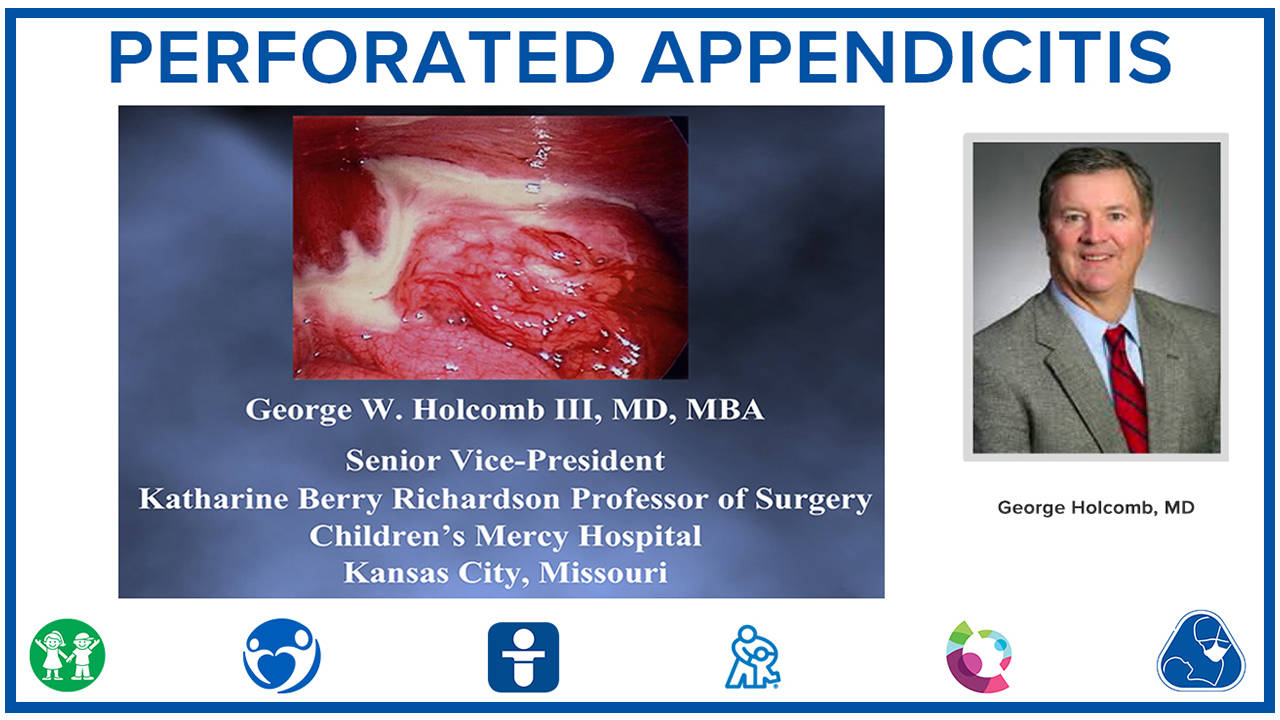
Perforated Appendicitis
18 min · Published Mar 2020
Podcast
Journal Club: Appendicitis in 2021
15 min · Published Aug 2021
Podcast
Update Course Rewind: Perforated Appendicitis 2019
12 min · Published Apr 2021
Video
Non-Operative Management of Appendicitis: 2018 Pediatric Surgery Practice Gap #2
Dr. Todd Ponsky · 1 min · Published Jun 2019
Video
Appendicitis Irrigation Technique with ZERO Abscesses!
Published Sep 2018
Video
Appendicitis Management & APPY Trial: Update Course 2016
31 min · Published Oct 2018
Podcast
Surgical Decision-Making in Necrotizing Enterocolitis: Imaging, Timing, and Operative Strategies
11 min · Published Nov 2026
Video
AI applications in pediatric surgery and clinical transformation with Dr. Todd Ponsky
Dr. Todd Ponsky · 7 min · Published Oct 2026
Podcast
The Future of Surgical Education: A King, an Ox, & Elon Musk
Todd Ponsky · 26 min · Published Oct 2026
Podcast
Unconscious Bias
Todd Ponsky · 58 min · Published Oct 2026
Video
Storycasts in Pediatric Surgery: Interactive Storytelling to Transform Clinical Education
Todd Ponsky · Published Oct 2026
Podcast
Necrotizing Enterocolitis
Todd Ponsky · 46 min · Published Oct 2026
Podcast
Diaphragm pacing as alternative to mechanical ventilation in pediatric respiratory failure
1 min · Published Nov 2026
Podcast
Fetoscopic endoluminal tracheal occlusion for congenital diaphragmatic hernia
4 min · Published Nov 2026
Podcast
FETO procedure for late-diagnosed severe CDH with liver herniation
4 min · Published Nov 2026
Podcast
Severe CDH case with FETO: unexpected anatomic findings and clinical outcome
3 min · Published Nov 2026
Podcast
Pediatric pancreatitis: diagnosis, causes, and genetic insights with Dr. Juan Gurria
3 min · Published Nov 2026
Podcast
Understanding craniosynostosis: skull sutures, growth patterns, and diagnosis in infants
10 min · Published Nov 2026
What the experts said
The way pediatric surgery is done is quite variable and not standardized, especially appendicitis.
The hospital had a clinical pathway in place for about 30 years before implementing a new pathway in 2015.
The new pathway initiated a disease severity classification for perforated appendicitis.
The new pathway refined discharge criteria for perforated appendicitis.
The new pathway standardized the operative technique for perforated appendicitis.
The new pathway established criteria for the use of postoperative TPN in perforated appendicitis.
The new pathway established criteria for the use of postoperative imaging in perforated appendicitis.
The new pathway established criteria for the use of postoperative invasive procedures such as draining an abscess.
The study prospectively evaluated outcomes of all children treated on the new standardized protocol over 20 months.
The study compared prospective outcomes to all patients treated in the 58 months prior to standardization.
Median follow-up time post-discharge was 14 days in the pre-standardized group.
Median follow-up time post-discharge was 25 days in the post-standardized group.
Standardization significantly reduced postoperative abscess in perforated appendicitis.
Standardization significantly reduced hospital stay in perforated appendicitis.
Standardization reduced the odds of developing a postoperative abscess by 4 times.