


From
StayCurrentMD
QUAD #2 Thoracoscopic Tracheopexy with Dr. Aaron Garrison
With Dr. Aaron Garrison · hosted by Dr. Em Gootee
Chapter 5 of 7 · Surgical Management
Tracheopexy technique
Posterior Tracheopexy Technique
Cued at 4:28 · stops at 6:07 · press play
Expert statements on this page
No expert statements were drawn from this page.
Host summaries · secondary, not cited in answers
Educational content from recorded physician discussions — not medical advice. Talk to your (or your child's) care team about your situation.
Podcast
Combined cervical and thoracic approach for esophageal atresia with tracheopexy
Alessandro de Alarcon · 5 min · Published Dec 2023
Video
QUAD #1: Cervical Tracheopexy with Dr. Alessandro de Alarcon
Dr. Todd Ponsky · 5 min · Published Dec 2023
Video
Posterior Tracheopexy For Severe Tracheomalacia
Dr. Todd Ponsky · 2 min · Published Feb 2018
Video
Posterior Tracheopexy during Primary Esophageal Atresia Repair
Published Sep 2018
Video
BOB Ped Surg 2023 - Basma Magdy, PAPSA - Presentation
Published Feb 2023
Podcast
Journal of Pediatric Surgery Article Review: 4th Quarter (Oct-Dec) 2024
18 min · Published Feb 2025
Video
Surgeon annual volume impacts recurrence rates of pediatric inguinal hernia repairs: A multi-institutional study
54 s · Published Feb 2026
Podcast
Journal of Pediatric Surgery Article Review: 2nd Quarter (Apr-Jun) 2025
16 min · Published Aug 2025
Video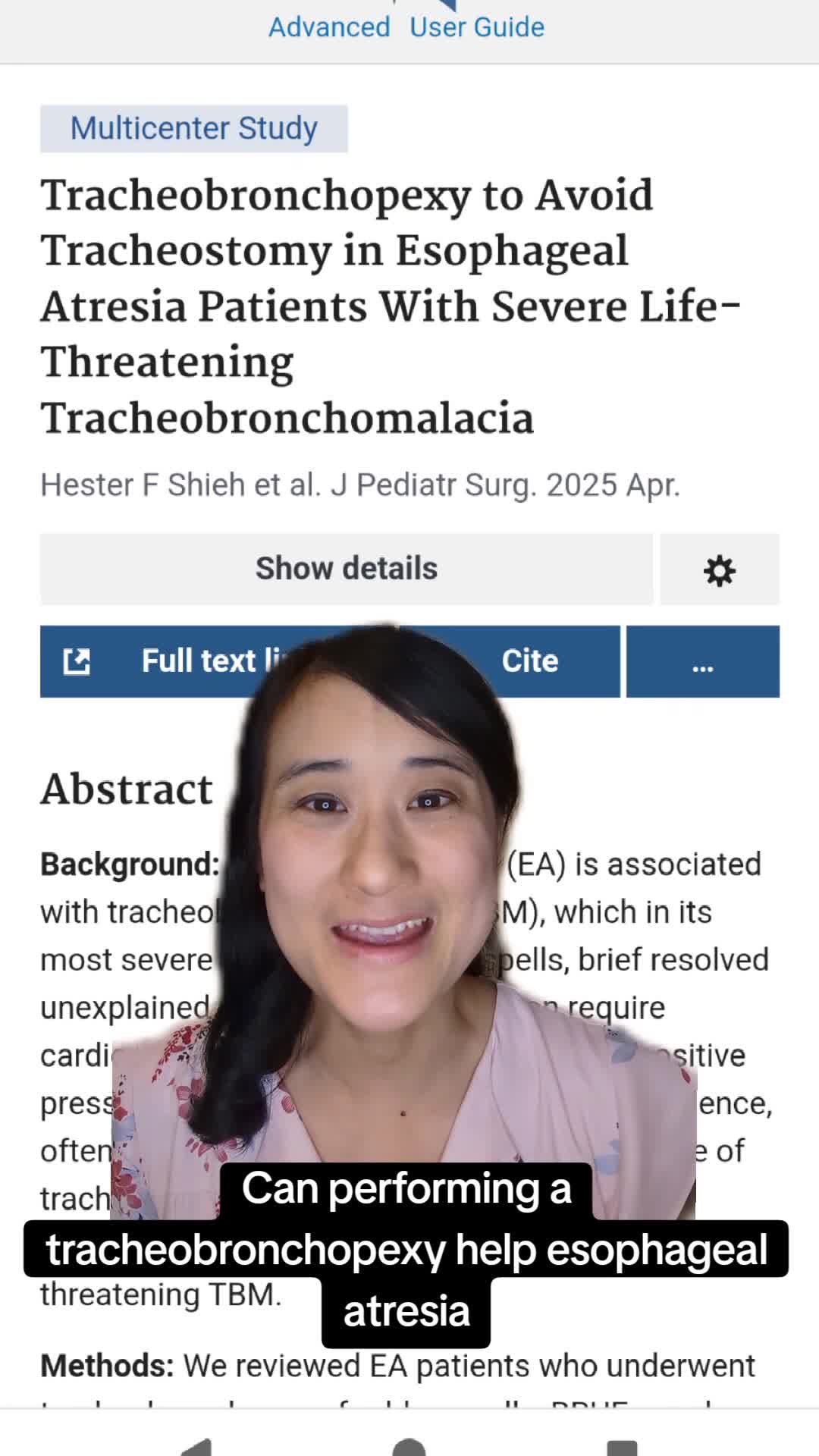
Tracheobronchopexy to Avoid Tracheostomy in Esophageal Atresia Patients With Severe Life-Threatening Tracheobronchomalacia
50 s · Published Apr 2025
Video
QUAD #27 - Multidisciplinary - How Do Teams Enhance Outcomes by the CCHMC ADEC Team
CCHMC Pediatric Surgery · 10 min · Published Apr 2025
Video
QUAD #25: Medical Management of Minor Laryngeal Clefts with Dr. Greg Burg
CCHMC Pediatric Surgery · 7 min · Published Feb 2025
Video
QUAD #22: What is CHARGE syndrome? with Dr. Catherine Hart
CCHMC Pediatric Surgery · 59 s · Published Dec 2024
Video
QUAD #4: Surgical Management of Button Battery & Caustic Ingestion with Dr. Aaron Garrison
CCHMC Pediatric Surgery · 8 min · Published Mar 2024
Video
Esophageal Foreign Bodies
CCHMC Pediatric Surgery · Published Mar 2022
Video
Esophageal Atresia in Brief: Presentation, Workup, Diagnosis, and Treatment
Dr. Todd Ponsky · Published Feb 2022
Video
Esophageal Atresia/Tracheoesophageal Fistula Bronchoscopy and Surgical Technique
Dr. Todd Ponsky · 16 min · Published Nov 2021
Video
Hirschsprung Disease in Brief
Dr. Todd Ponsky · 10 min · Published Oct 2021
Podcast
The Colorectal Quiz Episode 5: Proximal Hirschsprung Disease Surgical Technique
14 min · Published Mar 2021
Podcast
Diaphragm pacing as alternative to mechanical ventilation in pediatric respiratory failure
1 min · Published Nov 2026
Podcast
Fetoscopic endoluminal tracheal occlusion for congenital diaphragmatic hernia
4 min · Published Nov 2026
Podcast
FETO procedure for late-diagnosed severe CDH with liver herniation
4 min · Published Nov 2026
Podcast
Severe CDH case with FETO: unexpected anatomic findings and clinical outcome
3 min · Published Nov 2026
Podcast
Pediatric pancreatitis: diagnosis, causes, and genetic insights with Dr. Juan Gurria
3 min · Published Nov 2026
Podcast
Understanding craniosynostosis: skull sutures, growth patterns, and diagnosis in infants
10 min · Published Nov 2026
What the experts said
Pediatric surgery trainees were initially told that tracheomalacia is something that kids will grow out of and will get better.
Recent data has shown that there are long term consequences for soiling into the lungs and having chronic lung aspiration, which over time is detrimental.
Preoperative dynamic reconstruction studies give a lot of information for determining which procedure is best for each patient.
Dynamic expiratory films show what you need to see with the airway that inspiratory films alone do not reveal.
Surgeons always look for the thymus and make sure that there is enough tissue to remove to be able to bring the trachea up anteriorly.
The classification system for tracheomalacia is in evolution, and trying to describe what is mild or severe or moderate is a little bit challenging.
The biggest benefit of minimally invasive approach is visualization and exposure.
Disadvantages of minimally invasive approach include that it takes longer to learn and is more uncomfortable to learn.
Anesthesia colleagues are sometimes hesitant to allow thoracoscopic cases to go on a little bit longer.
For anterior mediastinal work, babies are positioned with the arm up and a bump underneath so that there is access to the axilla and anteriorly.
The goal of aortopexy is to suspend the aorta.
The first step in aortopexy is taking out the thymus, finding the innominate junction, and then identifying the arch of the aorta.
If you go up too high during aortopexy, then you are doing a pericardiopexy and it is not quite as successful or durable.
The goal of posterior tracheopexy is taking the anterior spinal ligament and fixing it to the posterior membranous trachea.
The area of floppy membrane is distal to the dilated pouch usually.
Surgeons can make an indent on the posterior wall of the trachea, and pulmonologists can see it pop up on their bronchoscopy to help guide suture placement.
It usually takes about 2 or 3 sutures for posterior tracheopexy, leaving enough space for the esophagus to come through.
Using the knot pusher and tension suture is helpful during tracheopexy.
Getting the suture to roll through the anterior spinal ligament is the hardest part and is pretty challenging.
There are times when the esophagus is put to the left of the trachea, and times when it is put to the right of the trachea.
Dr. Garrison always worries a little bit about dysphagia when repositioning the esophagus, but it is not something he has seen a ton of.
Several years ago, the approach was that patients with tracheomalacia would undergo aortopexy.
In the last 4 to 5 years, it has become standard practice to determine which patients will respond best to tracheopexy versus aortopexy.
Part of the workup is making sure that there is space to anteriorly suspend the aorta so that the trachea diameter can actually be made larger.
Preoperative bronchoscopy gives the surgical team an idea of internal anatomy, which can assist in classifying the degree of tracheomalacia prior to surgical intervention.
A paper in Anesthesiology looked at open, thoracoscopic, and converted patients and found no difference in blood gases and metabolic derangements during surgery.
The same study found no difference when looking at blood pressure with acidosis and hypoxia between open and thoracoscopic approaches.
When using a thoracoscopic approach, correct positioning is the key to success.
It is best to use gravity to advantage as it aids in retracting the lungs and trachea placement.
Opening the pericardium and finding the area at the pericardial-adventitial junction to suspend is the key point of aortopexy.
Passing suture transternally is preferred with the aortopexy approach, though it can be technically difficult.
For tracheopexy, a posterior approach via semiprone position is preferred.
Creating a pneumothorax by putting the Veress off the tip of the scapula helps collapse the lung for trocar placement.
When operating posteriorly, triangulating your hands gives the best visualization and working space.
When available, a multidisciplinary team which includes a pulmonologist can allow for internal visualization via bronchoscopy.
Bronchoscopic guidance technique is primarily used in non-esophageal atresia patients.
It is important to create enough tension in the suture to ensure that the pexy is secure.
The approach changes for patients without esophageal atresia or with an esophagus in continuity.
For patients with esophagus in continuity, the first step is to dissect around the esophagus using a vessel loop for retraction.
Using pre- and post-operative bronchoscopy allows the surgeon to see the improvement prior to case completion.