


From
StayCurrentMD
Pregnancy in a Fontan Patient: New Horizons in Medical and Surgical Fontan...
With Dr. Anisa Chowdhury & Dr. Nicole Brown
Chapter 3 of 4 · Medical Management
Management strategy
Antepartum Care, Delivery Planning, and Contraception
Cued at 12:37 · stops at 17:15 · press play
Expert statements on this page
No expert statements were drawn from this page.
Host summaries · secondary, not cited in answers
Educational content from recorded physician discussions — not medical advice. Talk to your (or your child's) care team about your situation.
Video
Tricuspid Atresia: which first stage palliation operation does my patient need?
Meghan M. Chlebowski · 8 min · Published Oct 2023
Video
Management of hypoxia following the Glenn or Fontan operation
Meghan M. Chlebowski · 11 min · Published Aug 2023
Video
Case Review Dynamic Assessment of the Fontan Part II: New Horizons in Medical...
CCHMC Pediatric Surgery · 14 min · Published Jul 2017
Video
Malrotation Rapid Fire Session: Update Course 2015
8 min · Published Jul 2017
Video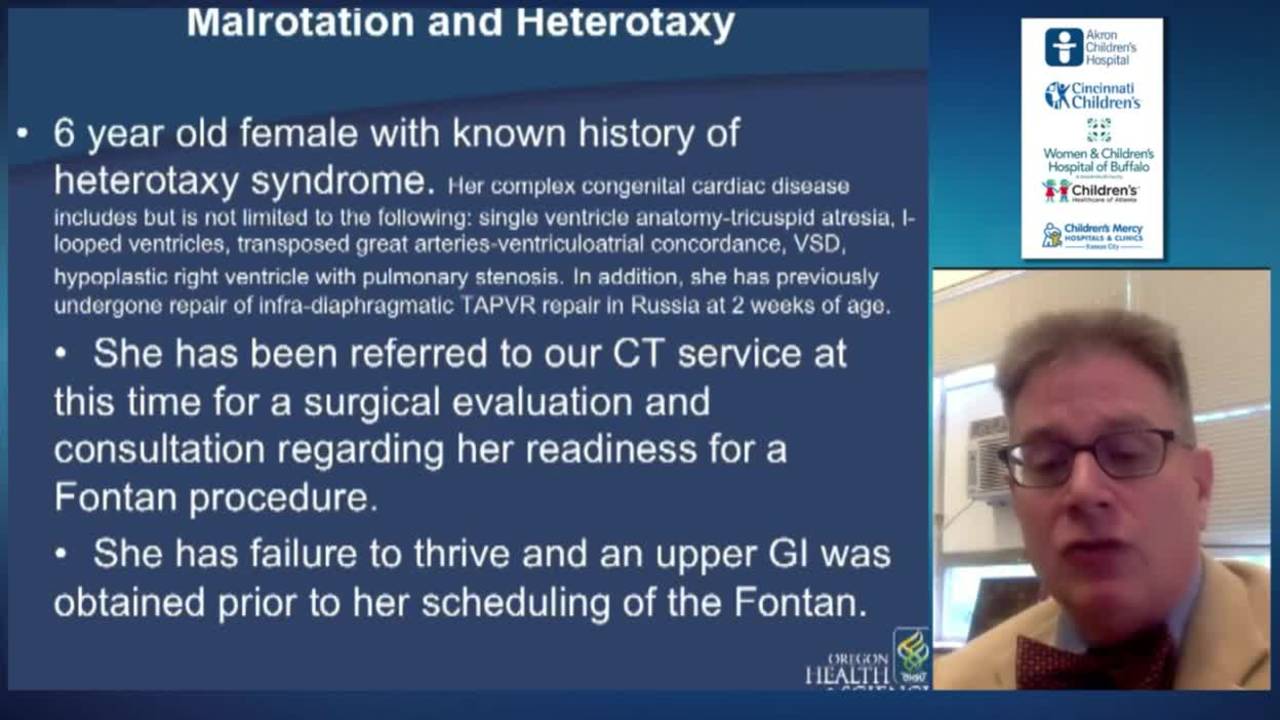
Malrotation - Volvulus - Meconium Ileus - Solid Organ Injury: Update Course 2015
27 min · Published Nov 2018
Video
Update on Surgical Practice and Current State on Fontan Conversion Surgery:...
CCHMC Pediatric Surgery · 25 min · Published Jul 2017
Video
Surgical and Catheter-Based Intervention in Pediatric Pulmonary Vein Stenosis
57 s · Published Jul 2026
Video
Outcomes of Fontan Patients Undergoing Combined Heart - Liver Transplantation in Pediatric Hospitals Across the U.S.
59 s · Published Dec 2025
Video
Pyloric Stenosis
CCHMC Pediatric Surgery · 12 min · Published May 2020
Video
How do we manage thrombogenicity and thrombosis in the Fontan? New Horizons...
CCHMC Pediatric Surgery · 16 min · Published Jul 2017
Video
Psychosocial Outcomes: New Horizons in Medical and Surgical Fontan Management...
CCHMC Pediatric Surgery · 22 min · Published Jul 2017
Video
The Role of Trans-Catheter Arrhythmia Management - Patient Based Decision...
CCHMC Pediatric Surgery · 20 min · Published Jul 2017
Podcast
Diaphragm pacing as alternative to mechanical ventilation in pediatric respiratory failure
1 min · Published Nov 2026
Podcast
Fetoscopic endoluminal tracheal occlusion for congenital diaphragmatic hernia
4 min · Published Nov 2026
Podcast
FETO procedure for late-diagnosed severe CDH with liver herniation
4 min · Published Nov 2026
Podcast
Severe CDH case with FETO: unexpected anatomic findings and clinical outcome
3 min · Published Nov 2026
Podcast
Pediatric pancreatitis: diagnosis, causes, and genetic insights with Dr. Juan Gurria
3 min · Published Nov 2026
Podcast
Understanding craniosynostosis: skull sutures, growth patterns, and diagnosis in infants
10 min · Published Nov 2026
What the experts said
The patient underwent coarctation repair and PA banding at 2 days of life via end-to-end anastomotic repair after resection of coarc segment, plus left carotid to left subclavian artery side-to-side anastomosis
The patient underwent right modified Blalock-Thomas-Taussig shunt at 6 weeks of age, bidirectional Glenn at 6 months, and 20mm extracardiac Fontan at 4 years of age
The Fontan fenestration spontaneously closed and patient had transcatheter coil and vascular plugging of veno-venous collaterals at approximately 10 years of age
On 2006 catheterization, Fontan pressures were 12 mmHg and left ventricular end-diastolic pressure was 5 mmHg, both normal
Patient was lost to follow-up from age 16 to 21 years until presenting pregnant in first trimester
Lisinopril is teratogenic and should be stopped in pregnancy
Patient had 3 prior miscarriages and was told to use Depo-Provera contraception but only had 1 injection in past 3-4 years
Patient had baseline NYHA class 2-3 dyspneic symptoms (short of breath climbing one flight of stairs or walking 2 blocks) with no change during first couple trimesters of pregnancy
Patient's oxygen saturation was low-normal at 92% on room air
Echocardiogram showed mildly reduced left ventricular systolic function with estimated LVEF 45-50%
Patient had mild polycythemia with hemoglobin of 17, indicative of probable intermittent desaturations likely from venous collaterals
Patient was classified as WHO class 3 risk, indicating significantly elevated risk of both maternal morbidity and mortality during peripartum period
Management included aspirin 162 mg daily; stronger anticoagulation not pursued given unremarkable thrombophilia profile
Beta blocker was considered if LV function remained depressed on subsequent visits
Normal pregnancy causes decreased systemic vascular resistance, decreased PVR, increased heart rate, drop in blood pressure mid-pregnancy that rises again, and increase in cardiac output by about 50% and blood volume by 25%
Risk of thrombosis is about 6 times normal during pregnancy and as high as 11 times normal in first 6 weeks postpartum
During labor without analgesia, cardiac output may increase by about 30% during each contraction; with regional analgesia this is mitigated to some degree
It takes about 6 months for cardiac output to return to non-pregnant levels postpartum
Miscarriage rate among Fontan single ventricle patients is about 46%
In a systematic review of about 198 pregnancies in 110 Fontan women, there were no maternal deaths
In Fontan pregnancies, SVT occurs in about 8.9% and heart failure in about 5%
Most Fontan women deliver between 26 and 36 weeks gestation, not making it to term (37 weeks)
Risk of congenital heart disease in fetus of Fontan mother is probably between 3-10%
WHO class 3 indicates significantly increased risk of maternal mortality or severe morbidity; in Fontan pregnancy it is more the morbidity that is concerning, not the mortality
Fontan women should be followed in a multidisciplinary care unit with serial echocardiograms
Higher-risk Fontan patients include those with significant NYHA functional class deterioration, residual cyanosis, pulmonary hypertension, arrhythmias, multi-organ failure, or protein-losing enteropathy; these should be classified as class 4 and advised against pregnancy
Warfarin is concerning from aspect of teratogenicity, especially in first trimester
Aspirin seems reasonable for most Fontan pregnant patients
For Fontan patients at higher thrombotic risk (arrhythmias, prior clot, low cardiac output), therapeutic anticoagulation should be considered
Delivery should be at tertiary care center where highest level of cardiac, OB, anesthesia, and neonatal care is available
Left lateral decubitus position improves systemic venous return in pregnant Fontan patients
Fontan patients should be kept adequately hydrated but avoid fluid overload
Vaginal delivery with epidural is the preferred method for most Fontan women from cardiovascular perspective
Oxytocin should be used at lowest effective dose to avoid significant hemodynamic fluctuations
Fontan women should stay in hospital for up to about a week postpartum because that is how long it takes for hemodynamics to settle back out
Estrogen-containing contraceptives should be avoided in Fontan women because of increased thrombogenicity
Pneumoperitoneum required for laparoscopic tubal ligation may be detrimental for Fontan patients
Subdermal contraceptive implants are lowest risk, requiring only local anesthesia
The aspirin dose of 162 mg in this patient was based on aspirin resistance testing
Many centers use full anticoagulation in pregnant Fontan patients by definition, but this carries risk of antepartum and postpartum hemorrhage