

Necrotizing Enterocolitis
With Dr. Gail Besner · hosted by Dr. Todd Ponsky
Chapter 8 of 10 · Surgical Management
Stoma management
Stoma Creation and Reversal
Cued at 38:07 · stops at 38:45 · press play
Expert statements on this page
No expert statements were drawn from this page.
Host summaries · secondary, not cited in answers
Educational content from recorded physician discussions — not medical advice. Talk to your (or your child's) care team about your situation.
Video
NEC: Update Course 2013
34 min · Published Sep 2013
Video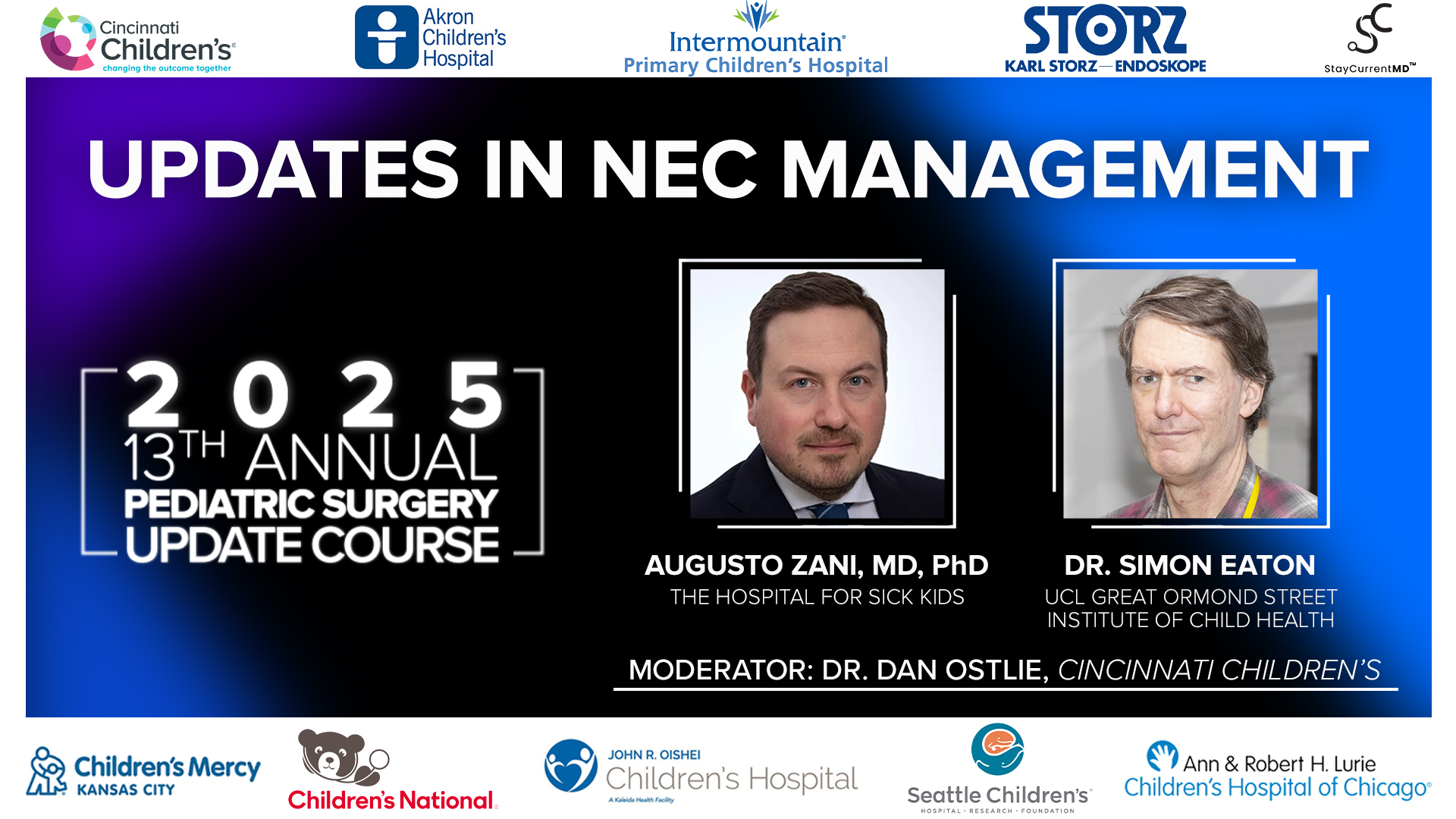
2025 Pediatric Surgery Update Course - Updates in NEC Management
26 min · Published Aug 2025
Podcast
Surgical Decision-Making in Necrotizing Enterocolitis: Imaging, Timing, and Operative Strategies
11 min · Published Nov 2026
Video
Update Course Rewind 2025: Updates in NEC Management
11 min · Published Jul 2026
Video
Routine contrast enema prior to stoma reversal seems only required following treatment for necrotizing enterocolitis: An evaluation of the diagnostic accuracy of the contrast enema
56 s · Published Apr 2023
Video
Update Course Rewind: Laparotomy Over PPD 2022
Published Jul 2023
What the experts said
Despite 6 decades of research, the exact cause of NEC is unknown and there is no absolute cure for the disease.
Indomethacin administration predisposes babies to both isolated ileal perforation and necrotizing enterocolitis.
Acid suppression medications (PPIs and H2 blockers) should be avoided as they predispose to NEC by neutralizing gastric acid.
In premature babies with NEC, intestinal contents can leak into the scrotum through a patent processus vaginalis, causing scrotal swelling and discoloration.
Neutropenia (low white blood cell count) in NEC patients is more concerning than elevated white count, as it may indicate overwhelming sepsis that the patient cannot compensate for.
Thrombocytopenia can result from endotoxemia and gram-negative septicemia in NEC, and knowledge of platelet count is important for optimizing patient condition prior to surgery.
Cross-table lateral or lateral decubitus films should be obtained in addition to plain films because free air can be subtle and easily missed.
Free air on imaging is an absolute indication for surgical intervention (either drain or laparotomy).
Clinical deterioration despite maximal medical management is an indication for surgery.
Fixed loops of intestine on serial X-rays are not an absolute indication for surgery but are a worrisome sign suggesting the patient is not improving.
Portal venous air is a concerning sign but not an absolute indication for surgery; some patients with portal venous air improve with medical management.
Medical management of NEC includes NPO status, orogastric tube decompression, broad-spectrum antibiotics, and serial monitoring with exams, labs, and X-rays.
Small feeding tubes are inadequate for gastric decompression in NEC; an orogastric tube should be placed instead.
There is tremendous diversity in antibiotic regimens for NEC across the United States, possibly depending on bacterial colonization of individual NICU environments.
Serial abdominal X-rays should be obtained at intervals (approximately every 8 hours) rather than waiting 12-24 hours between films.
Medical management (NPO, decompression, antibiotics) should continue for at least 1 week to 10 days before attempting to restart feeds.
Stricture formation after medical NEC typically occurs in the colon, usually near the splenic flexure, but can occur anywhere.
When evaluating for stricture post-NEC, contrast enema should be performed before upper GI with small bowel follow-through, as strictures are more common in the colon and waiting for contrast to pass through obstructed small bowel takes longer.
In Europe, 100% of surgeons perform laparotomy for NEC and no one uses peritoneal drainage.
The two randomized controlled trials (MOSS trial in US and NET trial in Europe) comparing peritoneal drainage versus laparotomy showed no difference in overall mortality.
Babies who have peritoneal drains instead of laparotomy may have worse neurological outcomes at 1-2 years post-NEC.
The ongoing NEST trial has randomized 300 babies to peritoneal drainage versus laparotomy and will assess neurological outcomes at 18-22 months, with results expected in 1-2 years.
Laparotomy may produce better neurological outcomes than drainage because it removes all inflammatory necrotic tissue, whereas drainage leaves necrotic bowel in the abdomen.
Babies can become equally sick and hemodynamically unstable from systemic inflammatory response syndrome with isolated intestinal perforation as with necrotizing enterocolitis.
Peritoneal drain placement is performed at bedside with local anesthesia through a small transverse right lower quadrant incision using a quarter-inch Penrose drain.
If the incision for peritoneal drain is made too large, herniation can occur once the drain is removed.
When a baby continues to produce stool from a peritoneal drain for weeks and requires conversion to laparotomy, the surgeon may encounter extensive adhesions causing serosal tears and enterotomies; in this situation, the best decision may be to stop, create a proximal diverting stoma if possible, and avoid making the situation worse.
Peritoneal drains should be advanced gradually over several days starting at 7-10 days post-placement, rather than removing all at once.
Upper GI with small bowel follow-through before drain removal is not routinely necessary if the baby is doing well without stool leakage, but should be obtained if feeds are not tolerated after drain removal.
For laparotomy, a supraumbilical transverse incision is used, with extreme care required to avoid injury to the liver and spleen, as even minimal trauma can cause subcapsular hematoma and exsanguination in premature babies.
Blood products (packed red blood cells, platelets, fresh frozen plasma) should be available for NEC laparotomy, and coagulation abnormalities should be at least partially corrected preoperatively.
Spontaneous intestinal perforation (SIP) is characterized by one small localized area of perforation, while NEC involves more diffuse disease with pneumatosis affecting more than one area.
In some parts of the world, surgeons perform primary anastomosis after resection for NEC, but in the United States most surgeons create stomas due to concern about anastomotic healing.
Stomas should be brought out through the laparotomy incision close together (functional end and mucous fistula) to facilitate easier closure operation later, and should be tacked to fascia but not matured.
The distal end of the stoma should be left protruding slightly to prevent it from sloughing off and receding under the fascia.
When bowel appears injured with pneumatosis and thin walls but not clearly necrotic, it may be appropriate to not resect, leave the abdomen open to avoid increased pressure compromising blood flow, and return for second-look operation in 24-48 hours.
For multiple skip lesions, if close together and resectable without causing short bowel syndrome, resect all rather than creating multiple anastomoses; if at different areas, resect and perform multiple anastomoses distal to a proximal diverting stoma.
Clip-and-drop technique (resecting dead bowel, clipping ends, replacing in abdomen, returning another day) can be life-saving in unstable patients without time for multiple anastomoses.
Stoma reversal is typically performed when the baby reaches approximately 2000g, though earlier reversal is indicated for TPN-induced cholestasis or inability to nourish the baby due to high stoma output.
Refeeding through mucous fistula is done selectively for high-output stomas rather than routinely, and can substantially decrease TPN use.
When planning to refeed through mucous fistula, consider leaving a small soft catheter in the mucous fistula post-operatively to maintain access, as the opening often strictures.
The chance of a baby with true NEC totalis surviving long enough to receive a small bowel-liver transplant is very close to zero.
For very small premature babies with NEC totalis, months to years of required TPN will irreversibly injure the liver, and even if they survive to transplant size, small bowel transplant results remain suboptimal.
In premature infants with pneumoperitoneum, pneumothorax can dissect through the diaphragm into the abdomen, so it is important to confirm the problem is truly intra-abdominal rather than thoracic.
In hemodynamically unstable patients with pneumoperitoneum and abdominal distention, placing an angiocatheter through the abdominal wall to release pressure is a useful temporizing maneuver while mobilizing for surgery.