


Chapter 1 of 8 · Case-Based Learning
Teen malrotation
Case 1: Teenager with transient symptoms and malrotation on imaging
Expert statements on this page
No expert statements were drawn from this page.
Host summaries · secondary, not cited in answers
Educational content from recorded physician discussions — not medical advice. Talk to your (or your child's) care team about your situation.
Video
Malrotation Rapid Fire Session: Update Course 2015
8 min · Published Jul 2017
Video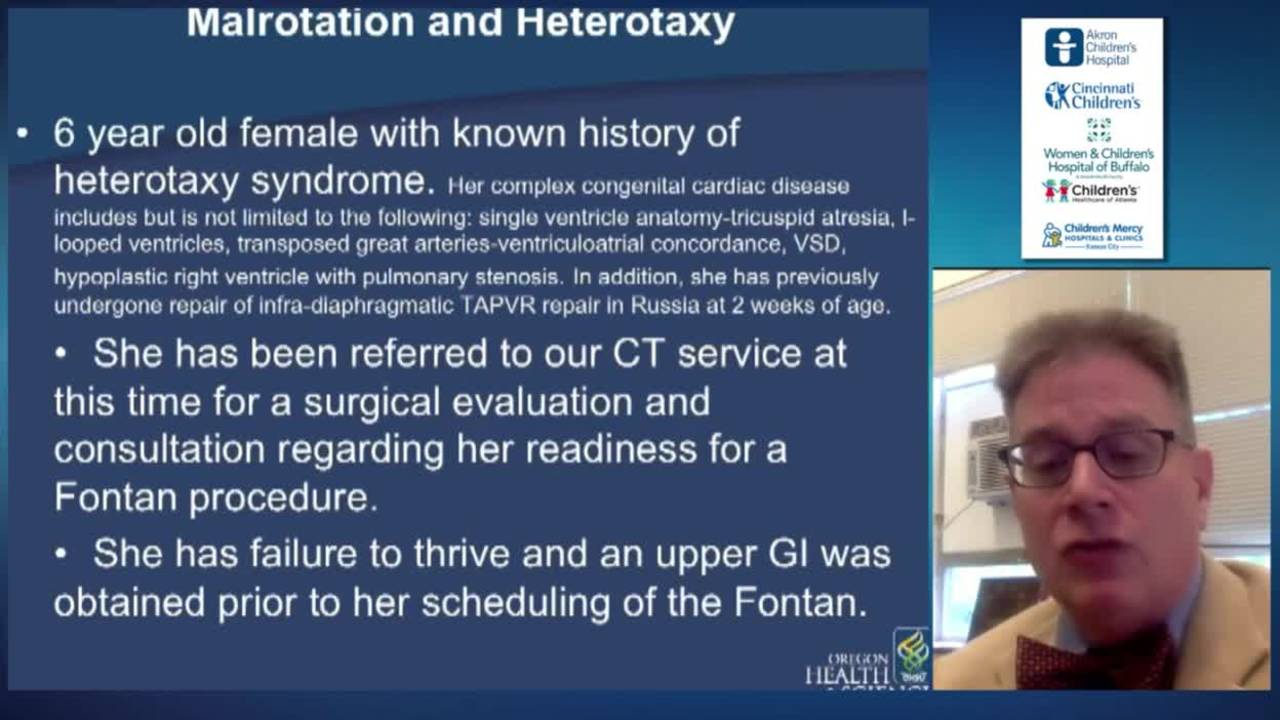
Malrotation - Volvulus - Meconium Ileus - Solid Organ Injury: Update Course 2015
27 min · Published Nov 2018
Video
New Concepts in Radiology: Update Course 2017
40 min · Published Aug 2017
Video
Malrotation and Volvulus with Trinity
Dr. Steve Rothenberg · 8 min · Published May 2026
Podcast
Malrotation with Dr. Meera Kotagal
13 min · Published May 2023
Video
Technique: Laparoscopic Repair of Duodenal Atresia, Ladd's Procedure, and...
Dr. Steve Rothenberg · 15 min · Published Nov 2018
Video
Impact of social determinants of health on outcomes in pediatric short bowel syndrome...
43 s · Published Aug 2026
Video
Advancements in Pediatric Intestinal Failure: Innovative Therapies and Improved Outcomes
17 min · Published Aug 2026
Podcast
Update Course Rewind: Omphalocele & Gastroschisis 2020
Miguel Guelfand · 15 min · Published Jul 2026
Video
Update Course Rewind 2025: Updates in NEC Management
11 min · Published Jul 2026
Video
Availability, utilization, and barriers to bowel ultrasound for necrotizing enterocolitis...
55 s · Published Jul 2026
Video
Malrotation Infant
Dr. Steve Rothenberg · 9 min · Published May 2026
Only a few other public items share this expert — go deeper there →
Video
Intestinal Atresia Types Explained: Grossfeld Classification for Pediatric Surgery
1 min · Published Sep 2026
Video
Derivation and validation of the Pediatric Community-Acquired Pneumonia Severity (PedCAPS) score: A prospective cohort study
50 s · Published Sep 2026
Video
FETO for Late-Diagnosed Severe Congenital Diaphragmatic Hernia (CDH) at Cincinnati Children's with Dr. Beth Rymeski
4 min · Published Sep 2026
Video
Severe Congenital Diaphragmatic Hernia (CDH) Case: FETO Management & Unexpected Findings with Dr. Beth Rymeski
3 min · Published Sep 2026
Video
Fetoscopic Endoluminal Tracheal Occlusion (FETO) Procedure: Step-by-Step Guide with Dr. Beth Rymeski
4 min · Published Sep 2026
Video
Choledochal Cyst Types Explained: Pediatric Surgery Fundamentals
1 min · Published Sep 2026
What the experts said
The key reason to operate on an asymptomatic patient is to avoid midgut volvulus
Ladd's bands do not cause midgut volvulus
The critical measurement is the distance between the ligament of Treitz and the ileocecal junction to prevent volvulus, though nobody knows the exact distance required
Laparoscopic Ladd's procedure can be very effective even in a newborn, though if there's too much twist and no room, conversion to open may be necessary
When bowel loops are dilated, this will always give you a low-lying ligament of Treitz
In cardiac patients between first stage and Glenn procedure who get G-tubes, Nissen fundoplication is often requested because they vomit and are too small for PEGs
A 45-minute Nissen at pressures of 8 is tolerated by cardiac patients between stages
In patients with heterotaxy syndromes who have asymptomatic malrotations and undergo operations, the complication rate is remarkably high, between 30 and 50%
Atypical malrotation with a low-lying ligament of Treitz has some data showing lower risk of volvulus, though the data is not strong
In 20% of cases with true malrotations of the fore and mid-gut, you have a normal barium enema
A normal ultrasound does not rule out volvulus, supported by multiple studies
In the heterotaxy subgroup, the risk of volvulus in the early period (4-5 years) is actually very low if patients are not symptomatic
In the first two months of life, about 70% of volvulus cases occur, and by the first two years of life, 90% of volvulus cases that are going to occur do occur
Ladd's bands are thought to be an attempt of the body to fuse the cecum to the lateral peritoneal wall
In situs inversus or ambiguous cases, measuring the distance between ligament of Treitz and ileocecal junction matters regardless of where the bowels are; if less than half the diameter of the abdominal cavity, intervention is needed
In patients with rotation abnormalities, reversed mesenteric vessels may or may not be seen; it doesn't definitively indicate malrotation
In Jack's series of several hundred patients, there was never a case where the vessels were normal in a patient who had risk for volvulus (narrow base mesentery), so they use it as a screening test in sick patients
Upper GI is clearly better than ultrasound for diagnosing malrotation, but in a sick patient who can't get to radiology, ultrasound can be useful
In a published study combining experience with Kansas City, the cardiac risk group did not stratify out to be at higher risk for reflux complications; neurologically impaired CP kids maybe, but not cardiac kids
In a study from Edmonton on heterotaxy patients who underwent procedures for malrotation, the complication rate was about 50%
In a study by Papillon from Children's LA of about 200 heterotaxy patients, a quarter got screening upper GIs and three quarters did nothing; in 4 years there was only one case of volvulus, and in patients without bilious emesis and symptoms, no cases of volvulus
Yama does not operate on asymptomatic malrotation as long as the patient has non-bilious vomiting, is gaining weight, and is clinically well
If a patient has a narrow pedicle, the patient always has vomiting and is symptomatic
Ladd's bands themselves are not risky; the risk is bilious vomiting and narrowing of the pedicle