


From
StayCurrentMD
Laparoscopic Hydrocele Repair Technique
With Dr. Todd Ponsky · hosted by Dr. Todd Ponsky
Chapter 3 of 5 · Surgical Management
Sac resection
Step 2: Sac Resection
Cued at 2:25 · press play
Expert statements on this page
No expert statements were drawn from this page.
Host summaries · secondary, not cited in answers
Educational content from recorded physician discussions — not medical advice. Talk to your (or your child's) care team about your situation.
Video
2026 Laparoscopic Pediatric Hernia Repair
123 min · Published Jun 2026
Video
2024 Laparoscopic Hernia Event
102 min · Published Jun 2024
Video
Laparoscopic Pediatric Hernia Repair 2025
140 min · Published Jun 2025
Video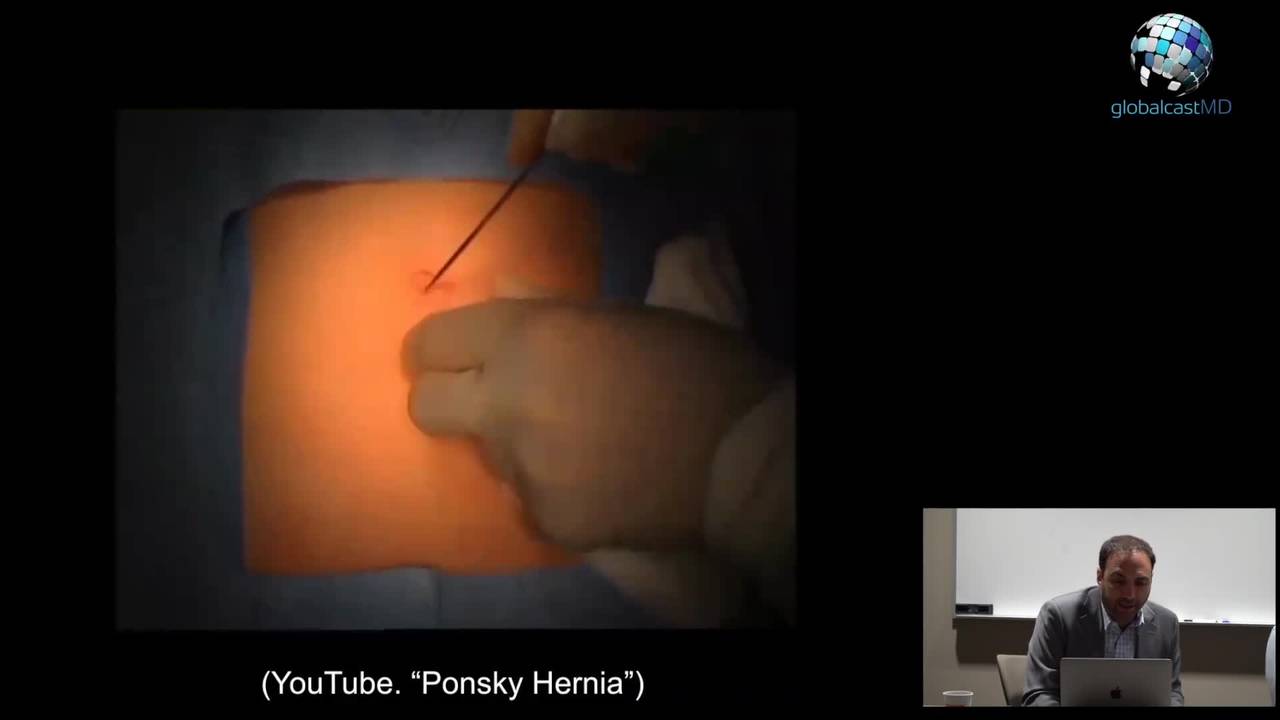
Laparoscopic Pediatric Hernia Repair: Online Course 2017
Dr. Todd Ponsky · 102 min · Published Aug 2017
Video
Focus on Technique- Laparoscopic Pediatric Hernia Repair 2015
Dr. Todd Ponsky · 140 min · Published Mar 2014
Video
Laparoscopic Epigastric Herniorrhaphy-Case and Discussion: Pediatric Surgery...
Dr. Todd Ponsky · 14 min · Published Jul 2017
Podcast
Surgical Decision-Making in Necrotizing Enterocolitis: Imaging, Timing, and Operative Strategies
11 min · Published Nov 2026
Video
AI applications in pediatric surgery and clinical transformation with Dr. Todd Ponsky
Dr. Todd Ponsky · 7 min · Published Oct 2026
Podcast
Tracheoesophageal Fistula
Todd Ponsky · 45 min · Published Oct 2026
Podcast
The Future of Surgical Education: A King, an Ox, & Elon Musk
Todd Ponsky · 26 min · Published Oct 2026
Podcast
Necrotizing Enterocolitis
Todd Ponsky · 46 min · Published Oct 2026
Podcast
Wilms Tumor
Todd Ponsky · 64 min · Published Oct 2026
Podcast
Routine Anal Dilations After PSARP: Questioning a Decades-Old Practice
2 min · Published Nov 2026
Podcast
Pediatric Surgery Literature Updates: Lymphatic Malformations, G-Tube Complications, and Cryptorchidism Timing
4 min · Published Nov 2026
Podcast
Botox injection during Hirschsprung pull-through: evidence and technique considerations
1 min · Published Nov 2026
Podcast
Central line troubleshooting and vascular access preservation in pediatric patients
2 min · Published Nov 2026
Podcast
Colorectal Quiz Episode 50: Key Takeaways from the 16th European Pediatric Colorectal Conference
24 min · Published Nov 2026
Podcast
Nerve monitoring and risk stratification in pediatric thyroid surgery
6 min · Published Nov 2026
What the experts said
Laparoscopic hydrocele repair requires a 3 or 5 millimeter trocar for umbilical port with corresponding camera size based on patient age and weight, plus 3mm grasper with Maryland teeth and 3mm scissors.
The first step in laparoscopic hydrocele repair is to push the sac into the abdomen, create a hole while avoiding cord structures, and drain the fluid.
Sac resection is performed through a 3mm stab incision in the ipsilateral lower quadrant using scissors, but if there is no safe separation from cord structures, this step can be avoided or the sac resected only partially.
Sac resection can alternatively be performed with hook cautery, but requires maintaining safe distance from vas deferens and cord vessels to avoid thermal spray injury.
The internal inguinal orifice is closed using a double-loop technique with prolene suture.
Hydrodissection with local anesthetic serves dual purposes: postoperative pain control and dissecting the peritoneum to avoid injury to cord structures.
The double-loop technique involves creating a 1mm skin incision and passing an 18-gauge spinal needle through half of the internal inguinal orifice.
A prolene loop is threaded through the needle into the abdomen, the needle is retracted, then passed again through the same skin incision with a new prolene loop that must pass through the first loop.
The first loop is snagged around the needle, and once the second prolene loop is in the abdomen, the needle is retracted and the first loop is used as a snare to pull out the second loop, surrounding the inguinal orifice.
The internal inguinal orifice opening is closed by tying the prolene loop knots.
The same double-loop closure technique can be used to close a contralateral patent processus vaginalis.
Throughout laparoscopic hydrocele repair, the surgeon must always work at a safe distance from cord structures including vas deferens and cord vessels.