


From
StayCurrentMD
Journal Club: Review of 2018 Pediatric Surgery Practice Gaps
With Dr. Todd Ponsky
Part of
DVT 7 items
Chapter 4 of 6 · Evidence & Research
Firearm safety, isotonic fluids
Practice Gaps #5-4: Firearm Injury Prevention and Maintenance Fluids
Cued at 5:20 · stops at 5:49 · press play
Expert statements on this page
No expert statements were drawn from this page.
Host summaries · secondary, not cited in answers
Educational content from recorded physician discussions — not medical advice. Talk to your (or your child's) care team about your situation.
Video
APSA 2018 Practice Gaps
Published Mar 2020
Video
7th Annual Pediatric Surgery Update Course 2019 - FULL SHOW
285 min · Published Jul 2020
Video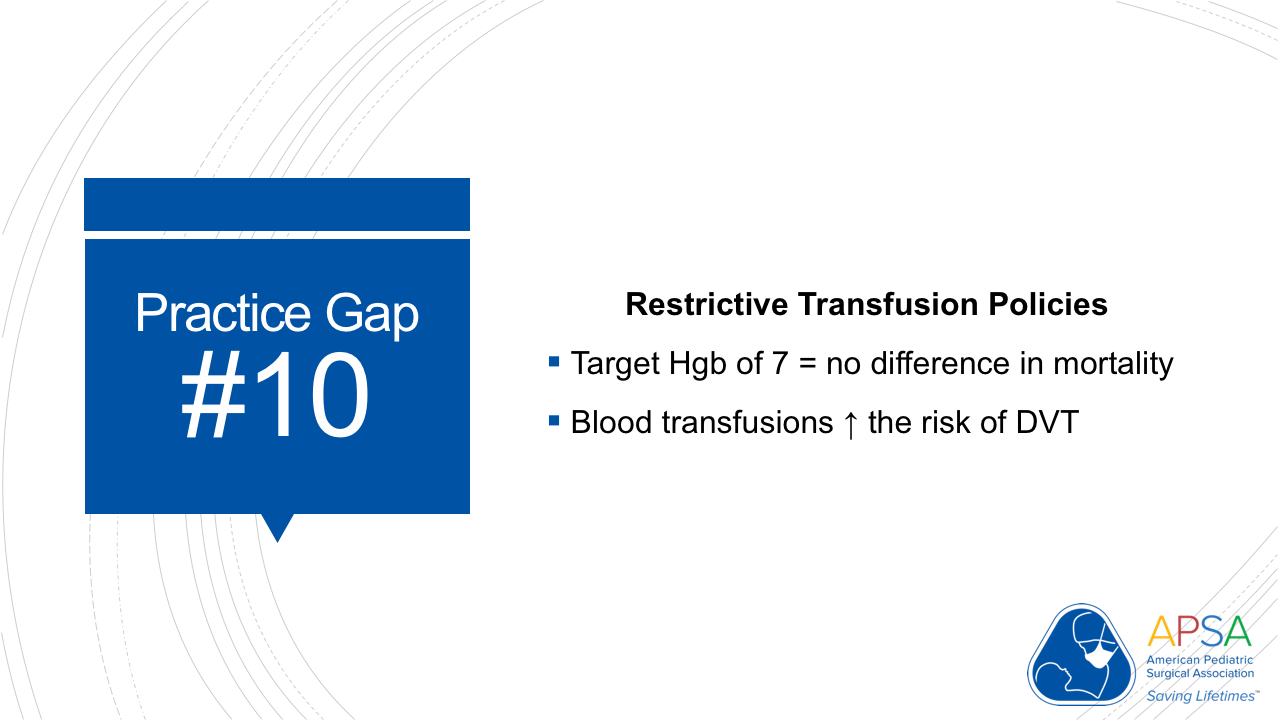
Restrictive Transfusion Policies: 2018 Pediatric Surgery Practice Gap #10
Dr. Todd Ponsky · Published Jun 2019
Video
Enteral Nutritional Support For Pancreatitis: Practice Gap discussion at...
16 min · Published Aug 2018
Video
Update Course Rewind: DVT Prophylaxis 2024
Published Dec 2024
Video
Venous Thromboembolism Prophylaxis In Trauma Patients: Practice Gap...
10 min · Published Aug 2018
Podcast
Surgical Decision-Making in Necrotizing Enterocolitis: Imaging, Timing, and Operative Strategies
11 min · Published Nov 2026
Video
AI applications in pediatric surgery and clinical transformation with Dr. Todd Ponsky
Dr. Todd Ponsky · 7 min · Published Oct 2026
Podcast
The Future of Surgical Education: A King, an Ox, & Elon Musk
Todd Ponsky · 26 min · Published Oct 2026
Podcast
Unconscious Bias
Todd Ponsky · 58 min · Published Oct 2026
Video
Storycasts in Pediatric Surgery: Interactive Storytelling to Transform Clinical Education
Todd Ponsky · Published Oct 2026
Podcast
Necrotizing Enterocolitis
Todd Ponsky · 46 min · Published Oct 2026
Podcast
Diaphragm pacing as alternative to mechanical ventilation in pediatric respiratory failure
1 min · Published Nov 2026
Podcast
Fetoscopic endoluminal tracheal occlusion for congenital diaphragmatic hernia
4 min · Published Nov 2026
Podcast
FETO procedure for late-diagnosed severe CDH with liver herniation
4 min · Published Nov 2026
Podcast
Severe CDH case with FETO: unexpected anatomic findings and clinical outcome
3 min · Published Nov 2026
Podcast
Pediatric pancreatitis: diagnosis, causes, and genetic insights with Dr. Juan Gurria
3 min · Published Nov 2026
Podcast
Understanding craniosynostosis: skull sutures, growth patterns, and diagnosis in infants
10 min · Published Nov 2026
What the experts said
A practice gap is the distance between what is best practices or evidence-based and what you should be doing and what actually happens.
Transfusing to a target hemoglobin of seven instead of nine or ten has no difference in mortality.
Blood transfusions increase the risk of DVT in patients.
The restrictive transfusion policy of 7 not 9 or 10 applies across the board to pediatric patients, not just trauma, including NICU patients and other general surgery patients.
Early enteral feedings when not associated with vomiting decreases morbidity, infectious risk and mortality in pancreatitis.
NG feeds are equally as tolerated as NJ feeds in pancreatitis.
We should be operating earlier for gallstone pancreatitis.
Ultrasounds right now are not very good in terms of ruling out ovarian torsion.
In a patient with suspected ovarian torsion, you have to go to the operating room, and when you're there, you don't take the ovary out even if it's black in order to preserve fertility.
Even if there's Doppler flow in a suspected ovarian torsion, you still need to go to the operating room because it could be intermittently torsing or there may be a part that has blood flow and some that doesn't.
For low bleeding risk trauma patients, it's okay to do SCDs and low molecular weight heparin for VTE prophylaxis.
For high bleeding risk trauma patients, they recommend SCDs until they're ambulatory, and then a screening ultrasound on ICU day seven.
Burnout directly impacts patient care and establishing support systems should be a focus throughout education and practice.
The most effective state laws in reducing pediatric firearm injuries are those that hold adults criminally liable for negligently storing firearms.
You should continue with isotonic fluids instead of switching from isotonic to hypotonic once you reach maintenance space because this decreases the risk of hyponatremia without any adverse consequences.
We need to be sure that we're taking out lymph nodes when doing Wilms tumor nephrectomy because that automatically upstages our patients if we're not taking out the nodes.
Pulmonary metastases do not preclude a primary nephrectomy in Wilms tumor.
Treating appendicitis with antibiotics had equal outcome measures compared to initial operative management, with a 15% risk of recurrence at one-year follow-up, but decreased hospital stays and decreased days of disability.
You don't need to be giving opioids for incision and drainages or for breast biopsies.
Tylenol plus NSAIDs like Motrin are equally as effective as narcotics in kids.