


Chapter 2 of 5 · Acute Management
Reduction attempts
Reduction techniques and number of attempts
Cued at 4:08 · stops at 5:01 · press play
Expert statements on this page
No expert statements were drawn from this page.
Host summaries · secondary, not cited in answers
Educational content from recorded physician discussions — not medical advice. Talk to your (or your child's) care team about your situation.
Video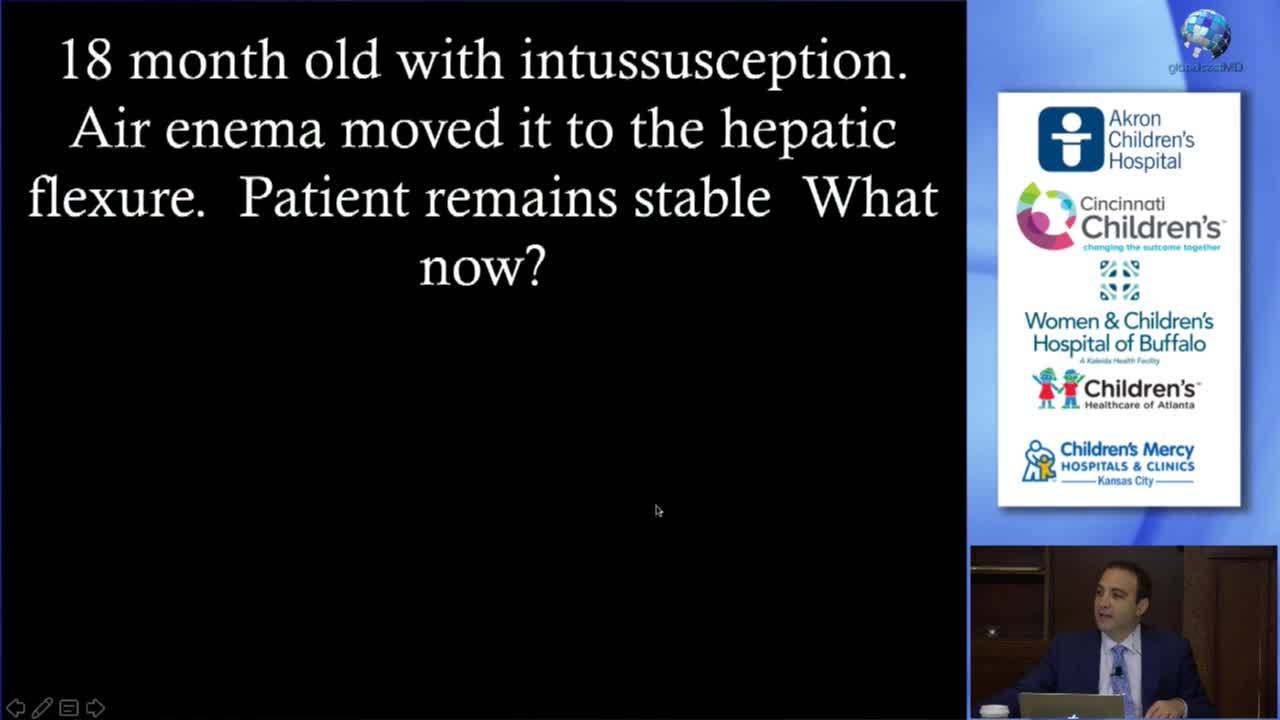
Repeat Enema for Intussusception: Update Course 2016
3 min · Published Aug 2016
Video
Discharge after Reduction of Intussusception Is Safe and Effective
Published Feb 2019
Podcast
Case-Based Journal Review- Intussusception in 2022
20 min · Published Feb 2022
Video
Reduction of intussusception with saline enema superior to air enema
Published Aug 2018
Video
Intussusception Guideline
Published Jul 2019
Video
New Concepts in Radiology: Update Course 2017
40 min · Published Aug 2017
Video
Clinical & Research Update: Renal Tumors with Drs. Ethan Smith, Lindsay Haacker, Michael Daugherty, and Meera Kotagal
71 min · Published Sep 2026
Video
Clinical & Research Update: Neuroblastoma with Drs. Katherine Somers, Cara Morin, Juan Gurria, and Meera Kotagal
67 min · Published Sep 2026
Video
Clinical & Research Update: Sarcoma w/ Drs. Roshni Dasgupta, Joseph Pressey, Arthur Meyer, Luke Pater
66 min · Published Sep 2026
Video
2026 Laparoscopic Pediatric Hernia Repair
123 min · Published Jun 2026
Video
Beyond the Spectrum: Diagnosis, Myths & Management - Caitlin Couch & Leslie Lopez - APP Conference 2026
50 min · Published May 2026
Video
Dysautonomia: Navigating the Journey - Martha Willis - APP Conference 2026
55 min · Published May 2026
What the experts said
Radiologists at some institutions refuse to perform enema without plain film to rule out free air
Reduction attempts fail in two ways: intussusceptum moves to mid-right colon but cannot progress further, or complete reduction occurs without reflux through ileocecal valve meeting radiographic criteria
If reduction progresses all the way to ileocecal valve without reflux, patients' symptoms typically resolve and they can be safely observed or confirmed with ultrasound
In study of patients reduced to ileocecal valve without reflux, repeat contrast enemas the next day were all normal
Patients with incomplete reduction continue to have recurrent colicky pain similar to pre-reduction symptoms, while those completely reduced are asymptomatic even without ileal reflux
Time lapse between reduction attempts is typically 1-2 hours, though timing depends on when first attempt was performed
Early laparoscopic intussusception cases that appeared to be easy reductions were often already reduced by radiology but not called as such due to lack of ileal reflux
As radiology success rates have increased, surgical cases have become more challenging because easy reductions are now handled non-operatively
Patients who travel 2-4 hours from outside facilities and had initial CT scan may receive another CT scan at outside facility if symptoms recur, influencing admission decisions
Patients have more crampy pain in first few hours after air reduction compared to contrast reduction due to increased gas distension
Incidental small bowel intussusception seen on imaging can be observed, but postoperative small bowel intussusception warrants laparoscopy or operation
Chinese RCT comparing ultrasound-guided saline enema versus air contrast enema found 96% success rate for ultrasound-guided versus 83% for air contrast
Outside the United States, ultrasound-guided saline enemas are commonly performed for intussusception reduction
Ultrasound-guided saline enema uses lower intraluminal pressure (88 mmHg) compared to air contrast enema (120 mmHg)
Some surgeons perform on-table air enema during laparoscopy to help push the intussusception, avoiding the need to pull which has traditionally been discouraged
Study of 51-52 patients found no difference in recurrence rates between overnight admission (15%) and four-hour observation (16%) after hydrostatic reduction
Study of 51-52 patients found no difference in time to recurrence or adverse outcomes between overnight admission and four-hour observation
Systematic review meta-analysis of 10 papers found no statistical difference in recurrence rates (6-8%), return to ED, need for operative intervention, or mortality between short observation and overnight admission
Four-hour observation protocol after successful reduction significantly reduces length of stay and cost compared to overnight admission