


From
StayCurrentMD
Gastroschisis and sutureless abdominal wall closure
With Dr. Jason Fraser · hosted by Dr. Rod Gerardo
Chapter 5 of 5 · Emerging & Future Directions
Clinical implications
Clinical Implications and Closing Thoughts
Cued at 11:22 · stops at 12:06 · press play
Expert statements on this page
No expert statements were drawn from this page.
Host summaries · secondary, not cited in answers
Educational content from recorded physician discussions — not medical advice. Talk to your (or your child's) care team about your situation.
Video
Sutureless Closure of Gastroschisis - APSA Practice Gaps 2019
21 min · Published Mar 2020
Video
What is Gastroschisis? An ERNICA animation for parents and families
2 min · Published Dec 2023
Video
Journal of Pediatric Surgery Article Review: January 2022 - APSA Issue
Todd Ponsky · 13 min · Published Jul 2026
Video
91% Decrease in Mortality with Gastroschisis Bundle!
3 min · Published Dec 2018
Video
Quick Literature Updates Episode 11
Published Jul 2023
Podcast
Defectos de la Pared Abdominal en resumen
11 min · Published Mar 2023
Video
Impact of social determinants of health on outcomes in pediatric short bowel syndrome...
43 s · Published Aug 2026
Video
Advancements in Pediatric Intestinal Failure: Innovative Therapies and Improved Outcomes
17 min · Published Aug 2026
Podcast
Update Course Rewind: Omphalocele & Gastroschisis 2020
Miguel Guelfand · 15 min · Published Jul 2026
Video
Update Course Rewind 2025: Updates in NEC Management
11 min · Published Jul 2026
Video
Availability, utilization, and barriers to bowel ultrasound for necrotizing enterocolitis...
55 s · Published Jul 2026
Video
Laparoscopic Ladd Procedure for Midgut Volvulus in a 12-Year-Old Using CoolSeal Trinity
Dr. Steve Rothenberg · 8 min · Published May 2026
Video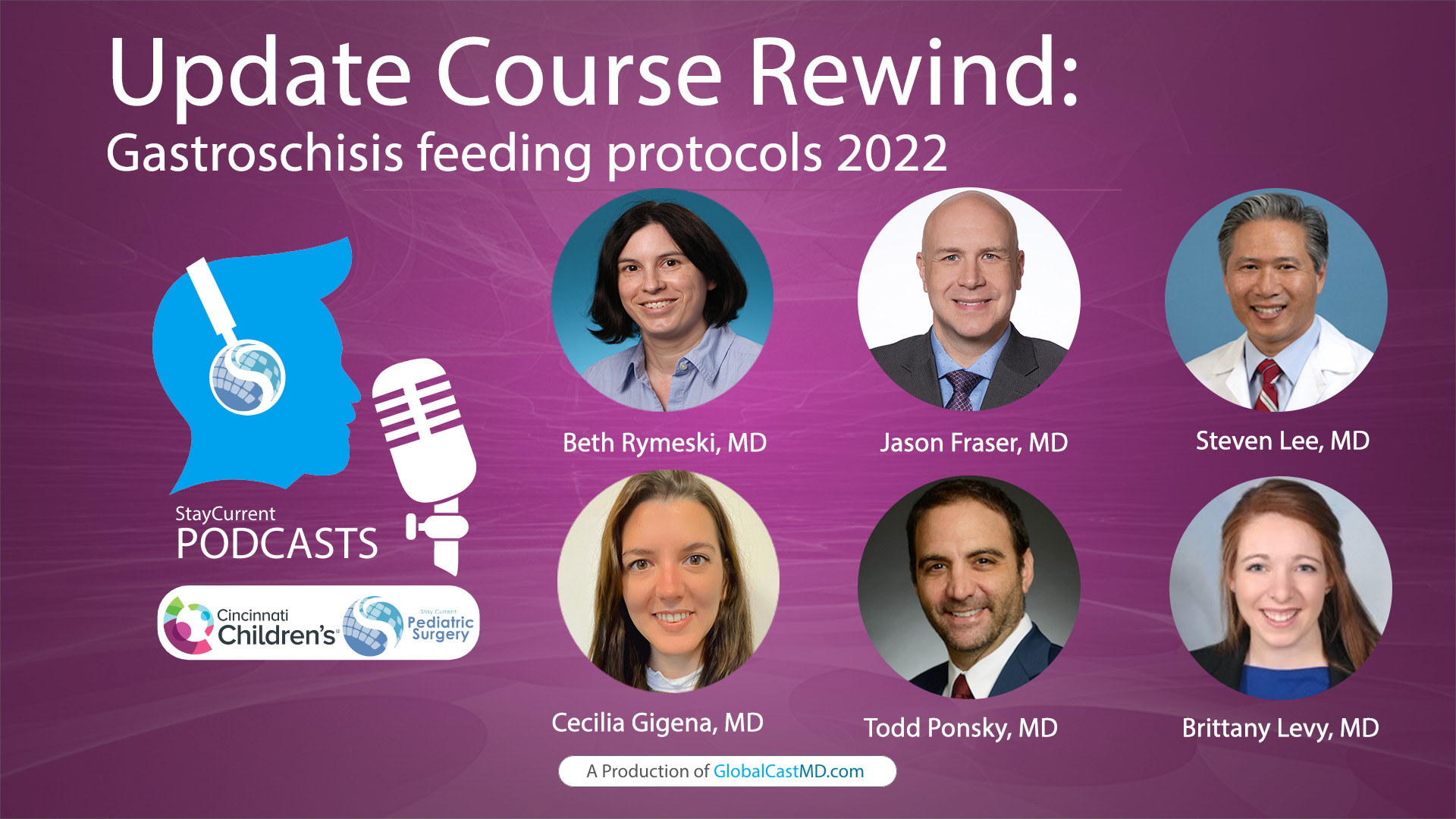
Update Course Rewind: Gastroschisis Feeding protocols 2022
CCHMC Pediatric Surgery · Published Feb 2023
Video
BOB Ped Surg 2023 - Jason Fraser, APSA - Presentation
Published Feb 2023
Video
Update Course 2022 - UPDATES IN GASTROSCHISIS FEEDING PROTOCOLS - Jason Fraser, Beth Rymeski, and Steven Lee
21 min · Published Sep 2022
Video
Complications and Beyond
66 min · Published Sep 2020
Podcast
Diaphragm pacing as alternative to mechanical ventilation in pediatric respiratory failure
1 min · Published Nov 2026
Podcast
Fetoscopic endoluminal tracheal occlusion for congenital diaphragmatic hernia
4 min · Published Nov 2026
Podcast
FETO procedure for late-diagnosed severe CDH with liver herniation
4 min · Published Nov 2026
Podcast
Severe CDH case with FETO: unexpected anatomic findings and clinical outcome
3 min · Published Nov 2026
Podcast
Pediatric pancreatitis: diagnosis, causes, and genetic insights with Dr. Juan Gurria
3 min · Published Nov 2026
Podcast
Understanding craniosynostosis: skull sutures, growth patterns, and diagnosis in infants
10 min · Published Nov 2026
What the experts said
Due to the heterogeneity of gastroschisis, patients able to undergo primary repair probably had more favorable bowel and theoretically would have less hospital stay and feed faster.
Many patients who underwent sutureless repair were done in more recent cohorts and tended towards less interventions.
In sutured repair, mobilizing flaps from the skin and fascia causes redness and bruising around the incision, which puts patients at higher risk for potential infection.
The finding of increased antibiotics needed after sutured repair was expected due to tissue manipulation.
The next phase of the study is examining the same patients over several years of follow-up to assess growth and umbilical hernia repair rates.
The consortium is working on operationalizing protocolization of gastroschisis closure across member institutions for a more prospective study with long-term follow-up.
In 2004, Tony Sandler published the first manuscript about sutureless closures utilizing the natural umbilical properties to close the gastroschisis defect by itself.
The Midwest Pediatric Surgery Consortium study was a retrospective cohort of infants born with gastroschisis between 2013 and 2016, with a total of 315 patients.
The study divided patients into sutured versus sutureless abdominal wall closures and required subgroup analysis because some babies received silos and some did not.
Patients who underwent sutureless abdominal wall closure had no difference in days on TPN, time to goal feeds, time to initial feeds, or length of stay compared to sutured closure.
Sutureless closure patients had less antibiotic use compared to sutured closure patients.
Sutureless closure patients had fewer surgical site and deep space infections compared to sutured closure patients.
Sutureless closure patients had fewer episodes of general anesthetics compared to sutured closure patients.
Sutureless closure patients had less ventilator use compared to sutured closure patients.
The positive outcomes for sutureless repair were observed even when considering patients who required silo use.
Initial small studies showed that some sutureless patients had a high umbilical hernia repair rate, or at least a high umbilical hernia rate.
Gastroschisis is an abdominal wall defect that used to necessitate a trip to the OR and is now more like a safe bedside procedure.