


From
StayCurrentMD
Evidence-based diagnosis and management of pediatric appendicitis with Dr. Whit Holcomb
With Dr. Whit Holcomb · hosted by Dr. Todd Ponsky
Part of
Appendicitis 36 items
Chapter 3 of 12 · Medical Management
Antibiotic protocols
Antibiotic selection and dosing protocols
Cued at 13:29 · stops at 14:20 · press play
Expert statements on this page
No expert statements were drawn from this page.
Host summaries · secondary, not cited in answers
Educational content from recorded physician discussions — not medical advice. Talk to your (or your child's) care team about your situation.
Podcast
Appendicitis with Dr. Whit Holcomb
58 min · Published Apr 2017
Video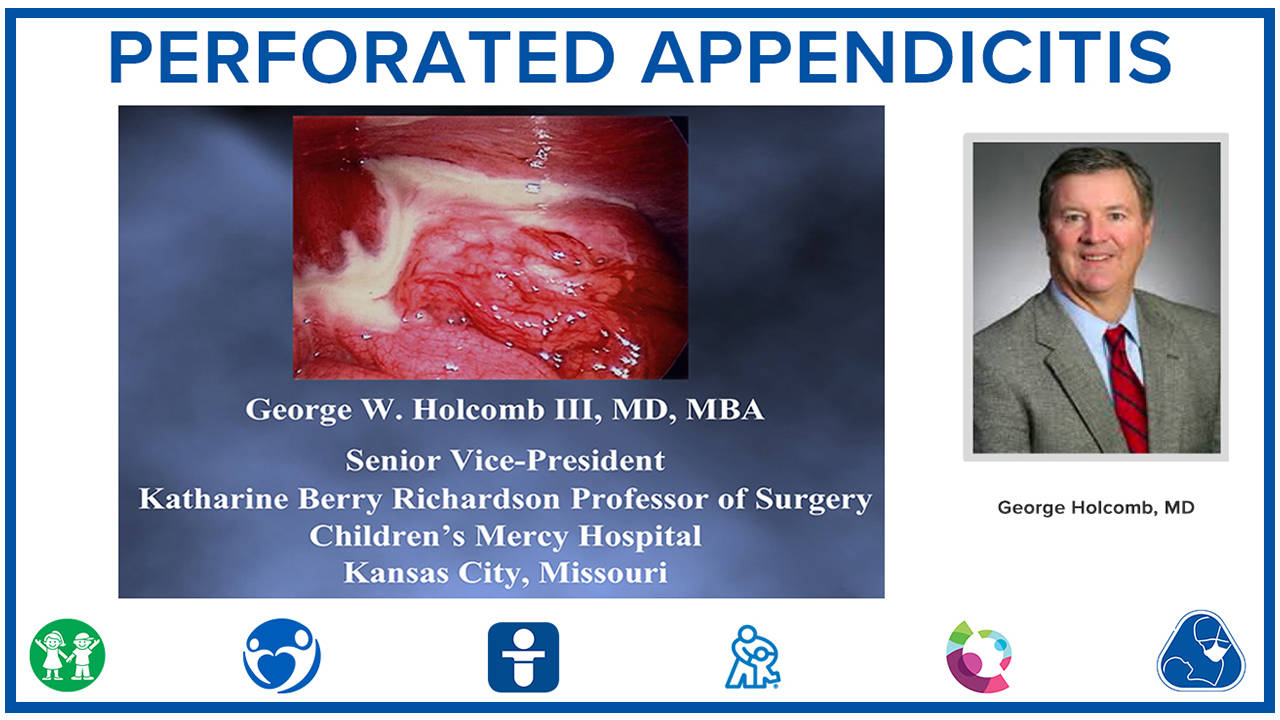
Perforated Appendicitis
18 min · Published Mar 2020
Podcast
Journal Club: Appendicitis in 2021
15 min · Published Aug 2021
Podcast
Update Course Rewind: Perforated Appendicitis 2019
12 min · Published Apr 2021
Video
Update Course Rewind: Management of Appendicitis 2022
Published May 2023
Video
Appendicitis Management & APPY Trial: Update Course 2016
31 min · Published Oct 2018
Podcast
Acute Appendicitis 2020 Update
Todd Ponsky · 12 min · Published Oct 2026
Podcast
Journal of Pediatric Surgery Article Review: 3rd Quarter (Jul-Sep) 2024
19 min · Published Oct 2024
Podcast
Journal of Pediatric Surgery Article Review: 2nd Quarter (Apr-Jun) 2024
17 min · Published Sep 2024
Podcast
Pediatric Gastroesophageal Reflux Disease
81 min · Published Aug 2018
Podcast
Gastroesophageal Reflux Disease
81 min · Published Aug 2018
Podcast
Biliary Atresia, Appendicitis, Intestinal Failure, and Anesthetic...
44 min · Published May 2017
Podcast
Diaphragm pacing as alternative to mechanical ventilation in pediatric respiratory failure
1 min · Published Nov 2026
Podcast
Fetoscopic endoluminal tracheal occlusion for congenital diaphragmatic hernia
4 min · Published Nov 2026
Podcast
FETO procedure for late-diagnosed severe CDH with liver herniation
4 min · Published Nov 2026
Podcast
Severe CDH case with FETO: unexpected anatomic findings and clinical outcome
3 min · Published Nov 2026
Podcast
Pediatric pancreatitis: diagnosis, causes, and genetic insights with Dr. Juan Gurria
3 min · Published Nov 2026
Podcast
Understanding craniosynostosis: skull sutures, growth patterns, and diagnosis in infants
10 min · Published Nov 2026
What the experts said
Classic acute appendicitis presentation (pain migration to right lower quadrant, McBurney's point tenderness, elevated WBC and CRP, low-grade fever in thin patient with short symptom duration) can proceed directly to laparoscopic appendectomy without imaging
At Children's Mercy Hospital, emergency department physicians often perform imaging studies before surgical consultation, though this is at their discretion not surgeon direction
Symptom duration over 24-36 hours raises concern for perforation and warrants imaging starting with ultrasound
If ultrasound is not diagnostic but raises concern, proceed to CT scan; if ultrasound is diagnostic of appendicitis, CT is not needed
Non-visualization of appendix on CT at 4 days should show secondary signs of appendicitis and likely perforation; absence of both findings makes appendicitis unlikely though not zero
Children's Mercy uses IV contrast for CT and performs limited/focused CT scans to minimize radiation exposure; rectal contrast protocol was attempted but not adopted by ED physicians
Ceftriaxone and metronidazole is the most cost-effective antibiotic combination for appendicitis and has similar efficacy to triple antibiotic regimens
Non-perforated appendicitis receives only single preoperative antibiotic dose with no postoperative antibiotics
Once-daily ceftriaxone/metronidazole dosing facilitates home health care transition if needed, does not require serum levels like gentamicin, and avoids gentamicin toxicities
In 2008 Journal of Pediatric Surgery randomized trial of 100 patients, daily ceftriaxone/metronidazole showed no difference in abscess rate or wound infections versus ampicillin/gentamicin/clindamycin but resulted in lower antibiotic charges
Ceftriaxone dosing is 50 mg/kg once daily and metronidazole is 30 mg/kg once daily for appendicitis
Single-incision or double-incision laparoscopic approaches are used only for thin patients with non-perforated appendicitis
In double-incision approach, 5mm umbilical port is placed with 5mm suprapubic port for mobilization, then appendix is exteriorized through umbilicus for extracorporeal appendectomy
Locking grasper is essential when exteriorizing appendix to prevent dropping it back into abdomen
Fascial incision of 10-12mm is needed to safely exteriorize appendix because grasper creates U-shaped configuration rather than end-on grasp
Perforation is strictly defined as stool in the abdomen (fecalith in abdominal cavity) or a visible hole in the appendix; without these findings the patient does not have perforation
This strict perforation definition was necessary because literature uses terms like gangrenous, necrotic, and perforated inconsistently, all meaning different things to different surgeons
Children's Mercy has been sending non-perforated appendicitis patients home the same day (within 6 hours of surgery) for over a year with over 100 patients managed this way
Same-day discharge for non-perforated appendicitis uses local anesthesia in incisions, pain medications at home, and no postoperative antibiotics
Rationale for same-day discharge includes patient satisfaction, opening hospital beds for patients who need them, and preparing for potential future trials of antibiotics versus day-surgery appendectomy
October 2011 Annals of Surgery study randomized 360 patients (August 2009-November 2010) comparing single-incision to three-port laparoscopy for non-perforated appendicitis
Single-incision appendectomy showed no difference versus three-port in wound infection rate, time to regular diet, length of hospitalization, or time to return to full activity
Single-incision approach had longer operative time (5 minutes, statistically significant but not clinically relevant), more narcotic doses, greater surgical difficulty, and higher hospital charges than three-port
For single-incision approach, umbilical fascia is closed and interrupted plain sutures placed in umbilical skin; for three-port, umbilical incision closed similarly and 5mm port sites closed with 5-0 Vicryl in U-fashion
Interrupted plain sutures allow wound infection drainage while not requiring removal due to short half-life; wounds dressed with rolled gauze and Tegaderm
St. Peter study compared irrigation plus suction versus suction-only for perforated appendicitis and found no difference in abscess rate or location; both groups had approximately 20% postoperative abscess rate
Study used strict perforation definition (hole in appendix or fecalith in abdomen), not just distended, angry, necrotic, or gangrenous appendix
Across 6-7 appendectomy studies for perforated disease at Children's Mercy, abscess rate has consistently been 15-20%; Holcomb counsels families on 20% abscess risk
Surgeons reporting lower abscess rates for perforation likely include gangrenous/necrotic non-perforated cases in their perforated group, lowering the rate
At Children's Mercy, OR billing is $225 per minute; a $600 stapler is cost-effective if it saves 3 minutes of OR time
Children's Mercy surgeons use stapler for both mesoappendix and appendix because it can be justified as cost-effective under their per-minute billing model
Standard stapler load is used for appendix and vascular load for mesoappendix, which is another reason not to staple both simultaneously
In early 1990s at Vanderbilt, three children who had cautery used for appendectomy developed adjacent small bowel injuries requiring reoperation due to electrical arc
When using cautery for appendectomy, must carefully watch entire field to prevent electrical arc to adjacent small bowel loops
Murky fluid throughout abdomen in non-perforated appendicitis is very unusual and would prompt placement of additional port for better visualization and investigation of source
In single-incision approach, pelvic fluid should be suctioned before incising the bridge between ports because it becomes difficult to suction after appendix removal
For normal appendix found at surgery, if imaging study was done preoperatively, full small bowel run is often not performed; without prior imaging, full small bowel examination is done
Initial perforated appendicitis protocol at Children's Mercy was 5 days of IV antibiotics postoperatively, developed when beginning prospective randomized trials
Discharge criteria for perforated appendicitis: normal WBC on day 5, afebrile, tolerating regular diet; then discharged without oral antibiotics
If WBC elevated on day 5, patient receives 2 additional days of antibiotics and repeat WBC; if still elevated, receives 3 more days and CT scan to look for abscess
Almost all postoperative abscesses in perforated appendicitis develop while patient is in hospital, very few develop after discharge
Follow-up study randomized 100 patients (50 per group) comparing mandatory 5 days IV antibiotics versus early discharge with oral Augmentin to complete 7 total days if discharge criteria met
Early discharge study found no difference in postoperative abscess rate between groups; 40% of patients in early discharge group went home before day 5
For well-defined abscess at 5-6 days symptom duration, two options exist: immediate appendectomy or non-operative management with interval appendectomy
2010 Journal of Pediatric Surgery study of 40 patients compared initial appendectomy versus initial non-operative management with interval appendectomy for well-defined abscess from perforated appendicitis
Study found no difference between immediate versus interval appendectomy in total length of hospitalization, recurrent abscess rates, or overall charges
Initial appendectomy took longer (61 minutes) versus interval appendectomy (42 minutes)
Holcomb prefers initial non-operative management with interval appendectomy because immediate operations can be difficult, patients have prolonged hospitalization, bad ileus, sometimes need NG tube, and risk recurrent abscess complications
Interval appendectomy is performed 8-10 weeks after non-operative abscess management and is becoming a day surgery procedure
At 3-4 days symptom duration, would operate; at 6-7 days with well-defined abscess, would treat non-operatively; 5 days is transition zone requiring clinical judgment
Even if abscess can be managed for 2 weeks non-operatively, that operation is much easier than going in early through dense inflammation and purulent material
Current data suggests 50-60% of patients could likely be managed non-operatively with antibiotics
High-quality studies on non-operative appendicitis management will emerge in next 5 years showing good percentage can be treated without operation
Long-term follow-up of 25-30 years will be needed to determine if non-operatively treated patients develop recurrent appendicitis years later
Inflammation and infection may cause appendiceal scarring leading to closed-loop obstruction and recurrent appendicitis, but this won't be known for 25-30 years
Current data is not mature enough to justify non-operative management, especially when patients can have surgery and go home same day returning to routine activities
Longer-term data (5, 10, 20 years) is needed to determine true recurrence rate after non-operative management; if patients return years later, this justifies interval appendectomy when young
Children's Mercy currently proceeds with interval laparoscopic appendectomy after non-operative abscess management because families do not want child at risk for recurrent appendicitis
In Ponsky's inter-observer variation study published in Journal of Laparoendoscopic and Advanced Surgical Techniques, attending surgeons viewing same images agreed on perforation status only 25% of the time without defined criteria
Wound infection rate was 3.3% (6/180) for single-incision versus 1.7% (3/180) for three-port, p=0.5, not statistically different