


From
Live Event Content
Dr. Yujie Ma - Best of the Best in Pediatric Surgery 2025
With Dr. Yujie Ma & Dr. Erin Brown
Chapter 2 of 5 · Fundamentals
CAMK2G mechanism
Background and mechanism of CAMK2G activation
Cued at 1:03 · stops at 1:12 · press play
Expert statements on this page
No expert statements were drawn from this page.
Host summaries · secondary, not cited in answers
Educational content from recorded physician discussions — not medical advice. Talk to your (or your child's) care team about your situation.
Video
Neuroblastoma with Dr. Meera Kotagal
14 min · Published Sep 2024
Video
Neuroblastoma vs. Nephroblastoma (Wilms Tumor): Pediatric Surgery Differences Explained
3 min · Published Nov 2026
Video
Social Determinants of Health Influence on Survival in Wilms Tumor, Neuroblastoma, and Hepatoblastoma
1 min · Published Jan 2026
Video
Update Course Rewind: Staging and Management of Neuroblastoma 2022
Published Jun 2023
Podcast
Journal of Pediatric Surgery Article Review: The Disruption Score
12 min · Published Aug 2021
Video
The International Neuroblastoma Risk Group (INRG) staging system: an INRG Task Force report
59 s · Published Mar 2026
Video
Rare Ovarian Tumor in Infants: Small Cell Carcinoma of Ovary, Hypercalcemic Type & SMARCA4 Mutation
21 s · Published Oct 2026
Video
Can Normal X-Rays Miss Metastatic Neuroblastoma? A Pediatric Radiology Case Study
26 s · Published Oct 2026
Video
Can Fractures Be a Sign of Hepatoblastoma in Children? Understanding Pediatric Liver Cancer Symptoms
37 s · Published Oct 2026
Video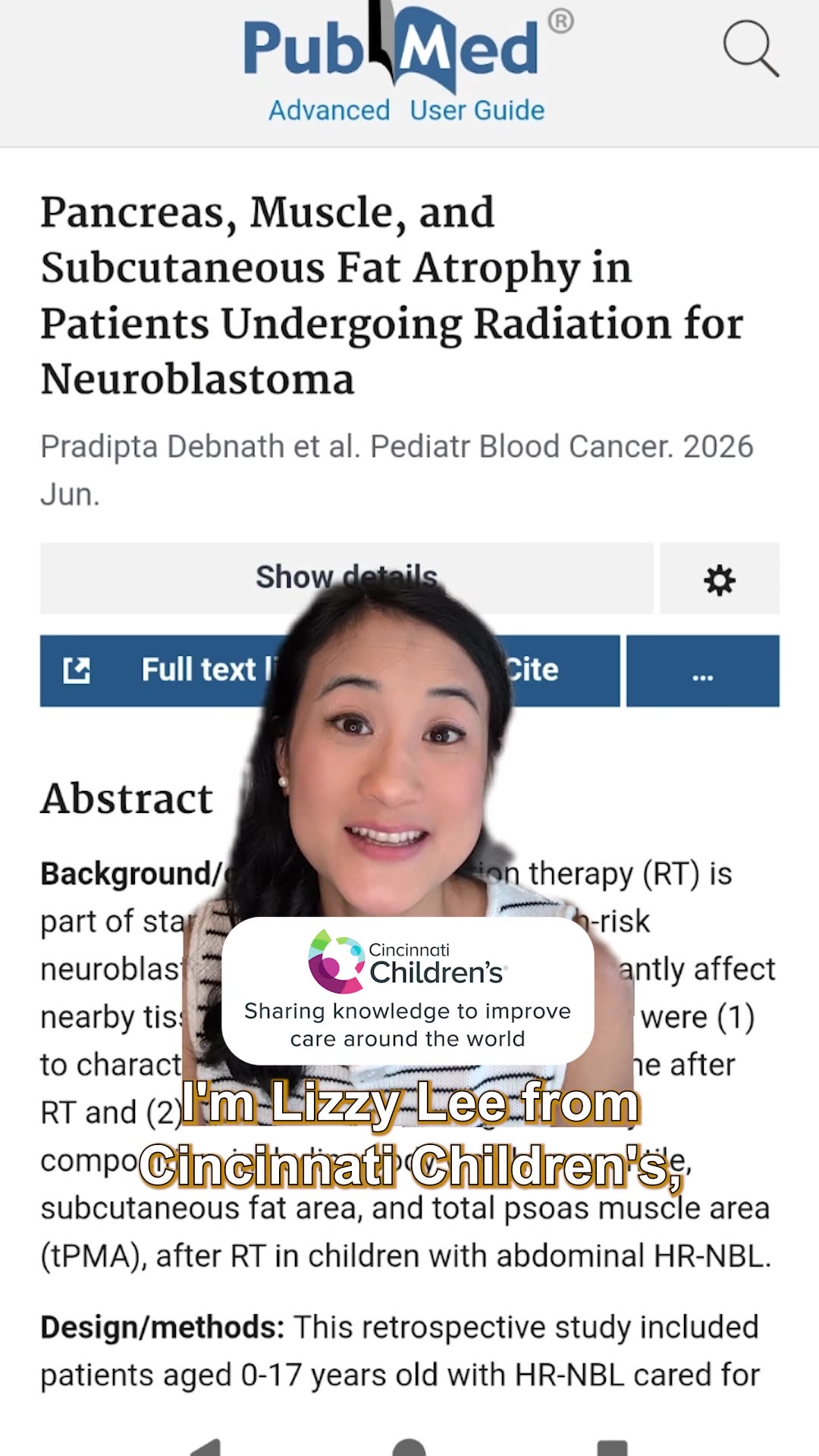
Pancreas, Muscle, and Subcutaneous Fat Atrophy in Patients Undergoing Radiation for Neuroblastoma
47 s · Published Oct 2026
Podcast
Hepatoblastoma
Todd Ponsky · 54 min · Published Oct 2026
Podcast
Wilms Tumor
Todd Ponsky · 64 min · Published Oct 2026
Video
Clinical & Research Update: Renal Tumors with Drs. Ethan Smith, Lindsay Haacker, Michael Daugherty, and Meera Kotagal
71 min · Published Sep 2026
Video
Clinical & Research Update: Neuroblastoma with Drs. Katherine Somers, Cara Morin, Juan Gurria, and Meera Kotagal
67 min · Published Sep 2026
Video
Clinical & Research Update: Sarcoma w/ Drs. Roshni Dasgupta, Joseph Pressey, Arthur Meyer, Luke Pater
66 min · Published Sep 2026
Video
2026 Laparoscopic Pediatric Hernia Repair
123 min · Published Jun 2026
Video
Beyond the Spectrum: Diagnosis, Myths & Management - Caitlin Couch & Leslie Lopez - APP Conference 2026
50 min · Published May 2026
Video
Dysautonomia: Navigating the Journey - Martha Willis - APP Conference 2026
55 min · Published May 2026
What the experts said
Neuroblastoma is the most common extracranial solid tumor of childhood arising from aberrant differentiation of sympathoadrenal cells in neural crest.
Retinoic acid is used to induce differentiation in treatment of high risk neuroblastoma.
Retinoic acid efficacy varies in patients due to the highly heterogeneous nature of neuroblastoma.
PCP4 was identified as one of the differentiation markers of neuroblastoma tumor cells in a previous Cancer Cell publication.
PCP4 modulates the rate of calcium binding to calmodulin, which is a critical step in activating calmodulin dependent kinase.
The binding of PCP4 with calmodulin was verified in neuroblastoma by co-immunoprecipitation.
CAMK2G was identified as a target kinase of calmodulin using mass spectrometry.
CAMK2G is a member of the serine/threonine protein kinase family.
CAMK2G plays an important role in neuronal development and synaptic plasticity.
When CAMK2G is activated by calmodulin, it gets autophosphorylated at the site of threonine 287.
PCP4 overexpression upregulated the threonine 287 phosphorylation of CAMK2G in neuroblastoma cells.
Low CAMK2G mRNA expression was associated with worse overall and event-free survival in neuroblastoma patients.
Low CAMK2G expression was associated with advanced INSS stages and unfavorable histology in neuroblastoma.
Low CAMK2G expression was associated with MYCN amplified status, high risk, and tumor progression in neuroblastoma.
CAMK2G knockdown in SKNSH cells resulted in inhibited neurite outgrowth even under retinoic acid induction.
Expression of neuronal differentiation markers were downregulated following CAMK2G knockdown.
Gene enrichment analysis of downregulated genes following CAMK2G knockdown showed enriched terms related to neuronal differentiation including synaptic signaling, plasma membrane, and ion channel activity.
CAMK2G knockdown promoted migration and invasion of neuroblastoma cells as shown by transwell assays.
KEGG analysis of upregulated genes following CAMK2G knockdown identified enriched pathways associated with tumor migration and invasion, including extracellular matrix receptor interaction, focal adhesion, and regulation of actin cytoskeleton.
CAMK2G is expressed at low levels in SKNSH neuroblastoma cell line.
CAMK2G is highly expressed in BE2 and SKNS neuroblastoma cell lines, which are MYCN amplified cell lines.
CAMK2G function is not strong enough to overcome the oncogenic function of MYCN in MYCN-amplified neuroblastoma cell lines.
CAMK2G did not regulate neuronal differentiation in MYCN-amplified neuroblastoma cell lines.
The CAMK2G differentiation mechanism is not universal for all neuroblastoma cell lines and patients, and can only be explained in MYCN non-amplified cell lines and corresponding patients.