


From
Live Event Content
Dariusz Patkowski, MD, PhD - Best of the Best in Pediatric Surgery 2024
With Dr. Dariusz Patkowski
Chapter 2 of 4 · Surgical Management
Technique overview
Technical presentation of thoracoscopic internal traction technique
Cued at 1:40 · stops at 1:57 · press play
Expert statements on this page
No expert statements were drawn from this page.
Host summaries · secondary, not cited in answers
Educational content from recorded physician discussions — not medical advice. Talk to your (or your child's) care team about your situation.
Video
Update Course 2021: MAGNET THERAPY FOR ESOPHAGEAL ATRESIA
Dr. Steve Rothenberg · Published May 2022
Podcast
Journal of Pediatric Surgery Article Review: February 2022 BAPS Issue
11 min · Published Apr 2022
Video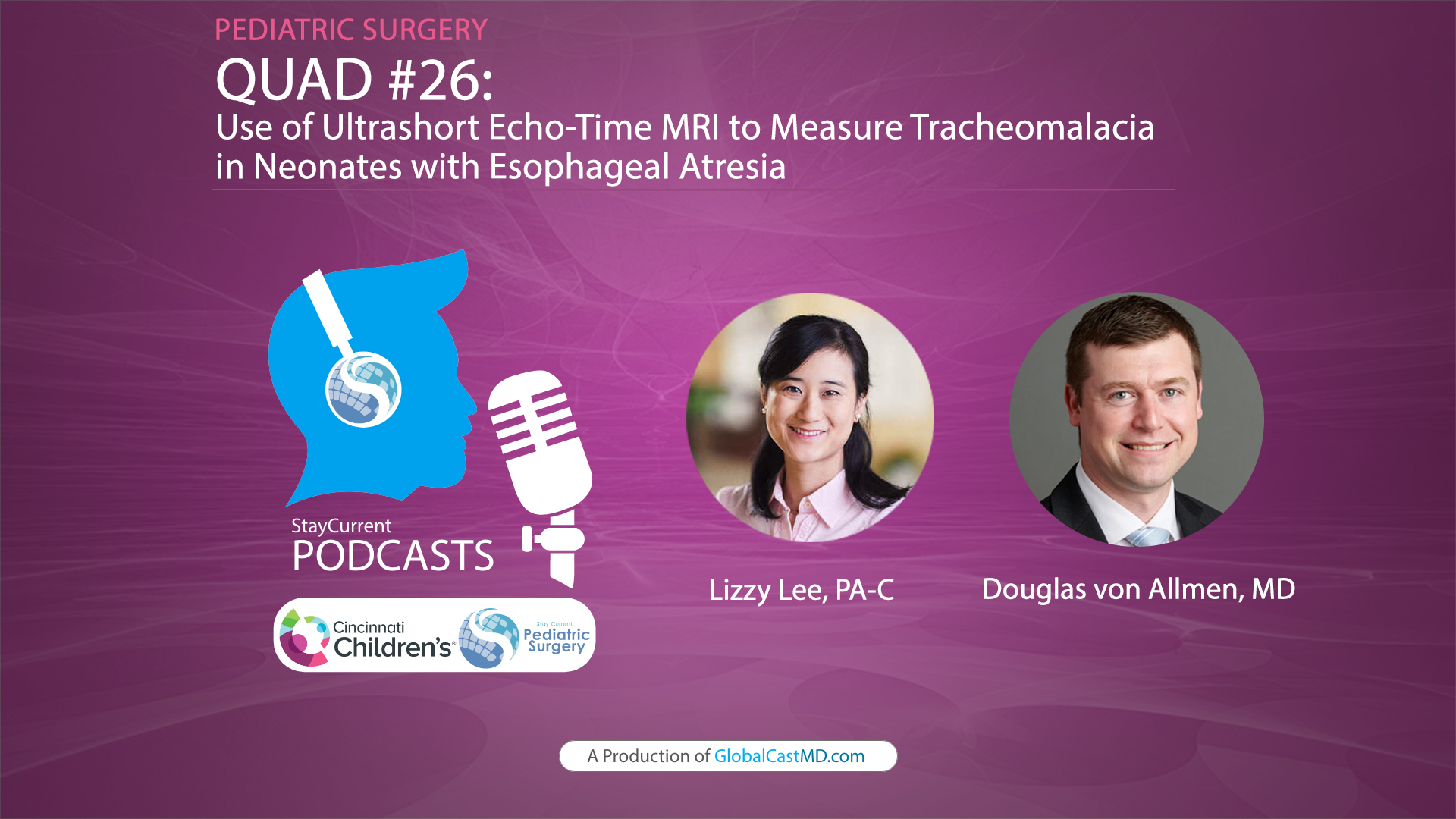
QUAD #26 - Use of Ultrashort Echo-Time MRI to Measure Tracheomalacia in Neonates with Esophageal Atresia with Dr. Douglas von Allmen
CCHMC Pediatric Surgery · 5 min · Published Feb 2025
Video
Introduction and Panel Discussion: EA & TEF
Dr. Todd Ponsky · 36 min · Published Dec 2012
Video
Long Gap Discussion: EA & TEF
Dr. Todd Ponsky · 10 min · Published Dec 2012
Video
Long Gap Esophageal Atresia – How I Do It: Update Course 2018
Dr. Todd Ponsky · 38 min · Published Aug 2018
Video
Clinical & Research Update: Renal Tumors with Drs. Ethan Smith, Lindsay Haacker, Michael Daugherty, and Meera Kotagal
71 min · Published Sep 2026
Video
Clinical & Research Update: Neuroblastoma with Drs. Katherine Somers, Cara Morin, Juan Gurria, and Meera Kotagal
67 min · Published Sep 2026
Video
Clinical & Research Update: Sarcoma w/ Drs. Roshni Dasgupta, Joseph Pressey, Arthur Meyer, Luke Pater
66 min · Published Sep 2026
Video
2026 Laparoscopic Pediatric Hernia Repair
123 min · Published Jun 2026
Video
Beyond the Spectrum: Diagnosis, Myths & Management - Caitlin Couch & Leslie Lopez - APP Conference 2026
50 min · Published May 2026
Video
Dysautonomia: Navigating the Journey - Martha Willis - APP Conference 2026
55 min · Published May 2026
What the experts said
The technique was designed to bridge the gap between the esophageal pouches of long gap esophageal atresia, which for the presenter means type A and B.
All 27 cases of long gap esophageal atresia were operated thoracoscopically.
Both ends of the esophagus are brought together under tension with internal traction suture using static, not active tension.
Preoperative rigid bronchoscopy is a standard procedure to check for upper fistula and any tracheal malformation.
The patient lies in a prone position on the edge of the operating table with the right scapula as the anatomical reference point for trocar placement.
The distal esophagus is usually located at the level of the diaphragm and is dissected bluntly from surrounding tissues.
There is no need to use electrosurgery for dissection of the esophageal pouches and fistula.
For internal traction, a 2-0 non-absorbable braided suture is used.
Placing the internal traction suture requires full thickness of tissue, including the mucosal layer.
Clips are placed to cover the entire thickness of the tissue and part of the suture to prevent leaks and allow for greater force to be used for traction.
Subsequent stages are performed every 1 to 5 days.
There is no need for a gastrostomy in this technique.
The patient remains intubated in the intensive care unit on parenteral nutrition between stages.
Chest drainage is not used in this technique.
The presenter prefers intermittent suction on demand rather than continuous suction with a Replogle tube, as continuous suction dries the mucosa.
Anastomosis is possible if both ends overlap, but care must be taken when deciding as there is no way back and any failure will result in the loss of part of the esophagus.
An 8 French nasogastric tube is passed down into the stomach after pouches opening.
Traction must be maintained until the first sutures are placed, because both esophageal pouches can easily retract, making anastomosis very difficult.
The thoracoscopic internal traction technique was used in 25 cases of long gap esophageal atresia and completed with anastomosis in 23 cases.
Most cases were completed in 2 stages, but there were also 2 cases operated on in 5 and 6 stages.
Initially, the time between stages was about 4 weeks, but this was reduced to a few days.
When both ends overlap each other, anastomosis can be started, but if there is any tension even with overlap, the presenter would connect them with one suture and wait 2 or 3 days more before proceeding.
In the last series of 9 primary cases without gastrostomy, the average hospital stay was 31 days.
One gastric pull-up complication occurred and was later successfully treated laparoscopically.
The presenter strictly defines long gap as only type A and B esophageal atresia, not type C.
In the presenter's experience, type C esophageal atresia was always possible to make primary anastomosis, with the only exception being when the patient was unstable.
If the sliding knot needs adjustment in subsequent procedures, the same sliding knots can be unlocked and reused rather than placing new sutures.
To unlock a sliding knot, one end is a little bit longer and the other end is a little bit shorter; the long one is pulled to unlock it.