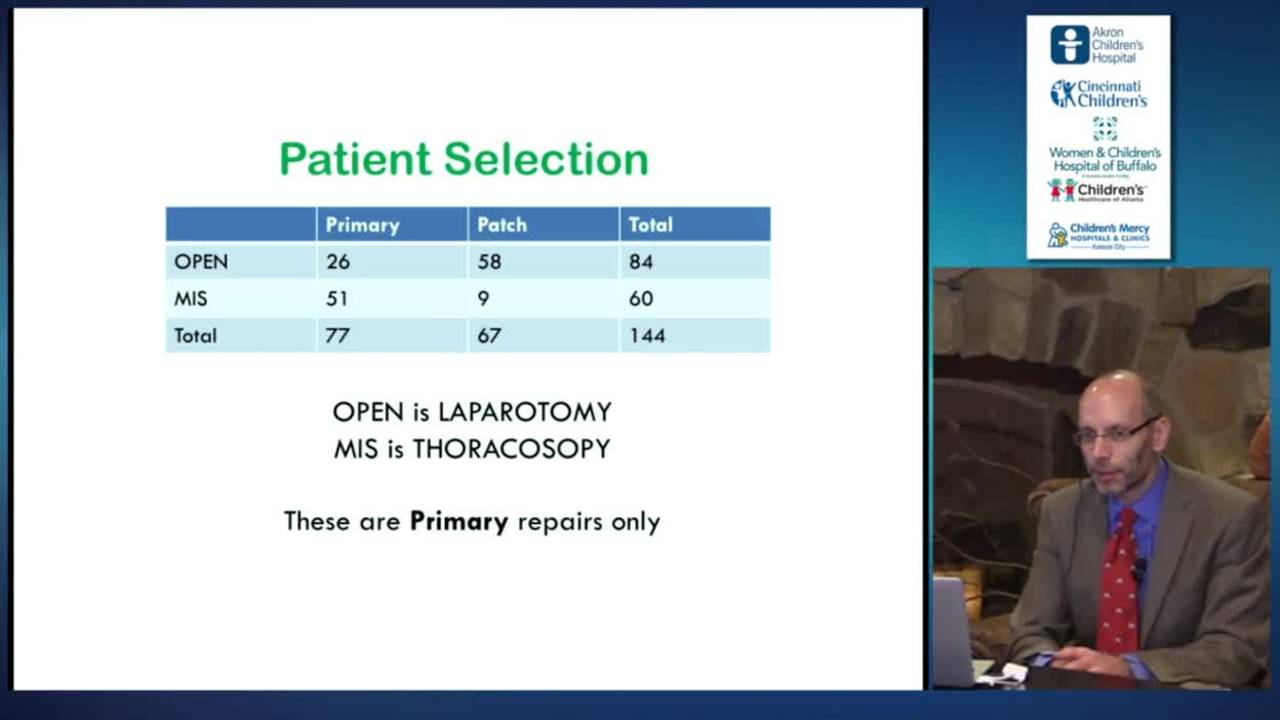
And now talk about congenital diaphragmatic hernia, um, And we actually did this similar presentation a few years ago and there was a lot of Uh, interest in it. So, uh, given the talk about, uh, Ron's talk on ECMO, we figured the, it would be a nice time to review some of the, the new concepts in diaphragmatic hernia repair. So we have Doctor Wolfan presenting. Thank you, Todd, and we're gonna go ahead and uh bring this up thinking now you're gonna, you're gonna help me with some of these case presentations or you can read them or it doesn't matter because we've rehearsed this so many times. OK. And I, I know I have some video clips and stuff, but we're gonna, we'll probably go through things pretty quickly. Um, because I know we're pretty short on time. So, uh, today we're going to talk or say tonight, it is almost, it is tonight somewhere, somewhere, some of you folks that are watching this are in the middle of the night. That is right. Uh, I don't, you know, so we're going to talk about controversies in diaphragmatic hernia. So really where I'm going to go is really the whole concept of open versus MIS repair, which I think is, is still out there. I think that there's a lot of resistance to doing the MIS repair since that paper that came out of Columbia, but there's some other data that would suggest otherwise. Um, and then the other piece is when do you repair a diaphragmatic hernia? And I bet we have as many strategies as we have people in this room. And then I'm going to, if we have time, and you know there's there's, there are people in this room that know a whole lot more about the fetal world than I do, but just talking about when would you refer for a fetal intervention. So, you know, we'll start out with this patient here is a 37 week gestational age male. Basically, the bottom line is this is what we would all say is a good diaphragmatic hernia, you know, not too sick on reasonable event settings. You can see on the chest X-ray, and let's see, I'm going to see if my pointer works here. It kind of works. Are they seeing that? OK, so you're not seeing this. Um, so you can see you've got a bunch of intestines in the chest, or as we say in the southern United States, there's chits in the chest. You don't see a shadow of the liver up there. You can see the OG tube is not in the chest, so the stomach's down. So this, everybody thinks this is a pretty good diaphragmatic hernia. OK, so, when do you repair it? So I'm gonna, I'm gonna actually, I'm gonna pass this around, Ron. I'd probably wait a couple of days. Yeah, I, I, I think first off, I mean, if, if they're fine, like they're, they're on low ventilator settings, I'd wait a couple of days. Otherwise I would wait till they're just about, they're on very low ventilator settings nearing extubation, and then I would, uh, would. Why, why would I wait? Because I'd like to have them first off, um, go through their transitional period. It's 11 reason so that they're not flipping in and out of, of fetal circulation. The second thing is I'd like them to have, if they were on higher vent settings, I'd like them to have some reserve so that when I repair, if they do tend to, you know, get worse, I have some room before I would have to put them on ECM. OK, and I thought this was going to be the easy question. Yeah, I would probably agree with that. I mean, I think a, a, a kid who's uh not on ECMO and not sick, you know, 24 to 48 hours probably. I think the sooner the better because what I don't, can't control is how much distention occurs in those bowels, and that's compromising pulmonary and cardiac function over time, so I'd rather fix them sooner. I'm humble in that I think I'm relatively ignorant about how the lungs are doing, so I get an echo and try and follow that for how their, how their pulmonary hypertension is doing. Yeah, I would, I would kind of agree with Ron. We'd let them chill out for a little while and make sure they're doing OK, so otherwise stable and then fix it. My slides back here. So it looks like most people would wait a couple of days. Uh, I think that's, uh, what, what we would probably do. Um, and we'll talk about. Why or what we're going to go to our second question next before we get into this a little bit. So question two, how would you repair this? So thoracotomy, laparotomy, thoracoscopy, or laparoscopy? No. Ron, what we do, you know the right answer, right? Well, I, I would repair a patient that had, um, uh, you know, that, that was not on ECMO and, um, and was we had gone down on the vent settings or otherwise was in low vent settings, I would do it thoracoscopically. I do a laparotomy. I have no dog in that race. Um, I think the most important thing is to get a good repair that doesn't come undone, which has been the problem with thoracoscopy in the past and not affect the pulmonary and cardiac function during the operation. So, discuss with the anesthesiologist about the best way to do it. Not proud of me. Uh, I guess it would depend on the day of the week. So if they're not sick, and I think they have a small defect, probably thoracoscopically, if I thought I'd have to put a patch in, then I'd probably convert it to open. Although, having said that, sometimes we put patches over the repair because the repair is tearing through, so. I would agree with that. That this seems like a good candidate for a thoracoscopic repair, but, uh, the question about a patch, uh, might affect that intraoperatively. If you do a patch, what do you use? Teeing team me up for further on down, but that's a good question. Excellent question. So what, what patch will we use if we do? So I, I think all you make a good point, good points. Um, we would put a scope in. I would put a scope in, and I, and again, I'll put a scope in anybody and see and then make a decision. Decision about whether it's something that's amenable to thoracoscopic closure or not, but we will do A and B type defects, and you know, if you're a small patch, or, you know, as long as it's not agenesis, and again I'll get to that. I know we're trying to move things along, but Yeah, you want to say something, Ron? Yeah, I do, because, um, because, you know, Charlie Stoller, I think was the one that, that showed us, I believe it's about a 30% recurrence rate from doing thoracoscopic. And, and I, you know, I, I do think that with any technique, you're going to get better and better as you go along. And, and so I, I don't believe that it's, I believe you try to examine what you're doing that's causing that. And, and sometimes it may be because we're not, um, you know, we're trying to avoid doing a patch. And uh and so, and what I mean by that is I'm doing it thoracoscopically and I want to complete it and maybe I should put a patch in, but I don't, you know, that kind of thing. But the bottom line is that we have to be thoughtful about, about that complication rate, not necessarily throw out the, the approach, because over time we're just going to get better. OK, Ron just summarized my talk so we can stop now. We're done. We're done here. Drop, drop the mic, drop the mic. I mean, but that's the point. We're going to talk about some of those papers, but it is, it's, it's, you know, we approached this by saying, OK, why, why are other people having these high recurrence rates, and we'll get into that, and I'm going to, I'm going to blast through some of this stuff quickly in this for the sake of time and not. A belabor a lot of this. But so when we fix them is, you know, basically, you know, what are our indications for an MIS repair? It's if the patient can go to the OR. So if there's a, you know, if you have a really sick patient that can't be transported or something like that, that's not an MIS patient. But really what we look for is the patient's stable, and David, did you say something about an echo? And on that list it did say the echo was just mildly elevated pulmonary pressures on that case presentation, but if the right sided pressures are lower than systemic, if they're kind of equal, you know, the cardiologists always fudge. They don't tell you exactly what it is, but they can't really tell either because they're extrapolating it. But really, if their, if their pressures, if their pulmonary pressures are reasonable, I think that's the time to go to Ron's point, you don't want them flipping back and forth with transitional circulation. So we give, I think, a day or two is very reasonable. We're going to get into some more discussion around timing of, uh, I think this becomes more critical timing of repair when you have a patient on ECMO, right? So that's Some of the other controversies. Um, so, you know, we, if we have the liver up, stomach up, oscillator redo, we'll still, we'll still put a scope in and see. And if it, because I've been fooled on some of these, some of these are not as big a defect as you think they are, and you don't, you don't know until you get there. And if you give everybody a laparotomy, everyone gets a laparotomy. So. So technical pieces that, uh, you know, I'm going to go through this pretty quickly, and these slides will be up for everybody to take a look at. I think there's a couple things that are important and the most important piece I think that I'm going to get to is don't be afraid to put in stitches. So you need to be comfortable sewing. to Ron's point, it can't be like, well, I have to, you know, if I have to put one more stitch in, and that's going to be. You know, if it's, if you're taking 10 minutes to do every, to tie those knots, you, you shouldn't be doing this. Um, you really need to be facile and putting another stitch in cannot be. Something that you view as negative because otherwise again we talked a little bit last night about unconscious bias. You'll unconsciously be biased to put in less stitches, and I've seen some videos and I've seen pictures of some other diaphragmatic hernia repairs and you know I'm not worried about those patients getting silk poisoning like I am worried about mine. Um, the other piece of this that I think is important, I use silk because I want to see some inflammation at those ends so they heal, and the other piece is that that I think it's that you should cauterize the edge of the defect. And a lot of people have talked about that because when you do an open repair, you know, you always unfold that posterior leaflet. I think some folks when they're doing a thoracoscopic repair, don't realize that there's a posterior leaflet to unfold, and You just start putting stitches in. The other piece is that I think it is easy to make it too tight thoracoscopically, and you have to have that mental image and understand in three dimensions that you're not making a flat diaphragm. Although at Akron Children's, Avi Schleger showed that the post-op bowing of the diaphragm doesn't make that much difference, but I think it's important not to make it too tight. So some of the other things are to put a stitch around the rib. Since it's from the Todd living room studio. But you can, you basically put a stitch around the rib, and the way we do this is by basically putting a needle from the outside to the inside around the rib. When you go back out, you can actually take the backside of your needle out through your original stab wound and make a little stab wound before you put the needle first in. It's the seesaw technique actually. I think Hahn Min Lee coined it, the seesaw technique. But you know, again, the other thing that we do, and there's, there's actually, I think one of the papers out of Rusty and Craig's Institution showed that if you use, if you use some buttress material that you get a lower recurrence rate, and we are very liberal. If there's, we think there's any tension in almost all cases now, we, we just lay a piece of absorbable mesh underneath as an underlay. And again, again, don't be afraid to put stitches there. You can see we've put a fair number of stitches. No, I stitch the underlay, so what the technique, and the videos aren't running, I can't show you, but you put the, you put the underlay underneath and then as I'm closing, I'll take a bite of diaphragm, mesh, diaphragm, and bring it together because it just needs to sit there. It's not doing anything other than staying there and when you do that, the recurrence rate is very low. Um, if you have a small patch to put in, it's very doable thoracoscopically, but again, it's, I don't think everybody should do this unless you feel really comfortable and that you're, that you're not afraid to sew. And what we've done is, so here we're just using. So one of the little tricks to measure how big your patch needs to be is to know the, know the distance between the teeth of your grasper. So that's 1.1 centimeters. We call it 1 centimeter, and we just, we're just measuring the mesh and we use a PTFE biologic composite. Um, we don't sew them together, but we do the underlay like I was talking about, and you might take some stitches from the edge of your diaphragm to the underlay to hold it in place because you're not bringing it together, obviously, and then take a piece of PTFE on top of that and uh. You know this. You start off, you have your gap. So, so I just wanna make sure I understand this technique. So you're in the thorax, you're looking down, you start off first, you put your biologic. Under somehow and then stitch it even though you can't see what's on the other side of the diaphragm. Yeah. On this slide, we're putting the biologic and now the biologic is is underneath the whole. Kitten caboodle, including medially where that, where we got it closed to put a few stitches in. You can't see. Well, you can see you lay it down before you put the stitches in. But it's under, it's under. You just sort of slip it under, yeah, OK, yeah, you slip it under, um, and it's before you close it, and then you can put your stitches in and it's buttressed in the corner medially with that stitch I was telling you about going diaphragm patch out and then, yeah, and tacking it laterally. And it's almost a limbert on the patch. I like to have this, this, I don't like seeing this edge here because what I like to do is have at least 1 centimeter of patch underneath that leaflet, and then you can put your Gore-Tex on top of that. And I'm looking at this and I'd say, I, you know, this, you know, again, this is very magnified. Those sutures are about 1 centimeter apart and you can see those sutures laterally are going around the rib. Um, but again, it's like, so a small patch is very, it's very doable. Um, for people that if you, as long as, as long as tying knots is not a big deal for you, if, if, if you're someone who tying knots is like, you know, if it's just torture like watching paint dry, then don't, you know, how do you measure it? How do I measure the patch? So, well, if you were paying attention earlier. Now use the tip, the tips of your instrument to measure how to set up the patch. So this instrument is 1.1. Centimeter or 11 millimeters. So, so I just sort of rock it around and you can measure how many centimeters here and then you just measure the patch and you remember you can always make the patch smaller and a dome is a good thing. So the dome, we talk about the doming of the diaphragm and I know Avi wrote the paper that says that doesn't matter, but it is an indication of how tight you are and I think there is a point at which you're too tight. You know, when you're looking at it thoracoscopically, you have this pressure, you have the gas going down, but also to the point about the physiology, a lot of times you can turn the gas nearly off. You can once because remember hypoplastic lung, it's not in your way. Once you get the, once you get the guts down, I put the spleen there and the spleen is a really nice underlay and is a cap to prevent stuff from coming back up, and you can cut back on your CO2, and then you, you can watch your, your end tidal will come down a little bit. The other thing to remember is when you're dealing with this physiology, there's a lot of work we've done a long time ago, is you want to be careful as you increase the pneumothorax and as you do other things, we've done this in kids with congenital heart disease, the title CO2 may actually be underestimating your PCO2, especially if you're decreasing cardiac output. So just something to be aware of, yes, for a non-patch repair. So in a non-patch repair, um, I wanted you to address, you know, so the data suggests that there might be a higher recurrence rate with thoracoscopy. Do you think that some of that has to do with not the same idea of the inguinal hernia repair that you need to rough up the edges and you're not roughing up the edges? You said that already. That's OK, Todd. It's, it's OK, Todd. Excellent point. Yes, and I'll, and I, I'd like, I'd like to repeat again that, that, yeah, you cauterize the edges. Like I said, I use silk because I think it causes some inflammatory reaction and you got to put enough stitches in. But again, you know, you want to look at it. So yeah. So we have a question from the audience or more like a comment. They're saying time is not the problem. The time to put the stitches in, it's the ventilation that they have problems with. So, so any neonatal MIS case and especially a thoracic case, your first assistant is the anesthesiologist. And you know, and if you have, if they're, if they're not comfortable or if you're having problems with ventilation, like I said, you can back off on your CO2 insufflation, and at that point the patient ought to just be ventilating at baseline. A couple of things you need to also remember is that if they're putting them on their anesthesia machine and it's an older anesthesia ventilator, they have a really hard time with controlling the pressures and the tidal volumes. It's not, it's not like a neonatal ventilator. So, if you're having, and I don't know where the question came from. If it was, you know, somewhere in the US or or elsewhere, but you can always have your neonatologist come down and use one of your ventilators out of the NICU. That can help. And the other thing you can do is you can do this on the oscillator if you need to, if that makes it easier. But if you're having problems with ventilation. Then you know it's one of two things. Either you're in the OR and you shouldn't and you shouldn't be, because you have to remember that, you know, the other thing we say in the South, it's not the chits in the chest that are causing the problem, right? It's the pulmonary hypoplasia. Um, so either they're not ready to come to the operating room yet or there's a ventilator issue and you need to make sure that the anesthesiologist, in this operation, and I'd say it's even more critical for an esophageal atresia repair, that, you know, the anesthesiologist is really your first assistant and they need to be paying attention. And if you're having troubles ventilating, then just stop, convert. That's the other piece is that, you know, um. When I, you know, early in my career, I, you know, we were presented, we'd present conversions from MIS to open as a complication, and I, you know, said, wait a second. It's not a complication, it's good judgment. So don't persist with something that is not working well for the patient. And remember what your ultimate goal is. I have a question about, it looks like you're using a Gore-Tex patch, which is Teflon. Teflon doesn't grow in, and we all know when you open the scar, it pulls right out. And I've seen many, many recurrences of Gore-Tex grafts. How about using polyester expanded or Teflon felt so it totally grows in and you'll, it's very difficult to remove. So I'm afraid of that stuff because I've seen it erode into some things, uh, not necessarily from this position, but, um, I, I've, I've seen a lot of that. If you get near the esophagus, it can, it can cause a whole lot of trouble. So our compromise with this, so, is, you know, PTFE as everybody knows, is gonna, where you're going to see a recurrence is lateral. It's going to pull away from the chest wall. Um, in my really young days, I thought that this absorbable mesh would be like phenomenal, and I put it in everybody, but guess what, it's absorbable, so it goes away and the middle will dissolve before you get ingrowth from the sides. So we actually looked at it in the laboratory and you do get, you get tissue ingrowth, but it's from the sides and it's very slow. So that's where we came up with the, the, basically we use the PTFE or Gore-Tex and you know Sergis, I think it's now called biodesign on the underside. So we have the center covered with the Gore-Tex and the side covered with the sergisis and using that sandwich technique we've had really, we've had. Really good results. Um, any recurrences? Yes, but much fewer than we had, way fewer than we had before. And we're going to get to, we'll get to some of the outcomes on this. Um, the, the other piece that we always forget about is why we do MIS in the first place, and a lot of it we talked about the tho you missed the thoracotomy, you missed the laparotomy. When you're doing a laparotomy, the morbidity of a small bowel obstruction is real. We see it more than we think. In the pediatric population and then if you follow our patients into adulthood or when I talk to the the acute care surgeons across the street from me at Emory University Hospital, they tell me, oh yeah, I see your patients all the time coming in with bowel obstructions. So with using an MIS approach you greatly reduce bowel obstructions and we actually saw this as one of the outcomes in our series. Now in this series. We did not see a huge difference in actual recurrence rates between between MIS and Open, although a patch repair, as you can imagine, was a was a big factor in that. But the real thing that came out of our data was that the main thing was that we saw less bowel obstructions in the open repairs, which I thought was interesting. So the technical points, I mean, open, so if you go in and it's agenesis or near agenesis, even, even a C, you know, I might do a C, but I'm not going to sit here and say that you need to do a C. But if it's a C or a D, just open. It's a long run for a short slide, you know, and you want to close it right. It's, it's really complicated, especially if you have agenesis trying to, you know, as everybody knows, it's really complicated medially in a lot of these kids. You're right next to the esophagus. You want to do it, you can, you, you want to be able to be very precise and you don't want the bowel sticking up in your face. Just go ahead and open. So I don't muck around. So I'll like get in, put, reduce the bowel, assess the defect, and then, OK, either we're going to open or we're going to continue thoracoscopically. And then the other piece is to use a, you know, a biologic mesh or don't use biologic mesh alone, but liberal use of the underlay. What missed this slide was the roughing up the edges, as Todd mentioned that you want to cauterize. I just take the bovie and cauterize it, and that posterior leaf, you can still get a little bit more out of it. You can go ahead and do that and put enough stitches in. So Moving on to our next case. So Ron, this one's, this one's for you. Um, so this is uh a kid Apgar's 3 and 3, high ventilator settings, OIF 45. He's on some rope a dope as Mark Rowe used to call it, a little bit of dopamine, uh, brought to the NICCU. He's got super systemic pulmonary pressures. So what would you do? Repeat echo, VV ECMO, VA ECMO, or trial of nitric oxide. So probably VV ECM, um, one of the things about diaphragmatic, really bad diaphragmatic hernias, and I say those that have, you know, O to E's, uh, in terms of their lung size that are, you know, 25% and below, and so on and so forth, and, and, and that, that, you know, that have really bad predictors is they also have small left ventricles and so they have, they have, um, hemodynamic problems as well and. So VV in those patients sometimes doesn't work out very well. And, and so if they fall into that category, we'll go with VA, but if they're in that between that and of course the patient that doesn't need ECMO we'll apply VV. Uh, I would not trial INO before ECMO. I'd only use INO if, um, to get the patient on ECMO because the data are pretty good that INO does not work, um, before ECMO, um. And I'm sorry, I just don't know about the repeat echo in 6 hours. It was super systemic, but I'm, that's probably was a distractor anyway but yeah. So Rusty Jennings is asking uh how, how long Doctor Herschel would wait to cannulate this kid. So, um, one of the things is that, that, uh, very often after babies are born, uh, they'll have very high CO2. They may be hypoxic and so on. And then, and then what happens is it starts to fall down. And, um, and so I do give them that time. And again, a lot of times based on our predictors, uh, our LA lunghead ratios and OD ease on, on lung volume and so on. We have an idea of whether they're going to be a bad diaphragmatic hernia or not, but uh I'll give them time to, to see what happens with their, their CO2 specifically. Is their CO2 falling? And if it does, does it start to come down to a reasonable range? And if not, then we'll cannulate. So, so I don't, it's hard for me to give you a specific time. It really, it, huh. Well, yeah, well, yeah, I mean, that usually occurs within the first couple of hours. If you're not improving, go, you're saying to go on. Yeah, yeah. So I was told that we need to start moving really fast. So we're going to do some lightning, so we're not going to go through the whole panel with all this. Um, but your point about VVECMO, so we would go VVECO first as well. Um, a lot of people think that of a diaphragmatic hernia is a contraindication of VVECMO. Um, and then here's just some data on VA versus VV showing that you can, and we'll put this all out there, when to repair on the on ECMO, let's go ahead and do this. It will be the last poll that we do, but uh. See what people say about you do it early in the run just before you're ready to come off, uh, off repair open, MIS repair off. Um, don't worry, we would not do an MIS repair on. I haven't done that yet. I know, but I, I, I haven't done that yet. Well, it doesn't fit into my algorithm because they have to come off ECMO to get repaired. So how would you prepare for that. On ECM early. So, so I'm gonna, Ron, what would you do? Well, you know, so the, so the data, I'm going to go, OK, but the bottom line is in our, in our, our experience is that actually if you do it early, that you have an increase in mortality, and, and that's in contrast to others. And so what we've done is we've said those that are really bad and we know are going to be on ECMO a long time. We're going to do them early. Those that have a chance of coming off and getting repaired, so they're not as bad with what we call our spear kids, those, those that have bad predictors will do early, and those that are, are not that need ECMO will do them later. I'm not going to ask Todd what he would do since he was a part of this paper here. Um, you know, but this was a, this is a very recent paper in Pediatric Surgery International and basically showed that the rate of return to ECMO and death following repair is, is, of course, is very low, um, and it doesn't really justify the repair on ECMO where you end up, you always end up with some bleeding and more blood products and a longer ECMO run. Um and those sorts of things. And then again, you know, earlier delayed, and the reality is at the end of the day that the timing of repair has no real influence on ultimate survival. So the question, and really there's a lot of outcomes that show that it doesn't really matter and we don't, you know, we don't repair on ECMO. We would repair, we would let them come. Off and then repair. There's always that occasional patient that's the last ditch thing. They're not coming off and you repair them to get them off. And you know, I'd actually like you to see a raise, a raise of hands. How many people, how many people have actually done that when they thought there's no way this patient is going to survive and you operate on them on ECMO and then they come off? Who has survivors for that? Yeah, so it's interesting. Yeah, everybody has, and it's kind of anecdotal, but it's, but I think that's what drives us to do that. But for the most part, um, you know, if you look at, if you, if you look at a lot of the papers out here and you guys can disagree with me, we'll have to do that in the chat and offline since Todd's pushing me along for time, but really looking at, uh, at all this, you, uh, Yeah, go ahead. So, briefly, the national survival rate for diaphragmaticaria is 60, 70%, pretty much everybody. There's a facility in Saint Petersburg, David Kay's, 100% survival, all comers, preemies, heart disease in the last 75 patients I was just talking to recently. 80% go on ECMO. He fixes them all on ECMO immediately. And he's got the best survival in the world. So, who do I listen to and why isn't he here? So I, I had the pleasure of, uh, flying back for, I was from ABSA last year, and I ended up serendipitously sitting next to David Kayes. Um, and maybe we need him here next year to talk about that. Um, I, I don't know that anybody else has been able to replicate his results. So I don't know exactly what he does or how he does it or why he gets the results he does. But you, you are correct that he shows phenomenal survival with uh with his treatment strategy. I, I, I don't know how, and, and, you know, in all of, I'd like to think that, you know, we represent some pretty reasonable institutions and uh we, we haven't, we haven't been able to move the overall needle on diaphragmatic hernia that much. Yeah, for a very long time. So some of the things that he's done, first off, he switched his strategy, and some of it was around by Valeruddin. He says that because he was just repairing, he was repairing those that he thought would not come off ECMO. He was that had liver up, he repaired them before they went on ECMO. In other words, so he would in that interval of those hours, he would do the repair and then, and then get them out as long as he could and put them on ECMO. Now he's putting everybody on ECMO and not everybody, but those that need it and using Balerudin and he says that his bleeding rate has, has decreased. I just think that you have to, have to see where all of this goes, you know, we, we tend to have different approaches that seem to be working and let's, let's see what happens. But um I um I think that that it's the the the answer to that, your question, OK, is not in yet. I, I, I would agree with that and hopefully we'll, you know, if we can all replicate that, it'd be awesome, right? Um, I, you know, one of the other questions, how do you repair after ECMO? I, I personally, I know a lot of people would not put a scope in after ECMO because you're worried it's going to be a big defect. I still put a scope in. Sometimes I'm surprised that it's a small defect and you can go ahead and fix it and you save the kid a laparotomy. Who else would do that? OK, I have a question though. Yeah, if you repair a patient on ECMO, do you close the abdomen? Do you leave a silo? Do you put a patch on the abdomen? What do you do? If I repair them on ECMO, I usually end up with a patch on the abdomen in that case, because usually they're so edematous. I mean, but I only repair on ECMO as an absolute, like I can count on one hand the number of kids I've repaired on ECMO in my entire career. So I don't know. Yeah, I mean, if, if the guts are fine and they can go back in, not necessarily, but well, our my concern, our concern is that, is that when you get the guts back in, that's also causes increased thoracic, um. You know, resistance and, and so in terms of your pulmonary functions, you're going to, you're going to have, uh, you know, poor, less optimal pulmonary function. And so for that reason we, we, we err on the side of leaving the abdomen open, maybe put in a silo or something like that, so that, so that we're not compromising our compliance. OK, that, that makes sense. Um, just a couple of other quick things. The, the last case which I'll skip over was a redo, and you can do redos, uh, even if it was done with a laparotomy, you can go back into the chest. I've gone, you know, I had a couple of kids, you, you know, I mean, I, I don't know about you guys, but I have had a couple of kids in my career that just keep recurring no matter what the heck I do. They're usually agenesis. Um, and I've been following them a long time and I've even flipped back and forth between the chest and the abdomen where there were the least 3 adhesions and things like that, um. This, this one is one of those kids. It took me 3 times. I finally got it right. She's 12 years old now, knock on wood. She hasn't recurred for the last one was, she was like 4 or 5, so it's all OK. One of the little tricks I wanted to show you here is the video. Instead of trying to push a patch into the belt, this doesn't matter whether you're doing anything. If you ever have to put a piece of prosthetic material in a patient. It's much easier to pull it into the belly than to push it in a belly down the trochar. So take your trocar, run it out another trocar, pull that trochar out, grab, grab your, uh, patch, and then just pull it in. It takes something that, you know, you struggle with and is a pain in the rear, and it takes 2 seconds to do. But that's just a little trick. Yes. Uh, so, uh, we have a question from Dan. So I've been waiting patiently to see if you were going to discuss this and maybe you still were planning on it, but our fetal guys who do most of our CDH repairs have, because of the recurrence data and the data from Utah and such, have switched almost universally to doing muscle flap repairs. Thoughts on that. So the muscle flap repair seems to have a very low recurrence rate, and that's taking transversalis muscle and flipping it down, and it's actually something that you can do laparoscopically. So you don't have to give up on MIS for that. Those patients do get a bulge on the side of their abdomen. And so you're, you know, you are trading one problem for another. I think it's a great thing in your armamentarium for redos to do. Yeah, yeah, that's a good point. Yeah, I was lucky enough to watch one of those there and, and it was really intriguing to me because I've never done one. So, um, a few questions quickly from the audience because we want to address their stuff. I don't know if we'll be able to get to everything here, um, but, uh, one question was, uh, what is the overall mortality in any baby with DH that goes on ECMO? Uh, do we know that? What's the number? About 50%. OK, so there's your answer. Uh, the second question was, uh, something that the question was, what about doing the repair before you go on ECMO? I don't know how, how you, what are your thoughts on that? Well, we talked about that. With regard to what, what, um, David Kayes is doing and that is, that is doing the repair like in the time before ECM it's a small window. It's a very small window. Yeah, right. So, um, is that no one here does that though. OK. And then the last question was my rotation. Do you do a lads? So no, and that's that's, that was an argument against the thoracoscopic repair a long time ago, and I think there's a cultural difference, if you will, between different regions of the world where in some places they do diaphragmatic hernia repair through the abdomen and they routinely do a lads. You have to remember that any patient Any kind of abdominal wall defect or anything or diaphragm defect, it's going to affect rotation. Most of these patients are not at risk for a volvulus because they have more of what we would call non-rotation with a relatively wide mesenteric base, but we don't address that, and we have not seen any of our patients come back with mid gut volvulus. I don't know if anybody else has you have. Yeah, I can't remember whether I reviewed it or read it or what, but there was a paper that looked actually at the incidence of uh of volvulus after diaphragmatic hernia, and it was surprisingly low. Yeah. Yeah, but you'd think we'd see more of that with, uh, thoracoscopy then because you're not making as many abdominal adhesions and that, I guess that we'll, we'll find out, I'm sure. Uh, the last, the last thing I wanted to mention, uh, is this is the last case, and I know we're trying to wrap up quickly, uh, is just the prenatal, you know, he's a prenatal consult, 29-year-old, the 19-week gestational age male, liver up, LHR of 0.95. So, what would you, what would you do with that patient? Who would refer that patient here? The questions are, do you deliver at a center with ECMO capability, or do you refer to a fetal center for fetal intervention? Rusty, you want to take that? This is a tough one because the fido stuff is um sort of in flux, and it depends on where you are and just getting the balloon is not so easy, so not everybody can do it. Um, I can tell what's happened recently at Boston Children's. The patient's been going down to Saint Petersburg, uh, for the really bad ones, they just go down there. And they actually, the families actually know about it. So we haven't actually had to deal with this. And as you can see, as many folks know, there, there is some data to suggest that tracheal occlusion prenatally and then removing the balloon is is of some benefit to some of these babies that have a very, very poor survival and very, very poor prognosis. So again, the FETO trial is underway. It, it is a trial. Right, yeah, it is a trial and it is the. Doctor Van Alman is, uh, saying, yeah, this is, this is, this is how we should study all these innovations. Which we don't always do. I really think we should, um, but this is a great example of something that somebody had a great idea and now we're studying it in a prospective randomized or a prospective manner, and we'll see what the results are for that. But I, but I do think that the indications for getting into the feto trial, the generally from the baby's point of view are liver up and an LHR of greater than 0.9. OK, so I think that is. That is pretty much it for the diaphragmatic hernia piece. Thank you, Todd, for, uh, for getting us up, back up and going.