


From
StayCurrentMD
Case-Based Journal Review: Inguinal Hernia 2025
With Dr. Todd Ponsky & Dr. Jose Campos · hosted by Dr. Em Gootee
Chapter 2 of 6 · Evidence & Research
JAMA RCT findings
First Article: Early vs Late Repair in Preterm Infants - JAMA RCT
Cued at 4:07 · stops at 4:22 · press play
Expert statements on this page
No expert statements were drawn from this page.
Host summaries · secondary, not cited in answers
Educational content from recorded physician discussions — not medical advice. Talk to your (or your child's) care team about your situation.
Video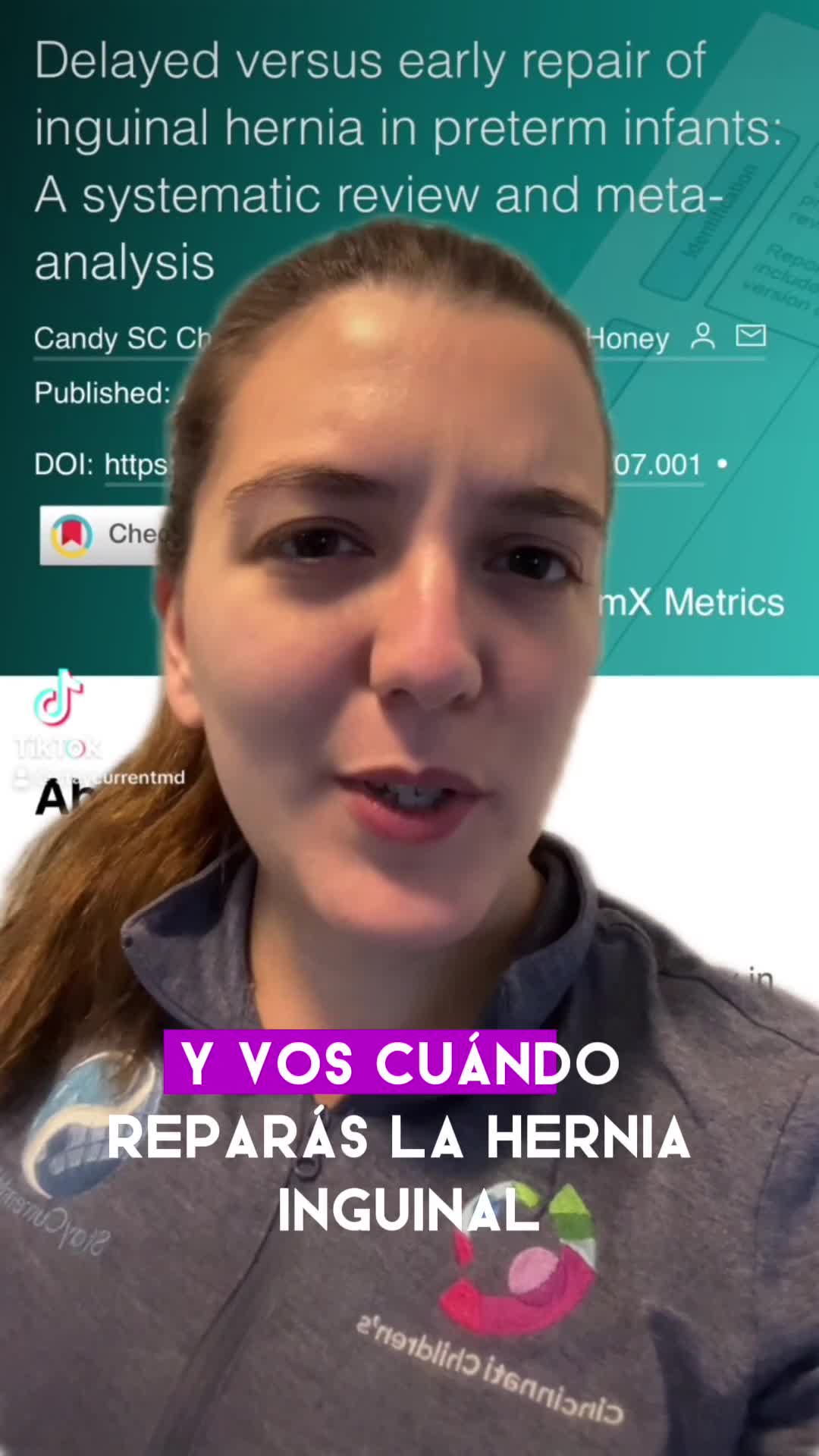
Reparación tardía versus temprana de la hernia inguinal en bebés prematuros
Published Nov 2023
Video
BOB Ped Surg 2023 - Jason Fraser, APSA - Presentation
Published Feb 2023
Video
Delayed versus early repair of inguinal hernia in preterm infants
43 s · Published Nov 2023
Video
Surgeon annual volume impacts recurrence rates of pediatric inguinal hernia repairs: A multi-institutional study
54 s · Published Feb 2026
Video
PAPS -Perioperative Opioid Use In Paediatric Inguinal Hernia Patients- A Systematic Review And Retrospective Audit Of Practice - Isabel Hageman
11 min · Published May 2022
Video
Best of the Best Gen Surg - Predictors of Low and High Opioid Tablet Consumption after Inguinal Hernia Repair – an ACHQC Opioid Reduction Task Force Analysis - Dr. Warren
11 min · Published Sep 2022
Podcast
Surgical Decision-Making in Necrotizing Enterocolitis: Imaging, Timing, and Operative Strategies
11 min · Published Nov 2026
Video
AI applications in pediatric surgery and clinical transformation with Dr. Todd Ponsky
Dr. Todd Ponsky · 7 min · Published Oct 2026
Podcast
The Future of Surgical Education: A King, an Ox, & Elon Musk
Todd Ponsky · 26 min · Published Oct 2026
Podcast
Unconscious Bias
Todd Ponsky · 58 min · Published Oct 2026
Video
Storycasts in Pediatric Surgery: Interactive Storytelling to Transform Clinical Education
Todd Ponsky · Published Oct 2026
Podcast
Necrotizing Enterocolitis
Todd Ponsky · 46 min · Published Oct 2026
Podcast
Diaphragm pacing as alternative to mechanical ventilation in pediatric respiratory failure
1 min · Published Nov 2026
Podcast
Fetoscopic endoluminal tracheal occlusion for congenital diaphragmatic hernia
4 min · Published Nov 2026
Podcast
FETO procedure for late-diagnosed severe CDH with liver herniation
4 min · Published Nov 2026
Podcast
Severe CDH case with FETO: unexpected anatomic findings and clinical outcome
3 min · Published Nov 2026
Podcast
Pediatric pancreatitis: diagnosis, causes, and genetic insights with Dr. Juan Gurria
3 min · Published Nov 2026
Podcast
Understanding craniosynostosis: skull sutures, growth patterns, and diagnosis in infants
10 min · Published Nov 2026
What the experts said
Preterm infants with inguinal hernia have a very high rate of incarceration
The younger the baby, the higher the risk of incarceration in inguinal hernia
In the JAMA trial of 308 preterm infants, 44 patients (28%) in the early repair group had at least one serious adverse event versus 27 patients (18%) in the late repair group
Recurrence rate after inguinal hernia repair in the trial was less than 1%
Incarceration rate in the late repair group was around 4%
In the early repair group, 4% of hernias resolved spontaneously; in the late repair group, 11% resolved spontaneously
One patient in the trial had a bowel injury during hernia repair
There was zero incidence of bowel loss in the trial
The trial showed more reintubations and more apnea in the early repair group
The JAMA trial was terminated early, had low recruitment rate, and ended up with less statistical power than initially calculated
In the Dutch one-stop surgery study of 91 patients (54 one-stop, 37 usual care), all but one of the one-stop surgery patients were discharged home on the day of surgery
Post-operative complication and recurrence rates did not differ between one-stop surgery and usual care patients in the Dutch study
General satisfaction and inclusion of family were higher after one-stop surgery experience
There was no diagnostic uncertainty in the one-stop surgery program
A recent Surgery journal article found that routine post-operative visits alter management in less than 1% of cases for routine pediatric surgical conditions including circumcision, orchiopexy, and inguinal hernia
When facing medical problems with low risk of complications, family satisfaction becomes a surrogate for quality
In the multi-institutional patent processus vaginalis study, 246 eligible infants under 4 months with PPV found at pyloromyotomy were enrolled at 8 children's hospitals, with 85% responding to at least one annual follow-up
Of the 246 infants with patent processus vaginalis, two had inguinal hernia repair for symptomatic hernia, one had orchiopexy and incidental inguinal hernia repair, for a total of 3 hernia repairs
The presence of patent processus vaginalis at the time of pyloromyotomy was common, but the need for hernia repair was around 1% in the first year of follow-up
A Mayo Clinic study by Ben Zendejas showed contralateral hernia occurrence after a 50-year follow-up period