


From
StayCurrentMD
Case-Based Journal Review: Congenital Diaphragmatic Hernia 2023
With Dr. Fernando Bullettin · hosted by Dr. Cecilia Gigena & Dr. Jose Campos & Dr. Todd Ponsky
Chapter 2 of 6 · Evidence & Research
ECMO repair timing
Timing of CDH repair in ECMO patients: early on-ECMO versus post-decannulation
Cued at 5:18 · stops at 5:39 · press play
Expert statements on this page
No expert statements were drawn from this page.
Host summaries · secondary, not cited in answers
Educational content from recorded physician discussions — not medical advice. Talk to your (or your child's) care team about your situation.
Video
Severe Congenital Diaphragmatic Hernia (CDH) Case: FETO Management & Unexpected Findings with Dr. Beth Rymeski
3 min · Published Sep 2026
Podcast
Timing and anticoagulation strategies for CDH repair on ECMO
4 min · Published Nov 2026
Video
BOB Ped Surg 2023 - Shelby Sferra, AAP - Presentation
5 min · Published Feb 2023
Video
BOB in Ped Surg 2023 - AAP Winner - Shelby Sferra, MD
11 min · Published Feb 2023
Video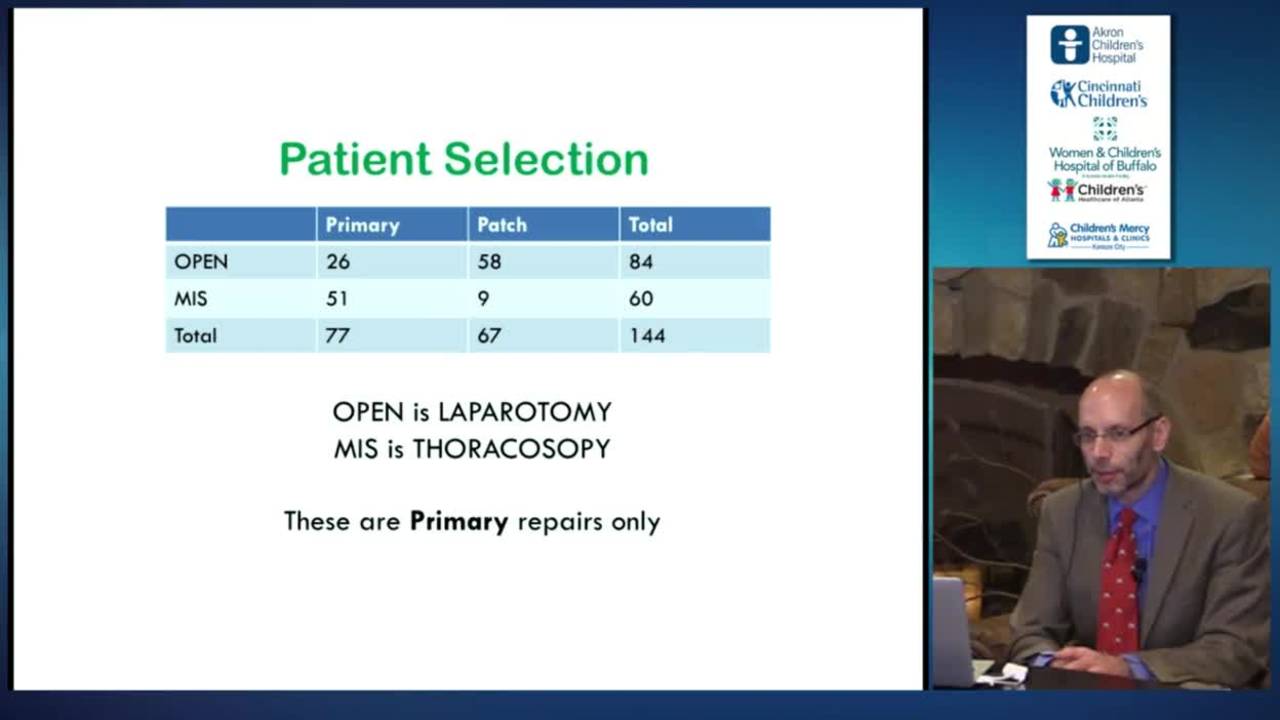
CDH - MIS vs. Open: Update Course 2015
5 min · Published Nov 2015
Video
Quick Literature Updates Episode 4
Published Apr 2023
Podcast
Diaphragm pacing as alternative to mechanical ventilation in pediatric respiratory failure
1 min · Published Nov 2026
Podcast
Fetoscopic endoluminal tracheal occlusion for congenital diaphragmatic hernia
4 min · Published Nov 2026
Podcast
FETO procedure for late-diagnosed severe CDH with liver herniation
4 min · Published Nov 2026
Podcast
Severe CDH case with FETO: unexpected anatomic findings and clinical outcome
3 min · Published Nov 2026
Podcast
Pediatric pancreatitis: diagnosis, causes, and genetic insights with Dr. Juan Gurria
3 min · Published Nov 2026
Podcast
Understanding craniosynostosis: skull sutures, growth patterns, and diagnosis in infants
10 min · Published Nov 2026
What the experts said
Some FETO patients still required ECMO, but some avoided ECMO due to the fetal intervention
Centers with high CDH volume doing ECMO achieve survival of almost 50% or more in severe CDH
Not all centers in the European FETO trials used ECMO, which may affect the apparent benefit of FETO
In Europe, some maternal-fetal medicine centers perform FETO but then transfer patients to other centers for delivery and neonatal care
In Chile during training, the protocol was to place babies on ECMO as a 'trial for life,' then decannulate and perform repair if the baby survived
A protocol of very early repair (8-10 hours after ECMO cannulation at 6-8 hours of life) has been implemented, though the speaker's feeling is it may not be doing better
At least 4 reports confirm the data favoring early on-ECMO repair, representing a practice change
Thoracoscopic CDH repair is performed if the baby can go to the operating room, unless a patch is needed or the baby is too sick, in which case open repair in the NICU is preferred
Most commonly open approach is used; thoracoscopy is reserved for babies who don't need oxygen in the NICU, and conversion to open occurs if a patch is needed
Prolonged operative time required for thoracoscopic repair in babies requiring inotropes or special ventilation (increasing CO2, decreasing pH) is not good for the patient
Possible explanations for higher thoracoscopic recurrence include: insufficient scar formation, inadequate diaphragm unfurling, taking bites at the same level creating a muscle bundle that pulls away, or insufficient number of sutures
Choice between muscle flap and mesh depends on the defect characteristics; mesh is usually used, but flap is chosen if there is good lift of diaphragm posteriorly
A lower transverse incision (rather than subcostal) allows intraoperative decision-making between flap and mesh based on defect size, making mesh repair slightly more difficult but not impossible
Biologic patches should never be used by themselves as they are not designed to be a bridge; they can be used to reinforce a synthetic patch on top
Skeletal deformity is part of the CDH disease itself, making it unclear whether chest deformity is due to the patch or the underlying condition
Synthetic patches pulling on ribs causing chest deformity makes sense in type A-D defects, but these defects are very rare
Fundoplication is performed in type D defect patients who are on ECMO
In the speaker's experience with type D ECMO patients receiving fundoplication, no subsequent surgery for reflux has been needed, representing definitive repair of both CDH and fundoplication
FETO (fetal endoscopic tracheal occlusion) shows higher general survival in severe CDH compared to no FETO, based on 4 randomized controlled trials with 341 patients total
For severe CDH, referral to a center that performs FETO should be considered to evaluate if it would increase the baby's chance of survival
For on-ECMO CDH repair, anticoagulation is managed by decreasing heparin and using Amicar before, during, and after surgery
Boston Children's Hospital retrospective study found on-ECMO repair group had lower mortality rate, lower hazard ratio, and lower incidence of non-repair compared to after-ECMO repair
Early repair on ECMO was associated with lower mortality rate, hazard ratio, and lower incidence of non-repair compared to late repair on ECMO
2014 Canadian meta-analysis found MIS approach has higher rates of recurrence (especially with patch) and longer operative time compared to open repair
Open repair was associated with more postoperative ventilator time and higher mortality rates in the meta-analysis
University of Colorado retrospective study (52 patients, 2008-2018) found patients with flap repair have lower risk of recurrence compared to patch repair
Lower recurrence with flap repair might be due to the flap's ability to grow over time with the child
UK systematic review and meta-analysis (986 patients: 226 biological, 760 synthetic) found biological patches had 30.3% recurrence rate versus 16.7% for synthetic patches
Biological patches had adhesion rates of 7-35% and synthetic patches 4-29% in the UK meta-analysis
Synthetic patches were associated with 80% chest wall deformity rate in the UK meta-analysis
The UK meta-analysis had heterogeneity due to different synthetic meshes, different biological meshes, and different fixation techniques that were not accounted for
French prospective cohort study (762 CDH neonates, 81 underwent fundoplication) found preventive fundoplication during patch repair does not decrease the need for curative fundoplication and is associated with adverse GI outcomes
The decision to perform fundoplication at time of CDH repair is based on knowing from the defect type that fundoplication will eventually be needed in a baby who just had very difficult surgery
Prophylactic fundoplication was associated with 81% failure-to-thrive rate versus 51% without fundoplication in the French study