


Chapter 4 of 5 · Evidence & Research
Bile acid pools
Bile acid pool analysis and mechanistic insights
Cued at 8:00 · stops at 9:02 · press play
Expert statements on this page
No expert statements were drawn from this page.
Host summaries · secondary, not cited in answers
Educational content from recorded physician discussions — not medical advice. Talk to your (or your child's) care team about your situation.
Podcast
Intestinal Rehabilitation, Episode 3: Enteral Autonomy, Part 1
16 min · Published Mar 2022
Podcast
Intestinal Failure with Dr. Brad Warner
52 min · Published May 2017
Podcast
Biliary Atresia, Appendicitis, Intestinal Failure, and Anesthetic...
44 min · Published May 2017
Video
Intestinal Rehabilitation, Episode 4: Surgical Management, Part 1
CCHMC Pediatric Surgery · 19 min · Published Oct 2022
Video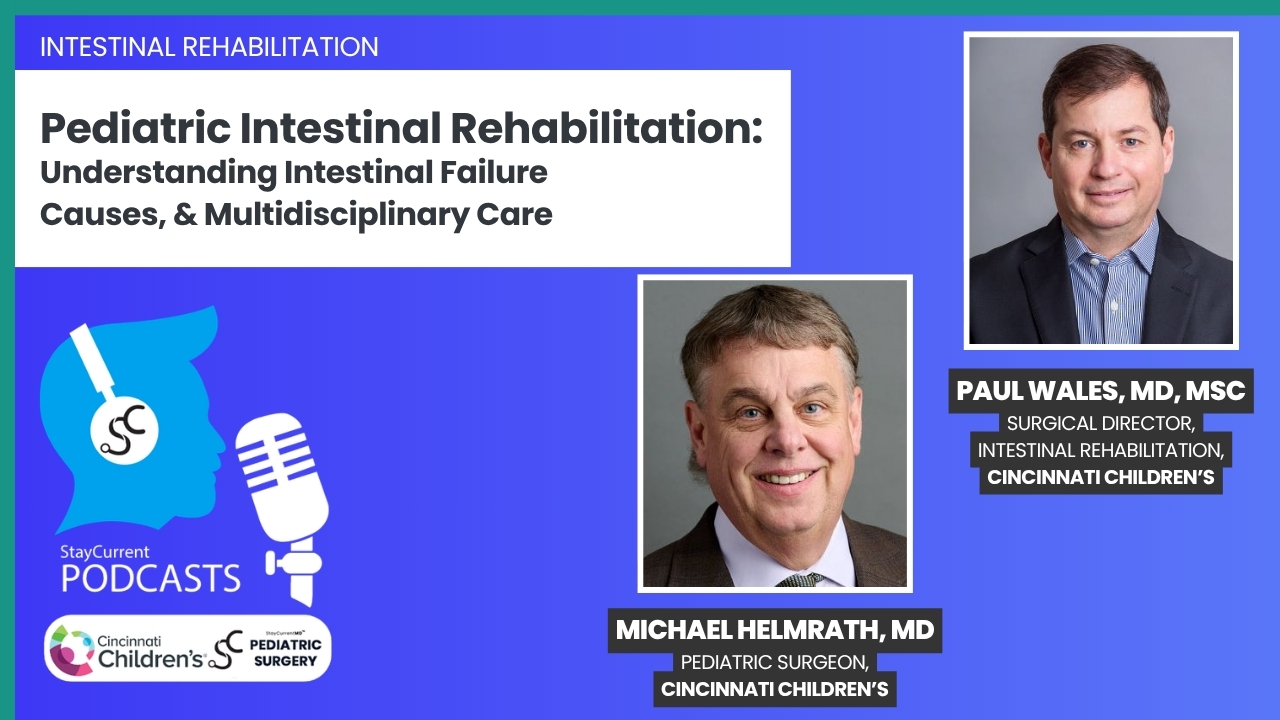
Pediatric Intestinal Rehabilitation: Understanding Intestinal Failure, Causes, & Multidisciplinary Care
12 min · Published Nov 2026
Video
Intestinal Failure - Feeding Access and Nutrition
118 min · Published Nov 2018
Video
Clinical & Research Update: Renal Tumors with Drs. Ethan Smith, Lindsay Haacker, Michael Daugherty, and Meera Kotagal
71 min · Published Sep 2026
Video
Clinical & Research Update: Neuroblastoma with Drs. Katherine Somers, Cara Morin, Juan Gurria, and Meera Kotagal
67 min · Published Sep 2026
Video
Clinical & Research Update: Sarcoma w/ Drs. Roshni Dasgupta, Joseph Pressey, Arthur Meyer, Luke Pater
66 min · Published Sep 2026
Video
2026 Laparoscopic Pediatric Hernia Repair
123 min · Published Jun 2026
Video
Beyond the Spectrum: Diagnosis, Myths & Management - Caitlin Couch & Leslie Lopez - APP Conference 2026
50 min · Published May 2026
Video
Dysautonomia: Navigating the Journey - Martha Willis - APP Conference 2026
55 min · Published May 2026
What the experts said
Short gut syndrome patients face a 25% mortality within two years.
Approximately 25% of short gut syndrome survivors go on to have intestinal transplantation.
Less than 50% of short gut syndrome survivors ever regain enteral autonomy.
TPN is a significant contributor to liver injury in short gut syndrome.
In a murine small bowel resection model without TPN, intestinal loss alone is sufficient to mount oxidative stress that results in liver fibrosis.
In mice, serum evidence of liver injury was found as early as post-operative week two in proximal resection mice and persisted to post-operative week 10.
Liver injury was only found in proximal resection mice, not in distal resection mice.
Liver fibrosis measured by Sirius red staining and collagen 1A1 expression were present at higher levels in proximal resection mice, with distal resection showing liver protection.
Inflammatory markers of oxidative stress (tumor necrosis factor alpha, NADPH oxidase, and glutathione synthetase) were all increased in the proximal resection group compared to sham and distal resection.
The proximal resection group had a compensatory increase in lipocalin 2, an acute phase protein known to increase against oxidative stress.
Removal of the ileum decreased the size of the bile acid pools.
Distal resection resulted in decreased taurolithocholic acid (TLCA), the most toxic, insoluble, hydrophobic bile acid.
Distal resection resulted in increased tauro-ursodeoxycholic acid (TUDCA), the most soluble hydrophilic bile acid.
Proximal resection bile acid profile was the exact opposite of distal resection (increased TLCA, decreased TUDCA).
CYP7A1, the rate limiting step of de novo bile acid synthesis in the liver, was increased in the distal resection group.
TUDCA acts as an endogenous antioxidant and cellular chaperone.
TUDCA supplementation in proximal resection mice resulted in significantly less oxidative stress.
The compensatory increase in lipocalin 2 previously observed in proximal resection was absent with TUDCA supplementation.
Liver fibrosis measured by Sirius red staining was rescued by TUDCA supplementation.
TUDCA supplementation rescued the bile acid profile to a healthier milieu in proximal resection mice.
The liver injury in proximal small bowel resection is likely the result of direct liver exposure to oxidative stress and toxic bile acids via enterohepatic circulation.
Removing the ileum where bile acid absorption occurs shields the liver from inflammation and stimulates healthy new bile acid production.