32 views 0 likes

Live Event Content

GCMD Space · View profile →

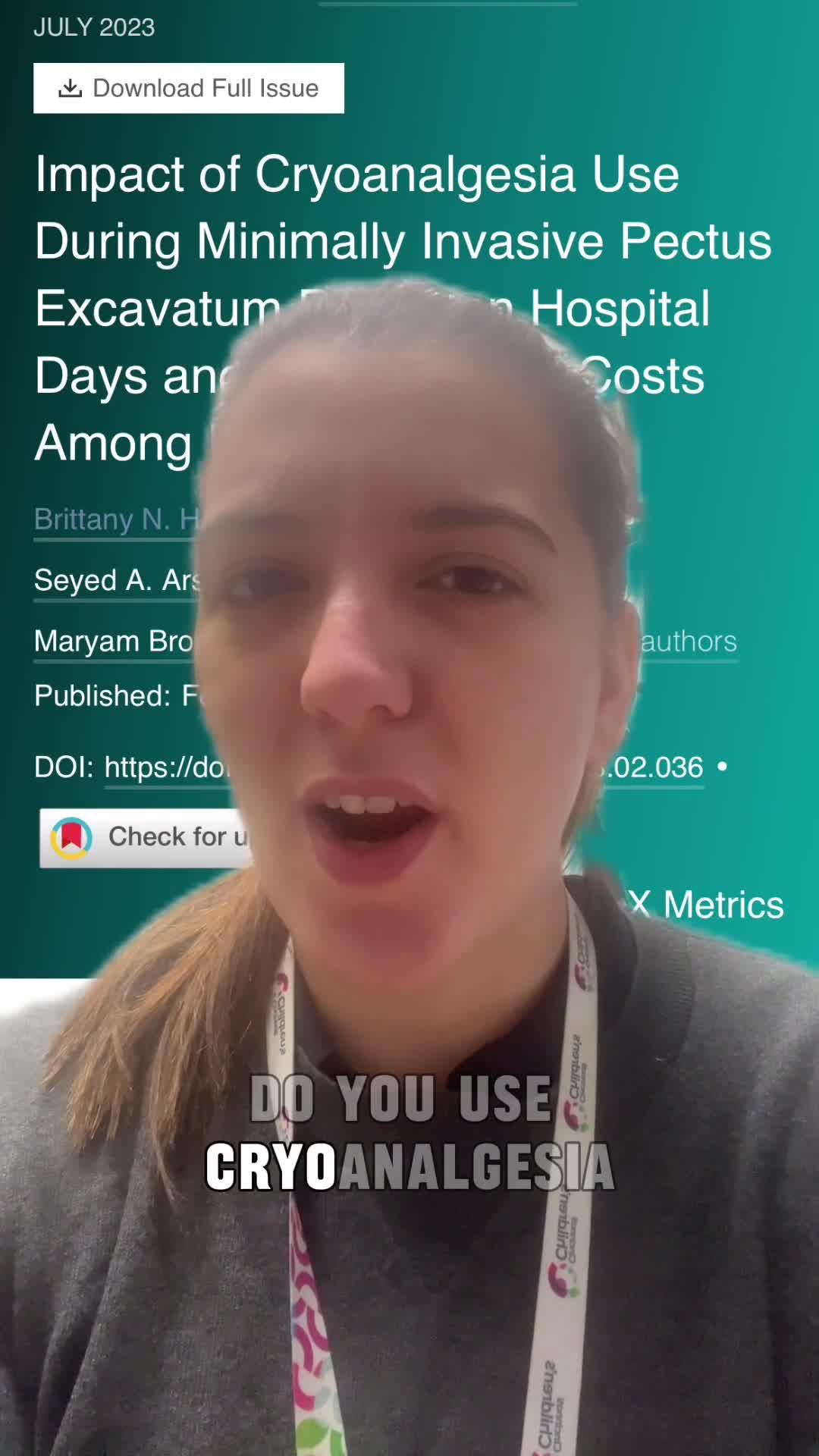
BOB Ped Surg 2023 - Brittany Hegde, PAPS - Presentation

Video Published 2023-02-06 Updated 2026-08-01

Timestops (10)

Topic Overview

A retrospective pre-post study of 44 pediatric patients undergoing minimally invasive repair of pectus excavatum (MIRPE) at a single institution between 2011 and 2021, comparing outcomes before and after the introduction of cryoanalgesia in November 2016. The study found that cryoablation of intercostal nerves was associated with an 89% probability of reducing total hospital costs by $880, a 100% probability of reducing index hospital days, and a 99% probability of reducing total hospital days including readmissions, with a 70% probability of reducing post-operative complications. The presenter concludes that larger multicenter studies are needed to validate these findings.

Key Takeaways

  • Cryoablation of intercostal nerves during MIRPE reduced index hospital stay with 100% probability in this 44-patient cohort. (5:00)
  • Cryo use showed 89% probability of reducing total hospital costs by $880, likely driven by shorter length of stay. (5:00)
  • Cryoablation demonstrated 70% probability of reducing post-op complications with no increase in adverse events vs. no cryo. (6:00)
  • Thoracoscopic cryoablation targets intercostal nerves bilaterally in spaces 3-7, providing weeks to months of pain control. (1:00)

Inside this episode

Kai, the Library's AI content creator, listened to this episode and mapped who's speaking, the chapters, key claims, and cases. Every item links to the exact moment in the recording.

AI-enriched

Who's speaking

  • Britney Hegdy — guest

Chapters

  • 0:00Introduction and Background — Introduction of presenter and overview of minimally invasive repair of pectus excavatum (MIRPE) as treatment for the most common pediatric thoracic anomaly, noting historical pain management challenges.
  • 1:00Cryoablation Technique and Study Rationale — Description of thoracoscopic cryoablation technique targeting intercostal nerves bilaterally in spaces 3-7, with explanation of mechanism and duration of pain control. Study aims to evaluate impact on hospital costs, length of stay, and complications.
  • 3:00Methods and Patient Demographics — Retrospective pre-post study design from 2011-2021 with cryo introduction in November 2016. Description of 44 patients divided by treatment group, with similar baseline demographics between groups.
  • 5:00Results and Conclusions — Bayesian analysis results showing cost reduction, decreased hospital days, and no increase in complications with cryo use. Acknowledgment of single-center limitations and call for multicenter validation.

Key claims

  • 0:00Minimally invasive repair of pectus excavatum is used to correct the most common thoracic anomaly in pediatric patients — Britney Hegdy
  • 0:00Minimally invasive approach has been associated with decreased operative time, less blood loss and a quicker return to baseline compared to previous open approaches — Britney Hegdy
  • 0:00MIRPE remains a painful procedure that historically required multiple adjuncts and a large amount of narcotics to achieve pain relief — Britney Hegdy
  • 0:00A previous study at the institution found the use of cryo during minimally invasive repair lowered post-operative opioid use and hospital length of stay without increasing complications — Britney Hegdy
  • 1:00Cryoablation is performed thoracoscopically using cryo nerve block probes under direct visualization — Britney Hegdy
  • 1:00Probes are inserted via thoracoscopic port sites and activated at the site of intercostal nerves, usually bilaterally and within intercostal spaces three through seven — Britney Hegdy
  • 1:00Cryo ablation subjects the intercostal nerves to extreme cold and is estimated to allow for pain control lasting weeks to months post ablation — Britney Hegdy
  • 3:00Study included pediatric patients less than 18 from January 2011 to December 2021 who underwent minimally invasive repair — Britney Hegdy
  • 3:00Cryo was introduced at the institution in November 2016 and every patient treated after this date received it — Britney Hegdy
  • 4:00Of the 44 patients included, 29 (65.9%) received cryo during minimally invasive repair — Britney Hegdy
  • 4:00A greater percentage in both treatment groups were male — Britney Hegdy
  • 4:00Both treatment groups were similar regarding age, height, weight, insurance status, race, symptoms at presentation and Haller index — Britney Hegdy
  • 5:00Bayesian models were used to analyze the impact of cryo on various outcomes utilizing a neutral prior assuming no treatment effect — Britney Hegdy
  • 5:00Cryo use was associated with an 89% probability of total hospital cost reduction compared to no cryo use with a difference in total cost of $880 — Britney Hegdy
  • 5:00The decrease in total cost is likely attributable to the impact of cryo use on hospital days — Britney Hegdy
  • 5:00Cryo use was associated with a 100% probability of reduction in index hospital days compared to no cryo use — Britney Hegdy
  • 5:00When comparing total hospital days including readmissions during 90 days, there was a 99% probability of total hospital days reduction with the use of cryo — Britney Hegdy
  • 6:00The incidence of post-operative complications did not differ between treatment groups — Britney Hegdy
  • 6:00Cryo use was associated with a 70% probability of reduction in post-operative complications compared to no cryo use — Britney Hegdy
  • 3:00Total hospital cost data was adjusted for inflation by the consumer price index for medical services — Britney Hegdy

Open questions

  • What are the long-term outcomes of cryoablation beyond 90 days post-operatively?
  • Can these single-center findings be replicated in multicenter studies with larger sample sizes?
  • What is the optimal technique and anatomic targets for cryoablation in MIRPE?
This episode was analyzed and enriched by Kai, the Library's AI content creator. Every item links to the moment it comes from — click a timestamp to listen in context.
Written for:

Intercostal Nerve Cryoablation for Pectus Excavatum Repair: A Cost and Recovery Analysis

The episode's main topic retold as a plain-language walkthrough — what it is, why it matters, and what the speakers concluded. Written by Kai from the episode transcript and reviewed before publishing.

For the care team · Explainer · AI-written, human-reviewed

Why This Exists

Pectus excavatum is the most common thoracic wall anomaly in pediatric patients 0:00. The minimally invasive repair — MIRPE, or the Nuss procedure — replaced open approaches two decades ago and brought real advantages: shorter operative time, less blood loss, faster return to baseline 0:00. But it remains an intensely painful operation 0:00. A metal bar is tunneled beneath the sternum and left in place for years. Historically, controlling that pain required epidurals, patient-controlled analgesia pumps, scheduled IV narcotics, and multiday admissions with all the cost and risk that entails 0:00. Cryoablation of the intercostal nerves emerged as an alternative: freeze the nerves intraoperatively, achieve weeks to months of analgesia, and potentially send patients home sooner with less opioid exposure 1:00.

The Core Clinical Problem

The bar placement itself — elevating the sternum, remodeling the anterior chest wall — generates severe postoperative pain that peaks in the first days and can persist for weeks 0:00. Traditional multimodal analgesia works but carries trade-offs: epidurals require monitoring and can fail or migrate; IV narcotics bring nausea, ileus, and respiratory depression; prolonged hospitalization increases infection risk and cost 0:00. The question is whether a single intraoperative nerve ablation can replace or substantially reduce all of that 0:00.

How Cryoablation Works in This Context

The technique is thoracoscopic 1:00. After placing the pectus bar, the surgeon inserts cryoprobes through the existing port sites and applies them directly to the intercostal nerves under visualization, typically bilaterally in the third through seventh intercostal spaces 1:00. The probe subjects the nerve to extreme cold, inducing Wallerian degeneration without disrupting the nerve sheath — meaning the nerve will eventually regenerate, but analgesia is estimated to last weeks to months 1:00. It is a reversible nerve block with a duration far exceeding any local anesthetic 1:00.

The appeal is straightforward: one intervention, performed while the patient is already under anesthesia, that may eliminate the need for epidural placement, reduce opioid consumption, and shorten hospital stay 0:00. The risk profile appears favorable — the nerves regenerate, the technique is performed under direct vision, and early reports suggested no increase in complications 0:00.

What This Study Found

This is a single-center retrospective analysis from a pediatric institution that adopted cryoablation in November 2016 3:00. They compared 44 patients: those treated before cryo was available and those treated afterward 4:00. The groups were well-matched for age, weight, insurance status, race, presenting symptoms, and Haller index 4:00. All patients after November 2016 received cryoablation; none before that date did, creating a clean pre-post comparison 3:00 4:00.

The analysis used Bayesian models with a neutral prior — meaning they started from the assumption of no treatment effect and let the data shift the probability 5:00. Cryo use was associated with an 89% probability of reducing total hospital costs, with a mean difference of $880 5:00. That cost reduction likely came from shorter admissions: there was a 100% probability of reduced length of stay during the index hospitalization 5:00, and a 99% probability of reduced total hospital days when readmissions within 90 days were included 5:00. Complication rates did not differ between groups 6:00, and the Bayesian model suggested a 70% probability that cryoablation actually reduced complications 6:00.

The cost figure accounts for the additional equipment required to perform cryoablation 5:00, meaning the savings are net of the intervention cost. The mechanism is not mysterious: patients go home faster, use fewer nursing hours, require less pharmacy support, and avoid the monitoring overhead of epidurals or PCA pumps 5:00.

Where Uncertainty Remains

This is a 44-patient series from one institution 4:00. The pre-post design is clean, but it cannot control for secular trends — changes in anesthesia practice, nursing protocols, or discharge criteria that may have occurred independently over the same decade 2:00. The study does not report opioid consumption, pain scores, or patient-reported outcomes, so we know patients left the hospital sooner but not precisely why. The long-term sensory outcomes of intercostal cryoablation in adolescents are not well characterized 1:00. Nerve regeneration is expected, but the timeline and completeness of recovery are not tracked here.

The findings are consistent with prior work from the same group showing reduced opioid use and shorter stays 0:00, but external validation is absent. The authors appropriately call for multicenter studies 2:00.

When to Consider This Approach

For pediatric surgeons performing pectus repair, cryoablation is now a standard option at many centers 0:00. The technique requires thoracoscopic skill and the appropriate equipment, but it is performed during an operation that already uses thoracoscopy for bar placement 1:00. The decision is made preoperatively, not at the bedside.

For referring clinicians, this does not change the indications for pectus repair itself — those remain based on Haller index, cardiopulmonary symptoms, and patient preference 0:00. But it does mean that the postoperative course may be shorter and less opioid-intensive than it was a decade ago 5:00 5:00, which is worth discussing with families during preoperative counseling. If a patient is being evaluated for repair, ask the surgical team whether they use cryoablation and what their typical length of stay is. The answer will vary by center, but the trajectory is toward shorter admissions and less reliance on neuraxial analgesia 0:00 5:00.

Takeaways from this story

  • Cryoablation of intercostal nerves during pectus repair may reduce hospital costs by $880 and shorten length of stay without increasing complications.
  • The technique involves thoracoscopic freezing of nerves in the 3rd-7th intercostal spaces bilaterally, providing weeks to months of analgesia.
  • This single-center study used Bayesian analysis showing 100% probability of reduced index admission length and 99% probability of reduced total hospital days.
  • Multicenter validation is needed; this 44-patient series cannot control for secular trends in perioperative care over the study decade.

Keywords

Hashtags

Transcript

Comments

Loading comments…