11 views 0 likes

StayCurrentMD

GCMD Space · View profile →

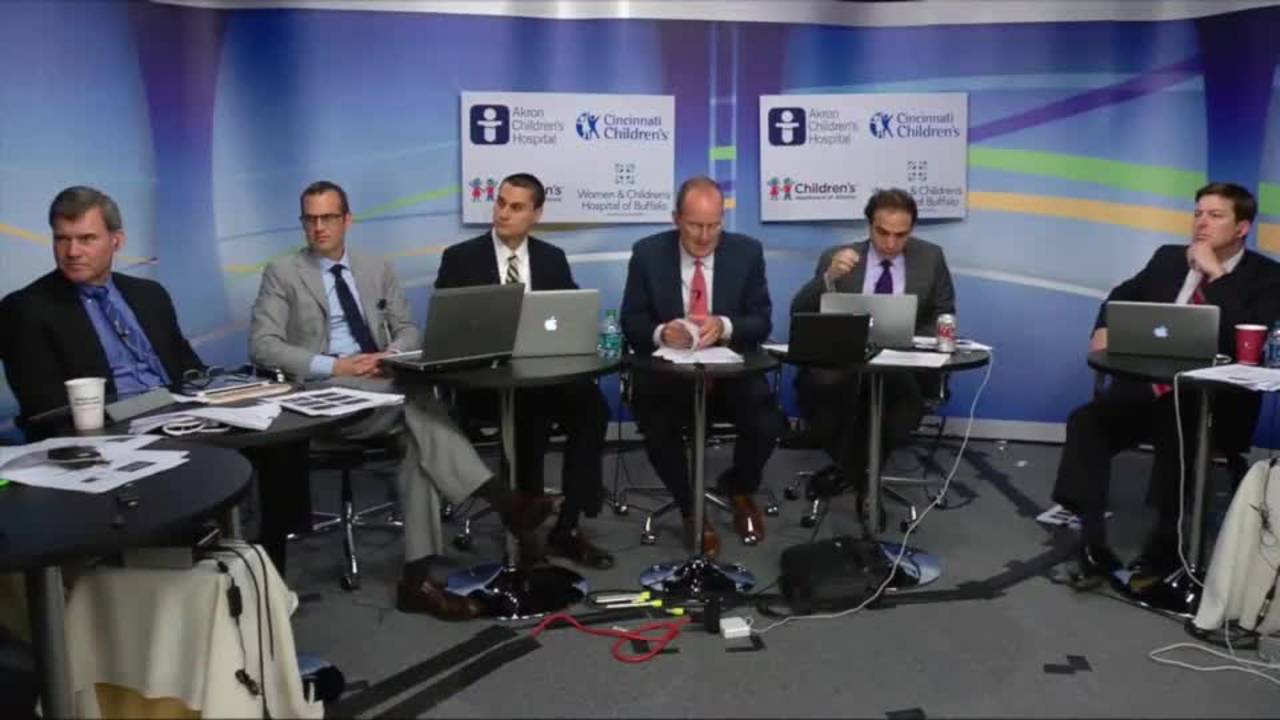
Biliary Atresia - Robert Parry: Update Course 2014

Video Published 2018-11-10 Updated 2026-08-01

Timestops (5)

Topic Overview

A panel discussion on biliary atresia management focusing on optimal timing for Kasai portoenterostomy. The discussants examine whether age at operation or duration of symptoms better predicts outcomes, with French registry data showing significantly better 5- and 10-year native liver survival when surgery is performed before 30 days versus after 90 days. The group debates the role of preoperative liver biopsy, the utility of phenobarbital-enhanced HIDA scans given their time cost, and whether severe portal hypertension or advanced fibrosis should preclude Kasai in favor of direct transplant listing. Technical refinements from Japanese centers—wider dissection planes, superficial suturing to preserve ductules, and avoidance of sutures at the 10 and 3 o'clock positions—are presented as potentially improving drainage outcomes.

Key Takeaways

  • Kasai before 30 days doubles 5- and 10-year native liver survival vs. surgery after 90 days (French registry data). (2:32)
  • Degree of cirrhosis at surgery predicts outcome better than age alone; reversed portal flow is ominous even with good drainage. (3:24)
  • End-stage fibrosis with reversed flow may warrant direct transplant listing; Kasai stress may harm without benefit. (10:56)
  • Japanese technique refinements: wider dissection, superficial sutures to preserve ductules, avoid 10 and 3 o'clock positions. (22:15)
  • Liver biopsy in a scoring system predicts biliary atresia with near 100% accuracy; pathologist expertise has improved markedly. (17:34)

Inside this episode

Kai, the Library's AI content creator, listened to this episode and mapped who's speaking, the chapters, key claims, and cases. Every item links to the exact moment in the recording.

AI-enriched

Who's speaking

  • Robert Parry — guest
  • Speaker 2 — host
  • Speaker 3 — guest

Chapters

  • 0:00Case presentation and optimal age for Kasai — 10-week-old boy with jaundice, cholestasis, acholic stools, and non-visualized gallbladder. Discussion of optimal surgical timing, with French registry data showing age-stratified survival differences.
  • 4:56Age versus symptom duration debate — Panel debates whether chronologic age or duration of jaundice/acholic stools better predicts outcomes. Discussants note most biliary atresia patients are symptomatic from the first week of life, making symptom duration difficult to isolate from age.
  • 9:11Upper age limit and contraindications to Kasai — Discussion of whether any age is too late for Kasai. Reversal of portal flow and advanced fibrosis raised as potential contraindications. Debate over whether Kasai can 'buy time' for transplant even in advanced disease versus whether hepatologists can manage medically to expand donor pool.
  • 13:11Diagnostic workup: HIDA, biopsy, and cholangiography — Panel reviews phenobarbital-enhanced HIDA scans (high sensitivity but 5+ day time cost), percutaneous liver biopsy (now routine, high accuracy when combined with clinical parameters), and percutaneous cholangiography (rarely successful in true biliary atresia due to obliterated gallbladder).
  • 19:33Postoperative steroids and Japanese technical refinements — Brief discussion of postoperative steroids (studied, not routinely recommended, but still used in Japan). Japanese centers report improved outcomes with wider dissection, superficial suturing to preserve ductules, and avoiding sutures at 10 and 3 o'clock positions where bile ducts bifurcate.

Key claims

  • 2:32French registry data show children who had Kasai at less than 1 month of age have nearly twice the 5- and 10-year native liver survival rate compared to those operated after 90 days — Robert Parry
  • 1:03In the Michigan series, children operated on after 3 months had the best drainage and long-term outcomes — Speaker 3
  • 3:24The critical factor determining outcome is the degree of cirrhosis developed in the liver at the time of surgery, which does not always correlate directly with age — Speaker 3
  • 4:03Rich Ricketts' series showed not statistically significant better results with Kasai performed at 76 days or older versus 0-75 days — Speaker 2
  • 5:12In most biliary atresia cases, jaundice and acholic stools are present from the first week of life — Speaker 3
  • 5:57Peter Altman from Columbia, who had the largest US series, argued that Kasai should be performed between 60 and 75 days — Speaker 3
  • 9:19Reversal of portal flow is a very concerning sign because patients can achieve good biliary drainage and normal bilirubin but still progress to transplant due to profound portal hypertension — Speaker 2
  • 10:56If a patient has signs of end-stage liver disease with profound fibrosis and reversed portal flow, a Kasai may not improve outcomes and the stress of surgery may be harmful — Speaker 2
  • 10:41Hepatologists can manage biliary atresia patients medically for up to a year without Kasai or transplant, though nutritional status suffers — Speaker 2
  • 11:44The Kasai operation itself is not technically demanding and does not carry high technical risk — Speaker 3
  • 12:20Some biliary atresia patients show delayed clearance, with bilirubin remaining elevated for months post-Kasai then dropping to normal at 5 months, suggesting a race between hepatocyte regeneration and fibrosis progression — Speaker 2
  • 15:21HIDA scan with phenobarbital has high sensitivity for biliary atresia, but an effective study requires at least 5 days of phenobarbital at adequate levels — Robert Parry
  • 17:34A recent paper in Gastroenterology showed that liver biopsy combined with other clinical parameters in a scoring system can predict biliary atresia with almost 100% accuracy — Speaker 2
  • 18:04Pathologists' understanding of biliary atresia histology has improved significantly over the past 20 years — Speaker 2
  • 18:41It is rare to have a patent gallbladder in true biliary atresia — Speaker 3
  • 20:44Prenatal ultrasound diagnosis of biliary atresia based on absent gallbladder is unreliable and angle-dependent — Speaker 3
  • 21:32Japanese centers still recommend postoperative steroids either routinely or when drainage decreases — Speaker 3
  • 22:15Japanese surgeons now perform Kasai dissection much wider than Dr. Kasai originally described — Speaker 3
  • 22:39Japanese technique uses more superficial sutures to avoid damaging small ductules and avoids placing sutures at 10 o'clock and 3 o'clock positions where bile ducts normally bifurcate — Speaker 3
  • 23:01Japanese centers claim improved results with their modified technique, though numbers are not yet statistically valid — Speaker 3

Cases discussed

  • 0:0010-week-old boy with failure to thrive, jaundice, acholic stools, cholestasis, mildly elevated INR, hepatomegaly, and non-visualized gallbladder/biliary tree on ultrasound
  • 7:24Longest survivor from 1974 who underwent initial failed exploration at another hospital, then successful redo Kasai after 4 months of age, surviving into late 40s

Points of disagreement

  • 0:33Optimal age cutoff for Kasai procedure
    • Robert Parry: French registry data support earlier surgery (under 30 days) with significantly better outcomes
    • Speaker 3: Michigan series showed best outcomes after 3 months; patient selection bias may explain late successes
    • Speaker 2: Rich Ricketts' data showed better (though not statistically significant) results after 76 days
  • 9:11Whether to perform Kasai in patients with advanced liver disease
    • Speaker 2: Patients with end-stage disease, profound fibrosis, and reversed portal flow should not undergo Kasai; hepatologists can manage them medically until transplant
    • Speaker 3: Even if outcomes are uncertain, Kasai can buy time and increase the donor pool; the operation itself is low-risk
  • 11:44Value of redo Kasai procedures
    • Speaker 3: Redo Kasai is reasonable when uncertain about initial drainage; sometimes achieves flow and prolonged survival
    • Speaker 2: Unclear whether redo surgery improves drainage or if delayed clearance represents natural regeneration overcoming fibrosis
  • 14:36Use of phenobarbital with HIDA scans
    • Speaker 3: If ordering HIDA, should use phenobarbital to increase accuracy
    • Speaker 2: Should not use phenobarbital because it delays surgery by a week, contradicting goal of early operation

Open questions

  • Is chronologic age or degree of hepatic fibrosis the better predictor of Kasai outcomes?
  • Can liver biopsy findings at the time of Kasai reliably predict long-term outcomes?
  • Does redo Kasai surgery improve bile drainage or do delayed clearances represent natural regeneration?
  • What is the true success rate of percutaneous cholangiography in confirmed biliary atresia cases (versus cholestatic patients with patent gallbladders)?
  • Do the Japanese technical modifications (wider dissection, superficial sutures, avoiding 10 and 3 o'clock positions) produce statistically significant outcome improvements?
  • Should postoperative steroids be used routinely, selectively when drainage decreases, or not at all?
This episode was analyzed and enriched by Kai, the Library's AI content creator. Every item links to the moment it comes from — click a timestamp to listen in context.
Written for:

Biliary Atresia: When to Operate and What Determines Success

The episode's main topic retold as a plain-language walkthrough — what it is, why it matters, and what the speakers concluded. Written by Kai from the episode transcript and reviewed before publishing.

For the care team · Explainer · AI-written, human-reviewed

Why This Exists as a Distinct Problem

Biliary atresia is a progressive obliteration of the extrahepatic bile ducts in infants, presenting with jaundice, acholic stools, and cholestasis in the first weeks of life. Without intervention, all affected children progress to cirrhosis and death. The Kasai portoenterostomy — creating a direct anastomosis between the porta hepatis and a Roux limb — remains the only operation that can restore bile drainage and delay or prevent transplantation. The procedure's effectiveness depends critically on timing, but the relationship between age at surgery and outcome has proven more complex than initially believed.

The Core Clinical Problem

The central question is not simply "how early" but "what determines success." French registry data show children operated before 30 days have nearly twice the 5- and 10-year native liver survival compared to those operated after 90 days 2:32. Yet individual series contradict this: the Michigan cohort showed best outcomes in children operated after 3 months 1:03, and Rich Ricketts' series found non-significantly better results at 76 days or older versus 0-75 days 4:03. Peter Altman, who maintained the largest US series, argued for operating between 60 and 75 days 5:57.

The explanation appears to be that chronologic age is a proxy for the true determinant: degree of hepatic fibrosis 3:24. Some infants develop cirrhosis rapidly; others progress more slowly. Most biliary atresia patients are symptomatic from the first week of life 5:12, making it difficult to isolate symptom duration from age as independent variables. The operation itself is not technically demanding 11:44, so the challenge is identifying which livers retain sufficient regenerative capacity to benefit.

How the Approach Works

Diagnostic workup has evolved significantly. Phenobarbital-enhanced HIDA scanning has high sensitivity but requires at least 5 days of adequate phenobarbital levels 15:21 — a delay that conflicts with the imperative for early surgery. Percutaneous liver biopsy, now routine and low-risk, combined with clinical parameters in a scoring system can predict biliary atresia with near-perfect accuracy 17:34. Pathologists' understanding of the histologic features has improved substantially over two decades 18:04. Percutaneous cholangiography is rarely successful in true biliary atresia because the gallbladder is typically obliterated 18:41. Prenatal ultrasound diagnosis based on absent gallbladder is unreliable and angle-dependent 20:44.

The Kasai procedure itself involves wide dissection at the porta hepatis and anastomosis to a Roux limb. Japanese centers have refined the technique beyond Kasai's original description: wider dissection planes 22:15, more superficial suturing to preserve small ductules, and deliberate avoidance of sutures at the 10 and 3 o'clock positions where bile ducts normally bifurcate 22:39. Early data suggest improved outcomes, though numbers are not yet statistically valid 23:01. Postoperative steroids have been studied but are not routinely recommended in Western centers; Japanese centers continue to use them either routinely or when drainage decreases 21:32.

Where Practice Remains Contested

The upper age limit for Kasai is genuinely uncertain. Some patients show delayed clearance, with bilirubin remaining elevated for months then normalizing at 5 months post-operatively, suggesting a race between hepatocyte regeneration and fibrosis progression 12:20. This raises the question of whether "failed" Kasai procedures might eventually succeed without reoperation.

Reversal of portal flow represents a concerning threshold. Patients can achieve good biliary drainage and normal bilirubin yet still progress to transplant due to profound portal hypertension from established fibrotic changes 9:19. If a patient presents with end-stage liver disease, profound fibrosis, and reversed portal flow, the surgical stress may be harmful without improving outcomes 10:56. However, even a temporarily successful Kasai may expand the donor pool by allowing the child to grow, making transplantation technically easier with lower risk of hepatic artery thrombosis. Hepatologists can manage biliary atresia patients medically for up to a year without Kasai or transplant, though nutritional status suffers 10:41.

When to Involve This Team

Any infant with conjugated hyperbilirubinemia and acholic stools requires urgent evaluation. The discussion here suggests that once biliary atresia is suspected on clinical grounds and imaging, biopsy confirmation followed by prompt surgery is the standard approach. The specific age cutoff matters less than the degree of hepatic fibrosis, but because fibrosis correlates imperfectly with age, operating as early as feasible remains the safest strategy. Referral to a center with pediatric hepatology and transplant capability is essential, as even successful Kasai patients require long-term monitoring for progressive liver disease and potential transplantation.

Takeaways from this story

  • Degree of hepatic fibrosis, not chronologic age alone, determines Kasai success — some infants cirrhose rapidly, others slowly.
  • Reversed portal flow predicts poor outcomes even with successful bile drainage, as fibrotic injury progresses independently.
  • Percutaneous biopsy plus clinical scoring now predicts biliary atresia with near-perfect accuracy, reducing diagnostic delay.
  • Japanese technical refinements — wider dissection, superficial sutures, avoiding 10 and 3 o'clock positions — show early promise.
  • Some patients show delayed bilirubin clearance months post-Kasai, suggesting regeneration can eventually overcome fibrosis.

Keywords

Hashtags

Transcript

Comments

Loading comments…