14 views 0 likes

StayCurrentMD

GCMD Space · View profile →

Biliary Atresia-Case Presentation and Panel Discussion: Update Course 2014

Video Published 2019-01-11 Updated 2022-08-22

Timestops (8)

Topic Overview

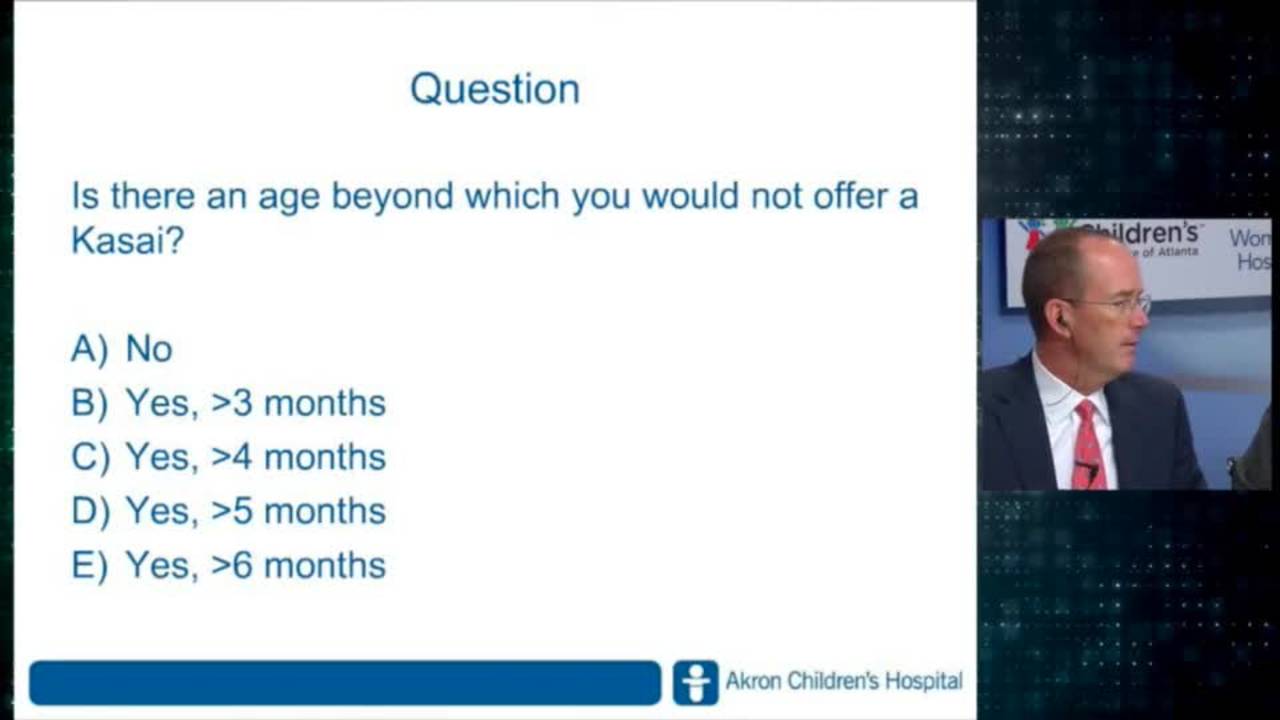
A panel discussion on biliary atresia management centered on a 10-week-old boy with jaundice, failure to thrive, cholestasis, and acholic stools. The core clinical debate focused on optimal timing for Kasai portoenterostomy, with French registry data showing significantly better 5- and 10-year native liver survival when performed before 30 days versus after 90 days. Panelists disagreed on whether chronologic age or degree of hepatic fibrosis is the primary determinant of outcome, with some citing anecdotal late successes (>3-4 months) and others emphasizing that reversal of portal flow and advanced cirrhosis may contraindicate surgery. Additional controversies included the value of phenobarbital-enhanced HIDA scans (high sensitivity but 5+ day delay), routine preoperative liver biopsy (increasingly standard but not universally required), and postoperative steroid use (studied but still practiced in Japan). Technical refinements from Japanese centers—wider porta dissection, superficial suturing to preserve ductules, and avoidance of sutures at 3 and 10 o'clock—were presented as potentially improving drainage.

Key Takeaways

  • Kasai before 30 days yields nearly twice the native liver survival at 5-10 years vs after 90 days per French registry data. (2:44)
  • Degree of cirrhosis, not chronologic age alone, determines Kasai outcome; some patients start disease progression later. (3:24)
  • Reversal of portal flow is a contraindication; patients can drain bile yet progress to transplant from portal hypertension. (9:19)
  • HIDA scan requires ≥5 days therapeutic phenobarbital; inadequate prep yields false negatives in ~33% of BA cases. (15:47)
  • Japanese modified Kasai uses wider porta dissection and avoids sutures at 10/3 o'clock to preserve ductules. (22:15)

Inside this episode

Kai, the Library's AI content creator, listened to this episode and mapped who's speaking, the chapters, key claims, and cases. Every item links to the exact moment in the recording.

AI-enriched

Who's speaking

  • Speaker 1 — host
  • Speaker 2 — guest
  • Speaker 3 — guest
  • Speaker 4 — guest
  • Speaker 5 — guest
  • Speaker 6 — guest

Chapters

  • 0:00Case Presentation and Optimal Timing for Kasai — 10-week-old with jaundice, cholestasis, acholic stools, and non-visualized gallbladder. Discussion of optimal age for Kasai: French data show better survival <30 days vs >90 days, but panelists cite anecdotal late successes and question whether chronologic age or hepatic fibrosis is the true determinant.
  • 7:01Contraindications and Redo Procedures — Debate on when NOT to offer Kasai: reversal of portal flow and advanced fibrosis cited as concerning. Some advocate for attempting Kasai even late to buy time for transplant; others note hepatologists can manage medically. Redo Kasai discussed with mixed opinions on efficacy vs spontaneous improvement.
  • 13:21Diagnostic Workup: HIDA, Phenobarbital, and Liver Biopsy — HIDA with phenobarbital shows high sensitivity but requires 5+ days and therapeutic levels. Percutaneous liver biopsy increasingly standard; recent scoring system combining biopsy with clinical parameters approaches 100% predictive accuracy. Percutaneous cholangiography discussed but rarely successful in true biliary atresia.
  • 18:21Postoperative Steroids and Japanese Technical Refinements — Postoperative steroids studied but still used in Japan. Japanese centers report improved outcomes with wider porta dissection, superficial suturing to preserve ductules, and avoiding sutures at 3 and 10 o'clock positions. Laparoscopic Kasai being evaluated in Japan despite IPEG recommendation against it.

Key claims

  • 2:44French registry data show significantly better 5- and 10-year native liver survival when Kasai performed before 30 days versus after 90 days, with nearly twice the survival rate — Speaker 1
  • 1:03In a Michigan series, children who had Kasai after 3 months had the best drainage and long-term outcomes — Speaker 2
  • 1:50Under 60 days there was a clear difference in outcomes; procedures done on weekends if approaching day 60 — Speaker 2
  • 3:24The critical factor determining outcome is the degree of cirrhosis developed in the liver, which varies among children and does not always correlate directly with age — Speaker 2
  • 3:53Biliary atresia does not start at day zero in all patients; some may begin at day 20 and progress from there — Speaker 4
  • 4:03A series from Rich Ricketts showed not statistically significant better results with Kasai performed at 76 days or older versus 0-75 days — Speaker 5
  • 5:57Peter Altman from Columbia, who had the largest US series, argued Kasai should be done between 60 and 75 days — Speaker 2
  • 9:19Reversal of portal flow is very concerning because patients can achieve good biliary drainage and normal bilirubin but portal hypertension continues to progress, leading to transplant need — Speaker 3
  • 10:05Performing Kasai can buy time and increase the donor pool potential, even if the liver looks horrible — Speaker 2
  • 10:27Transplant becomes technically easier in older children with lower risk of hepatic artery thrombosis — Speaker 3
  • 10:41Hepatologists can manage biliary atresia patients medically for about a year in the absence of Kasai or transplant, though nutritional status is not optimal — Speaker 3
  • 10:56If patients have signs of end-stage liver disease with profound fibrosis and reversal of portal flow, Kasai may not improve outcomes and the operation may stress them unnecessarily — Speaker 3
  • 11:44The Kasai operation itself is not technically demanding with low technical risk, so if uncertain, redo procedures are reasonable — Speaker 2
  • 12:20Some biliary atresia cases show a race between hepatocyte regeneration and fibrosis progression; one patient's bilirubin dropped to normal 5 months post-op — Speaker 3
  • 14:02If liver biopsy is suggestive of biliary atresia, additional testing is not needed — Speaker 2
  • 15:21HIDA scan with phenobarbital has high sensitivity and specificity for biliary atresia — Speaker 1
  • 15:47An effective HIDA requires at least 5 days of phenobarbital at therapeutic levels — Speaker 4
  • 16:40In cases where initial HIDA without adequate phenobarbital was negative, about one-third showed biliary atresia when repeated with proper phenobarbital levels — Speaker 4
  • 17:35A recent paper in Gastroenterology showed a scoring system combining liver biopsy with clinical parameters had almost 100% ability to predict biliary atresia — Speaker 6
  • 18:01Pathologists' understanding of what to look for in biliary atresia biopsies has improved compared to 20 years ago — Speaker 6
  • 18:10Interventional radiologists can perform percutaneous liver biopsies safely and routinely — Speaker 6
  • 18:41Patent gallbladder in true biliary atresia is super rare — Speaker 2
  • 18:59In Milwaukee, percutaneous cholangiography combined with biopsy can quickly provide answers when successful — Speaker 4
  • 19:49If percutaneous cholangiography shows contrast in the gallbladder and bowel, biliary atresia is ruled out without need for surgery — Speaker 4
  • 20:44Prenatal ultrasound diagnosis of biliary atresia based on absent gallbladder is unreliable and angle-dependent — Speaker 2
  • 21:46Japanese centers still recommend steroids either routinely or when drainage decreases after Kasai — Speaker 2
  • 22:15Japanese surgeons now perform Kasai with wider porta dissection than Dr. Kasai originally did — Speaker 2
  • 22:39Japanese technique uses more superficial sutures to avoid damaging ductules and avoids placing sutures at 10 o'clock and 3 o'clock positions where normal bile ducts bifurcate — Speaker 2
  • 23:06Japanese centers claim better results with modified technique, though numbers are not statistically valid — Speaker 2
  • 23:08Yamataka is attempting to show laparoscopic Kasai results are as good as open, contrary to IPEG recommendations — Speaker 2

Cases discussed

  • 0:0210-week-old boy with biliary atresia
  • 7:31Long-term biliary atresia survivor from 1974
  • 12:20Delayed bilirubin clearance case
  • 20:44Prenatal misdiagnosis case

Points of disagreement

  • 0:50Optimal age for Kasai procedure
    • Speaker 1: French data support <30 days for best outcomes
    • Speaker 2: 60-75 days may be optimal; some late cases (>3 months) had best outcomes in Michigan series
    • Speaker 5: 76 days or older showed better (though not statistically significant) results in one series
  • 9:19Whether to perform Kasai in advanced disease
    • Speaker 3: Should not perform Kasai if reversal of portal flow and profound fibrosis present; may stress patient unnecessarily
    • Speaker 2: Should attempt Kasai even with poor-looking liver to buy time for transplant; operation is low-risk
  • 11:44Value of redo Kasai procedures
    • Speaker 2: Redo procedures are reasonable given low technical risk; sometimes achieve good drainage
    • Speaker 3: Uncertain whether redo success is due to the operation or spontaneous improvement from regeneration vs fibrosis balance
  • 14:36Use of phenobarbital with HIDA scan
    • Speaker 2: If ordering HIDA, should use phenobarbital to increase accuracy
    • Speaker 3: Should not use phenobarbital because it delays diagnosis by a week when early surgery is goal
  • 17:20Need for preoperative liver biopsy
    • Speaker 2: Do not need liver biopsy before exploration
    • Speaker 5: Era has changed; everyone now gets preoperative biopsy
    • Speaker 6: Biopsy plus clinical scoring system approaches 100% predictive accuracy

Open questions

  • Is chronologic age or degree of hepatic fibrosis the primary determinant of Kasai outcome?
  • Should Kasai be attempted in patients with reversal of portal flow and advanced fibrosis, or should they proceed directly to transplant listing?
  • Do redo Kasai procedures achieve drainage through surgical intervention or coincide with spontaneous improvement from regeneration?
  • What is the true success rate of percutaneous cholangiography in confirmed biliary atresia cases (vs cholestatic jaundice in general)?
  • Are the Japanese technical modifications to Kasai (wider dissection, superficial sutures, avoiding 3 and 10 o'clock positions) truly superior to traditional technique?
  • Should postoperative steroids be used routinely, selectively when drainage decreases, or not at all?
  • Can laparoscopic Kasai achieve equivalent outcomes to open procedure?
This episode was analyzed and enriched by Kai, the Library's AI content creator. Every item links to the moment it comes from — click a timestamp to listen in context.
Written for:

Keywords

Hashtags

Transcript

Comments

Loading comments…