


From
StayCurrentMD
Biliary Atresia
With Dr. Greg Tiao · hosted by Dr. Todd Ponsky
Part of
Biliary Atresia 26 items
Chapter 6 of 6 · Medical Management
Steroids and Alagille
Postoperative Steroids and Alagille Syndrome
Cued at 18:57 · stops at 19:24 · press play
Expert statements on this page
No expert statements were drawn from this page.
Host summaries · secondary, not cited in answers
Educational content from recorded physician discussions — not medical advice. Talk to your (or your child's) care team about your situation.
Video
Biliary Atresia: Update Course 2015
CCHMC Pediatric Surgery · 20 min · Published Jul 2017
Video
Biliary Atresia - Clinical Practice Updates
Published Dec 2020
Podcast
Choledochal Cysts: Classification, Diagnosis, and Management in Pediatric Patients
Alexander Bondoc · 16 min · Published Oct 2026
Video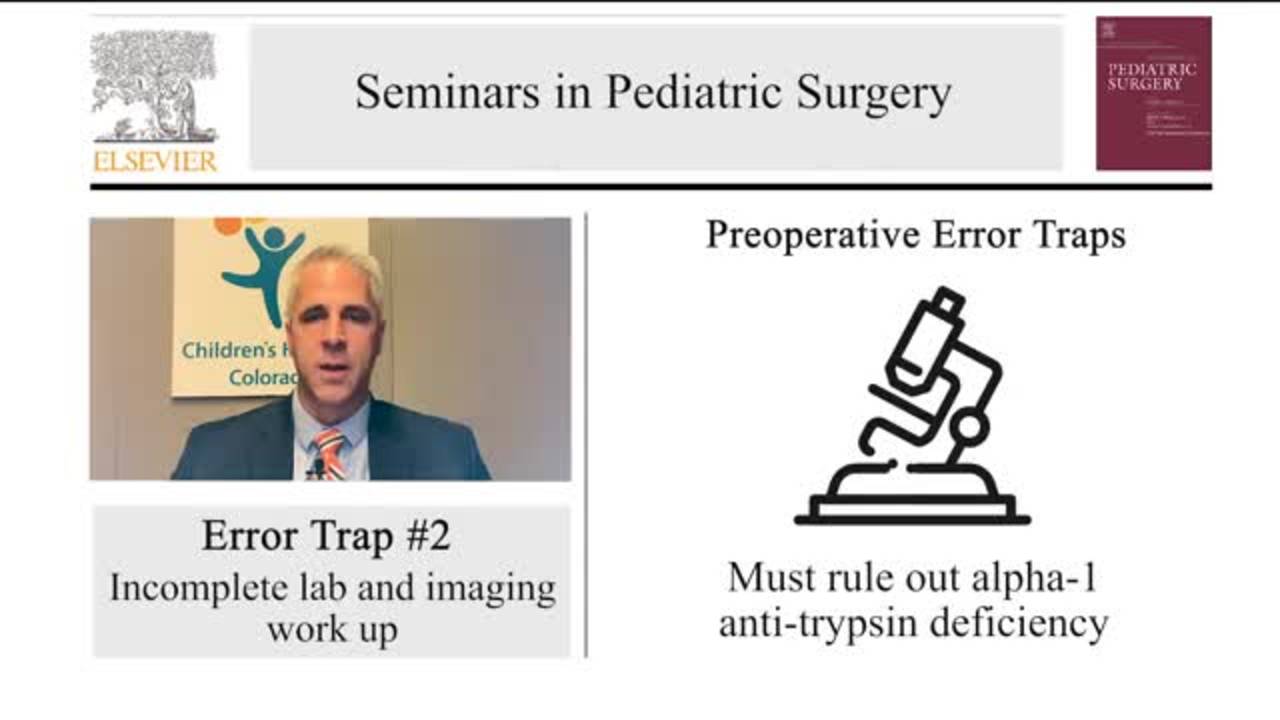
Error Traps and Culture of Safety in Biliary Atresia
CCHMC Pediatric Surgery · 4 min · Published Nov 2019
Video
Biliary Atresia: Where are we now? Advanced Practice Providers Pediatric...
Dr. Todd Ponsky · 48 min · Published Jul 2017
Podcast
Choledochal Cyst Podcast
22 min · Published Nov 2020
Video
Update Course Rewind: MMP-7 & Biliary Atresia Diagnosis 2024
CCHMC Pediatric Surgery · 6 min · Published Mar 2025
Video
Biliary Atresia with Dr. Greg Tiao
CCHMC Pediatric Surgery · 11 min · Published Jun 2022
Video
Hepatoblastoma with Dr. Greg Tiao
CCHMC Pediatric Surgery · Published Mar 2022
Podcast
Biliary Atresia Part II
42 min · Published Feb 2022
Podcast
Biliary Atresia Part I
31 min · Published Jan 2022
Video
Compiled Sandler Rapid Fire Sessions: Update Course 2015
29 min · Published Nov 2015
Podcast
Diaphragm pacing as alternative to mechanical ventilation in pediatric respiratory failure
1 min · Published Nov 2026
Podcast
Fetoscopic endoluminal tracheal occlusion for congenital diaphragmatic hernia
4 min · Published Nov 2026
Podcast
FETO procedure for late-diagnosed severe CDH with liver herniation
4 min · Published Nov 2026
Podcast
Severe CDH case with FETO: unexpected anatomic findings and clinical outcome
3 min · Published Nov 2026
Podcast
Pediatric pancreatitis: diagnosis, causes, and genetic insights with Dr. Juan Gurria
3 min · Published Nov 2026
Podcast
Understanding craniosynostosis: skull sutures, growth patterns, and diagnosis in infants
10 min · Published Nov 2026
What the experts said
Idiopathic neonatal hepatitis has decreased from 70% of cholestatic infants in the 1970s-1980s to approximately 10% currently due to recognition of inborn errors of bile acid metabolism and genotyping of progressive familial intrahepatic cholestasis (PFIC).
A paper published approximately one year prior demonstrated that a scoring system combining liver biopsy and clinical parameters achieves 99% accuracy in diagnosing biliary atresia.
The jaundice chip is a microarray gene chip that tests for PFIC abnormalities (PFIC 1, 2, 3), alpha-1 antitrypsin, and JAG-1 mutation, but takes 4-6 weeks to return results.
The absence of a gallbladder on ultrasound does not conclusively show biliary atresia, and the presence of a gallbladder does not exclude biliary atresia due to sophisticated ultrasound probe sensitivity.
The triangular cord sign is a radiographic finding representing the fibrous plate above the portal vein where bile ducts were supposed to be, now showing inflammatory fibrous scar.
At Cincinnati Children's Hospital, HIDA scans are not routinely used because the 3-5 day phenobarbital loading period can delay intervention into a time period potentially detrimental to Kasai outcome.
Pathognomonic findings on liver biopsy for biliary atresia include significant bile duct proliferation in portal triads and bile plugs within bile ducts, with likelihood of biliary atresia exceeding 90% when these are present.
At Cincinnati, liver biopsies are reviewed with pathologists before taking patients to the operating room, making intraoperative decision-making easier and sometimes reducing the necessity of intraoperative cholangiogram.
Alagille syndrome patients do not have the same bile duct proliferation as biliary atresia patients and will not have the pathognomonic finding of a bile duct plug.
At Cincinnati, the workup for biliary atresia is limited to liver biopsy, labs, and ultrasound before posting the patient for surgery.
The extended hilar dissection technique, going to the first bifurcation of vessels beyond the portal vein, is the proper way Kasai originally described the procedure.
Japanese centers uniformly perform extended dissections, which may explain why their Kasai outcomes are better than those in the United States.
Polysplenia syndrome patients with biliary atresia are the most difficult cases because they often have pre-duodenal portal veins and frequently have no bile duct remnant, making Kasai nearly impossible in this population.
Choledochal cyst patients will have pigmented stool, while cystic variant biliary atresia patients will become acholic, providing a simple clinical differentiation.
A Roux limb length of 20 cm is inadequate because 5-8 cm of length is almost always lost during hilar dissection at the time of transplant.
The target Roux limb length should be 30-40 cm to preserve adequate length for transplant teams, as one advantage of transplanting biliary atresia patients is having a pre-existing Roux limb.
Anti-refluxing valves for the Roux limb have not been proven effective.
The British health service focused all Kasai procedures at three high-volume centers, which are the only centers that can be reimbursed for the procedure.
Despite negative trial results, there is a subset of biliary atresia patients with an inflammatory gene profile in which steroids might prove beneficial.
Cincinnati does not use MRCP for biliary atresia diagnosis due to having a high-capacity pathology team.
Performing Kasai on Alagille syndrome patients will shorten the natural history of their native liver and result in earlier transplantation.
For patients with cholestasis where biliary atresia diagnosis is uncertain, workup includes echocardiogram to rule out pulmonic stenosis, spine X-rays to rule out butterfly vertebrae, and eye exams, all to evaluate for Alagille syndrome.
Data from England by Mark Davenport showed that cystic variants of biliary atresia have better outcomes if intervention occurs before 30 days of age.
UK data from approximately 15 years ago showed that centers performing more than 5 biliary atresia cases per year had statistically significantly better outcomes (approximately 20% difference) than those performing fewer cases.
Two European studies (King's Group using 2 mg/kg steroids and Klaus Peterson's German group using 10 mg/kg for 5 days) showed no benefit from postoperative corticosteroids in biliary atresia.
The Children's Network biliary atresia Research Consortium multi-center trial with approximately 70 patients in two arms showed no improvement in bile drainage with corticosteroid use and a slight increase in adverse events (primarily medical rather than surgical complications).