


From
StayCurrentMD
An Update on Chest Wall Anomalies and Their Treatment: Advanced Practice...
With Dr. Todd Ponsky
Chapter 1 of 7 · Fundamentals
Excavatum overview
Pectus Excavatum: Epidemiology, Pathophysiology, and Diagnostic Workup
Cued at 0:06 · stops at 7:53 · press play
Expert statements on this page
No expert statements were drawn from this page.
Host summaries · secondary, not cited in answers
Educational content from recorded physician discussions — not medical advice. Talk to your (or your child's) care team about your situation.
Podcast
Chest Wall Deformities with Dr. Robert Kelly
46 min · Published Jan 2017
Video
Pectus - Preoperative Assessment - Genetics
9 min · Published Nov 2018
Video
Pediatric Surgery Updates for the PCP - Full Show
CCHMC Pediatric Surgery · 58 min · Published Nov 2020
Video
Pectus - Preoperative Assessment - Radiology and Cardiac Evaluation
Dr. Todd Ponsky · 44 min · Published Nov 2018
Video
Genetics: Pectus Innovations
9 min · Published Oct 2015
Video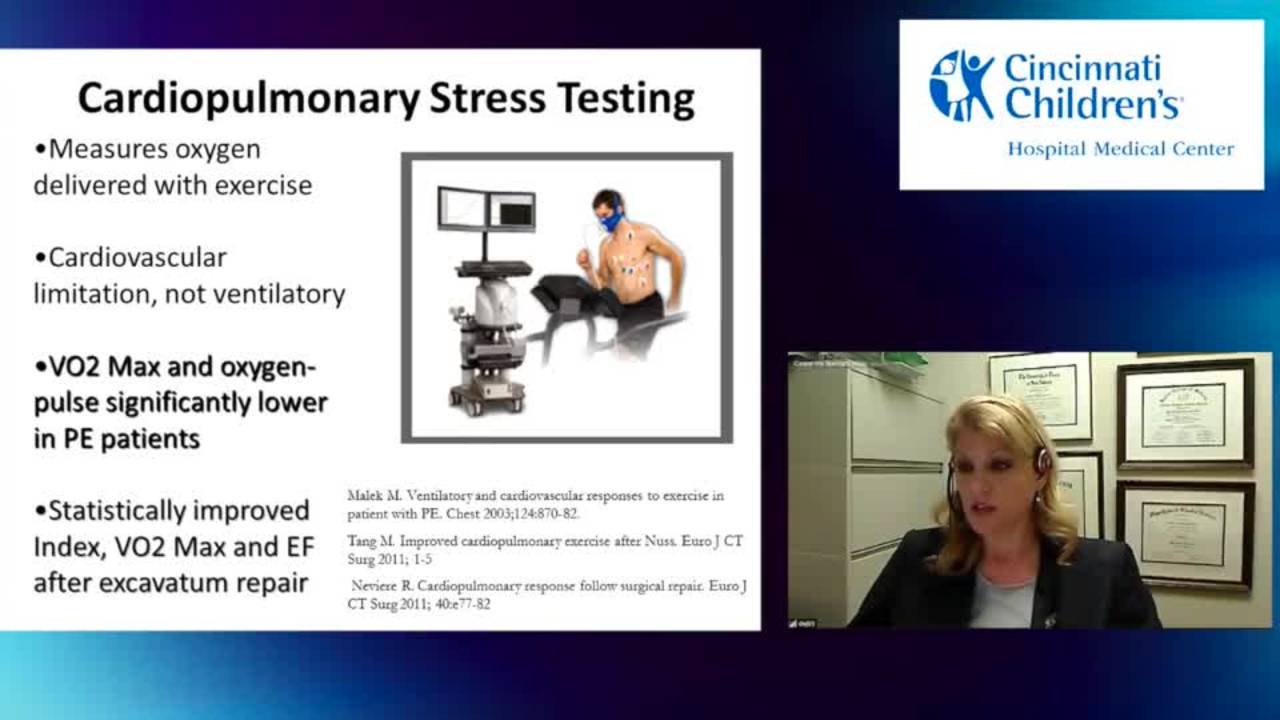
Pectus - Physiologic Consequences and Research
22 min · Published Nov 2018
Podcast
Surgical Decision-Making in Necrotizing Enterocolitis: Imaging, Timing, and Operative Strategies
11 min · Published Nov 2026
Video
AI applications in pediatric surgery and clinical transformation with Dr. Todd Ponsky
Dr. Todd Ponsky · 7 min · Published Oct 2026
Podcast
The Future of Surgical Education: A King, an Ox, & Elon Musk
Todd Ponsky · 26 min · Published Oct 2026
Podcast
Unconscious Bias
Todd Ponsky · 58 min · Published Oct 2026
Video
Storycasts in Pediatric Surgery: Interactive Storytelling to Transform Clinical Education
Todd Ponsky · Published Oct 2026
Podcast
Necrotizing Enterocolitis
Todd Ponsky · 46 min · Published Oct 2026
Podcast
Diaphragm pacing as alternative to mechanical ventilation in pediatric respiratory failure
1 min · Published Nov 2026
Podcast
Fetoscopic endoluminal tracheal occlusion for congenital diaphragmatic hernia
4 min · Published Nov 2026
Podcast
FETO procedure for late-diagnosed severe CDH with liver herniation
4 min · Published Nov 2026
Podcast
Severe CDH case with FETO: unexpected anatomic findings and clinical outcome
3 min · Published Nov 2026
Podcast
Pediatric pancreatitis: diagnosis, causes, and genetic insights with Dr. Juan Gurria
3 min · Published Nov 2026
Podcast
Understanding craniosynostosis: skull sutures, growth patterns, and diagnosis in infants
10 min · Published Nov 2026
What the experts said
Pectus excavatum is the most common chest wall deformity, though Argentina reports carinatum as more common in their country.
Pectus excavatum is rarely seen in African Americans.
Pectus excavatum is more often in males than females and statistically appears more common in tall, thin white boys.
Females with pectus have a slightly increased risk of mild scoliosis, occurring in 18% of those with pectus.
Many patients with pectus have a connective tissue disorder higher than in the normal population, such as Marfan syndrome and Ehlers-Danlos syndrome.
Studies show varying degrees of cardiac and pulmonary compromise in pectus excavatum, which seems to worsen as patients grow and their chest wall becomes less compliant.
Patients with deep pectus defects can have decreased cardiac output due to heart displacement, causing them to tire quicker than peers during exercise.
Pulmonary effects can include restrictive lung disease pattern and atelectasis if the chest is sufficiently restricted.
In Maryland, insurance typically covers pectus repair if the Haller index (pectus index) is greater than 3.25.
Johns Hopkins developed a pectus excavatum CT protocol using a flash scan with fewer cuts at deeper depth to reduce radiation exposure.
PA and lateral chest X-ray can be used to accurately measure pectus severity index without CT scan.
Some patients with severe psychological symptoms from pectus may not be satisfied with surgical outcomes even when the chest result is objectively good.
Dr. Nuss from King's Daughters Children's Hospital in Virginia began the minimally invasive pectus repair operation in 1988, placing a stainless steel rod underneath the chest wall.
The Nuss bar is usually kept in place for 2 to 3 years.
At Johns Hopkins, bars are left in closer to 3 years because longer duration decreases recurrence rate, especially in younger patients who may have significant growth spurts.
The average age for pectus excavatum surgery is about 14 years.
Vacuum bell therapy involves wearing a device for several hours a day to pull up the sternum, likely requiring a younger patient with compliant chest wall.
Dr. Nuss and colleagues in Virginia use the vacuum bell intraoperatively to elevate deep pectus defects and facilitate safer bar passage.
UCSF and Shriners are conducting the Magnetic Mini Mover trial for pectus excavatum in 8-14 year olds, using internal and external magnets to create a force field over several months to elevate the chest.
At Johns Hopkins, combined cardiac and pectus repair is performed simultaneously by pediatric and cardiac surgeons in patients with Marfan syndrome and cardiac issues, avoiding two separate surgeries.
Pectus carinatum patients may complain of tenderness at the protrusion, especially if they play sports with pads or sleep on their stomach.
Bracing has become the standard of care for pectus carinatum, with minimal postoperative problems and rare recurrence when surgery is performed.
Pectus carinatum braces are typically worn 23 hours a day initially, then weaned to nighttime only, for about 9-12 months total.
The dynamic compression device from Argentina (Marcelo Martinez Ferro's brace) is emerging as the best brace for pectus carinatum, with pressure measurement and time sensing capabilities.
Physical therapist application of pectus carinatum braces, with chest massage and manual defect reduction before tightening, results in better compliance and outcomes compared to orthotist application.
The Abramson technique (reverse Nuss) for pectus carinatum places a bar over the sternum, but wire erosion through bone has been reported due to the compressive force.
Poland syndrome patients with underdeveloped fingers or syndactyly are referred to plastic surgery at a young age for early intervention.
For Poland syndrome chest wall reconstruction, plastic surgery waits until patients are nearly done growing and uses flap techniques similar to post-mastectomy reconstruction.
Pain from the Nuss repair is reportedly greater than the Ravitch repair despite smaller incisions.
At Johns Hopkins, PCA provides better pain control than epidurals for pectus patients, and epidurals delayed early ambulation.
Pectus excavatum patients at Johns Hopkins do not receive Foley catheters and ambulate to the bathroom the night of surgery.
Typical hospital discharge after Nuss procedure is by postoperative day 3 or 4.
Patients are transitioned from PCA to oral oxycodone the day after surgery if eating well.
Haller index greater than 3.25 is the threshold for insurance coverage of pectus repair at Johns Hopkins.
Patients in better physical condition who play sports and do upper body work recover faster from pectus surgery.
The Nuss procedure typically takes about one hour of operative time.
Intraoperative antibiotics are given but not continued postoperatively for pectus repair.
Patients are allowed to position themselves however comfortable after Nuss repair, with no strict positioning restrictions.
Activity restrictions after Nuss repair include no heavy lifting greater than 10 pounds for 6 weeks and no contact sports during that period.
Valium is added to oxycodone for postoperative pain management to help with anxiety and muscle spasms in the back from posture changes.
Most pectus patients are off narcotic pain medication between 2 and 4 weeks postoperatively.
Compliance rate with pectus carinatum bracing is approximately 85%.
Diana Farmer reported that the magnetic therapy is quite effective based on preliminary results.