


From
StayCurrentMD
Managing Advanced Chronic Kidney Disease: Cincinnati Fetal Center
With Dr. Paul Kingma & Dr. Jan Scober & Dr. Maria Alonso
Chapter 1 of 3 · Fundamentals
Pulmonary survival
Pulmonary Survival in Neonates with Bladder Outlet Obstruction
Expert statements on this page
No expert statements were drawn from this page.
Host summaries · secondary, not cited in answers
Educational content from recorded physician discussions — not medical advice. Talk to your (or your child's) care team about your situation.
Video
Fetal Diagnosis Imaging: Fetal Genitourinary Disease 2015
10 min · Published Jul 2017
Video
Fetal Diagnostic Imaging: Cincinnati Fetal Center
10 min · Published Nov 2018
Video
Renal transplantation: Fetal Genitourinary Disease 2015
13 min · Published Jul 2017
Video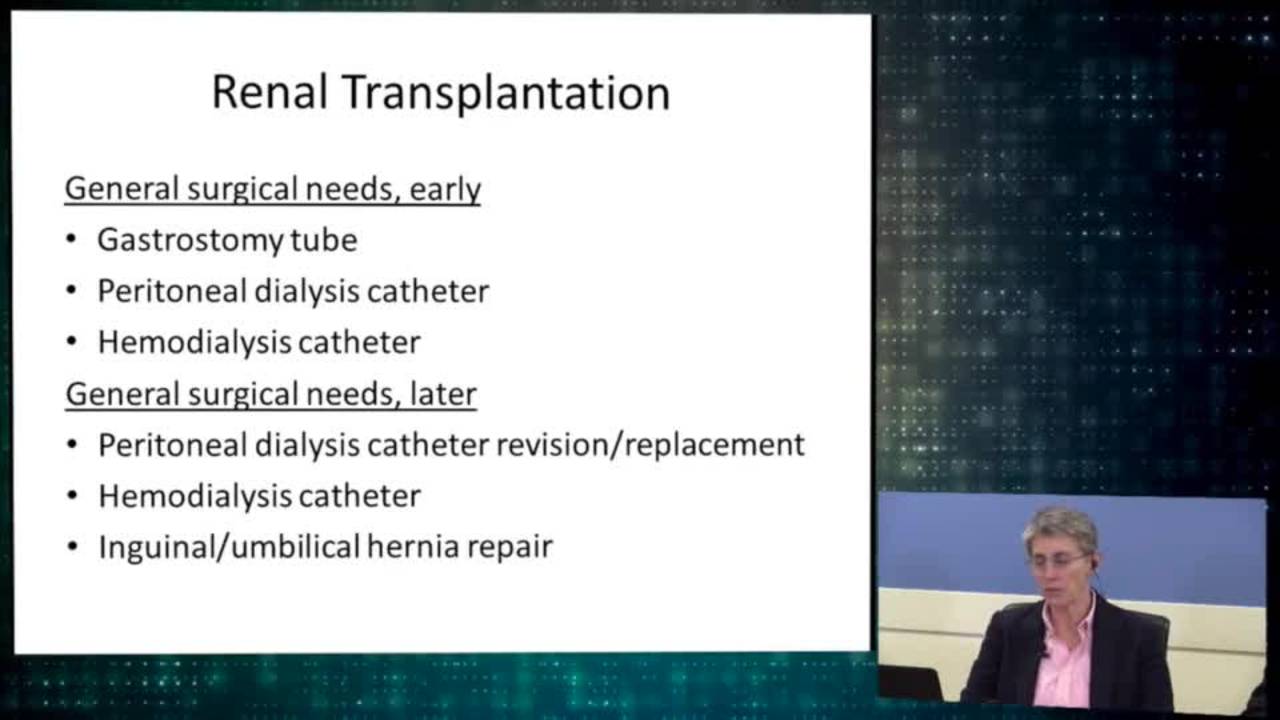
Renal transplantation: Cincinnati Fetal Center
13 min · Published Nov 2018
Video
Prenatal Imaging and Counseling: Cloaca and Complex ARMs 2015
CCHMC Pediatric Surgery · 31 min · Published Oct 2015
Video
Cloaca - Prental Imaging & Diagnosis - Counseling
Dr. Todd Ponsky · 36 min · Published Nov 2018
Video
Practice Patterns and Outcomes of Hemodialysis in Infants Undergoing Congenital Heart Surgery...
53 s · Published Jun 2026
Video
Practice Patterns and Outcomes of Hemodialysis in Infants Undergoing Congenital Heart Surgery in the
53 s · Published Jun 2026
Video
Practice Patterns and Outcomes of Hemodialysis in Infants Undergoing Congenital Heart Surgery in th
53 s · Published May 2026
Video
Surgeon annual volume impacts recurrence rates of pediatric inguinal hernia repairs: A multi-institutional study
54 s · Published Feb 2026
Video
Quick Literature Updates Episode 13
4 min · Published Nov 2023
Video
Early Peritoneal Dialysis and Postoperative Outcomes in Infants After Pediatric Cardiac Surgery
47 s · Published Sep 2023
Video
Improving Outcomes for Congenital Diaphragmatic Hernia (CDH): Protocol Changes at Cincinnati Children's
5 min · Published Jun 2026
Video
Congenital Diaphragmatic Hernias (CDH): Improving Outcomes with Advanced Imaging & Nutrition
5 min · Published May 2026
Video
Fetal management of advanced chronic kidney disease: Fetal Genitourinary...
34 min · Published Jul 2017
Video
Intestinal Atresia Types Explained: Grossfeld Classification for Pediatric Surgery
1 min · Published Sep 2026
Video
Derivation and validation of the Pediatric Community-Acquired Pneumonia Severity (PedCAPS) score: A prospective cohort study
50 s · Published Sep 2026
Video
FETO for Late-Diagnosed Severe Congenital Diaphragmatic Hernia (CDH) at Cincinnati Children's with Dr. Beth Rymeski
4 min · Published Sep 2026
Video
Severe Congenital Diaphragmatic Hernia (CDH) Case: FETO Management & Unexpected Findings with Dr. Beth Rymeski
3 min · Published Sep 2026
Video
Fetoscopic Endoluminal Tracheal Occlusion (FETO) Procedure: Step-by-Step Guide with Dr. Beth Rymeski
4 min · Published Sep 2026
Video
Choledochal Cyst Types Explained: Pediatric Surgery Fundamentals
1 min · Published Sep 2026
What the experts said
If amniotic fluid levels are restored to normal through shunting or amnioinfusion, the likelihood of pulmonary survival increases to approximately 80%.
If amniotic fluid levels are not returned to normal, the pulmonary outcome is poor.
Many infants who are pulmonary survivors have reduced reserve lung function, similar to reduced reserve renal function, and can rapidly transition from pulmonary survivor to non-survivor if injured.
Babies with renal problems who had normal amniotic fluid after replacement have developed chronic lung disease after delivery, demonstrating they are not normal from a respiratory standpoint.
Any kind of urine output is much better than no urine output, even if the urine is of poor quality and does not contain cleared metabolites.
Babies with obstructive uropathy often have a concentrating defect and produce large volumes of urine.
At this center, the size required for safe transplantation is typically between 8 and 10 kg, which usually occurs in the second year of life.
Lower urinary tract management aims to reduce the risk of urinary tract infection through antibiotic prophylaxis and bladder irrigations, and to manage bladder pressure with anticholinergics and catheterization programs guided by urodynamic studies.
Obstructive uropathy bladders can be very high pressure and can change over time, requiring regular follow-up and potentially changing management strategies.
Hypertension is not commonly seen in these babies because they have high urine output and are not volume overloaded, and they tend to lose sodium due to tubular dysfunction.
Normal GFR for a newborn at 1 month of age is about 50, and it takes a whole year to reach what is accepted as normal GFR in older individuals, which is about 100.
Reasonable predictions based on clearance and creatinine cannot be made until a patient has spent the first year of life establishing their kidney function.
The GFR criteria in chronic kidney disease guidelines do not apply to children less than 2 years of age; these children can only be categorized as having normal, moderately reduced, or very severely reduced age-adjusted GFR.
Dialysis is indicated when chronic kidney disease management fails, specifically when the baby stops growing (including head circumference) or when hyperkalemia or metabolic acidosis cannot be medically managed.
Peritoneal dialysis is the technically least difficult way to provide dialysis in small children.
Urine output remains a significant advantage because it is very difficult to manage fluid balance with dialysis alone if there is no residual diuresis.
If parents want aggressive care, full respiratory support should be provided for at least the first 3 to 4 days, as many infants requiring high levels of support (including oscillator or pulmonary vasodilators) will begin to improve after this period.
If the baby is not showing signs of stabilizing and improving after the first 3 to 4 days, the reality that the infant is likely not a pulmonary survivor must be discussed with parents.
The question of pulmonary survival must be readdressed anytime there is an episode of lung injury, such as from sepsis.
When peritoneal dialysis is not available due to peritonitis, short-term hemodialytic strategies can be attempted, though they are challenging due to the need for blood priming and large catheters in small blood vessels.
Aquapheresis (ultrafiltration with convective clearance) using slightly smaller catheters has been successfully used to maintain an anuric baby with intraperitoneal problems.
Temporary hemodialysis catheters in newborns are difficult to maintain because there is not much catheter design for small children, resulting in excess extravascular catheter that moves despite securing, and the 8 French catheter is limited to jugular veins.
Tunneled hemodialysis catheters are easier to maintain from a movement standpoint but are still very large and likely to cause local thrombosis or stenosis in the central circulation.
Nutrition in babies with urine output is easier than in oliguric or anuric babies because the formula does not need to be as concentrated.
High-output babies lose electrolytes and may require supplementation of potassium and phosphorus, which are typically restricted in older chronic kidney disease patients.
The density of formula is essentially an inverse function of urine output.
The need to provide adequate protein intake may necessitate dialysis in some babies because their BUN cannot be managed otherwise.
It is relatively unusual to expect these babies to drink spontaneously in amounts sufficient to supply adequate nutrition.
Breast milk can be incorporated into specialized formulas that meet the baby's specific needs when mothers are motivated to provide it.
The majority of these children have an NG tube or gastrostomy tube, which they keep even around transplant time for medication administration.