

22. Pediatric Hernias
With Dr. Todd Ponsky · hosted by Dr. Em Gootee & Dr. Todd Ponsky
Part of
Umbilical Hernia 10 items
Chapter 1 of 12 · Fundamentals
Introduction
Introduction and Background on Pediatric Hernia Surgery
Expert statements on this page
No expert statements were drawn from this page.
Host summaries · secondary, not cited in answers
Educational content from recorded physician discussions — not medical advice. Talk to your (or your child's) care team about your situation.
Video
22. HerniaTalk LIVE Q&A: Pediatric Hernias
Todd Ponsky · 59 min · Published Jul 2026
Podcast
Pediatric Inguinal Hernia with Dr. Todd Ponsky
Todd Ponsky · 13 min · Published Oct 2026
Video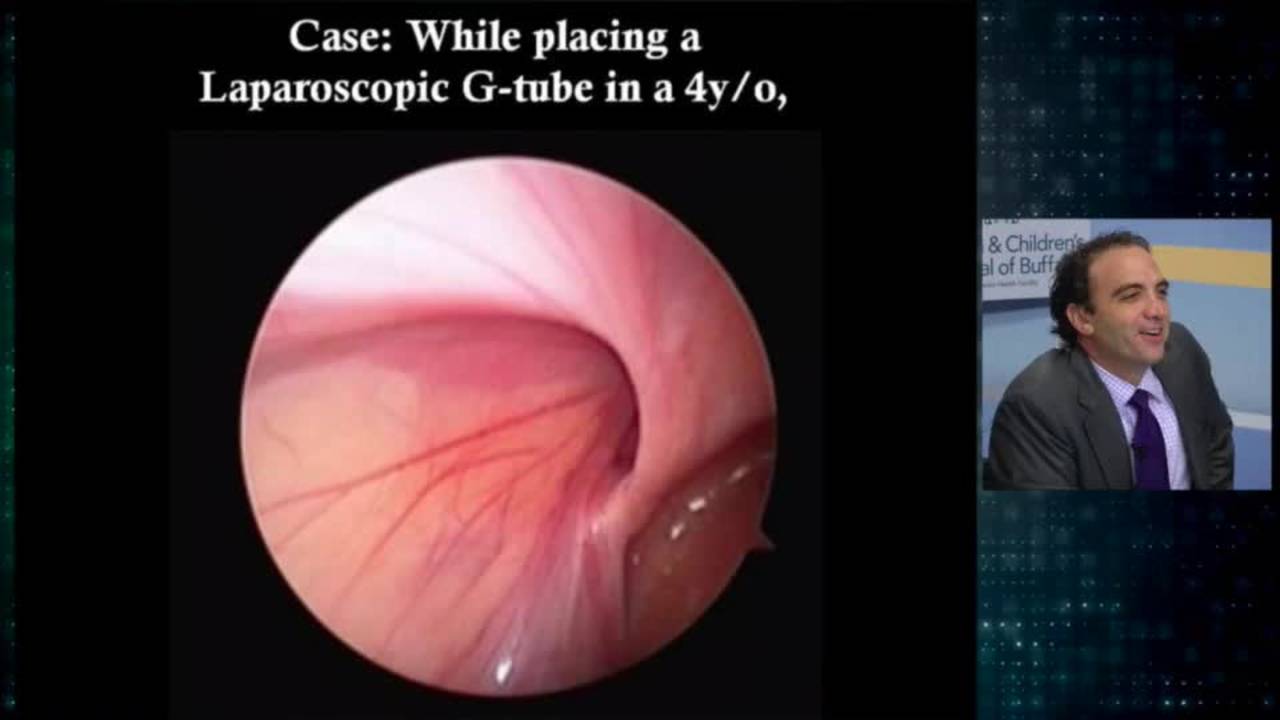
Groin Controversies: Update Course 2016
Dr. Todd Ponsky · 28 min · Published Jul 2017
Video
Focus on Technique- Laparoscopic Pediatric Hernia Repair 2015
Dr. Todd Ponsky · 140 min · Published Mar 2014
Video
Pediatric Hernia: Update Course 2013
52 min · Published Jul 2017
Video
2024 Laparoscopic Hernia Event
102 min · Published Jun 2024
Video
AI applications in pediatric surgery and clinical transformation with Dr. Todd Ponsky
Dr. Todd Ponsky · 7 min · Published Oct 2026
Podcast
Tracheoesophageal Fistula
Todd Ponsky · 45 min · Published Oct 2026
Video
Storycasts in Pediatric Surgery: Interactive Storytelling to Transform Clinical Education
Todd Ponsky · Published Oct 2026
Podcast
Pediatric Trauma II: Solid Organ Injury
Todd Ponsky · 37 min · Published Oct 2026
Podcast
History Of Pediatric Surgery
Todd Ponsky · 52 min · Published Oct 2026
Podcast
Necrotizing Enterocolitis
Todd Ponsky · 46 min · Published Oct 2026
What the experts said
Inguinal and umbilical hernias, along with appendicitis, are the most common operations performed in children.
Pediatric surgeons began exploring laparoscopic hernia repair to avoid manipulating fragile structures in newborns.
The current laparoscopic technique is modified from a Japanese approach and has been refined through years of research.
Umbilical hernias close spontaneously 80% of the time by age 3 to 5 years.
The incidence of umbilical hernia incarceration (intestines getting stuck) is less than 2%, making watchful waiting safe.
Umbilical hernia repair in children is straightforward (4 stitches), with rapid recovery and return to activity the next day.
If an umbilical hernia is not repaired in childhood and grows, it may require mesh in adulthood, making early simple repair preferable.
The chance of inguinal hernia incarceration in premature newborns is 30% (1 in 3).
After age 1 year, the inguinal hernia incarceration rate drops to the same low level as in adults (less than 1%).
One patient had a documented inguinal hernia defect (seen during appendectomy) that closed spontaneously over 5 years.
In fetal development, the testicles or ovaries start high in the abdomen and descend during the third trimester; the testicles pass through a canal in the muscle and the canal normally closes behind them.
Inguinal hernias in children occur when the canal fails to close after testicular descent, often because the baby was born prematurely.
The original laparoscopic hernia repair had a 3–4% recurrence rate, but newer techniques with improved tricks have reduced this to less than 1%.
A pediatric inguinal hernia is not a muscle problem; the muscle is normal. The issue is a persistent thin peritoneal sac that must be removed.
If a pediatric hernia repair fails, it is easy to repair again because the underlying anatomy is normal; the chance of failing twice is extremely low.
Recurrent umbilical hernias in children likely result from a broken stitch or untied knot and are repaired by placing another stitch.
In a 5-year follow-up study of adolescents, the recurrence rate for tissue-based inguinal hernia repair was less than 2% for both open and laparoscopic approaches.
Ponsky recommends laparoscopic non-mesh repair for adolescents because if it fails (which is rare), the patient can then have an adult mesh repair without having 'burned any bridges.'
Direct inguinal hernias are exceedingly rare in children; Ponsky has seen only one in 20 years of practice, and it was iatrogenic (caused by surgery).
Laparoscopic repair avoids the risk of iatrogenic direct hernia because it does not require lifting and manipulating the thin inguinal floor.
The standard open pediatric inguinal hernia repair is high ligation of the peritoneal sac; 90% of surgeons do not perform a Marcy repair (muscle reinforcement) unless there is visible muscle weakness.
Braided permanent sutures placed close to the skin in open inguinal hernia repair can cause infection or abscess, so most surgeons use absorbable sutures for open repairs.
The incidence of a problem (mortality) from anesthesia in children is less than the chance of being struck by lightning or hit by a car while walking.
Midline abdominal incisions have a higher incisional hernia rate in children than transverse incisions because the muscles are not yet strong and formed.
Pediatric surgeons prefer transverse abdominal incisions in small babies to reduce the incisional hernia rate.
Mesh is avoided in pediatric hernia repair because children are still growing; mesh will not grow with the child and will become distorted and displaced.
Pediatric primary inguinal hernia repair (high ligation) has a recurrence rate of less than 1%, so there is no need for mesh even in adolescents.
Placing mesh in the inguinal canal of a child who has not yet gone through their fertile years could theoretically injure the spermatic cord and affect future fertility due to scarring.
Ponsky performs single-port laparoscopic appendectomy through the umbilicus and discharges patients home from the recovery room (no overnight stay).
Port-site hernias after laparoscopic surgery occur when the 10–12 mm umbilical incision (used to extract the appendix or gallbladder) fails to heal; the absorbable stitch may dissolve too soon or break.
Mesh is used in pediatric surgery for congenital diaphragmatic hernias and large abdominal wall defects (omphalocele, gastroschisis) when primary closure is not possible.
Biologic meshes do not work well in pediatric surgery; when bridging is needed, polypropylene or Gore-Tex mesh is used.
Sports hernias are not true hernias but ligamentous tears from aggressive sports; they are treated with 6–8 weeks of rest and physical therapy, not surgery.
Epigastric hernias are small defects in the upper abdomen where only fat (not full-thickness peritoneum) protrudes; many surgeons now observe these rather than repair them because they are primarily cosmetic.
When an asymptomatic inguinal hernia defect is found incidentally during another operation, Ponsky does not repair it because many people have such defects that never cause problems.
Twenty percent of children with an inguinal hernia have a hernia on the contralateral side as well.
A hydrocele is a type of hernia where the canal closed almost completely after testicular descent, leaving only a microscopic hole through which fluid (but not intestines) can pass.
Hydroceles are not dangerous and are primarily a cosmetic problem; most resolve spontaneously, so repair is deferred until the child is older.
Undescended testicles that do not descend spontaneously are repaired by 6 months to 1 year of age to maintain fertility and allow lifelong examination for cancer.
Testicles need to be in the scrotum to be cooled; if they remain high in the abdomen, they can cause infertility and have a slightly increased cancer risk.
Most undescended testicles in newborns descend spontaneously over the first 6–12 months of life.
A retractile testicle (one that can be easily pulled down manually) does not require surgery; it will descend normally as the child grows.
There is a familial component to hernias, though it does not follow classic autosomal dominant or recessive inheritance patterns.
Hiatal hernias are very common in newborns (causing reflux and vomiting) and usually improve with time; surgery is reserved for babies who cannot feed.
The pendulum on hiatal hernia surgery has swung; the current era favors operating less frequently than in the past.
A study showed that umbilical hernias repaired before age 3 have a higher recurrence rate than those repaired at age 4 or later.
The mean optimal age for umbilical hernia repair is 4 years.
New research suggests there may be long-term deleterious effects of anesthesia in babies under age 2, prompting pediatric surgeons to defer elective surgery until age 2 or 3.
Some surgeons repair umbilical hernias preferentially in females because the defect may enlarge during pregnancy.
The laparoscopic hernia repair technique has evolved; the current needle-based approach has a recurrence rate of less than 1% in multiple studies.
A Mayo Clinic 50-year follow-up study found that the small number of patients who required re-operation after pediatric hernia repair had developed direct hernias (an adult-type hernia).
A New England Journal of Medicine paper suggested that multiple anesthetics before age 2 may be associated with neurodevelopmental effects in adulthood, though this finding is not yet definitive and will be re-examined.
Because of uncertainty about anesthesia effects, the new policy for most U.S. pediatric surgeons is to defer elective operations until age 2 or 3.
A pediatric study found that the female genetic lineage is a stronger predictor of hernias in children than the male lineage.