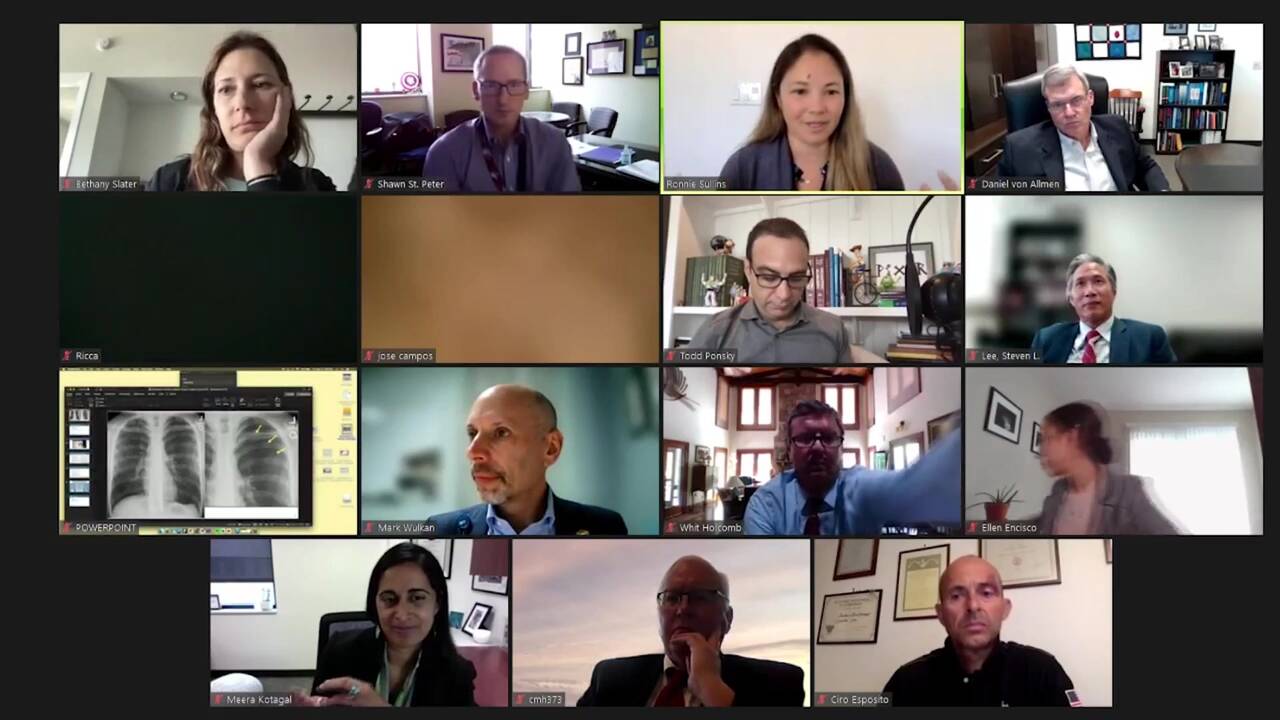
Something that we should be paying attention to. Are you ready for pneumothorax? Yes. All right, we have a 15-year-old male with a BMI of 19 who has sudden onset of chest pain and dyspnea, otherwise healthy, absent breath sounds on the right. Here's your X-ray. This doesn't come through. There's a pneumo. There's a new, OK. All right. All right, so. How was it a big pneumo or a little pneumo? It was a fairly large pneumo. OK, OK, so there's an air leak after you put in a pegtail. Um, next appropriate step. Do you watch it? Do you, do you get a CAT scan? Do you watch it as an outpatient? I love this topic because we've discussed it in a global cast of some sort almost every year and no one ever agrees. Um, that's why it's a great topic. That's why it's a great topic and I, uh, so I can tell you just what I do. Um, first of all, I want to make a point. If, if someone says 50% collapse, that's 100% collapse because the lung can't disappear. So a 50% drop is that it's completely collapsed. Um, so, um, I will put in a chest drain. I do talk to the family, so I'm not dogmatic anymore. It used to be I wait for their second episode and then I do something. I will now base it on the patient and I will actually give them a choice. I'll say, you know, if you're someone, someone that, that is risk averse, whatever, I will go ahead right now and do a VAT. I don't get CAT scans. I, I know that that's uh another point of controversy. I don't even want to know what's on the other side, uh, unless the family asks for it and says, really, I'm, I'm afraid of this ever happening. Get a CAT scan and operate on the other side. And then the question is, do you do it at the same time? I just don't do that. Um, we had a patient that we just discharged home that had, uh, a phlebectomy, pulled the tube out to get the postpo X-ray, and it was fine, but then they had dropped the lung on the other side. So then they went back to the, in the same hospital stay. So it happens, but I don't go looking for it. My, my approach is the same. The one thing I would add that's new to me, uh, is, uh, that's going to be probably tested in the, uh, a large group, uh, surgical. Uh, research clinical research forum is you see a patient like that in the emergency room, you put a tube in, aspirate the air, take the tube out, and then basically get an X-ray later and send them home. I just don't get that. I know Dan and I, Dan Osley and I have, actually. We're throwing blows, uh, about this. I mean, it, I don't understand that because, um, you're sending them home, I guess you keep them in the ER for 6 hours or something, is that right? OK. Would anyone do that? Just as aspirate the air. Get an X-ray after 6 hours and send them home from the ER. Yeah. If Dan tells me I have to, yes, yeah, so he's not, not even necessarily putting a tube in, but literally just doing a thoracentesis with a needle, and we've done some, we're trying to do some, uh, decision tree analysis modeling, and actually that is surprisingly to me, having repeated literature surprisingly effective. And if you just, just do a cost analysis, very cost effective, even with a relapse rate, may not be the best for family satisfaction, but a lot of families need to be talked into an operation, so they may not want an operation. They're given a choice of. Low risk, quick turnaround, might work, might work for a long time. That may be a new thing. I missed it. So what do you do? No, so, so, uh, the idea of just doing a thoracentesis in the ER, in the ER, not, not, not, not even putting a tube in. Yeah, you don't need a tube. You just use one of those thoracentesis trays. I, I, next time I'm based on what we've just started figuring out, yes, you'll do it, OK, yeah, we have, we have people in our institution that will start trying it, yeah, OK. So, so what's the What's the issue? Is it the lung parenchyma is hyperelastic, and that's what's causing, because the thoracentesis doesn't address that. Oh, they still have their labs, right? Right. The question is, will it scar enough from this burst that it won't happen again? What's the percentage? What percent come back again? Is it 50%? What numbers do you quote of them having a chance of it happening again? 30%. 30% say the same. OK. Literature on thoracentesis is actually more. Lower recurrence rate than chest tube at home after chest tube, but that's ridiculous. It's ridiculous, but that's, that just puts a question about the study then. I mean, the numbers shouldn't be better. I, uh, unless someone can say something like explain something why that would be better, it seems to me that that just. Unless that's the only good study we have of recurrence rate because it was really looked at well. Maybe that's the more accurate number. What was their number, 20% or something? OK, I want to know why you don't want to know what's going on on the other side, because at least in my patient population, that's, so you resect labs if they're a symptom and never had a pneumothoris. I'm going, I'm going to ask the question. You have a child that's coming in. You're going to do a vats on. You, you've decided that it's failure or whatever, and the You're not, you don't want to know what's going on on the other side. You don't want to consider the possibility that it might occur on the other side. The families are there's a very high possibility. Well, since there's a very high possibility, although it's not apparently not in the adult literature doesn't support it, but in my practice I get a CAT scan. If I see blebs, I tell, I give the family the option. I talk about it at least. And saying that there is pathology on the other side, I can do both sides of them with the same anesthesia. It will, this is the efficacy of doing bats and pleurodesis and. They'll say, what do you think? And I'll say, Well, if it was my son, I would have it done, especially if he wanted to be a jet pilot or something, you know. So I would, I would wanna know because a lot of, I, I don't know if it's a lot. I mean, I don't know if it's most, but at least a lot of the time it's gonna be there. So most of the time you're doing bilateral vats. Are you guys doing bilateral vets? Do you do CT scans? I'm doing bilateral vats if it's bilaterally symptomatic, right, not if they have blebs, correct? OK. Controversial point. We did not solve it today. OK, yes, so I have a question for you. Yes, so when you do the operation, Pleurectomy, pleurodesis, nothing. I have changed and I keep changing. I went from this week roughing up every week I will change, roughing up with the bovi pad. OK. Then I went and watched Rothenberg do pleurectomy. I said, Oh my God, that is great. I love it. Switched to pleurectomy. Then they were in so much pain they were climbing out of the hospital, so I stopped doing pleurectomy and then I went to the greatest solution. I had the answer talc. Aerosolized tal it looks like a snow globe. I said this is the best tal chlorodesis until Arnie Corn almost cut my head off because he said, you try to go and operate on one of those patients that have tlorodesis. I said, but isn't that the point? We're trying to get it to stick. Make a decision. Do you want it to stick or do you want it not to stick? If you want to stick, I'll make it stick. I'll put talc in. So, but they said it's different. It'll stick sort of with like irritation where it will be like cement if you use talc. So now I've gone full circle and I'm back to the bobi pad. So that's my evolution. So two papers I want to draw to your attention. One paper out of. Korea 1400 patients, 11 hospitals randomized to 1400 patients. 1400 patients randomized to half of them got a bleb resection and they covered the staple line with fibrinogen glue. OK. The other ones got pleurodesis, OK. There was no difference in the recurrence rate in the two groups, so no need to do any pleurodesis exactly. I think I buy that. So that's, that's one paper. In fact, on one year follow up, the, the group with the fibrinogen, uh, glue on the staple line had 5.8% recurrence versus an 8% recurrence in the pleurodesis. Mark the time right now, 3:45 p.m. I have changed my practice, OK. Because I do always wonder if we've solved the problem, why do we need to do this pleurodesis thing now. Here's the second question. OK. OK. The second paper is from Beijing, 300 patients, 300 patients in which it was pleurodesis or no pleurodesis. No difference. OK, so two studies showing it. So one study had fibrinogen glue, yeah, but who knows, right? That makes a difference exactly. So here's my question. Are you going to change now based on that? Yeah, he has already 4 as in 1 minute ago. I love it because I hate the pain they have afterwards. It's the reason Tom puts on these global casts so he can adjust his practice. My nurses in the operator were going crazy. Well, Dr. Harmon, would you change your practice? I, I have done it without pleurodesis, uh, and just, just this lebectomy. I love it. Well, there you go. I'm excited. Who's doing, who's gonna change? Come on. Nope. You're gonna change. You're half jaw, you wimp. You're gonna change. No, still do pleurodesis. You're gonna change. I'll, I'll change. I'm happy to change. I'm gonna do fiber and glue. Why not? It's a, I don't, I mean, I guess they're like 20 minutes and then shoving the thing in and out. This is great. It's more that they are in such excruciating pain and I think, I think the key to me is, is that if there is a study, and I don't doubt you, I mean there's a study with 1400 patients patients, that's more than a type two error kind of thing. This is, you know, there's probably real power to that. Yeah, 3 millimeter stab. I got a video for you. That's not single side. Yeah, all right, all right, so I think we'll stop we'll stop. That was awesome. You changed our practice. That's enough. I would stop right there. That was my goal tell you that.
Click "Show Transcript" to view the full transcription (9945 characters)
Comments