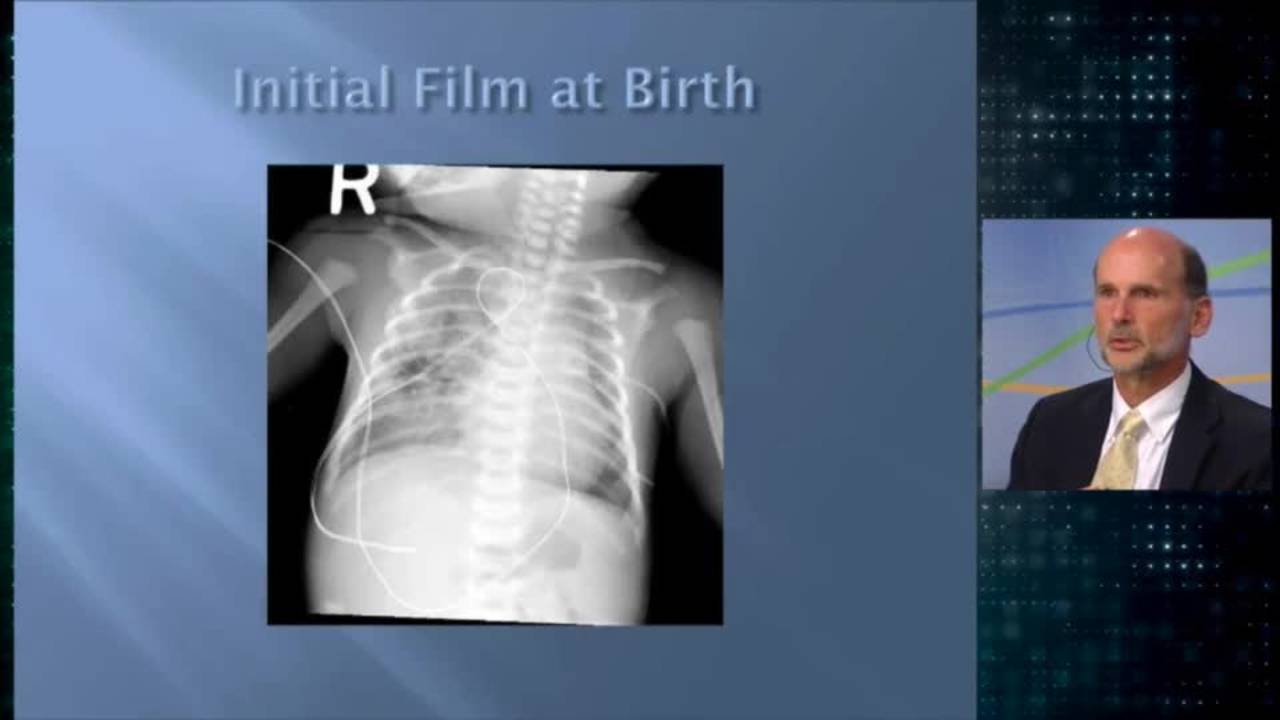
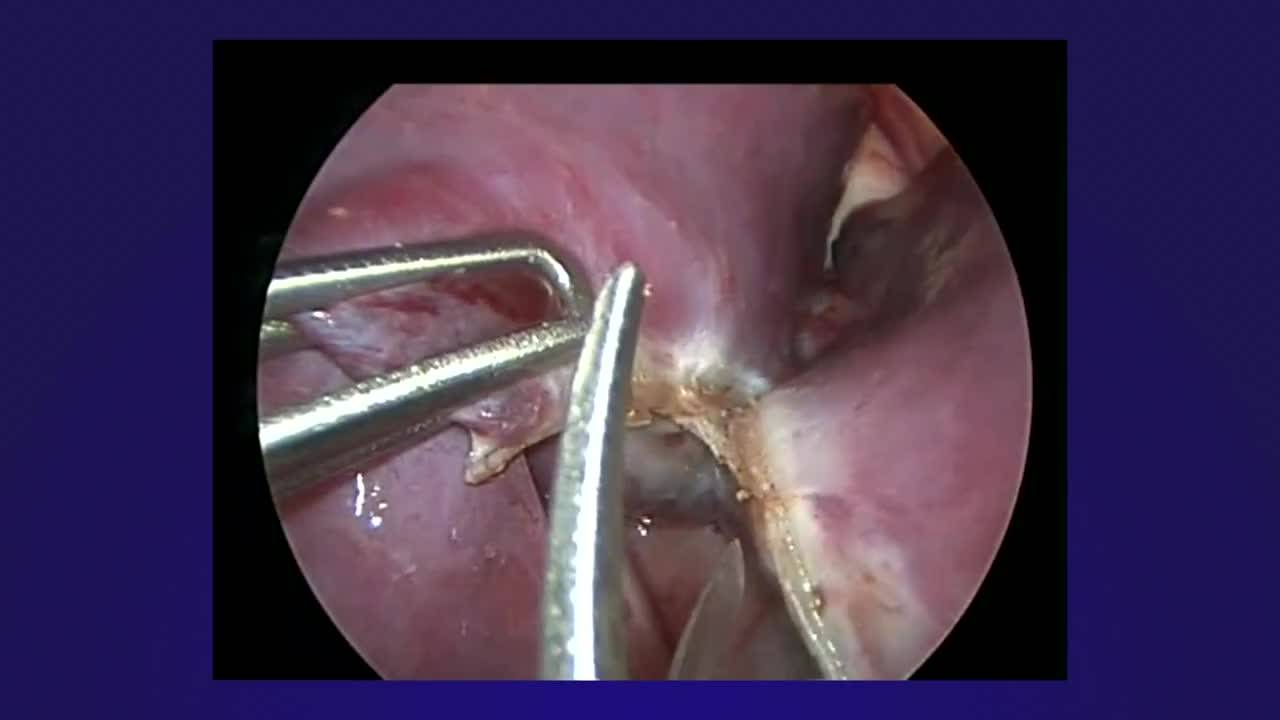
This is Todd Ponsky from Akron Children's Hospital, and today we're starting a new project called How I Do It. Periodically we'll be uploading videos from experts around the world on how they do a specific procedure. Today we're gonna start with thoracoscopic left lower lobectomy being performed by Doctor Steven Rothenberg from the Rocky Mountain Hospital for Children in Denver, Colorado. We hope you enjoy. This video demonstrates a left lower lobectomy in an infant with a CPAm using the just right 3 millimeter sealer and 5 millimeter stapler. The room set up for a thochoscopic lobectomy is shown here. The surgeon and assistant stand at the patient's front with the patient in a full lateral decubitus position. The monitors are set behind the patient to allow for inline viewing while performing the most delicate portions of the operation. The patient is put in a full lateral decubous position and then prepped and draped in a standard fashion. A right main stem inhibation is used to obtain left lung collapse. Here you see the trochar placement. The camera port is anterior to the tip of the scapula and approximately the 5th intercostal space in the posterior axillary line. The right and left hand operating ports are in the anterior axillary line. The scope is put in and an initial evaluation is done. The right hand operating port is then placed just above the diaphragm. In the anterior axillary line, initially a 3 millimeter port is placed, and this will later be upsized to a 5 for the 5 millimeter staple. The initial moves are to. Mobilize the inferior pulmonary ligament. This is done for two reasons. First, in order to test the energy source to make sure everything is operating clearly and efficiently. Second, In lower lobectomies, we always look for a systemic artery, even if one is not identified on CT scan. It is not unusual for there to be a hybrid lesion of a sequestration in CPAP, and occasionally these large vessels are missed. Here you can see the inferior pulmonary ligament being taken with the sealer simply by grasping the tissue, sealing the tissue, and then tearing it gently upwards towards the vein. This is in a very efficient motion and eliminates the need for sharp dissection for this portion of the operation. Once the inferior pulmonary ligament. Is taken, the inferior pulmonary vein can be seen, and then dissection turns to the. Hilam and the major Fisher. In this particular case, the fissure is quite complete. Here you can see how just changing the angle of the camera 30 degrees gives a better orientation. We start at the front of the fissure, mobilizing the tissue again to completely expose the pulmonary artery. Again, the sealing and tearing technique works quite well in where the tissues are this thin. We gently dissect above the pulmonary artery, which is clearly seen here to expose the branches going to the lower lobe. It is important to identify the branch going to the lingula so this can be preserved. The sealer works as an excellent dissector, and you can see that we're. Gently dissecting the tissues in front of the artery to completely expose it. This is done in a stepwise progression to completely expose the artery. In cases where the fissure is more incomplete, a similar technique is used, and the lung parenchyma is simply gone through a layer at a time. In order to expose the pulmonary artery. Once the artery has been exposed, uh, then all tissue anterior to this can be safely sealed and divided. We now reach the posterior aspect of the fissure, and we can begin to see. The branch going to the superior segment of the left lower lobe. This vessel usually comes off separately from the basal trunk, and it's usually best isolated. Alone, sealed and divided, as will be shown later. You can see when there is some small parenchymal bleeding in the lung, this is easily stopped using the sealer. Occasionally, char will build up on the sealer and so intermittently, it should be um removed and cleaned gently by the uh scrub nurse. After the superior segmental artery is exposed, we return to the anterior portion of the fissure to start mobilizing and sealing the basal branches. The fissure is still incomplete at this point and so in this area where there is lung parenchyma, we seal. The lung tissue. And then sharply divided. This can either be done in the center of the seal or in cases where the tissue is thicker. We often make two separate seals and cut between them. Now a sub sub sub subsegmental branch of the uh anterior basal segment is isolated. Two separate seals are made. One proximally and one distally. And then. The vessel is divided between the seals. We use this approach in case the seal is not complete or there is some other issue. By making two separate seals and only partially dividing the vessel, we can ensure that there is no bleeding or leak. Once we're sure that the vessel is completely occluded, then we can continue with the division of the vessel between the seals. If we were to encounter any bleeding by using this method, we still have control of the vessel before the two ends separate and retract. This Allows us to recover either by making uh further seals or doing some other intervention. We're now isolating the next branch. In a similar fashion, we use the sealer to dissect out the vessel. And with enough length adequately mobilized, we can again make two seals, one proximal. One distal Preferably 3 to 4 millimeters apart so that we don't disrupt the other seal with the energy. And then dividing between them again to ensure that the seal is complete and there is no bleeding. Once the lumen is visualized and there's no bleeding, then we complete the division of the vessel. Here we can see a large lymph node just behind the vessel, uh, which was slightly injured with a sharp dissection. And the sealer is quite good at sealing. This kind of tissue And we'll use it. In this instance, to minimize the bleeding. One of the reasons for performing these procedures earlier rather than later, I believe, is that even in asymptomatic patients, we often see these enlarged inflamed lymph nodes because of chronic inflammation secondary to the CPA. It is not unusual in a patient one year of age to have the fissure obliterated by inflammation and enlarged lymph nodes, even though the patient has been completely asymptomatic. We're now mobilizing the lymph node out of our way so that we can get at the main trunk to the basal segments of the left lower lobe. Here we're just dividing some small adhesions between the lymph node and that trunk to better mobilize it. Now we can see the main trunk to the rest of the basal segments, and we'll again mobilize this using the sealer. Because of the segmental anatomy of the lung, the bronchus to the lower lobe is just below this, and we can use the bronchus, uh, as a Tactical landmark to help us dissect out the vessel. We've now completely isolated the segment to the superior segment of the. Left lower lobe and we're taking this artery in the same fashion with proximal and distal seals and then dividing between it. It's usually. advantageous to take this uh apical branch first before taking the main trunk is it gives us more length on the main trunk so that we can safely. Ligate, seal, and divide it. Now we can, with that branch out of the way, we can now mobilize the trunk to the basal seg segments more easily. Again, we're using the bronchuss behind the vessel to help us dissect safely behind the artery. Once an adequate window has been made. We have elected to use the 5 millimeter stapler. Prior to this, we upsized the trochar, the right hand trochar, which we had placed just above the diaphragm, approximately the 8th intercostal space. As you can see, the 5 millimeter stapler easily fits in the window we've created. And we now uh compress the stapler and wait for a count of 10 seconds to allow the staples to completely um form. We, we also noticed that we had proximal control of the vessel in case there was any leak or problem with the staples, we would have had full control of the main trunk of the artery. With the artery complete, we now begin to dissect out the bronchus to the left lower lobe. Here we're looking at the inferior pulmonary vein just for orientation. Now we're dissect, completing the fissure anteriorly to expose the bronchus uh to the left lower lobe. Uh, in general, I like to perform these deceptions going from front to back, sort of as in turning the pages of a book. In open surgery, we often took the pulmonary artery and then the pulmonary vein, uh, and then the bronchus. But I find, uh, because of the thoracoscopic approach, it is often easier to take the bronchuss first. Uh, and this leads the pulmonary vein, uh. Well exposed. It is important to remember that the vein is just behind the bronchus during your dissection to make sure that none of the branches of the vein are injured. Uh, because the bronchus follows the same segmental, uh, anatomy as does the artery, uh, we will separate the superior segmental bronchus, uh, from the basal, uh, segmental bronchi. Usually in a child. Over 2 to 3 months of age. Uh, this is preferable, uh, because of the size of the bronchus to make sure that, uh, we get a good, adequate, uh, division and seal using the stapler. Here you see the. Segmental bronchus to that apical segment. And we dissect it out the same way we did the artery, uh, freeing it from all surrounding tissue and ensuring that we do not injure the vein lying behind it. The last plural covering posteriorly is sealed and divided, and then we have an excellent window. We then um compress the bronchus. In order to make sure that the stapler will uh adequately fit on it. Uh, and also to aid in the formation of the staples once the stapler is set. The stapler is then inserted and again clamped down. We count to 10, allowing for compression of the bronchus uh to improve the formation of the staples. And then we fired the stapler, uh, laying down 4 rows of staples and dividing between it. Uh, the stapler, uh, works quite well, uh, in these instances, uh, especially in children, uh. Under 10 kg. In larger children, the bronchi may be too large for the 5 millimeter stapler, and the surgeon needs to evaluate that on a case by case basis. Now we can dissect out the main trunk to the basal segments. And you see this is done in the same fashion. Uh, however, we are very cognizant that the, uh, inferior pulmonary vein lies just below this. Again, the bronchus is compressed. And then Another load of the stapler is inserted. Uh, place through the window. Then closed, and again for a count of 10 seconds to ensure compression of the tissues, and then the stapler is fired. You can see the excellent staple line uh dividing the bronchus. All that remains now is the inferior pulmonary vein. Uh, there is still some, uh, adventitial tissue, um, anterior to it, which we need to, uh, seal and divide to better expose the vein. The vein uh follows a fairly similar segmental anatomy. And this superior branch that we see here goes to the uh superior apical segment of the left lower lobe. By taking this branch first. Uh, with the sealer. Uh, will gain more length on the main trunk. Which will allow us uh. To use the stapler in a safe fashion on the trunk of the van. Once again, we use the technique of proximal and distal seals. There's a stapler in the way here and we'll remove it to ensure that it doesn't uh. Interfere with the seal, as you can see, was partly in the jaws of the instrument, so we removed that staple. So it doesn't disrupt the current. And then Perform our distal seal. You can see two excellent seal lines, and again we cut between them. Uh, this is a minimally edited video. This procedure took 45 minutes in real time. The child had a chest tube in just overnight and it was removed on the first postoperative day and she was discharged later that evening. The pathology did come back consistent uh with the type of. To see Paul Now we're exposing the inferior pulmonary vein, the main trunk. We're taking down some of the last. Thorough reflections, uh, to get better exposure and create more length. There is still a bit of the. Fissure, which is incomplete and that we are uh sealing the lung tissue and dividing it here uh to better expose the vein. The sealer works extremely well on lung tissue, and we've used it to complete uh incomplete fissures as well as perform segmental resections with no problems with bleeding or airloom. If you are going through a great deal of tissue using the sealer, it is important to clean the jaws and remove some of the char, which may occasionally build up. And this year. The uh fissure was complete, and now you can see uh the main trunk of the inferior pulmonary vein. Bit more uh surrounding uh. Pleura and tissue is removed, giving us greater length. And now. Another application of the stapler could be used. The key here is to make sure that the staple line is well away from the base of the. Vein well away from the pericardium. And when taking the trunk like this, I always make sure that I'm able to grasp the trunk of the vene proximal to where we're applying the stapler just in case there is any leak or problem. In this case, we're a good 2 centimeters away from the pericardium, and you can see that using the 3 millimeter Maryland, I can grasp the trunk proximal as I fire the stapler. Once the stapler is fired, uh, we can see that the staple line is completely intact. There is no bleeding or other issues, and the reception is complete.
Click "Show Transcript" to view the full transcription (13595 characters)
Comments