
Endoscopic & Surgical Interventions: Pancreatic Disease
With Dr. Tom Lynn & Dr. Milton Smith · hosted by Dr. Todd Ponsky · StayCurrentMD
Educational content from recorded physician discussions — not medical advice. Talk to your (or your child's) care team about your situation.
Video
Update Course 2023 - Updates in Pancreatitis
32 min · Published Aug 2023
Video
Overview of the Surgical Management of Acute and Chronic Pancreatitis in Children with Dr. Juan Gurria
66 min · Published Apr 2026
Video
Chronic Pancreatitis, Function Tests, & Pain Management: Pancreatic Disease
51 min · Published Sep 2016
Video
ERCP: Pancreatic Disease
CCHMC Pediatric Surgery · 9 min · Published Sep 2016
Video
Acute and Acute Recurrent Pancreatitis: Pancreatic Disease
56 min · Published Sep 2016
Video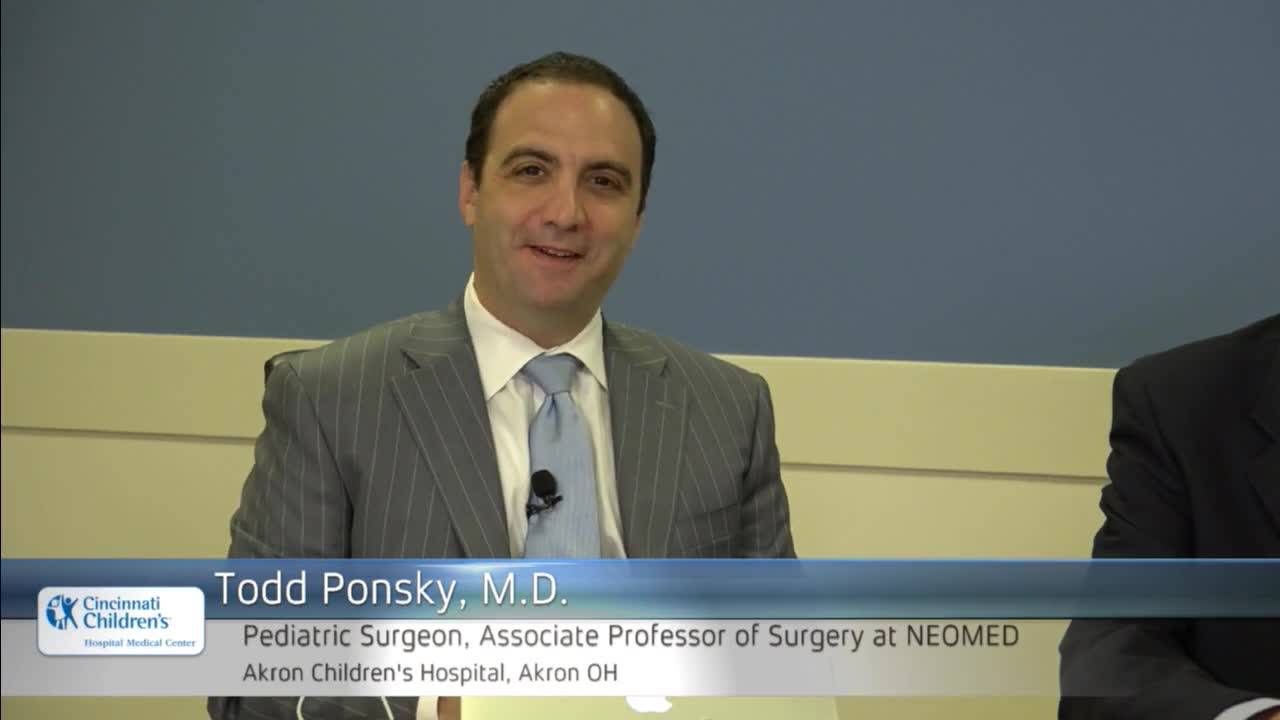
Welcome and Introductions: Pancreatic Disease
Dr. Todd Ponsky · 6 min · Published Sep 2016
Only a few other public items share this expert — go deeper there →
Video
Pediatric Surgical Oncology Research Collaborative (PSORC): Studying Rare Pediatric Tumors
56 s · Published May 2026
Video
Update Course Rewind 2025: Hirschsprung + ARM: Rare but Real
1 min · Published May 2026
Video
Update Course Rewind 2025: Hirschsprung + ARM: Rare but Real
1 min · Published May 2026
Video
Pooling Patients to Study Rare Pediatric Tumors: An Introduction to PSORC
56 s · Published May 2026
Video
The fetal frontier: A review of current and emerging fetal therapies for genetic diseases
44 s · Published May 2026
Video
Indocyanine green assists with sentinel lymph node mapping in pediatric and adolescent patients
1 min · Published May 2026
What the experts said
When draining pseudocysts through the GI tract endoscopically, it is important to evaluate the pancreatic duct status before removing catheters to check for communication, ductal disruption, or stricture.
Endoscopic drainage catheters are generally left in place for about 1 month to 6 weeks with repeat imaging before removal.
Percutaneous drainage was chosen over repeat EUS cystgastrostomy for the mediastinal pseudocyst in Case 2 because introducing a stomach-to-pseudocyst connection might create more retroperitoneal scarring and make the planned TPIAT more challenging.
Taking out the tail of the pancreas for a distal duct leak in a child with genetic pancreatitis would compromise islet yield if the patient needs total pancreatectomy in the future.
After cystgastrostomy catheter removal, the fistula typically closes within a few days, even if there is ongoing pancreatic duct leak, because the flow is usually not brisk enough to keep it open.
The Atlanta criteria classification scheme was described for adult patients and specifically did not consider pediatric patients, though it appears to hold true when extrapolated to the pediatric population.
Patients who undergo Puestow followed by total pancreatectomy have compromised islet yield compared to those who undergo total pancreatectomy without prior Puestow.
When considering whether a patient may need total pancreatectomy in the future, this significantly influences the decision to pursue conventional surgical options versus proceeding directly to TPIAT.
Puestow is typically considered for isolated large duct disease or chain-of-lakes appearance without an inflammatory mass in the head of the pancreas, and typically not in hereditary pancreatitis.
Intraoperative ultrasound can be used during Beger procedure to locate the bile duct, and sometimes the duct can be found by sticking a needle into it under ultrasound guidance.
In children with genetic etiology of pancreatitis, we are less likely to consider resectional and drainage procedures because the genetic makeup of the remaining pancreas will not change.
Genetics is involved in about 70% of chronic pancreatitis patients in the pediatric population.
Whipple is uncommonly considered in children with head-predominant pancreatic disease and is reserved primarily for cases with suspected malignancy.
Pancreatic duct leaks can manifest internally as peripancreatic fluid collections, pseudocysts, pancreatic ascites, pleural effusions, or pancreaticoenteric/biliary/bronchial fistulas, and externally as pancreaticocutaneous fistulas.
Transpapillary pancreatic stent placement has greater likelihood of success when the defect can be bridged, but certain leaks can still resolve despite inability to bridge the defect.
Risks of endoscopic intervention (EUS or ERCP) for pancreatic disease include developing or exacerbating pancreatitis, introducing infection into a sterile fluid collection, and developing pancreatic duct strictures from temporary stent placement.
Approximately 40% of acute pancreatitis patients will develop some form of fluid collection, but the majority resolve spontaneously, with less than 5% evolving into pseudocysts.
The revised Atlanta Classification (2012) categorizes inflammatory pancreatic fluid collections into four types: acute peripancreatic fluid collections, pancreatic pseudocysts, acute necrotic collections, and walled-off necrosis.
Pancreatic pseudocysts are formally defined when they reach a time threshold of 4 weeks or greater, contain high amylase-rich fluid with little to no internal debris, and have a well-defined non-epithelialized wall.
Endoscopic ultrasound has limited use in pediatrics due to limited pediatric indications, insufficient awareness of its capabilities, and a very limited number of pediatric gastroenterologists with appropriate EUS training.
Approximately 50% of chronic pancreatitis patients will eventually require surgery, with the most common indication being debilitating pain that fails to respond to medical and endoscopic treatment.
There is no clear consensus on optimal timing for surgical intervention in chronic pancreatitis; some advocate earlier surgery to avoid progressive inflammatory destruction, while others prefer a watch-and-wait approach due to variable surgical success rates.
Puestow procedure provides short-term pain relief in 75% of patients, but greater than 50% have recurrent pain, largely related to inability to fully decompress the duct or continued inflammation in the pancreatic head.
Whipple procedure for chronic pancreatitis provides good pain relief at 4-6 years but results in late endocrine and exocrine dysfunction in approximately 50% of patients.
Duodenum-preserving pancreatic head resections (Beger, Frey) achieve benefits of head resection and duct decompression while preserving bile duct and GI continuity.
The Beger procedure provides good pain relief in 80-85% of patients maintained at 5 years with minimal endocrine and exocrine insufficiency compared to Whipple, based on adult data.
The Frey procedure shows equivalent pain relief (85-90%) and quality of life outcomes compared to Beger procedure in adults.
For conventional surgical procedures in chronic pancreatitis, about 50% of patients have recurrence of pain over the long term based on adult data, with no long-term pediatric data available.