


From
StayCurrentMD
The use of postoperative calibrations in Hirschsprung disease
hosted by Dr. Lizzie Lee
Chapter 1 of 1 · Evidence & Research
Postoperative Dilation Protocols in Hirschsprung Disease
Expert statements on this page
No expert statements were drawn from this page.
Host summaries · secondary, not cited in answers
Educational content from recorded physician discussions — not medical advice. Talk to your (or your child's) care team about your situation.
Video
Quick Literature Updates Ep 22
4 min · Published Oct 2025
Video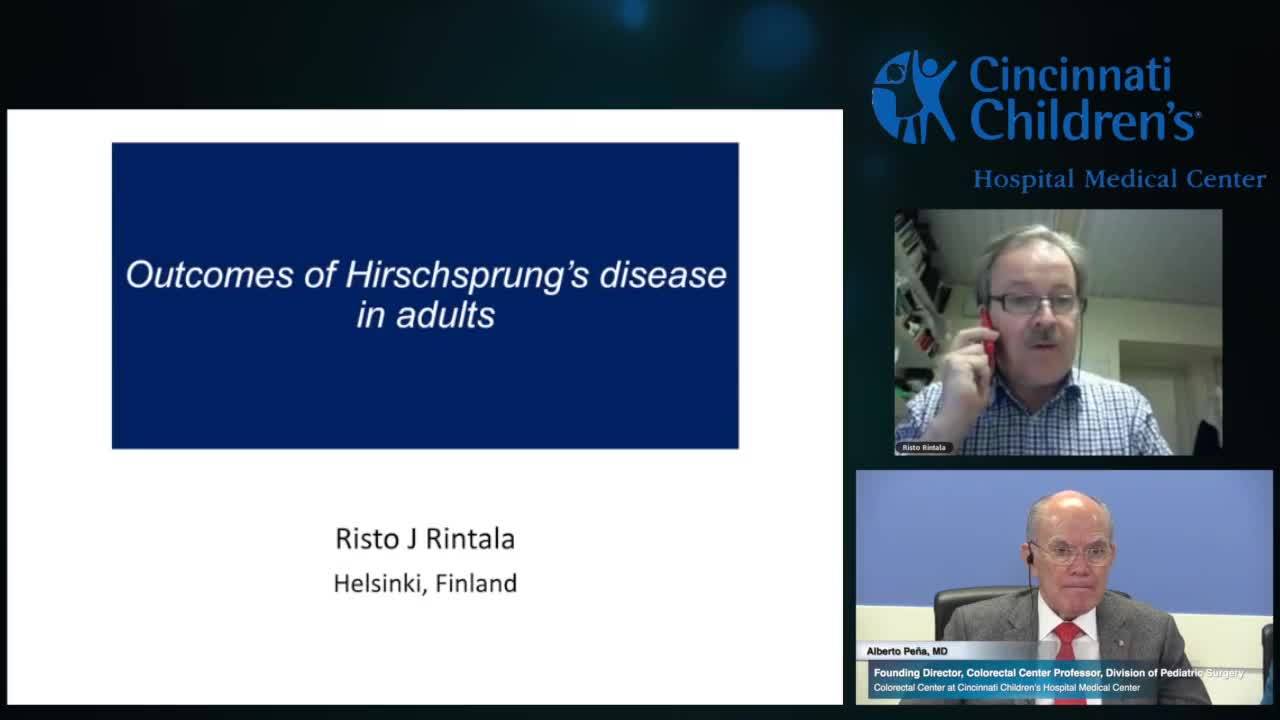
Adult Outcomes: Hirschsprung Disease
20 min · Published Feb 2015
Video
Does Delayed Diagnosis of Hirschsprung Disease Impact Post-operative and Functional Outcomes? A Multi-Center Review From the Pediatric Colorectal and Pelvic Learning Consortium
1 min · Published Oct 2024
Video
How to Administer a Rectal Irrigation at Home
5 min · Published Jun 2023
Podcast
Hirschsprung Disease Workup
10 min · Published Jul 2021
Video
CAPS - Educational Outcomes in School Age Children with a History of Hirschsprung’s Disease - Michael Cowap
Published May 2022
Video
Validation of an anorectal malformation trainer - Can a high-fidelity model simulate real life?
1 min · Published Jun 2026
Video
Complications and Long-Term Outcomes of Patients With Cloacal Malformation After Bowel Neovagina...
1 min · Published Jun 2026
Video
Safety and utility of long-acting steroid injection for management of post-operative stricture...
1 min · Published Jun 2026
Video
Association Between Social Determinants of Health and Choice of Urinary Reconstruction in Children
1 min · Published Jun 2026
Video
The Perineal Body Preserving PSARP (PPP)
11 min · Published Jun 2026
Video
Update Course Rewind 2025: Hirschsprung + ARM: Rare but Real
1 min · Published May 2026
Video
Intestinal Atresia Types Explained: Grossfeld Classification for Pediatric Surgery
1 min · Published Sep 2026
Video
Derivation and validation of the Pediatric Community-Acquired Pneumonia Severity (PedCAPS) score: A prospective cohort study
50 s · Published Sep 2026
Video
FETO for Late-Diagnosed Severe Congenital Diaphragmatic Hernia (CDH) at Cincinnati Children's with Dr. Beth Rymeski
4 min · Published Sep 2026
Video
Severe Congenital Diaphragmatic Hernia (CDH) Case: FETO Management & Unexpected Findings with Dr. Beth Rymeski
3 min · Published Sep 2026
Video
Fetoscopic Endoluminal Tracheal Occlusion (FETO) Procedure: Step-by-Step Guide with Dr. Beth Rymeski
4 min · Published Sep 2026
Video
Choledochal Cyst Types Explained: Pediatric Surgery Fundamentals
1 min · Published Sep 2026
What the experts said
The study was prospective and took place from 2021 to 2023
The study included 33 patients under six months old who underwent endorectal pull-through surgeries
Patients were assigned to either a new non-dilation protocol group or a traditional dilation group
The primary outcomes measured were anastomotic complications, enterocolitis, and constipation
There was no significant difference in anastomotic complications between the two groups
The non-dilation group had less enterocolitis compared to the traditional dilation group
The non-dilation group had less constipation compared to the traditional dilation group
Choosing not to do postoperative anal dilations may be a good alternative with benefits like lower constipation and enterocolitis