


From
StayCurrentMD
QUAD #22: What is CHARGE syndrome? with Dr. Catherine Hart
With CCHMC Pediatric Surgery
Chapter 1 of 1 · Fundamentals
CHARGE criteria
CHARGE Syndrome Definition and Diagnostic Criteria
Expert statements on this page
No expert statements were drawn from this page.
Host summaries · secondary, not cited in answers
Educational content from recorded physician discussions — not medical advice. Talk to your (or your child's) care team about your situation.
Video
QUAD #8 EA/TEF Repair– Thoracoscopic vs Thoracotomy, Role of ENT with Dr. Catherine Hart with Dr. Catherine Hart
CCHMC Pediatric Surgery · 5 min · Published Mar 2024
Video
QUAD #23: CHARGE Syndrome, Airway Considerations with Dr. Catherine Hart
CCHMC Pediatric Surgery · Published Jan 2025
Video
QUAD #16 - Flexible Bronchoscopy in Management of Slide Tracheoplasty Patients - Sara Zak
CCHMC Pediatric Surgery · 9 min · Published Oct 2024
Video
Interesting Case Presentations Part II: EA/TEF
66 min · Published Dec 2012
Video
Aerodigestive & Esophageal Surgery: Aspiration in TEFs
5 min · Published Dec 2014
Video
QUAD #24: CHARGE Syndrome, Pulmonary Considerations with Dr. Cherie Torres-Silva
CCHMC Pediatric Surgery · Published Jan 2025
Video
Surgeon annual volume impacts recurrence rates of pediatric inguinal hernia repairs: A multi-institutional study
54 s · Published Feb 2026
Podcast
Journal of Pediatric Surgery Article Review: 2nd Quarter (Apr-Jun) 2025
16 min · Published Aug 2025
Video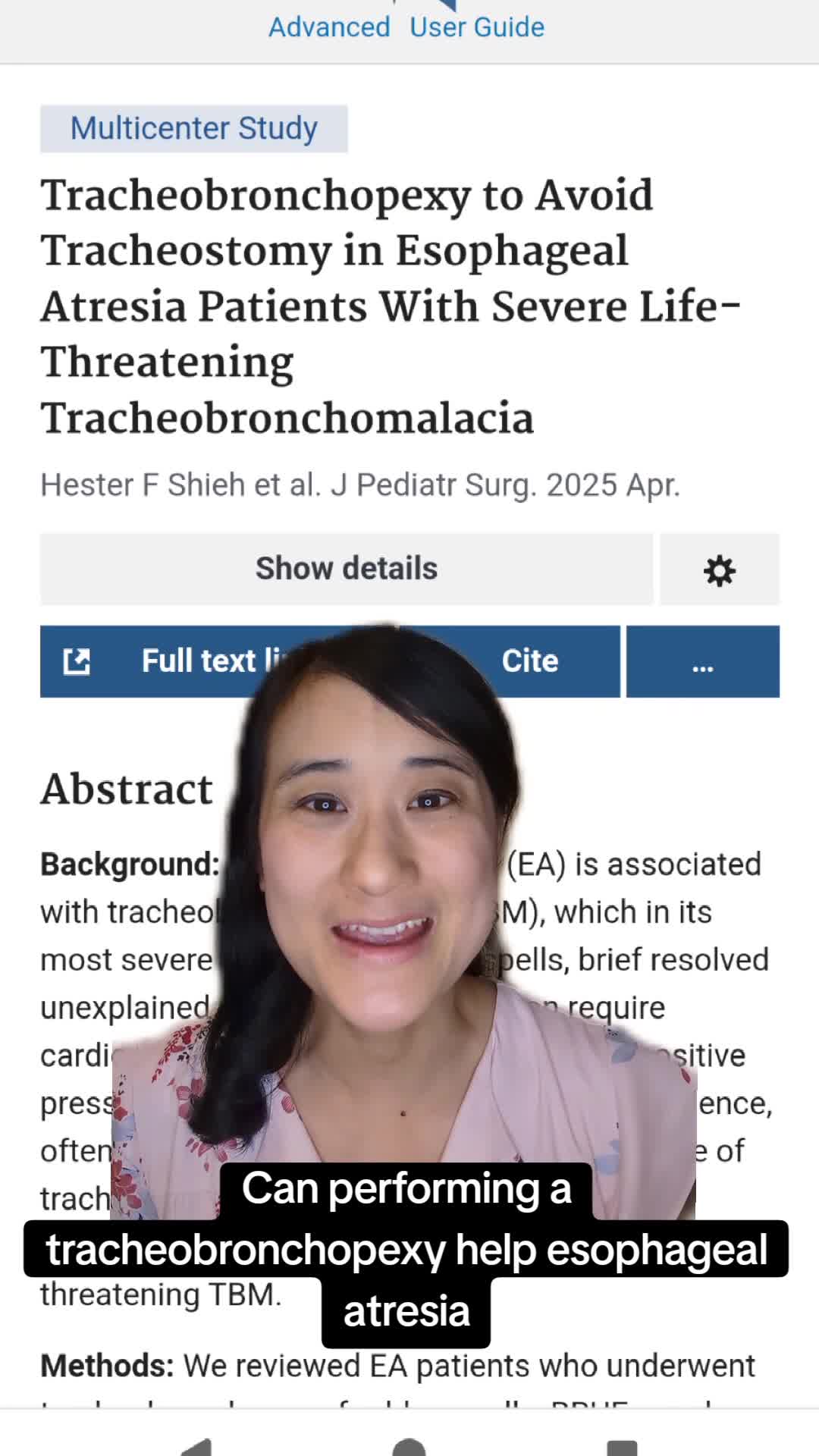
Tracheobronchopexy to Avoid Tracheostomy in Esophageal Atresia Patients With Severe Life-Threatening Tracheobronchomalacia
50 s · Published Apr 2025
Video
QUAD #27 - Multidisciplinary - How Do Teams Enhance Outcomes by the CCHMC ADEC Team
CCHMC Pediatric Surgery · 10 min · Published Apr 2025
Video
QUAD #25: Medical Management of Minor Laryngeal Clefts with Dr. Greg Burg
CCHMC Pediatric Surgery · 7 min · Published Feb 2025
Video
QUAD #20: Endoscopic Repair of Minor Laryngeal Clefts with Dr. Catherine Hart
CCHMC Pediatric Surgery · 6 min · Published Nov 2024
Video
Intestinal Atresia Types Explained: Grossfeld Classification for Pediatric Surgery
1 min · Published Sep 2026
Video
Derivation and validation of the Pediatric Community-Acquired Pneumonia Severity (PedCAPS) score: A prospective cohort study
50 s · Published Sep 2026
Video
FETO for Late-Diagnosed Severe Congenital Diaphragmatic Hernia (CDH) at Cincinnati Children's with Dr. Beth Rymeski
4 min · Published Sep 2026
Video
Severe Congenital Diaphragmatic Hernia (CDH) Case: FETO Management & Unexpected Findings with Dr. Beth Rymeski
3 min · Published Sep 2026
Video
Fetoscopic Endoluminal Tracheal Occlusion (FETO) Procedure: Step-by-Step Guide with Dr. Beth Rymeski
4 min · Published Sep 2026
Video
Choledochal Cyst Types Explained: Pediatric Surgery Fundamentals
1 min · Published Sep 2026
What the experts said
The CHARGE acronym stands for coloboma, heart defects, atresia of the choana, retardation of growth and development, genital and/or urinary anomalies, and ear malformations.
CHARGE syndrome is caused by a CHD7 mutation on chromosome 8.
A population of children with CHARGE syndrome will have a negative test for CHD7 but can still have CHARGE syndrome based on clinical criteria.
To make the diagnosis of CHARGE syndrome, you must have at least two of the major criteria.
The major criteria for CHARGE syndrome are coloboma, choanal atresia or cleft palate, characteristic ear abnormalities, and cranial nerve abnormalities.
If you have the major criteria, you have CHARGE syndrome independent of other clinical features.
To make a definitive clinical diagnosis of CHARGE syndrome, you need either 3 major features and at least 1 minor feature, or 2 major features and 2 minor features, or the CHD7 mutation.