


From
StayCurrentMD
Does Delayed Diagnosis of Hirschsprung Disease Impact Post-operative and Functional Outcomes? A Multi-Center Review From the Pediatric Colorectal and Pelvic Learning Consortium
With Dr. Alex Halpern
Chapter 1 of 4 · Evidence & Research
Introduction
Expert statements on this page
No expert statements were drawn from this page.
Host summaries · secondary, not cited in answers
Educational content from recorded physician discussions — not medical advice. Talk to your (or your child's) care team about your situation.
Video
Quick Literature Updates Episode 17
4 min · Published Feb 2025
Video
CAPS - Educational Outcomes in School Age Children with a History of Hirschsprung’s Disease - Michael Cowap
Published May 2022
Video
The use of postoperative calibrations in Hirschsprung disease
59 s · Published Nov 2024
Podcast
Hirschsprung Disease Workup
10 min · Published Jul 2021
Video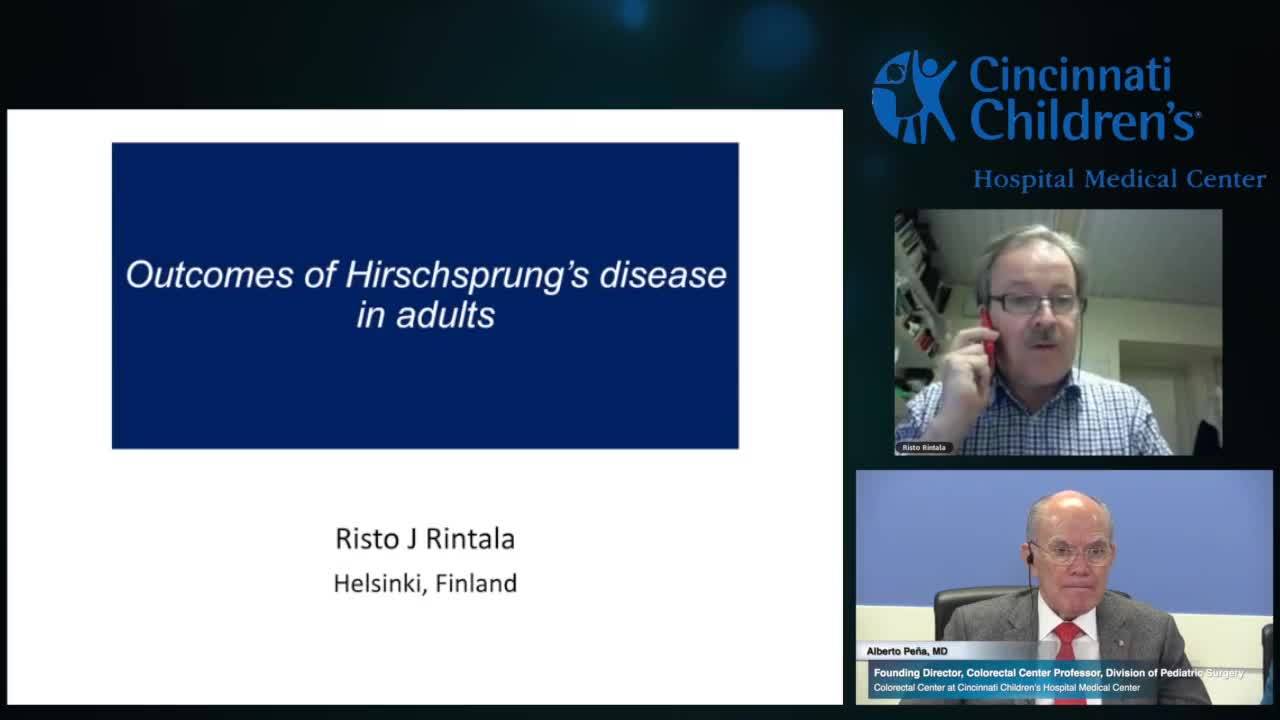
Adult Outcomes: Hirschsprung Disease
20 min · Published Feb 2015
Video
Update Course Rewind 2025: Hirschsprung’s Pull-Through: Why Family Training May Save Lives
2 min · Published May 2026
Video
Validation of an anorectal malformation trainer - Can a high-fidelity model simulate real life?
1 min · Published Jun 2026
Video
Complications and Long-Term Outcomes of Patients With Cloacal Malformation After Bowel Neovagina...
1 min · Published Jun 2026
Video
Safety and utility of long-acting steroid injection for management of post-operative stricture...
1 min · Published Jun 2026
Video
Association Between Social Determinants of Health and Choice of Urinary Reconstruction in Children
1 min · Published Jun 2026
Video
The Perineal Body Preserving PSARP (PPP)
11 min · Published Jun 2026
Video
Update Course Rewind 2025: Hirschsprung + ARM: Rare but Real
1 min · Published May 2026
Video
Quick Literature Updates Ep 27
4 min · Published Feb 2026
Video
Quick Literature Updates Ep 26
4 min · Published Jan 2026
Video
Quick Literature Updates Ep 23
4 min · Published Oct 2025
Video
Quick Literature Updates Ep 22
4 min · Published Oct 2025
Video
Quick Literature Updates Ep 21
4 min · Published Sep 2025
Video
2025 Pediatric Surgery Update Course - Updates in Pediatric Surgery feat. JPS Articles
Dr. Todd Ponsky · 15 min · Published Aug 2025
Video
Intestinal Atresia Types Explained: Grossfeld Classification for Pediatric Surgery
1 min · Published Sep 2026
Video
Derivation and validation of the Pediatric Community-Acquired Pneumonia Severity (PedCAPS) score: A prospective cohort study
50 s · Published Sep 2026
Video
FETO for Late-Diagnosed Severe Congenital Diaphragmatic Hernia (CDH) at Cincinnati Children's with Dr. Beth Rymeski
4 min · Published Sep 2026
Video
Severe Congenital Diaphragmatic Hernia (CDH) Case: FETO Management & Unexpected Findings with Dr. Beth Rymeski
3 min · Published Sep 2026
Video
Fetoscopic Endoluminal Tracheal Occlusion (FETO) Procedure: Step-by-Step Guide with Dr. Beth Rymeski
4 min · Published Sep 2026
Video
Choledochal Cyst Types Explained: Pediatric Surgery Fundamentals
1 min · Published Sep 2026
What the experts said
The Pediatric Colorectal and Pelvic Learning Consortium conducted a multi-center retrospective review from 2017 to 2023 examining the relationship between delayed diagnosis of Hirschsprung disease and postoperative/functional outcomes.
The study included 679 patients with Hirschsprung disease from 14 different sites.
Increased age at diagnosis was associated with a greater likelihood of undergoing fecal diversion after initial pull-through procedure.
Increased age at diagnosis was associated with an increased risk of constipation or incontinence requiring intervention postoperatively.
No association was found between age at diagnosis and 30-day complication rate after initial pull-through.
No association was found between age at diagnosis and need for pull-through revision.
Delayed diagnosis of Hirschsprung disease affects certain postoperative and functional outcomes in patients.