


From
StayCurrentMD
Pectus Bar Dislocation: Comparison Between Three Different Stabilization Techniques Adopted in a Single Centre
hosted by Dr. Lizzie Lee
Part of
Pectus Excavatum 58 items
Chapter 1 of 1 · Evidence & Research
Bridge vs Single Bar Fixation for Pectus Excavatum
Expert statements on this page
No expert statements were drawn from this page.
Host summaries · secondary, not cited in answers
Educational content from recorded physician discussions — not medical advice. Talk to your (or your child's) care team about your situation.
Video
Quick Literature Updates Ep 24
4 min · Published Nov 2025
Video
Criteria for Pectus Repair: Update Course 2015
55 s · Published Nov 2015
Video
Vacuum Bell Therapy for Pectus Excavatum: Long-term Experience at a Single Center
58 s · Published Apr 2025
Video
Novel index to estimate the cephalocaudal extent of the excavation in pectus excavatum - JPS article
1 min · Published May 2023
Video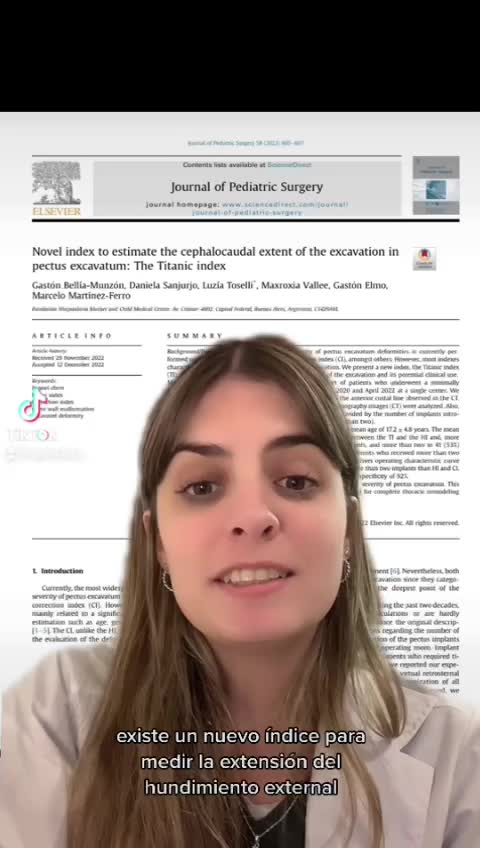
Novedoso indice para estimar la extensión cefalocaudal del hundimiento esternal en el pectus excavatum: El Índice Titanic
Published May 2023
Video
Cardiopulmonary Impact of the Minimally Invasive Repair of Pectus Excavatum in Pediatric Patients: A Prospective Pilot Study
55 s · Published Apr 2025
Video
Intestinal Atresia Types Explained: Grossfeld Classification for Pediatric Surgery
1 min · Published Sep 2026
Video
Derivation and validation of the Pediatric Community-Acquired Pneumonia Severity (PedCAPS) score: A prospective cohort study
50 s · Published Sep 2026
Video
FETO for Late-Diagnosed Severe Congenital Diaphragmatic Hernia (CDH) at Cincinnati Children's with Dr. Beth Rymeski
4 min · Published Sep 2026
Video
Severe Congenital Diaphragmatic Hernia (CDH) Case: FETO Management & Unexpected Findings with Dr. Beth Rymeski
3 min · Published Sep 2026
Video
Fetoscopic Endoluminal Tracheal Occlusion (FETO) Procedure: Step-by-Step Guide with Dr. Beth Rymeski
4 min · Published Sep 2026
Video
Choledochal Cyst Types Explained: Pediatric Surgery Fundamentals
1 min · Published Sep 2026
What the experts said
Bridge fixation was significantly more stable than single bar fixation.
Bridge fixation is the best technique for preventing bar dislocation in pectus excavatum patients.
The study was an observational perspective study conducted in Italy from 2013 to 2022.
The study included 468 patients around 15 years old.
Surgeons placed 733 bars total across the patient cohort.
Bar dislocation is defined as when a bar rotates more than 30 degrees out of place.
None of the patients with bridge fixation had dislocated bars.