Hepatoblastoma: Update Course 2014
Timestops (7)
Tools Used
Topic Overview
Key Takeaways
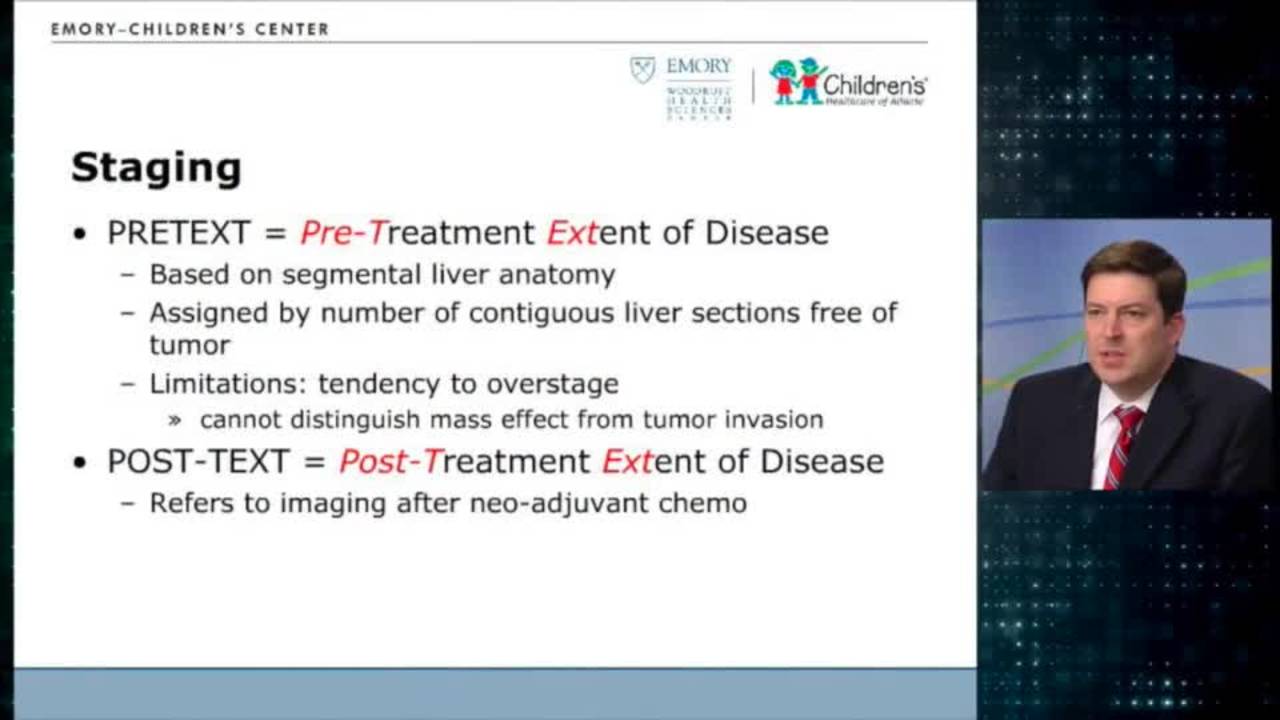
- PRETEXT staging (pretreatment extent) tends to overstage hepatoblastoma due to mass effect mimicking vascular invasion on imaging.
- PRETEXT staging uses segmental liver anatomy: stage 1-4 based on sectors involved, with annotations for vascular involvement (IVC, hepatic veins, portal bifurcation).
- Cross-sectional imaging (CT or MRI) is critical for staging; MRI increasingly preferred though no clear superiority established.
- PRETEXT 2 tumors with no vascular involvement may warrant neoadjuvant chemotherapy before resection per COG protocols.
- POST-TEXT staging (post-chemotherapy) provides more accurate assessment of resectability after tumor shrinkage from neoadjuvant therapy.
Keywords
Hashtags
Transcript
So, um, yeah. Here we go. Okay. So, um, my goals with this um were first of all, just to sort of blow through some quick stuff which is sort of an update on um staging because I don't know that um everyone necessarily is well informed about pretext and post text um staging of hepatoblastomas. And then after that get into um some of the current recommendations from COG in terms of um resections of tumors based on that staging. And then hopefully at the end, um get into the area of controversy and with hepatoblastoma, we don't really have um the the areas of controversy aren't don't have studies that are well-powered like you know Wilms tumor. And so, um it really is I think um maybe an area for more debate and um probably has a lot of opinion built into it. So um, so this is the first scenario that I um put up to cover this um staging issue and um so you have a two-year old boy who presents the emergency room with abdominal pain, lethargy, five pound weight loss, jaundice and dark urine. Um on exam has a large abdominal mass and uh CT AWB pelvis is done with IV contrast. shows the image, it shows multifocal disease affecting um all sectors of the liver with an elevated AFP. So the presumptive diagnosis of hepatoblastoma is made based on that. Um how would how would people um uh stage this patient? So 75% are saying four. Okay. 80%. Okay, so so yeah, so um so the the issue with staging so so pretext staging um sorry. Pretext staging stands for pretreatment extent of disease and um this staging system is based on segmental liver anatomy and and the important thing about this is this is staging prior to chemotherapy has been given. So so this patient is definitely a pretext and um and then you know I tried to make it relatively straightforward has one or four and you know with multifocal uh disease you're clearly not going to be a one. Um the interesting thing about pretext staging is that um it has a tendency to overstage. Um because this is based purely on imaging and many of these tumors are so bulky, um it it's hard to assess whether or not there's true vascular invasion sometimes or if it's just big uh mass effect of tumor so pressing on portal uh vein, hepatic veins, things of that nature. Post text uh in contradistinction refers to extensive disease after neoadjuvant chemotherapy has been given. So um these are just some images that I borrowed from um COG website you can see that pretext stage one involves one sector of disease. Um two involves uh two sectors the disease of of the liver. Um three is three sectors. Um one specifically spared because it's not um necessarily three contiguous and then four is um the the image that showed which is multifocal disease. So um so the next question for the audience would be which of the following other considerations are not factored into staging. there. Going to pull up in a second. We can blast through this. I guess there's an issue here. Yeah. Yeah, okay, all right. So basically um extramedullary hematopoiesis is not involved. I mean there are a bunch of additional annotations that are made. I think the two key ones that people look at are involvement of the retrohepatic cava or um hepatic veins and then um the portal vein uh bifurcation whether or not that's involved. Okay, so this image isn't coming up clearly but um for some reason the slides not loaded right but the the image that I have um is to say that you have a tumor that's classified as a pretext two, there's no involvement of the retrohepatic cava or the um hepatic veins and the portal vein confluence is spared. So appropriate management um strategies for this patient would include the following. Is that up? People can actually pull off of it or Yeah, Mark, can we get these polls or We're not seeing them. Sorry Matt, we'll try to get the. So that's okay. So so we can just sort of go through it. I mean um the the question is really I think boils down to um what would people do in the setting of a pretext two with no involvement of the um hepatic veins or portal veins. So maybe while we're waiting for that to come up we could just. Yeah and and Mark if you can't find the polls at least just write A B C D. Even if you can't. They're right next to you but the one that's just right here, that's not opening. Um the last two we don't see. There we go. opening. You have to scroll up to it. So you had commented before about the fact that the the pretext overstages uh patients and uh in a case like this would you base this on uh what kind of imaging studies do you get to make this kind of a decision? Yeah, so that's a good question. So I think I I think there's um people favor different things. Some people look at um CT um with multi contrast phase and other people favor MR. Um and I think that uh I I don't know that one's been shown to be superior. Um but I think clearly cross-sectional imaging is absolutely critical to to staging these. So does anybody get other studies other than would you get a CT or an MR? Steve, would you use CT or MR in your institution? We're using more and more MR. MR. MR. Both. Both. Yeah, well that's one of my concerns is frequently we end up with. Yeah they all end up with both somehow. Any role for pet scan? I don't know that Pet's really I mean I don't think Pet's going to be useful to to to use. Got to have one available in your hospital. However the converse is also true if you have one available then everybody. Right well I mean our we don't even have the oncologist are just getting pet scans in more and more patients and diffuse area and and it's like you have information and kind of what do you do with it type of thing. Because if you're going to make a decision based on the pretext uh staging you have to be able to trust your imaging uh or your imaging may play a factor in the answer to this question as to whether you think you would proceed directly to surgery or not. Absolutely. And so the the audience 60% is going with B. give chemo first. Give chemo first. So yeah, so this so this is sort of an interesting thing because if you look at the um recommendations um by COG, they would say that you know if you can get um a clear margin um on a pretext two, um you know a good margin a 1 cm margin doesn't involve any of the vascular structures that you just go for the um hepatectomy up front. Um and and you know and and I think that they're pretty clear also that um they feel that this is not something that necessarily gets referred to an area of you know expertise and liver resection that the ones and twos um if the surgeon feels competent should be resected locally which is sort of interesting. Well your diagram showed the tumor pretty close to the portal vessels. So I think that might have scared some people. You want a margin. Yes, absolutely. So so and and this issue of margin I bring up later on um because I think it um there's some controversy there too um in terms of what people refer to as a negative margin. Um people talk about shaving um tumors off the vessels and whether or not that's a negative margin or whether um you know cautery artifact actually obscures the fact that you may or may not actually have a negative margin. People use the cusa to come through the um liver that there's actually, you know some width there probably, you know five, six millimeters of tissue division and so does some of your tissue margin actually go um up the suction device and so you know. But some of the some of the decisions on this may also be uh related to differences in philosophy in the approach in the United States versus the approach in Europe. Is that true? Um certainly for Wilms tumor there is the European approach is to get chemotherapy first no matter what. Yes, um I think that's true. I think that um interestingly the um it's from from what I've uh read it seems to me that the um North American and European um approaches seem to be converging similarly. I think that's true. I'm people like Rebecca Myers who's has spent years getting those uh getting the two groups to come together on uh on an approach because as you mentioned at the outset they're very the what 100 hepatoblastomas in the country. You're so the only way uh to make progress with this is to to have a combined approach with the European groups and Rebecca spent a lot of time getting that organized. Um so another thing I think that's worth mentioning here is just um this issue of tumor shrinkage that we were talking about chemotherapy effect and um with hepatoblastoma I think the the recommendations are pretty clear now that most of the shrinkage of the tumor volume that you're going to get is going to be within the first two cycles. And so there are some, you know groups that in the past have advocated for giving more chemo before proceeding with resection and I think now the the recommendations are pretty clear that after two cycles if you haven't shrunk to a point that makes the tumor resectable that the patient be evaluated for transplant. Um there's been some nice studies done on that. The other interesting thing about that um I think the group out of Vanderbilt looked at this but the the the ways in which the tumors shrink is um something to consider because um you know some people would would say well you know if you give more chemo maybe you get more of a vascular margin. It turns out that as the tumor shrinks it doesn't really shrink away from the vascular supply um all that all that much and so um so that's sort of you know shrinks down in terms of size. It doesn't give you more of a margin. Exactly. So maybe maybe you preserve but not vascular margin. So don't do so don't do chemo for the vascular margin. Exactly. Wow. So so when you evaluate imaging do you want a 1 cm margin? Is that what you'd recommend to the audience? Yes, I would say a 1 cm margin is is the goal, yeah. Now, if you if you look at the survival results I'm sure you're probably going to show the data if you can get you can get the thing out. Don't those patients do better? They tend to do better and you know and we'll we'll go through a little bit of this because I think some of that controversy exists on who has better survival? Um somebody who has a very extended resection like you know a right trisegmentectomy or somebody who goes on and just gets a transplant. And I think um in years past it was felt that um very extensive or quote unquote heroic resections um were undertaken you know things like um tumor liver explants with back table resections and then reimplants, portal vein reconstructions, um hepatic vein reconstructions and I think the the take home message from that after it having been done for years um is that the survival in those patients is actually not as good as the transplant survival. So there's been sort of this move away from some of these certain heroic resections. But I think the other the other question is chemo, you know, if you if you're going to commit them to two rounds of chemo, those patients they get chemo don't have as high survival as a primary resection or do they? That's the question. I was just going to say prior to that with the previous discussion about you should if you can get it out you should try to get it out because they have a better survival. But if you try to get it out and you can't and they require then you have not done them a favor because then they have worse survival. So you have to be pretty confident that you're going to be successful in getting out out with a margin is that what you're saying? Or with a margin although I you know the data better than I but the the significance of a microscopic margin is unclear. What's the incidence of the ones that uh they recently out for a liver transplant, getting a liver transplant. Right. Uh what is the availability of organs because you have to factor that into which course you're going to take. Yeah, and and I think that that's an important um point is you know when you're looking at well I'll put it on this but um wh when when you're looking at patients that are going to go the route of transplant versus a right trisegmentectomy, you have to say well, you know if we put them into the transplant group, number one, what's organ availability like? Number two, you've committed now a very young child to lifelong immunosuppression which is not um an entirely benign thing. So um but to Dr Van Almon's point, you know these what they call rescue transplants that there's a failed resection that then goes on and needs a transplant. Those patients it's pretty clear do fair worse off than patients that are a plan transplant up front. Yeah, so that's been my rule of thumb. If I don't think I can get a margin and they don't respond to chemo so I can get a margin, they should be referred for transplant before resection. Is that still true? Yeah, so so the the It's that's a critical uh point. Yeah, I I think the current thinking is that you refer to the transplant center early. Doesn't necessarily mean that the patient's going to go towards transplant. You still might give two cycles of chemo and see where you end up, but at least you want the patient plugged into the system, have all the pre-transplant evaluation done sort of have them sort of plugged in in the event that they need to go that route. I think the concept is that the patients in whom transplantation is done as salvage therapy, don't do as well as a primary transplant. That's very clear. Yes. The primary transplant patient does surprisingly well. You know doing a transplant and immunizing somebody against rejection who has cancer has always been a a major question. Is that a safe thing to do? And it seems as though uh the liver patients do extremely well following the transplantation despite being immunosuppressed. And so so should all these complex liver resections for hepatoblastoma be done in here we go back again. You took word right out of my mouth. I was going to ask exactly the same question. Should they be done in centers that do pediatric liver transplants? Uh I think that's the way they do it in the UK. I mean I I think that's a critical obviously a very complicated uh question in terms of Same with biliary atresia. Yeah. But biliary atresia is different. Uh that's that operation it's not a big operation. It's easy to do. But the transplant is. So they they all those patients who have biliary atresia are referred up front to a transplant center. See, but they have time. I mean biliary atresia is is slowly get sick over time. This is different. These people, these children are going to get sick really quickly. If you're in a place that doesn't have a transplant program, you can't do all the uh arranging uh for a potential transplant. I'm not advocating total uh specialization for everything we do, but these are issues that are in the current year and put in a look at. So, so for the people who are at non-transplant centers, do you have criteria that you use to How would you manage a patient who has a questionably resectable tumor? Would you do it? Appears to be inactive and will be ended soon. you're on. Saved by the bell. I'm back next week. any key your telephone. Are we off the air? We just got a message. Audio feed. I think the audio's down. Okay. Okay. So so non-transplant center surgeons, I don't even know how many we have. Oh, that's that'd be yeah. So so what how do you manage? Because you do liver liver resections. So I I I think if there's I I need to feel very comfortable that I can do the resection. I mean, you know, first of all you have to decide are you comfortable doing major liver resections. assuming that then I need to feel very comfortable before I start the procedure that I'm going to I'm going to succeed and that's not that you couldn't have a complication or problem but that within my skill set there's a 95% chance that we're going to we're going to do that. And if I don't feel confident with that then I will refer them to a transplant center because to be in between is I think you've you've done a significant disservice. Risky business. Yeah, for us I think if you can do an anatomic resection with a good margin, I think that's fine you would proceed down. But if it's anything close to the hepatic veins, if you have disease that extends across the liver or anything in the portal vein, you should send it. And would you give pre-op chemotherapy to get to that point or would you send them before? Well you know we've we've actually had three in the last two months and then we go six months and don't really have them. I think it's case by case, but we have sent sent them early when we just as surgeons felt like um they couldn't be resectable and I I would say we've had a couple that we sent to your institution for that and you guys were able to safely resect it um because you probably have a little bit more confidence and do a lot more uh liver resections and the patient never did need a turn. So I think that's another value. But but Deb brings up another I don't want to be creating all these paradigms, but brings up another situation that's real and that is that the liver transplant surgeon has a lot of experience with operating on the liver. And so if there are issues being close to the portal vein, being close to the hepatic veins, it's not so bad to have somebody like that that might be available to help the pediatric surgeon who's done a lot of liver resections do it even better in this day and age. And there's no reason that the scans can't be sent to somebody from that center to have a look at to help you make the decision if that's somebody they should see earlier. There's nothing like looking at the anatomy with a belly open. we do all these laparoscopic ways. Touch. Too short. So yeah, well despite despite all the imaging that that that's available uh I think anybody who's done a fair number of liver resections will tell you that the truth is at the time of the operation whether it's resectable or not. And despite of all that. And uh people in Europe early on will give all liver tumors chemotherapy up front and then do the surgery because it's easier it's smaller tumors. think perhaps can avoid trans. Yeah. And that was their reasoning for it. But in our country avoiding a transplant and lifelong immunosuppression, you know is something if you can avoid it, it's probably okay. So I I I would not hesitate doing a trisegmentectomy for cure. And perhaps in certain centers I know Mike has had some experience doing central hepatectomies, which is a difficult operation, but he's done them successfully and the patients have been cured without requiring a transplant. So the you know there's a lot of thought process that goes into it. But certainly those uh procedures should be done by experienced personnel. We've had a couple kids who are over the age of three, like eight and nine with hepatoblastoma. Likewise we've had hepatoceller. Do you biopsy kids outside do you have a do you biopsy before you treat with chemo just to be sure it's really a hepato one or the other and how do you do that? Do you do it open or do you do it Yeah, so so I think um based on what I've read, um it seems that the field is sort of divided. So there are some people that would say you could do core needle biopsies and they usually recommend I think about 10 passes of the needle and that you're supposed to go through an area that includes normal parenchyma and that um and obviously you know get tumor uh as well. Our practice has not necessarily been to do that. We typically do an open wedge if we're you know to to get tissue but I'd be interested to see what other people do. I think we got to we're going to have to. Yeah is there any final final things that you wanted to hit before we move? But you've got you know in the last final 60 seconds. Well, the only other thing I would say is that I think a a topic of debate um is really this other issue of pulmonary metastasis in hepatoblastoma and the treatment of the pulmonary mets because um there are two different camps on this issue and one would say you know if you um you should resect the metastasis up front and then go on to do your um hepatectomy after. There's others that would say um well, you know the the growth factors that are secreted by the liver as it regenerates are going to stimulate growth of other sites in the lung that may not have been previously recognized. And so that maybe there was a benefit to waiting and doing it after because then you can actually clear them of disease. But I I don't know that there's good data on either side of this. all of it's limited to a handful of patients in in both sets. Matt, one last question on that. The the thought had been that they treated with chemotherapy and have stage four disease and the tumor in the lung disappears on chemotherapy alone. Do you go ahead and do the transplant? Or do you do the resection? And what happens then if you have everything that responds but you only have one or two nodules left in the lung that didn't respond to chemotherapy, would you operate on those patients? Right, and so um so again, that's um a small subset of of patients and the the papers that are out there are limited literally to a cohort of I think less than 20 um where this has really been looked at. So it's hard to really draw any good conclusions. Um the the other piece to this is that there may be some selection bias in what's reported or reporting bias because if you have a good response to chemo and you go on to do a transplant and your patient is a long-term survivor, that's a patient that gets reported as a success. But I don't know that the um all the failures are being uh reported. So to that point, um there's um a group and I think this would just be the last little thing to mention. there's a group um called um let's see if we can go back to it. Pluto, um this pediatric liver unresectable tumor observatory and this is um an international group and and they're really seeking to answer those questions because it's not answerable at individual centers or even multi centers within I think North America or Europe. This really takes, you know a global initiative to answer some of these questions and so they're looking at all these things, but I think it's probably going to be several years before we can really answer any of those questions. Okay. Thank you very much.