2024 Laparoscopic Hernia Event
Space: Live Event Content
Published: 2024-06-24
2
Views
0
Likes
0
Shares
0
Comments
Timestops
0:00
Introduction to Hernia Discussion
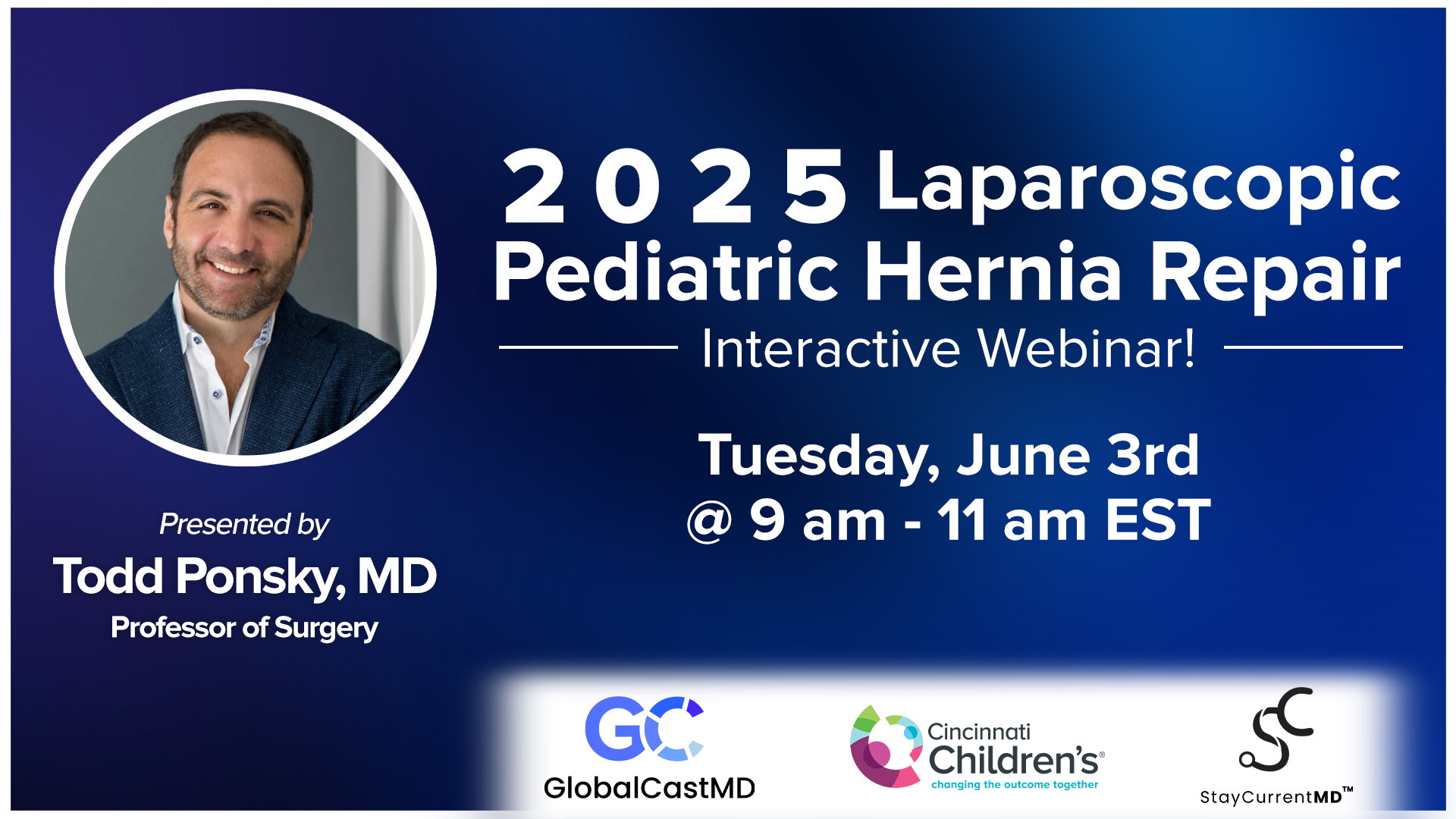
Todd Ponsky introduces the interactive session on inguinal hernia repair, emphasizing the importance of community discussion and thanking donors for their support.
12:06
Understanding Inguinal Hernia Repair
Discussion on the commonality of inguinal hernia repairs in pediatric surgery and the various techniques used, highlighting the lack of a definitive 'best' method.
30:15
Poll on Management of Groin Bulge
Participants engage in a poll regarding the management of a child with a groin bulge but no physical findings, exploring different surgical approaches.
48:25
Controversy in Appendectomy and Hernia Repair
Discussion on the management of a patent processus vaginalis encountered during an appendectomy, with varying opinions on whether to repair or monitor.
1:06:34
Contralateral Evaluation in Hernia Repair
Exploration of the debate surrounding contralateral evaluation during hernia repair, weighing the risks and benefits of additional surgical intervention.
1:24:43
Timing of Surgery for Preterm Infants
Discussion on the timing of hernia repair surgeries for preterm infants, emphasizing the risks of incarceration and the importance of follow-up.
1:42:53
Techniques for Repairing Inguinal Hernias
Overview of various techniques for repairing inguinal hernias, including open repair and laparoscopic methods, and the associated outcomes.
Categories
Specialty
Disease/Condition
Anatomy/Organ System
Procedure/Intervention
Care Context
Population
Clinical Task
Keywords
inguinal hernia
pediatric surgery
hernia repair
laparoscopic technique
open repair
contralateral evaluation
patent processus vaginalis
incarceration risk
preterm infants
surgical complications
anesthesia risks
surgical techniques
postoperative outcomes
patient follow-up
surgical decision-making
groin bulge
hernia sac
surgical intervention
pediatric patients
surgical education
Hashtags
#HerniaRepair
#PediatricSurgery
#SurgicalTechniques
#Laparoscopy
#OpenSurgery
#SurgicalEducation
#InguinalHernia
#SurgicalComplications
#PatientCare
#Anesthesia
#SurgicalOutcomes
#PediatricPatients
#SurgicalDecisions
#Healthcare
#Surgery
#MedicalEducation
#SurgicalIntervention
#PretermInfants
#HerniaManagement
#SurgicalPolls
Transcript
Good morning, good afternoon, good evening. Uh, this is Todd Ponsky. We are broadcasting from Cincinnati Children's, uh, super excited to do the, the hernia discussion again. This is obviously one of my favorite topics. And, um, I, for those who have done this before, this is very interactive. So, um, please, I think you can even, um, if you're interested and you wanna actually talk, have a conversation on camera, we can just send you a link and you can join the discussion. We invite anyone up to talk. This is meant to be an interactive group discussion, not really so much as uh just one person talking. So, um, Feel free to do that. Uh, we have, we, I just wanna thank everyone. Um, we tried something that, that a lot of people have suggested to me in the past that we've never done. It's, it's very important that we try to make every single thing we do free to everybody. You know that, we, we prioritize that. So we tried, but everyone keeps telling me, you know, you should see if anyone would be willing to donate. So, we did get some donations and I, I really appreciate, um, All of these people. These are people that, that graciously um offered some donations to, to this uh effort. And, uh, it's incredibly appreciated, but by no means should anyone ever feel obligated to, to do this at all. This is, uh, purely if you're interested, but, uh, we're, we're, our mission is always to do this for free. So, uh, thank you to everyone who, who graciously gave. Um, all right, I think we're gonna go ahead and get started. Um, Ayla or Carolyn, if there's anything you need me to say, let me know. Other than that, um, we'll get going. Leave your comments in the chat, and they'll send them to me, and then, um, like I said, Come on and talk with me. Push back and fight with me. This is not, I mean, we all do the same operation. So, um, um, everyone here will have their own different perspectives, and I'd love to hear what people do. Um, we're gonna have some polls as well, but I'm gonna go ahead and get started. So, Isa, let's pull it up there. Perfect. Um, And uh like I said, I love, if I'm not seeing the chats and you wanna stop me, interrupt me, just tell me. Um, so, we're gonna talk about what is absolutely the most common thing we do, the so-called bread and butter of pediatric surgery, which is the inguinal hernia repair. It is, it is the essence of what we do as pediatric surgeons, yet we still debate and talk about it forever. Um, so before we even jump into the lab part, you know, I, I wanna go over some Some, some common things we, we discuss amongst each other. So, I find it funny because everyone I talked to around the world, adults, adult surgeons or pediatric surgeons, you know, feel pretty uh strong about the way they do it and are very comfortable with the way they do it. So, everyone's sort of proud of how they do a hernia repair. And I will make this comment right off the bat. All of the hernia repairs are just as good. Uh, there's no, I will never say that, that one way is better than another way. I have my perspective, which I'll explain why I prefer the laparoscopic repair. Um, it may not be for the reasons you think. It's not for cosmetic reasons. Um, but there are, there's no right or wrong way. So, I would say do what you feel the most comfortable doing, but there are reasons to learn this technique. Um, So let's start with a poll. Um, so, you're in the office and clinic, and an eight year old boy comes with a good history of a groin bulge. Uh, it comes and goes by the, the, the pediatrician tells you, I've, you know, I've seen it. Mom, Uh, says they've seen it. But when you examine the child in the office, there's nothing there. It looks totally normal. So, what do you do in a very good history, but no findings in the office? Do you do a groin exploration, laparoscopy, wait for a photograph, or only operate if you have physical findings? So, um, the pole is open. Um, Ailsa, is the poll going? Carolyn, let's see. I, yes, it is. Here are the results. All right, here we go. Let's see. So, I love my site is awful. Read me the results. So looks like the majority is saying to do a laparoscopy, um, but second close is the, uh, groin exploration. OK. Um, it's still moving, so maybe we should give the smallest one. What's the green? The green is wait for a photograph. Look at it moving and the orange is which one? Orange is only operate when physical findings. So I think this is so fascinating, um. I, I, I, I think, um, you can argue, I think the data out there is pretty convincing that if you have a good history, it's almost always going to be, uh, an inguinal hernia. But a laparoscopy is a, is a, is almost a no regret situation. All of these are OK, I think. Um, I think the groin exploration is hard to justify unless you I mean, if you, if that's not true. If you're you're really, you know, if, if you do open repairs and you feel pretty comfortable, I think that's fine too. All of these are OK. Um, I do think that after, uh, you know, 2 or 3 years of age, the risk of incarceration is so low that watching and waiting is fine, waiting till you see a physical, they're all fine. Um, but I, I actually go and do laparoscopy if I believe the story. All right. So, I go and do a laparoscopy and, or whoever does it, and you go in and while performing, oh no, let's take a different situation. We'll get to that later. So let's take another controversy. Sorry, another controversy. So you're going to the operating room and you're doing an appendectomy. So you're in the groin, you're facing down in the groin, and when you're down there, you see a patent prosthesis vaginalis. I'm curious, what do people do if you see a PPV while you're doing an appendectomy? So, do you fix it through an open hernia repair? Do you do a lap hernia repair? Do you scrub out, go talk to the family, and tell them the situation and see um what they wanna do. Do you close and tell the family that he has an increased risk for a hernia and have them just let you know if there's, if they see a bulge, or do you plan for a delayed hernia repair? So, I'll tell you, there's no right answer here, um, but I'm curious what people do. So let's see. I'll read them out. OK, they're still moving, but looks like um it's a split between planned for delayed hernia repair and laparoscopic hernia repair right now, but it's still moving, followed by close and tell family, um, he has increased risk for a hernia. And last, scrub out and talk to family. OK. So it's, it's, isn't it funny how it's so divided. It's so funny. Um, yeah, there's no right or wrong answer. Please, by the way, if you have a, if you wanna voice your thoughts and why you answered a certain way, put the comments or just join us on stage here. But, um, yeah, so, um, I'll tell you, I used to fix these, um, until I got, uh, crucified for that. People said, you, you shouldn't do that. First of all, it's in the face of infection. You haven't talked to the family. So, I actually have changed my practice. There's no right or wrong to this. But now, I close and I just tell the family, he has an increased risk for a hernia, just because also you're in the face of infection. Um, and please, uh, you know, I don't have the right answer here. That's just what I do, and I don't, I'm just curious what others would do if they have other comments. Um, All right. If you do an open hernia repair, do you do a contralateral evaluation? So, uh, I'm not gonna do the poll here, but you could argue it one way or the other. So those who do a contralateral evaluation, um, can argue that the reason you do it is because about 30% of the time, you'll find something on the other side. This is from Witt's data. Um, and, uh, physical exam alone is not reliable. It would be another argument that even though it seems fine on that side, you, you should still look cause there's a high chance it could be a PPV. And if you have a PPV it's reasonable to close it because you have a higher chance of a hernia. Um, and a 3% to 11% risk of, of getting an actual hernia in, in the future. Um, There's, theoretically, you can avoid another anesthetic. But those who say don't do it, say that just because you have a PPV does not mean you'll ever get a hernia. 50% of the time, you'll do this for no reason. They didn't ever need any repair. Um, theoretically, you can have a vase injury, um, by operating when you didn't need to. Um, risk of testicular atrophy is always a possibility when you mess with the groin. If you, if you do it. Um, open. Now, we're gonna get to the, the chances of laparoscopy. Um, risk of infertility repair. Uh, I'm with repair, and there's a, um, low risk of anesthesia, so just bring them back if they need to. Also, low risk of incarceration. So, Um, all right. Next controversy. Um, and again, please leave your comments if you wanna opine on any of these things. Uh, another controversy is the timing of operation. So, if you have a preterm infant, um, and they are in your NICU, um, do you fix them, uh, uh, before they leave the hospital, or do you bring them back later? Um, again, there's no answer. I think I lean towards fixing it before they leave, um, because you just don't know, the risk of incarceration is pretty high at this age in the preterms. Um, and you don't know if you'll lose them to follow-up, so I fixed them before they leave. Probably next time, I'll put a poll in here. I'm just curious what people do, um, uh, on this one or the other. OK, Now, we're gonna get into the reason we're all here, which is to discuss um how to handle this very basic case. So, a six year old comes in with a reducible left inguinal hernia. Classic reducible left anginal hernia, you see it on exam. How do people fix this now? Open repair of the left hernia. Go do a laparoscopy and then confirm it, and if so, then do an open repair. Um, do an open repair, but do a lap look. Uh, do an intracorporeal laparoscopic repair or do a percutaneous laparoscopic repair. So, um, let's see what people are answering here. Isa, you want to pull up the polls? Yes, and it is calculating. Oh, it's spinning. Just give it a second. To, oh, all right. What's the purple? Uh, percutaneous laparoscopic hernia repair. Wow. OK, so most of the people here today are already doing the percutaneous lap repair. Um, which is interesting. What's the blue? The blue is your open repair of left hernia. Um, OK. And your yellow is um. Intracopial laparosc intracorporeal, yeah, intracorporeal repair. So that's the other type of lap repair. And what's the green. The green is open repair with laparoscopic uh look on the other side. yep, OK, so not many people do that. OK, very few people just look with the scope. Interesting circles in the lead, yeah, OK, awesome. So, um, let's go back then. So, let's talk about that. That's the rest of this time is to talk about which one should you do in this controversy. So, this is the traditional repair. It's an open high ligation. We all are very well trained in this. You make an incision in the groin, you find the, the, uh, PPV, you find the hernia sac, and you ligate it. Um, now, by the way, a lot of people don't even ligate. Um, I've learned that, that across the world, people will divide the sack, but not necessarily ligate it and just let it scar shut. Um, But what about laparoscopy? So, this is the debate, right? So, the argument for the traditional open repair, people that say we should still do open, is that it works. We know it works, why not keep doing it? It works with a very low recurrence rate. Um, you know, we, we, depending on the studies, it's, it's negligible, the amount of times that it comes back. Very low complication rate in the standard case. There's not really a cosmetic problem. The scars are below the underwear line. No one will ever see them. In the laparoscopic repair, you're leaving the sack, in theory. Uh, not everybody. There's some that remove the sac, but for the most part, people leave the sack and could that come back again? Is that a problem to leave a sac? Um, the lap repair may need to rely on a stitch. Like maybe the way it works is that that poor stitch has to work for the rest of the patient's life. And if it fails, might it actually, uh, recur. So, is that a concern that you're trusting one stitch forever? Um, the lap repair takes what is an extraperitoneal operation and makes it an intraperitoneal operation. Theoretically, you could have a bowel obstruction. Although I still Um, I have not heard of. I'm sure people have heard of it, but it's gotta be very rare, the chances of having a bowel obstruction from a lap hernia repair. But it's possible. Um. Now, let's talk about why I and others argue for the laparoscopic repair. So, first, let's go through a few things and then we'll get to the real main reasons. So, number one, There have been studies, especially in preemies and um tiny newborns, that when you are Messing with a vase of a baby that small. That I think in rabbits, there was a study that they just like grabbed it with the pickups and it obliterated the vase. It scarred it. It's so sensitive to scarring. So just by manipulating and pulling the sack off of it and, and operating around it actually could cause um some obliteration in the future of the child. And the laparoscopic repair never touches the vase. Theoretically, there's better cosmesis, but I actually don't agree with this. I think it's worse cosmetically because even though the scars are hardly visible, they are above the underwear line. So, although the scars are smaller, they're tiny. You could argue that it's worse because they're above the underwear line. So, I don't believe that cosmesis is truly an argument. Um, I think especially in older adolescent patients, this is a real argument that you can have more pain in an open repair. Um, lots of nerves in that area. There's lots of reports of, especially in the adult world of people having pain post-operatively in dissecting in a big groin operation. Um, you just don't have that situation with laparoscopy cause you're not cutting into this area. So, pain may be better. What about infertility? Uh, You know, I'm not sold on this. Ben did a study as a resident, I think. Um, it said that the impact, it was that, if they looked at uh 50-year follow-up of hernias, and they found there was that 5% of them were infertile. But I believe that's pretty close to the general infertility rate anyways. So I don't believe that that really is because of the hernia repair, but there was a study in Um by Yvets et al. in '91, with a huge number of patients at a fertility clinic and saw that 6% had a history of inguinal hernia repair, and their sperm quality was reduced. And this, I've heard this in other papers as well that theoretically, sperm quality could be reduced in patients that have um bilateral hernia repairs. But this, for those who have heard me give the spiel, this is the main reason I do it. This slide right here explains the absolute main reason why I do lap hernias. So Imagine you're out on the ocean on a beautiful sunny day. And this is what the water looks like on the surface of the ocean. And underneath the ocean, it looks calm and still. Beautiful sunny day. But on this day, it's a storm, the waves are crashing, it's treacherous on the surface of the ocean. But underneath, if you go fur further enough underneath, although they may be wavy, it's generally the same as on days when it's a calm day outside. So, no matter what, when, no matter what the surface looks like, the inside will always look the same. And that's the analogy I use for this. This is a beautiful sunny day hernia. There's no scarring. It's an older patient. It's not a preemie. It's like a beautiful sunny day. And this is what it looks like on the inside. It's a beautiful, calm ocean underneath. No scarring, easy. Now, you have this, an incarcerated preemie hernia. It's scarred. It's been there. And this is what it would look like. This is the equivalent of what it would look like on the ocean. If you go diving into here, this groin, getting the vase off of the sack will look like this. It's a treacherous surface. But if you go on the inside of this baby, it still looks the same. It's easy. So, Every case looks about the same. There really is not a, a, a situation that you go in and it's a treacherous, uh, operative field. It's always gonna be easy. That's, that's the reason why. So, the reason to do this on the easy patients is so you get good at it, so you're prepared on the tough ones. Because once you get good at it, every case is about the same. You're not gonna find many surprises when you go in to close a hole. All right, let's bring in another question here, um. And this is how laparoscopy changes things, theoretically. Um, by the way, Isa, stop me if there's any comments or questions. Um, So Just so you know, Todd, there is a question or a comment from um Doctor Anas, uh, um. You know, just commenting, fortunately, most laparoscopic assisted techniques, no dissection is being done with some statistics. Um, exactly. Yes, exactly. There's, there's, uh, there's, you, you're not doing dissection, um, in a laparoscopic case. It, it, now, it depends how you do it. We'll go through the different techniques. But the way that we do it, we don't. So, all right, so now, let's say you get called to the emergency room that a baby comes in with an incarcerated hernia. Look at, if you look carefully at this picture in the top right, you can see how red it is cause people have been mashing on the poor baby's groin to get it reduced. So, I'm just curious now, and, and I didn't make a poll for this, so maybe you could just write in the comments, and I, you can tell me the preponderance if it's yes or no, but If you can reduce this in the ER, um, do, do, I guess the question is, if you can reduce it in the emergency department, um, Do you then go and operate right away, or do you wait? So what do you do? So you reduce it in the emergency room, and then do you take them straight to the operating room, or do you wait till the next day? Um, I probably could have put a pole in there, but I'm guessing a lot of you say that you'll wait till the next day. Aya, if you see any comments, let me know. Um, But I'm, I'm guessing quite a few of you will admit the patient and do it the next day. Um, or send them home and bring them back. Uh, please, again, leave any comments, but. The reason I think we do that is because it's inflamed, and we don't wanna operate in an inflamed field. So we admit them overnight and we do it the next day. Um Todd, just so you know, um, some people are commenting. Um, Doctor Carl Christian Jackson is saying admit and repair the next day. Um, others are saying wait to repair, reduce, and operate the next day. So, everyone's actually saying wait. OK. Everyone's saying, wait, I agree um with that as well, and it's because you, you, you don't wanna operate in an inflamed groin. I am gonna challenge that in a minute. But, um, let me ask another question now. What if you cannot reduce it in the emergency department? Um, do you, I, I guess the question is, how do you approach it? And because we're not all together, that's gonna be a tough one. People are welcome to leave their comments, but do you, how do you approach the groin or how do you approach this, um, when it is incarcerated? So, here's what I do. Um And you'll laugh because it totally depends on the time of day, but If it's the middle of the day and I get called on this patient, I tell them not to even try to reduce it. If the OR is open and I'm available. I will leave it incarcerated and go to the operating room with laparoscopy. And the reason is the, that whole inflammation thing isn't really a problem laparoscopically. It does make it edematous for sure, but it doesn't typically make the operation really that much harder, whereas in an open groin, it's inflamed and it's tough. So, I believe that if you're doing it laparoscopically and you're available and the timing's right, You don't necessarily have to push, put the baby through the torture of a reduction in the emergency room. Just leave it out, go to the operating room, put in a laparoscope, reduce it, and do the repair. If I can't reduce it, and I'm curious, like, please push back. That's a controversial thing. So if anyone has a comment, let me know. Um, So, if you cannot reduce it, and I will interrupt me at any time if there's a comment you wanna ask, um, Then I put in a laparoscope and I do it laparoscopically. So here's a video of an incarcerated hernia that I took to the operating room, left it incarcerated, and took to the OR. So, um, here it is stuck. Now, this is like in susception. You gotta be very careful pulling. So I do a gentle tug. You can see I'm barely pulling, just to sort of get it out of the way, mostly, but I'm pushing on the outside. So that's why you see the abdominal wall pushing in, is I'm pushing in from the outside, and then I give a little bit of of, of counter traction. You'll see, but you've got to be really careful pulling or you'll tear the bowel. So I get a, a blunt grasper and I just get a slight amount of counter uh tension just to pull, but 99% of it is pushing from the outside. And you just gotta get that edema out and it pops in and you can see, and then you can evaluate the bowel and there's the hole. And you just fix it laparoscopically, which you can see like, it's edematous, but you can see the structures there. So, I don't believe that you need to wait and try to reduce, push the, put the kid through the reduction in the emergency room. Um, before you move on, there is a question from Doctor Farid, um, asking if it's associated with testicle torsion, what should you do? Yeah, well, that, so I have not had that happen. Um, I don't know if others have. Um, you got to address the torsion. Um, again, if I, if, if I had that happen, depending on how I do. Um, how I fix those. So I would probably then do a groin incision and fix the torsion through the groin, and you could do the hernia repair through the groin or do the hernia repair lap, and then make a, a groin incision or a scrotal incision. Um, But probably if I felt there was torsion because in the United States, um, most torsions are dealt with by pediatric urologists and not pediatric surgeons, I would probably call them in. But that's regional because most other places, the pediatric surgeons do both. Um, Another comment from Doctor Shi Shika. The only concern is the risk of bowel, um, Eczema, if the reduction is delayed further since we cannot gauge the degree of strangulation. Yeah, good point. You know, when kids come in to the emergency room with an incarcerated hernia, it's probably been out for a while, and I think we all know that almost all of them can be reduced and are non-ischemic. Um, so, I think waiting an extra hour to go to the operating room, as long as the kid is not an extremist and it's, you don't have a concern clinically for that there's bowel ischemia, um, if you're worried, um, You know, if it's ischemic, you won't be able to reduce it in the emergency room anyways. Like, ischemia, if it's, if it's truly necrotic bowel, it's stuck. Uh, so, uh, I think waiting a little bit is not a problem, but if you're worried, then, yeah, book the case emergently, uh, or try to reduce it. But that's, that's rare. Um, Anything else, Ayla? Yeah, there's two more questions. One from Doctor Bindi. Um, do you think there are any contradictions in former preterm or low weight infants? And then Doctor Hosman asked, what about girl hernia? Still prefer lap or open? Yeah, so, um, the first one is, is there any contraindication? So the person who taught me lab hernias was Craig Albanese, and he did it a different way, which I'll show. And I asked him that question. I said, would you do this in like, any, the, the more pre-term, the, the more preemie they are, the actual bigger the benefit because it's so easy and, and, and the, the, the more, the pre-term ones are the ones that are hard open and there's no contraindication. Sometimes you may find they don't tolerate insufflation. So then you open. But I have not had to, I'm not, I've been lucky that I have not had the case that I remember. It may have happened, but I don't remember a case where they couldn't tolerate cause I do very light insufflation. I don't do like 15 millimeters. I do like 8 to 10 in the little preemies or 12 millimeters of mercury, and you can go pretty low and, and they've been fine. Some have talked about, is it a contraindication to do it in patients on peritoneal dialysis. Um, no, I've done it with patients with PD as well. Um, so, um, I don't think it matters. You can do open or lap. People could push back on me and say that they should be done open. Um, open to other suggestions of others that have found contraindications. You could say if it's a baby that's had a ton of operations, and they have a formidable abdomen, just go in the groin, that's totally fine too. Um, The real advantage of going in the groin also is you'll find that for fellows who have trained in lap or people like me that have been doing lap for their whole career, you know, it's good to do open every now and then to make sure you stay comfortable in the groin. That's why I'll do my orchid epexies and, you know, in the groin, even though I also do those laps, but I'll do both just to make sure I'm comfortable with the groin. Um, the other question was, what again? Oh, girls, girls, yep, yeah. So it's so funny because some people will only do girls lap because they're afraid of injuring the vase. I'm, I'm the opposite. I, I do both. I do lap in everybody, but, um, the benefit is, I mean, the, the girls, the benefit is not as great cause you, you're not that whole thing of not messing with the groin or the risk of injury of anything is not there in a girl. So, the, the benefits are less, but it's certainly a good way to practice getting started in girls. So I, I do both. I do lap for boys or girls. I'm curious if anyone has a different way of doing it. Um, approaching that. All right. Um, this is a case that was sent to me, um, years ago, and it was after an open hernia repair. And this is what I saw when I went in laparoscopically. So they had a direct hernia. So here's the question. Why do they have a direct hernia? Was this? A misdiagnosis the first time? Did they develop the direct after this was fixed, or was it caused from the open hernia repair? Now, this will be controversial. A lot of you will probably comment about this and feel free. So, Sold's paper, they found that the majority of recurrences. After an open hernia repair were direct hernias. I don't know what that means. Just like I said, does that mean that the open hernia repairs were inadvertently causing a, uh, an injury to the floor? Or is it because they were a misdiagnosis or because they just coincidentally developed a direct hernia? I will tell you that I think We cause in the preemies that have An almost see-through floor. I mean, the floor is so fragile in those babies. It's so thin that when you're, if it's stuck, and you're getting the groin out of the canal, I mean, getting the, the structures out of the canal, I think people inadvertently, when you're scooping up the cord structures are inadvertently injuring the floor. And that is why the most common cause of recurrence after an indirect is a direct. I think we're injuring the floor. But I'm, I don't know that, so I'm, I'm open to arguments against that. You know, I just think When it's a stuck-down thing and you're trying to do this, um, manhandling of, of tissue in a very fragile floor, it's risky. Um, what about lap or any comments? I don't know if there's any comments, Isa, before I go ahead cause that could be controversial. Nothing. There are some, uh, comments. Doctor Shika said likely it is injury to the floor. It's very rare to have, um, a primary direct hernia in young ones. Um, Doctor Rodolfo Soto, uh, maybe damaged the floor. Mostly happens in preterm babies if you reopen. Um, and then Doctor Shika again, leaving the PPV behind might be beneficial to support the floor. Um, big hernias where, uh, wait, leaving a hernia behind may what? Say that again. Sorry, let me read again. Leaving the PPV behind may be beneficial to support the floor, especially in big hernias where the muscle around the PPV is stretched and weakened. That's interesting. So you tie it off, but then Like you ligate it, but you leave the tissue there for floor support. That's interesting. Wow, I never thought about that. Uh, like just like a tissue repair, um, and last comment, Doctor Saf, um, it's a missed weak floor which occasionally have, which you occasionally have to repair, right? Interesting. But I, I don't know, guys, we're gonna debate this. This is gets into, this is one of the key debates on why about adolescent repairs. I agree, um, with the comment that I think the weak floor, natural weak floors. are so rare. And even in these preemies, they have a weak floor from the from the indirect hernia cause it's just so big, it's been sitting there. And once you reduce it, the floor strengthens. So, I don't think it stays weak, that's my theory. Again, forgive me cause I'm saying all these things that are all hypotheses. I don't have data. But I can tell you that in the lap hernia on these huge ones, when I don't fix the floor, I just reduce these huge things laparoscopically. They don't end up getting anything. So I, I, I think that weak stretch comes back, but I do think we're injuring the floor, theoretically, that's what I, that's, that's Todd's guess. I don't have the right answer. Um, All right. Recurrence after lap hernias. A long time ago, people used to argue when we first started doing this, if you look at Felix's data, Felix Shear's data, when he was one of the, the true pioneers of this, and he was, you know, you gotta forgive that in the very beginning, we didn't know the best way to do it, and he was truly a pioneer, brilliant man, did uh, did this, um, laparoscopically at higher recurrences cause he just put like a Z stitch. Now that we're doing this and we know how to do them, the recurrence rates are the same, but you'll see even maybe better than an open repair. So, I don't think anyone could argue, although Sharif, Emil and I debate about this cause I know at, at Montreal, um, they had different data where they had a higher recurrence rate. But everyone, every other study out there that has high volume has shown Negligible recurrences, like, look at this paper. This is from Chung et al. in 2019 in JPS 1700 children. And if you look at the last line, the recurrence was 0.8, um, in open, 0.8 in open and 0.3 in lap. So their lap repairs, now, there were, there were half the number of laps. So it may not be a fair comparison, but, but they certainly were about the same. Um, so, I don't think anyone could really argue that in experienced hands, that the lap hernia has a higher recurrence rate of an open repair. Um, So, this is a great study. Another one is, um, was published in, uh, what year was this? Uh, anyways, I don't have it written there. Um, but this was another 10-year experience, um, and the recurrence rate was 0.75%, so very similar to the Chung paper. Um, Uh, this often is where people Um, disagree or leave comments. Is there anything, Ayla? Uh, yeah, there's a question from Doctor Bruno Marinho. Do you use etha bond? You'll see in a minute. Here we go. I'm gonna get into the specifics of the technique. I do use Ehabond, and I'm gonna show you why cause we studied all different suture and rabbits and the Ehabond worked the best, but we're gonna do that now. Um, And uh we're cooking way ahead of schedule, so we may actually even finish very early here. Um. So a million different ways of doing this. Um, this is CK Young. For those who don't know CK, he's absolutely a brilliant surgeon in Hong Kong. He's also a true pioneer. He does a totally different technique than I do. I tried this and found it a little more challenging, um, but he takes in all. Tom Loeb did the same thing, and he passes this like hernia hook. He actually, Carl Stortz, I think, sells his hook. It's like the CK hook. And here he is, he's going over first the vessels. And you'll see he's carrying, he's bringing that suture with him. Now, he uses a prolene. I don't know if he still does. I think he said after the study where we showed different sutures, he switched. But the prole here, and then now he's, he's going over the, the vase now. And once he pops over the vase, he pops out into the perineal space, and he grabs the prolene away from the all. Then he pulls it all out, but he says he doesn't pull it all the way out. You gotta come back in into the exact same spot, so he tries to pop into the exact same spot. And goes medial, you gotta make sure you don't get the inferior epigastric, and then he pops through the same hole or nearby at least. And then pops this in. This is the hard part. You have to put this in the hole. Uh, true test of your laparoscopic steady hand skills. And always tries to back out like that. So I just find this kind of cumbersome, but his results are just incredible as well. And this maneuver as he pulls the perineum to make sure that the stitch is truly in line with the internal ring. Um, he believes that's critical from a tension standpoint, and then he ties it down. Um, this, I, I don't really recommend anymore. Um, this was, um, again, early on. I don't know if anyone still does this. It's easy, but it had a rec a lot, quite a few recurrences. Um, what, so this, uh, oh, it's Kodak unavailable. I won't have it. But, oh, please, here we go. So, What you do here is you reduce the bow. This is, they reduce the bow here. This is an a um Garrett Zeen and my partner and uh Akron, Scott Bollinger did this in Buffalo. Garrett, they published this a, a long time ago. They were, again, one of the pioneers of this. They called it Lil's. Um, I don't remember what it stood for, laparoscopic something. Inguinal ligation or something. All right, there. Now, what they do is they grab, this is only in girls, only in girls. They grab the peritoneum. And they lasso it. Now, if you're going to do this, after you lasso it, you need to cut the peritoneal tip off or it will slip, it will for sure slip through that, that prole, um, or whatever it is. So I would cut it so it scars. So even if it slips through, um, but I, I wouldn't recommend, I don't recommend this anymore. Again, only in girls. This is what I learned on. This is from um Craig Albanese doing this operation. Um, Michael Harrison was on this paper with Carolynn Novahara. So, what they're doing here, I'm gonna go back. So what they're doing is they are taking from the outside, a huge CT1 or CT2 needle. And they make a little nick in the skin, and they pop it through, and you watch it come inside. So, imagine on the outside, they're using like a regular handheld needle driver, and they're pushing the needle through, and they send it all the way through the other side. So you have the back of the needle coming in the skin at one spot, going in and the tip of the needle coming out at a different spot. And they pull the needle almost all the way out through the skin. But before they get all the way out, they take the back of the needle and back it under the skin, subcu, so that the back of the needle pops back out where the original stick went in. So it's the same original stick site. So when you pull it all the way out, the suture goes in, around, and comes back out to the same skin site. It's kinda hard to explain. Um, I don't really do this anymore cause I had my first case I did after this recurred, and I, he had pain. And um, since I switched to the other technique I'm gonna show, I have not had a patient come back to me. I am sure I've had recurrences, but they probably went somewhere else. But I have never seen a recurrence, to me. Whereas this one I did, so I switched. I don't know if, so here it is. So, they're passing the needle through medially. Some people will use this, like if you have to go really quick and a baby that can't tolerate, you just, this is super fast. You just, and they would skip the vase and vessels. They would just skip right over and go out. Um, they didn't try to, you know, get over, over them, they just skipped them. Um, and I think they had very low occurrences in this technique. Uh, Matthias Bruzzoni has a modified way that, that, um, Sanjeev Data also did where they go around twice. It's like a double loop. Uh, so here, now, they're bringing the needle out to another point in the skin, and then they're gonna back the needle subcu to the original stick site. All right, so this is how I do it. I, um, Um, because I, um, talk a lot about hernias, people think that I, um, am describing a technique that I came up with. Absolutely not. I'm not that smart. This, the, the technique, um, I, I learned it from Darius Petkowski, who I think is one of the best surgeons in the world. Darius Petkowski in Poland. Um, wrote about this. But then Yama, um, told me, uh, Yamataka from, from Tokyo told me that Takahara is actually the person that invented this in Japan. So, I don't know who described it first, but they both do it a similar way. Um, and, um, I modified it, which I'll show why we do it differently, but I learned it from them. And this is me doing horrible animation to try to describe it. So we basically take a spinal needle through the skin, and this is how we do it. First, we're going to start off with an animation that demonstrates the basic operation. We start off with an 18 gauge spinal needle through a tiny 1 millimeter incision. We then thread a prolene suture through the needle and pull the needle out. Then entering through the exact same incision, we come medially and slide another loop prole through the first loop. Then when we pull the first loop up, it acts like a snare pulling the second loop. Around the So That's essentially how we do it. It's basically passing one loop. Through another loop and pulling it up as a snare. Here is a video. This was a video, um, I was with, uh, with, um, Corrientes Argentina. They were videotaping the monitor. And I use this video, so you, they're videoing the monitors, so you'll see that they don't have the whole thing. But here I am, first, injecting local. I inject local to lift the peritoneum off the structures, and it also numbs the groin. Look, you can see the appendix there. But here I am injecting with a tiny little like 25 gauge needle. And usually, it lifts really easily off the vessels, but the vase is more sticky. It doesn't, the vase doesn't, the peritoneum doesn't always lift as easily off the vase. Um, after I've injected, then I take this loaded spinal needle loaded with a prole suture. Now, I start with a prole, you'll see that I switched to an ethabo. Um, And I passed Now, as long as you. can see your needle, then there's no structure between you and the needle. There's no vase, there's no vessels. You're OK. And then I take that suture and I pass it through the back of the needle. It's a loop. The loop goes first. So, you'll see the loop pops out of the tip of the needle. And then I pull the needle out, then I'd bring another threaded needle through the other side immediately and try to get as close as I can. To the, the hole that I popped out last time. And here what I do is I pass the needle through the loop. And then I pull the loop tight. Now, that video ended, so I took another case to show you how it ends. So I passed. The, the 1st needle through the 1st, the 2nd needle through the 1st loop, and I'm gonna show this part again. Um, but if you, so, When you come here, the needle pops through, and I pass it through that first loop, and I pull that first loop tight now. And that removes the spaghetti. It removes all the, the, the suture in the belly. So now I know that that first loop is, is around my second needle, and it's secure. And then I pass out the suture out of the 2nd needle. This is from another patient. And once I do that, then I remove the needle. And I pull up that first loop, which pulls, which acts as a snare and pulls the second loop up. Now, you'll see it again, don't worry, I'm gonna show it a bunch of times. Um, now, before I describe the last part of the operation, I wanna take a, a minute to ask a question, which is, Why does this work and how does that work? Does the stitch have to stay there for life? Or does a scar form, and even if the stitch fell out, it wouldn't matter cause the scar formed and it, it obliterated the space, like a Seton. Well, I got this question answered when I visited these hooligans in South America. So, um, uh, Jorge Godoy took me in the OR. That's Miguel Gilfond and Patricio Varela. They were operating at Clinical Lacondas in Santiago, Chile, and they, they said, hey, come here, let me show you something cool. Jorge took me in the OR. He goes, this is how we're fixing hernias in girls now. These 3 are among the smartest surgeons I've ever known. Jorge Guidoy is probably the most innovative surgeon. I've ever come across as far as ideas. And this is what he did. So this is a girl, and he reached in with a Maryland, and he grabbed the perineum and pulled it inside. And I'm like, all right, well, what are you gonna do now in this girl? And he said, watch. And he stepped on the pedal, and he basically cauterized the PPV and he just kept cauterizing, cauterizing, cauterizing until it was just totally obliterated, and that's it. That's it. Just burn the sack, destroy the PPV. My mind was blown. I was like, oh my God, what's your recurrence rate? No recurrences. And I know, I think, uh Nathan Navotny and others have published with them, the recurrence rates incredibly low. We, we call this at the time, we called it Bernia, um, as a way to, to, to ligate it. Um, and then, on top of that, Mario Roelme, um, resects the sack with no stitch at all. He just resects the sack. Which shows me that scar, both the fact that Mario resects the sac laparoscopically and puts no stitch, and the fact that Jorge can just cauterize the perineum tells me that maybe the way that hernia repairs work in high ligation is that we're destroying the tissue and its scars, and that's why this works. Not the stitch or anything like that, it's the scar. That's what this all made me think. So, we wanted to study this. So we studied it in an animal model in a rabbit that come with, they, they're born with hernias. And we wanted to compare, uh, to see if you, if there's, if it's a scar that keeps it closed, or is it the stitch that keeps it closed. So what we did is we took these rabbits that have these hernias, and on the right side or on one side, we, we cut anteriorly. We took the scissors and we cut anteriorly to make a scar. We made a scar. We just caused injury, but we didn't cut at the bottom where the cord structures were, just anteriorly. And then the, uh, and then we fixed it, we, we closed the, the, the hernia. And then we looked, we uh kept him alive, and 42 weeks later and 4 weeks later, we came back. Now, on the other side, we didn't cut, we just stitched. So on one side, we cut and then stitched, and the other side, we did no injury at all and just stitched. And then we went and survived them at 2 and 4 weeks. So at 2 weeks, this is what we found, at 2 weeks. When you, when you, uh, cut the stitch out. Uh, so what we did is we went in at very low, uh, we went in 4 millimeters of mercury and we removed the suture. And we cut out the stitch on both sides. And then we put in a huge amount of pressure, 36 millimeters of mercury, to see what happened. We just like blew it up inside at two weeks. And we found that when you, when you cut out the stitch on the side that just did suture repair, Almost all of them popped open. But on the side that we first caused injury and then cut out the stitch, 87% stayed open even with 36 millimeters. But here's what's amazing. Watch this. In 4 weeks, Almost 80% popped open, more than 80% popped open. Um And on the side where we cause scar, 100% stayed closed after 4 weeks. So 4 weeks of scar formation, you don't need the stitch. You don't need the stitch. So this told us, oh well, then let's just use those absorbable suture. We tried that and it didn't work. So, I didn't have the money in the lab to figure out why it didn't work. But because of that, I still don't use absorbable suture. But I think you probably could use a PDS if you cause enough scar, and someone has to do that study to see if it really works. But we have reason to believe that scar is why this lasts forever. Um So we also compared different sutures. So we tried silk, vicro, and prolene. And at 6, at 6 weeks, the suture was removed, and we caused, um, scar in them. And we found that the silk, which was abraded, non-absorbable, had the lowest recurrence rate. So there must be some scar formation of the, of the, uh, of the multifilament, which is why we use silk, uh, ethabo or abraded non-absorbable. Um, So This is the one video. This is on YouTube, so feel free to go. You just type in my name and hernia, and you'll find a bunch of these. Um, this is bringing everything together that we talked about. So, the local injection, the hydro dissection. Um, using the percutaneous loops, um, causing scar injury, all that. By the way, I, the order of which I do things is, um, I cause the scar before I put the stitch in, so I don't accidentally burn my stitch. So here we go. We start with an 18 gauge spinal needle. Some people use a Tui needle, which has a more blunt curved tip. I then curve the tip. It's a gentle curve because if you make it too sharp of a curve, the prole won't slide through. I like to use a prolene suture initially because it's firm and it slides easily down the needle. I cut the needle of the suture off and then you'll see these little curved tips. I cut those off also, so you're left with two straight tips which more easily slide through the end of a needle. Here I line the tips up and I put it through the tip. Some people crimp the loop and put the loop through the back end of the needle. That works fine as well, but I have had that tear of the suture before. So I like to go retrograde like this. The two ends come out to the back, as you can see, and then I pull the loop. And I pull the loop just till it stops at the tip of the needle. If you pull it too far, sometimes it is a little difficult to advance. Then I inject marcaine into the inferior portion of the umbilicus, and I usually use a 3 millimeter camera. So this is a 3 millimeter incision. Because of that, you have to use a V approach. Here's a 3 millimeter step trocar. And I insufflate the abdomen usually to 15 millimeters of mercury. In a large adult sized patient, I use a 5 millimeter camera. Then I've added this instrument, which I used to not have in my procedure, but this is an extra 3 millimeter Maryland detector that I put in through a stab incision. No matter how large the patient is, I always use a stab, and we do this because in our study in rabbits, we found that in the rabbits that we caused injury and then did the repair. It was much more durable. In fact, even if we cut out the stitch after 12 weeks, the closure remained intact. So the, the injury really keeps things closed. So here you can see the cord vessels, the vase, and the vessels. Then we find exactly where we want to make our incision in the groin. The incision is ultimately going to be the size of a needle, but to find the spot, we're looking laparoscopically. We match up to find the 12 o'clock position on the outside, and then we make a 1 millimeter nick with a knife, just enough to get the tip of the needle through. Then prior to doing the repair, I hydro dissect with buppivacaine. I usually use 0.25% or 0.5% if it's a larger patient. This dissects the cord structures away from the peritoneum as you can see here. Sometimes if it's a very small patient, I may even dilute out the Marcaine so I can do both sides. It's a bilateral hernia. Then I take the threaded 18 gauge needle and I pass it first laterally. I, uh, you can see here that I'm clearly dissecting above the cord structures. I'm always standing on the patient's left, left side facing their feet. I have the monitor at the foot of the bed. That's whether it's a right or a left side hernia. I always. Stand that way and I always go lateral to medial first. Here you can see I'm clearly above the chord structures. I usually stop just short of the vas deferens when I'm going from lateral to medial. Then I thread the loop through. And I pull the needle out And then I secure that with a hemostat. You want to make sure that if you push the loop through the needle, you don't pull it back into the needle because then sometimes it's hard to push it back through. You want the loop just at the very tip of the needle. Then I go immediately. I will use the Marylin to help me give tension on the peritoneum. And you can see here that I keep making sure that I'm above the vase. If there's any question, I will skip out over the vase and leave 1 millimeter of tissue. I think that that is not a real problem to leave 1 millimeter of tissue. That needle goes through the first loop, and I snug the first loop around it, and then after it's snugged around, I push the thread through the second needle, through the needle. Then I pull the needle out. So now my second loop is threaded through the loop of the first loop, and I pull that first loop up like a snare, and it pulls that second prolene all the way through circumferentially. So now you have looped prole all the traversing all the way through. Now, you could be done and just tie this down, but I don't like the thick feeling of a, of the knot of a proling the patients complain. Plus we've shown that when we use a braided. Non-absorbable suture, the repair is better, at least in rabbits. So once we've got this around. We will exchange the prolene for anethe bond. You do have to start with a prolene because the etha bond is not stiff enough to be threaded through the needle. So we do this and then just do a quick exchange at the end. Like I said, you don't have to do this, but then you just pull it right through. It takes just a minute. You do have to evacuate the air out of the scrotum, an inguinal canal prior to doing this. So I usually have an assistant push down and then I cut the Uh, ethebo, which releases the prolene. And now you have the 3 ends of the. Ahabo suture. You can use silk or Ticron. Or any suture you want. I do think you need to use an um a non-absorbable suture. Um, although, like I said, if you had injury, you may not even need to. Then I cut this right above the knot. And uh I usually put about 4 or 5 knots in. On each. And then I pulled the skin. So that's a double ligation actually, because we've looped it and cut it. And then here you can see that the cord structures are well away from the repair, and it looks just like it does if you go in laparoscopically after an open repair. Then I close the umbilicus and the other skin incisions I just closed with surgical glue. They're too small to stitch. I do a little stretch to make them a straight line and I glue them together. All right. Um, So, I'm gonna, I see a lot of questions and I'm gonna answer them all cause these are all very good questions. Um. Sometimes anesthesia ask if they can give a caudal block. If so, then when I do my dis my hydro dissection, I use saline. Um, I never studied to see which one is better from an anesthetic standpoint. I always stand on the patient's left side, but some people switch sides. But for me, whether it's left or right inguinal hernia, it doesn't matter. I'm just maybe over a little more, but no matter what, my right hand is always the operative hand and the left hand is the supportive Maryland hand. Um, Oh, I use a finder needle. So, before I make my skin incision, I take a little 25 gauge needle and I poke around to see exactly where 12 o'clock is on the internal ring and I mark it. So that's where I make my little nick in the skin to pass my needles. So I use a finder needle. Um, I pre-bend the needles before the case starts, like as, as they're waiting for the paint to dry, I, I, uh, I bend the needle. You have to make sure you have a soft bend. Um, If it's a, if it's a hard bend, the stitch will get stuck in there. Um, just to save time, I use 2. Um, spinal needles instead of You can just use one, it's cheaper. But if you're willing to use 2, it's faster, cause then you have them both loaded ahead of time. Um, now, this is interesting. You can either load the needle from the back or the front. So, if you load the loop through the back of the needle, you have to crimp it with a needle driver to make it pointy, so it fits through the back of the needle. That broke on me once cause I frayed it when I, so from that point on, I take the tails, and I thread the tails through the tip of the needle and pull it back so that the loop is never damaged. The downside of that is, You have to like pull the loop just inside the very tip of the needle. If you pull it too far in, it's gonna be hard to push back out. But if you have it too far out, it's kind of some. Like, You get, you, basically, what I would say is make sure you definitely test that it goes in and out before you go pass it into the patient. Um. Um, make your incision big enough. If you don't, and it's dark in the room, and you accidentally put the second needle through a slightly different skin incision, you'll have a skin bridge, and you, it, it sucks. So, just make sure you make it, you know, a couple of millimeters, just big enough that you can definitely see the hole to put the needle through. Um. Yeah. So, when I'm training new residents on this, the hardest part is this, you have to pop through the thick fascia, and it's, it's tough cause you're like pushing gently and like, you're not getting anywhere. You have to like, pop in and then I go back. So I like safely aim, I pop in past the hard part, and then once I'm past the fascia, then I recalibrate where the needle's pointing. So, pop in past, and then recalibrate. Um I don't, when I go around, I don't, I don't, if here's the hole, I don't go like try to make this turn cause it's too hard. I almost do like a V and then the other way like this. It's just easier to do kind of this rather than trying to get that needle to turn. Sometimes it will turn depending on the size of the patient, you can get it to go. Um, Um, by the way, when you're hydro dissecting, To get the needle to go, like, if you, to get the needle to go across the whole thing from the vessels, the vessels, and then the vase. Don't inject from where your groin incision is gonna be. Go way out lateral, and so it's almost a straight line. So you can inject like in a straight line instead of trying to do this turn. You won't be able to with a 25 gauge. So you inject, I come out really lateral to inject. Um, Um, I, I always go lateral first. It's just easier and you can get, I just keep going as far as I can cause lateral is easier. So I just go, keep going. If I can get across the vessels, great. If I can get across the vase, even better. I just keep going as far as I can until I don't feel safe. And like I said, if you need to skip over the vase, skip over it. That little millimeter tissue won't matter as long as you cause injury anteriorly. Um. Um, some people say, well, I don't need an extra instrument. You don't, but it's uh, I like to add the injury, the cautery, or just cut with the scissors. I think Dan Osley cuts with the scissors, but you can cut or cauterize, um, just make sure you don't go anywhere near the cord structure, so just anteriorly. Um, but then I use the Maryland. I, I switched between a hook cautery or Maryland, depending on the anatomy and making sure I can get it in there. And I, by the way, when I cauterize, I go a little deeper than where my stitch will be. I go like 1 millimeter or two. For distal, so I'm not cauterizing in the exact same spot as where the stitch will be. If you do, it's not a big deal, but, um, and I spot cauterize. I don't destroy it, like I spot cauterize around. Um, but then I might switch, I either use a Maryland to cauterize, but if I use a hook, I switch out to a Maryland. And I use the Maryland to stretch the peritoneum to make it easy to get things across, to get the needles across. I put the the peritoneum on stretch. Avoid the inferior epigastric. Um, if you hit it, I have hit it in the past, um, it's not usually a problem. Um, and some people believe that it helps cause it causes scar. Um, Um, I told, as I said before, so I put my first loop in and take out the needle. So now I have a loop inside. When I take my second needle, I tighten that loop, so it doesn't get confusing to me. I tighten that loop around the needle, so it's out of the way, and then I clip it to the drapes. Now, inside, all I really see is that needle, the second needle. It makes it easier. Um. I exchanged to Eha bond, um, uh. So, oh, small holes are tough. So, What I mean by that is if you see a hole on the other side and you're like, oh, it's, it's tiny, those are actually the harder ones. Um, the bigger holes are actually easier. So, you know, if it's really, really tiny, you may decide just to leave it alone, and I don't have a right answer to that. I do that sometimes. If it's a tiny little pinhole, I'll leave it. Um, but some people repair it. I'm curious what people do. Um, all right. I'm gonna get to some of the comments, but one of them talked about the stitch causing a problem, especially that's the advantage of like a, an absorbable, yes. The knot can cause a suture granuloma. Now, Um, when I first started doing them, I had quite a few, and I cut them all out, and none of them recurred. So, it proved that our scar did the, solved it. But I made a change and since then have not had a suture granuloma. And that is, In the neonates When you're done and, and you have a loop, like a loop on one end and two free ends on the other, I pull one of those all the way through, so I have one stitch instead of a loop. And I tie it down. And the reason I do that is instead of having two knots, I only have one knot. Cause I feel like in the neonates, the knot is so close to the skin. Those are the ones that I've had suture granulomas. I have not had suture granuloma since I changed to the one knot. And really make sure you get that skin up away from it. But again, if people will find that PDS works, that's probably the best cause then, you know, hopefully, it'll dissolve away. But it's, it's very rare if you use the one, the one knot in a neonate. And I've never had a suture granuloma in an older kid. Um, Make sure you have your partner push on the scrotum before you tie it down or it'll leave air in the scrotum. If you forget, it's OK. Just take a, a needle and stick it through the scrotum and aspirate out the air. Um, as I mentioned, pull the skin. Once you tie the knot down, like, Tent up the skin to lift it so it's not tacked down by the knot. I use glue for the stabs. Make sure at the end of the case you pull both testicles down to make sure they're freely down in the scrotum. Um, So, before I go to. This, I wanna answer some of the questions. So let's see here. Um, so, um, Hydrocele. Uh, we're gonna show that. I, I do laparoscopy for hydrocele, yes. Um, and, um, Oh wait, hold on, let's go even further up. Um. So, um, Permanent sutures eventually will cause late infection. I've seen it after many years. I have not, uh, Zafer. So, um, if you have, that's interesting to know, and I'm, I, um, important for us to know that experience you've had cause it's, it's good to know that it can happen later on. I've had the suture granulomas, you know, in those neonates early on after. I've never had one years later. Um, but I suppose it could happen. Um, till what age is it a safe method? We're gonna talk about that now cause I do almost any age, um, and especially adolescents. Um, Um, I agree with Anas that the, uh, seal is the most problematic, even though it's the easiest. Um, By the way, the technique I did not show that a lot of people do, um, I was recently in, in Winnipeg and they do an intracorporeal. Uh, circumferential stitch. I just found that challenging, but I didn't feel like I gave the best repair, but if you do it, it's great, no problem. Um. And um I showed I use a prolene to do the, the passing of the suture but then change it to an etha bond. um. And I, I still use cautery, uh, um, as I showed, um, definitely do not, as I mentioned, ernia is only for girls. Do not do bernia in boys. You'll destroy their cord structures. It's only in girls. Um, um, by the way, I'm a wimp, so if I do bernia, I still put a stitch, but you could argue that you don't have to. Um, and, um, Hydrocele, I'll show, we, I do use laparoscopy, um. Uh, the port site for the Marylandect place. Uh, so I put the port site for the Maryland, the same place I do for like my appendectomies, which is, um, you know, like kind of right here on the left. Um, um. And it does not make the contralateral, so I do it at the level of the umbilicus. Not down low. I do it up high, so you have that angle to get to both left and the right. So don't make that low. You'll have trouble reaching the other side. You have to do it up at the level of the umbilicus or even higher. In fact, I don't think you can even go too high. I mean, the higher you go, the better your angle will be for both sides. Um. And uh do do do do if parame is, no, no, no, no, no, PDS or monocryl, that's fine. I would love to know, uh, Doctor Skeff, I'd love to know your outcomes. You should publish your reports. If you use PDS or monocryl, you should do a long-term follow-up and tell us if it works. I think people would be very excited to hear that. Um, Joel, do you do hydrosection through the Tuy needle? We tried that initially. That's how we first started. We even created this like needle, suture and dissector and injector all in one. I just do it separately, but you can absolutely do the TuI needle. Um, it's just Bigger and not as precise as the 25 gauge needle of getting above the vase, but you can try. It's just not as easy for the vase. Um, I do not switch to Maryland. If I do both sides, I leave it the same. It's just one's a little more off to the right than the other. So, I, I see them both sort of down in the groin, and I'm like this or like this. But either way, I keep everything the same, but that's personal. Some people find it easier to switch and all this, and I would do what works, try both and see what works. For me, I don't switch. Um. I cauterize every hole, no matter what, anteriorly. Uh, again, only anteriorly, unless it's a girl and you can do bernia. In a girl, you should burn the whole thing. Um, Um, other than the, uh, hydrodissection, do people use local anesthetic in the groin for lap hernias? Um, I don't think, I don't know. I'm very curious. We wanted to do a study about that. Um, what's the management for the not reactions? If you, if it's popping out, you can cut it in the office. If it's not popping out, you probably have to do it under sedation or anesthesia. Again, it's been Probably 15 years since I've done one because when I switched to the single knot, I haven't had one come back to me. Um. Uh, Doctor Yang, if you do single ligation on neonates, then you only need one prolene loop. That's right. The other one, that's true. Um, so, that's a great point. I'm so glad you said that. Marcus Jarboau taught me the same thing. So, Uh, what Doctor Ya is saying is that in the, if it's a neonatal, you're not gonna doubly ligate. First put in your loop. And then the second one just past an Ehabo is a single strand. Through your loop and pull it up. You don't need to do that whole thing that I described. So, I do it because I'm used to it, but this is, uh, absolutely another great way of doing it. Um. Uh, Doctor Marino, uh, about hydroseals, do you drain from inside? I'm gonna show you the video. Um, what is the age limit you suggest for this technique? No age limit for me, and I'll show you why. We have data. Um, CC says, um, what cautery setting do you use? Oh, I use like 8 and 8. and, um, That's just what I, I didn't, I wanted the balance between having enough cautery to make an injury, but not too much for thermal spread. Um, And um uh I've been using only prolene after hydro dissection, using, great. Um, yeah. So, using the diluted, perfect. And, um, lots of variations on how people do this, um, regarding just using prolene. I, again, I think prolene has a big knot. It's like poking out. And it also didn't work as durable, so I, I prefer a braided, but Uh, Jeffrey Pence in girls, do you skip over the round ligament. I knew that question was coming. Um, so, uh, I think Jeff, I think you're right about the question that Jeff's asking is, do you Just ligate the round ligament, um, uh, in the suture. And I have heard the same thing that it might hitch over the uterus for the long term, um, and It would be a problem, and you're probably right. So probably you should treat it like a vase and not be as much of a cowboy and as just like, as I do sometimes of including it. But I don't know if that's a real concern. If it is, you're, you're right, we should just treat it like the vase and it's good practice anyway, so you probably should avoid ligating it. You're, you're probably right. So thanks. These were great, great comments. All right. Um, by the way, I just wanted to comment that some people remove the sac. And here's the argument I say for that. The reason people argue that an inguinal, uh, an indirect inguinal hernia exists is that there's no hole in the muscle, that the muscle layers are usually shut or closed, and the patent processes, the peritoneum is sort of in the way. And if you would just remove it, they would shutter closed. So the thought is if you could just remove the sac, that's it. The muscles will shut or close and you don't have to do anything. Plus, there'll be a scar formation. So I usually show this video to say, if you just remove it, theoretically, the door should shut. Um, and so, Mario Roelme just does that. He just removes the sack and that's it. He does it laparoscopically and has good experience. A lot of questions about Hydroseal. So, here's how I do Hydroseals. Um, so, first thing I do is, um, Uh, this one, by the way, had a coexisting tiny blind ending PPV, which is interesting cause they have a, so it's like a, I thought it was a communicating hydrocele, but you'll see it, it's actually not. So, um, Let's see if I can skip ahead here. Um, So there, so now I'm like pushing. Oh, so I see this, sorry, that was the one, that was the other side. So this is the opposite side. Here it is. This is the hydrocele. And so I drain it. Anteriorly, staying away from the cord structures. I do cautery or scissors, either one. I've tried both. Um. I can't remember in this case, I think I. Yeah, so I pop in and make a little cautery and I pop in and drain it. And I don't resect that much of the hydrocele sac, by the way, cause I don't wanna, so you'll see, I, I dissect some of it. I put the other instrument in. And so now I have an extra instrument. So I put a scissors in on the right side, and I dissect anterior sac. I don't, you see the cord so perfect there. Look at that. You see the vase and the vessels? So you know you're safe. So I, I dissect out here and I, I just clear away just enough to, um. Marsupialize it. And for the sake of time, I'll kind of go fast over here. And I just stay, I keep making sure I stop and making sure I'm well away from the chord structures. And I remove the sac, and then I do my hernia repair. So there's the, the hydro dissection. And see, to that question about the Tui like. Yeah. It's kind of bigger than the. Anyway, so here Again, put the needle through it. And I tighten the suture, so now it's out of the way, and then I push the second suture out. Again, test before you put the needle in because if you find out at this point it doesn't pass. It sucks. And then pull it through. OK. This was fixing that small hole on the other side. So, I was just showing how it can be challenging to fix a small hole on the other side and make a tiny little cautery dot. Look how little that is, because I don't wanna cause injury and I hydro dissect. Then I come the other way. Perfect. All right. Femoral hernia, um, Jeffrey Lucas describes going in and putting your Maryland into the femoral hernia hole and then cutting on top of it on the outside and doing an open stitch repair, but using your Maryland. I don't think you should use, oh, this is critical. Do not do this technique for a femoral hernia or a direct hernia cause they are muscle problems. It's not just peritoneum, and it'll recur. I know people have presented it, but I really don't think we, and it's gonna throw off the data because you're gonna get recurrences because you're doing a muscle problem fixing with a peritoneal repair. So I would. You, the only way laparoscopy is good is to identify that it's a femoral hernia and poke in it to help you do an open repair, in my opinion. OK. Um, This is data I wanted to show that we looked at the risk. Do we really have to even do hernia repairs? So, after, like, look at this, when you get to like a, like 3 years of age, your chance of um the, this is the, the, the number of uh incarcerations, and it just goes super low, um, in, in babies that are, once you're, once you're older. So incarceration rates high as a preemie. And, but once you get older, some could argue you don't even have to fix them because there's such a low incarceration rate, but you certainly don't have to be in a rush. All right. Here's the question everyone was asking about, what age would I stop? So, Carolyn, let's throw a poll or Ayla. How would you fix this guy's hernia? Send to an adult surgeon, do an open high ligation, a lap high ligation, a lap mesh repair. A tap or a tap, an open mesh repair or an open muscle repair. So, let's see the poll results here. And either Carolyn or Isla, one of you are gonna have to tell me what it says. All right. Um, looks like it is moving around. It's, looks like a split between blue which is sent to an adult general surgeon. Oh, but yellow is growing now too, which is lap mesh repair, tap or tap. Um, Green is pretty big too, which is just the lap hernia, uh, ligation followed by red, which is open high ligation. So the wind, it's so tough to tell the winner. Yeah, it moves a lot, so it's divided all over the place. 27% say sent to adult general surgeons. So that's like, so basically most of you are saying do an adult type repair, either have an adult surgeon do it or you do it if you feel comfortable, but either way you believe they should get mesh. Um, which is how most adult surgeons would do that. You don't believe that this patient should get a lap high ligation. Some of you do, but most don't. Um, So We did, we, we did a survey of 2500 surgeons and asked this question. We published this. Um, and we saw, interestingly, that you could divide. The groups into two categories. Basically, half of the people felt. That this patient should get a high ligation, like 86% of them. The other cohort of people thought. The opposite. This should be like an adult repair. And we looked at what the difference was between these two groups that half thought high ligation and half thought mesh or muscle. They both read the same anatomy books. So why are their answers different? It's because pediatric surgeons and adult surgeons, how we were trained. So, pediatric surgeons with the same knowledge of an adult surgeon says this should get a pediatric repair, and adult surgeons say, no, I should get an adult repair. Now, you just proved this because a lot of you said. Adult repair. I believe he should get a pediatric repair, and I'm gonna show you why. So, when you look at this patient, and they have this hole, we call it an indirect inguinal hernia or a PPV. Um, and we say, you know, we know why it happens. The testicle migrates down, the peritoneal peritoneum follows. It's, there's not a muscle problem. It's just the peritoneum pushing and preventing shuddering of the muscles. So, if you could just remove the PPV you're OK. It's not a muscle problem, it's a peritoneum problem. Um, and so we do a high ligation. But in this guy with the exact same hole. People would say, well, maybe this is bigger, or for whatever reason, it shouldn't get the same repair, so we put mesh in. And I think Mesh is great for a direct hernia, but I think what has happened is the adult surgeons just know how to do a mesh repair, and they don't differentiate between an indirect and indirect. They barely even talk about. Direct or indirect. It's just a hole, and they put mesh in no matter what. And I think I get mesh for a direct hernia, but I don't think mesh should be placed for an indirect hernia cause I think almost all of them are patent processes vaginalis that were just never picked up as a child. So why are we putting mesh in? So, direct hernia gets mesh, indirect hernia gets mesh. It shouldn't be that way. Some people would argue. That even though it may be an indirect inguinal hernia and a PPV over time, the area around the hole gets weak. So it becomes a weakness, so you should treat it as a weak muscle problem and put mesh. But I'm not sure. I think it's more like a fishing hole where it's solid around the edges of the circle, and you can just remove the hole and that's it. So, if high ligation is appropriate for a small child, at what age is it inappropriate? Isa, next year I wanna make a poll for this, I forgot, cause I won't be able to see, so this is always fun. Um, I don't know how fast you can do an A, B, C, D, E, um. Poll, would that take forever, Isa? Um, it'll take a couple of seconds. If you just do A, B, C, D E F. I'm just curious, at what age, which of these patients would you start doing. An adult repair. A, B, C, D, like, um. So that's the question is, which, which patient would you start saying they should get an adult repair? A, B, C, D, E, or F? Here we go, one second. It should be live for you guys. Awesome. I forgot to write none of the above. So you can write none of the above. Let's see the poll results. Sorry, I screwed you up there, Isa. No, I think I messed up. Hold on one second. I'm Um, Carolyn, is this, are you able to, that's OK. Don't worry about it, Isa. Just leave it. Sorry, OK. So, so my point is it's so nebulous, like how you decide, like. Is it height? Is it age? Is it weight? Like, what is it that we use to decide when someone switches from a high ligation to a mesh repair? And um I don't know how we decide. So, this guy, Mike Rosen, he was an adult hernia surgeon in my hospital at the time. And he said, if you can prove to me that adolescents Do OK with high ligation, I could agree that maybe in adults may also do fine with high ligation in certain cohorts. So we did a multi-center retrospective review of adolescents that got a high ligation. And there was about a confirmed 0.9% recurrence rate. Maybe 2% if we include ones that we suspect might have a recurrence. So, the point is, it's a very low recurrence rate in adolescents just getting a high ligation. Two-center study. So, the question is, how do we decide? So, we do know that babies don't get direct hernias, but adults do. So there must be something that changes in the floor at some point in time when direct hernias start developing. Cause that means like, things change. So maybe at that point, when things start changing in the floor at a certain age, that's when they should be getting a, a floor repair as opposed to a peritoneal repair. So we did a, a very large study with um two hospitals, adult and pediatric, to see Um What's the natural history of when direct hernia is developed? So direct is blue and indirect is red, and you can see, like, early in time, they're almost all. Like, at this, like at. 20 years old, like, still, almost all the hernias that we see are indirect. But, and when you get way out here, they're equal. But as you can see, direct hernias start climbing. You know, through life. So, does this help us say, all right, there's still a preponderance of a, of an indirect, which I believe is mostly congenital. The directs come, so something happens to the floor, and it starts getting weak over age. So what's, so we statistically asked our statisticians, and you can see the first jump at around 18 years old, that the floor starts changing. But really, at around the age of 40, is this uptick in a change in the growth. So, Maybe at 40, you switch. Um, some would say maybe at 18, but still, like, 90% of the patients do not have a floor problem. Um, so these are questions, are these the two inflection points? We don't know what to do with that data. But for that reason, you know, pretty much around 40, I'll say they should get a direct repair. But my argument is, why not just do an, uh, a lap high ligation. And if they recur, they can get a mesh repair, but there's almost nothing you lose by doing a lap high ligation. So I'll do them in almost anybody as long as I explain to the patient that we don't have long-term data yet on this. Um, we did just do a study on uh laparoscopic high ligation in, um, adolescents, and it had the same thing. It was like a 9, 11-center study and there was almost no recurrences. Um, Just to show you something interesting, after we did this initial study, here's a patient, same thing you just saw, you know, da da da da. The difference is this patient's in their 60s. So this is an adult hernia surgeon doing this now. So there's several adult surgeons that say, I get it. I mean, if it's an indirect hernia, why do we need mesh? It's a peroneal problem. So, um, with a group in Norway, we did a prospective adult study. And unfortunately, Doctor Gessing, who is a brilliant surgeon, just passed away this past year, young, very young surgeon, um, died suddenly from a heart attack, and it, it's such a tragic event. And, um, so we don't Their results on the rough draft of the paper were almost no recurrences. I think they argued whether there was one, it could be argued, but essentially, in adults, this works. Um, So, I'm gonna skip all this. This was just showing how we did it. Um, um, so, in conclusion, although hernias are the most common operation we perform, we still have quite a bit to learn. So I'm gonna stop this now, Aya, and see if there's any, uh, questions. Did you send me stuff? I did. I sent you some stuff, lots of great stuff in the chat, um. Let's see here. Um, Let's see. Yeah, so Jeffrey's was the last question. Again, if anyone wants to come on and talk, feel free. We'll send you the link and you'll just open up. Um, is it safer to cauterize after you do the hydro dissection? So, um, I don't think it matters. Um, the reason that I, um, cauterize early, um, is because I don't wanna forget. It's, I wish I could say there's a better reason. I just don't want to forget, so I do it right away. And then I usually do the, the hydro dissection and then the repair. Some people also think it's good to Temporarily have the hydro dissection not too far in advance of when you're doing the, the repair. So I do, usually, I do cautery, hydro, and repair, but there's no, right, the only thing I would not do is cautery at the end cause I think you should not have your stitch in place when you're cauterizing. Um, CC says it looks like your hydro dissection is only aimed at elevating the vase and vessels, not correct. Um, that's it. Um, I only dissect off the vase and the vessels. Uh, the other stuff I don't care about, first of all, the other stuff is super easy. So, you can, um, but sometimes if you hydro dissect so much, it, it becomes a big blob and it's hard to see. Um, Sean Saint Peter, I believe, in his group in Kansas City, I was visiting them and watched a few cases in their operating room. I think, and I don't wanna say it wrong if this is not what they do, but they actually take the needle and they shoot straight down from 12 o'clock to 6 o'clock. They don't like skive around the peritoneum. They, they literally poke right on top of the vas and vessels and dis and dissect right on top of them, instead of going around in a circle. Um. I don't do that. Um, but yes, that's correct. You don't, I don't dissect the whole thing. Um. Uh, someone had a recurrence, I would not stop. You, you will probably, it, again, my first operation I ever did, it was using the seal technique recurred. So, I recommend doing it with someone for a while. Um, and, uh, when I had more time, I used to love going and spending a day or two doing a whole day of cases, but there are plenty of people out there who are so good at this, and I'm sure they would love to go and spend time on your first day, line up like two days of cases. It's a great way to learn. Hernias are easier than like TEFs. You can't do that. With a hernia, line them up, get 2 full days of cases or a full day of cases, and have someone come. And do it with you. That's how I would recommend getting started. Um. Um, OK. The last one has a direct hernia and the laparoscopic. I don't know what that was referenced to. Um, if it's a PPV I would always do high ligation. Um, if it's a direct hernia, I would repair the muscle. Absolutely. Thank you for saying that. Direct repair, please fix the muscle. Um, I do that open. So I open if it's a direct repair. Um, And I usually treat adolescents, they're based on tanner stage. I'm not brave enough to do only high ligation in adolescence. I think I'll start dissecting it with the patients and discussing it with the patients. Absolutely. Oh, so, Let them decide. Just say, look, we don't have data. There's almost no downside to this. It's a very safe operation. We think it works in almost everyone. The preliminary studies had almost no recurrences, but we don't have long-term data. If you want, we can just send you to an adult surgeon and they'll put mesh in. But there's a 20 to 30% incidence of some discomfort after mesh repairs for your life. Like you'll occasionally have discomfort. Why not just try high ligation? Um, Lap-assisted repair is very attractive, but many who are in favor of laparoscopy, they lack the experience of open surgery. If you use magnification, the surgery is very a-traumatic with excellent results and low recurrences. Um, yeah, absolutely. And I, I, I always say this, if you like doing the open repair, do it. Like, I like a lot better. I feel that it's safer, easier in my hands. Um, so, I will never get up here and claim that it's better. It's just better for me. Um, so, do whatever you think is giving the patient the best operation. And anyone that comes in like adamantly claims that lap is better. I, I challenge that. I think it depends on what you're most comfortable with. It is nice to have though, in a tough case. I think in a tough case, a lap hernia is safer. I think in that case, it's better, in my opinion. Um. And any experience usingvicro instead of Ethelbo. So, as I was saying earlier, like, I, because we tried it in rabbits and the viral study didn't work. Um, we didn't have the time or the money to, to see why. I just said, well, we'll do this later. But I know people that are getting recurrences when they use Vicro, so maybe it's PDS, maybe it's how they're doing the repair. Someone needs to do a good prospective trial. On usingvicro or PDS versus Ehabo or silk, I, or prolene. I think it's somebody has to do it. Um, Any other questions? By the way, Probably most of you know, email me anytime. I, I'll answer any of these questions. Um. If there's, I, are there any other questions or are we good? We are good. Oh, wait, I'm sorry. Um, one more from Heather. I still have a hard time getting Bass to lift off. I know, I know, it's such a pain in the butt, Heather. So here's the deal. Sometimes it lifts and sometimes it doesn't. I think it has to do on the patient, and sometimes like if you get into that perfect plane. If you can't do it. Skip it. Like, if you can, like, if you can get, first try to hydro dissect. If you can't, you can try to pass the Tui. If it doesn't go easy, don't mess around. If you cause injury anteriorly, Just skipping a millimeter of tissue and like get as close as you can to the vase, pop out. Then come the other way, get as close as you can to the vase, pop out. Just leave that tissue alone or pop up and over, like just pop out, pop up and over and get a little more tissue with your first needle, like go do that. I, I have done that. I still do that, and I've not had a problem. So, And people may disagree with me, but it happens. Anything else, Ayla? Uh, nope, that is it. That is it. Thank you so much, everyone. Thanks again for people that um gave a little uh donation that was very helpful to us. Uh, it means a lot. Um, but by no means does anyone ever need to do this. We are finding, you know, I have to thank Cincinnati Children's cause to be honest, Dan von Almen, for whatever reason, keeps allowing me to do this for free. And um for the update course, please come to the update course. Um, you can come in person or virtual. We may even do a mock oral boards on day two. so come to the update course. It's a great fun at my house and then we do the course the next day. Or come virtually. Um, we have a great agenda, and that's sponsored by a bunch of hospitals. Um, so again, thanks to the donors, thanks to Cincinnati Children's. Thanks everyone for joining. Email me anytime. And, uh, uh, we also have a chat GPT course, I think in a week or two. So come to that too. Thanks, everybody. Have a, a good morning, good afternoon, or good evening.
Click "Show Transcript" to view the full transcription (86307 characters)
Comments