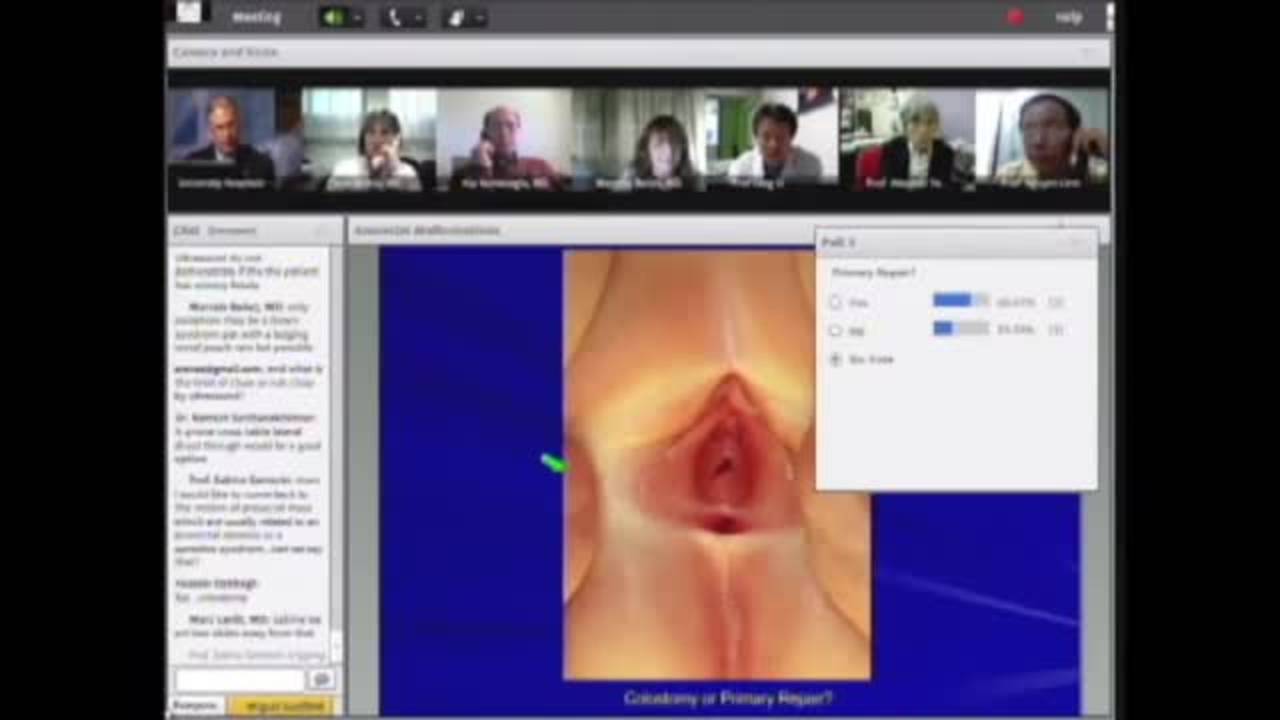
Good morning. Good afternoon. Good evening. Welcome to the update on complex colloal malformations. Today we have a fantastic course in store, and I don't know if you can see the table, but we have incredible faculty here who're gonna discuss something that definitely intimidates me and I know intimidates probably most of the pediatric surgeons around the world. And fortunately we have the expertise here at Cincinnati Children's Hospital and here broadcasting from the Center of Telehealth. People that know what's what on this topic, and they're gonna discuss it and, and let us join in and, and participate in the discussion and really get to the bottom of some of these things that really scare us in this field. And as usual, we are at the whim of some of the technical challenges. So if your browser starts acting funny, the best, the best fix is usually to just restart your browser. If things go wrong technically, usually it's fixed within a few minutes. So just keep reloading your browser. This entire show will be available online within about 24 to 48 hours, and that's actually a fantastic resource. It will be available in the sense that you can actually type in any keyword and find when that was discussed and go and watch that segment of the event, maybe even in preparation for a complex anorectal malformation. So, uh, the other thing is that at the end, uh, you'll get your CME credit if you take the question, the survey, you can get that by clicking on the file link at the top, and we'll also send you an email at the end. So, uh, without further ado, I'd like to introduce the, uh, course director, Doctor Belinda Dickey, and, uh, Belinda, the show is yours. So our slides. Thank you. Um, good afternoon, good morning, good evening. Just as Todd said, I hope that today we can have some active discussion, and I want, uh, a lot of audience participation, panel discussion. On complex malformations and in particular COACA, we have a multidisciplinary collaborative panel here, um, representing people from Cincinnati as well as, um, a couple of visitors from, um, sick kids as well as, uh, nationwide. So let's get started. She What's that? So we'll start by introducing the panel. Um, to my right here is Doctor Vanderbrink. He is, uh, the urologist here at Cincinnati Children's Hospital. Myself, I am one of the colorectal surgeons here at Cincinnati Children's Hospital. Doctor Leslie Breach, she's our gynecologist and the gynecologist for all of our patients here that come through the colorectal Center. We all know Doctor Alberto Pena, who is, uh, the founding director of the Cincinnati Children's Hospital, as as well as, um, the developer of many of the procedures and operations that we perform. Doctor Andrea Bischoff, once again she's one of our colorectal center, um, surgeons. Doctor Richard Wood is visiting us from Nationwide. He is originally from South Africa and he is a pediatric surgeon at Nationwide, part of their, um, pelvic reconstruction center. Doctor, uh, Maria Calvos, she is a radiologist here at Cincinnati Children's. Her expertise is in, uh, prenatal imaging, and she does a lot of our prenatal imaging for colorectal malformations. We have a couple of other panelists, um, Doctor Jack Langer from Sick Kids Toronto. I think he's on screen. Um, we also have Doctor Shamal Alam. He's, uh, from Columbia, New York. Um, he's one of our pediatric neurologists that we collaborate with. We also have the, um. Director of our center, Doctor Jason Friisher, who will be on screen shortly. Did I forget him and Doctor Manish Patel, who's sitting in the corner down at the very end, he is our interventional radiologist who helps us with a lot of our imaging, um, especially doing our cloacograms and complex imaging on our, um, colorectal patients. Yeah. So we'll, we'll get started. I can't see our slides. Is there any way to see our Mark, can you make it so we can see the slides? So we're just gonna get to our slides here. We're gonna start with some polling questions just to see what the audience, um, makeup is and what everyone's interest is and comfort with this, this, um, disease process. So overall our objectives today are going to describe sort of the current management of COICAS and discuss case-related, um, and it's gonna be case-related. Most of the discussion today will, will present cases and hopefully the faculty and the panel here as well as audience participation, we'll discuss further management. And then we'll look at potentially some new innovations and, and long-term outcomes of, of these patients. So just a couple of questions to start off. Just to find out what our audience, um, uh, audience is like today, what is your practice currently? Are you a pediatric surgeon? Pediatric surgeon with a focus in colorectal, pediatric urology? Pediatric gynecology, any other pediatric specialty, or an adult surgeon? Do we get any answers coming up? Uh, not yet. Jenny, is that pole up? OK. I can't see that very well, so I think the majority of our pediatric surgeons and. A lot with a focus in colorectal issues. That's great. Followed by my urology. There is how many urologists there a sliver, a sliver and a sliver of gynecology. There you go. I don't know which slice is bigger. All right, so in your practice, since most of the people logged in here today are pediatric surgeons with a focus, what sort of operations would you perform? Um, the initial management, so that includes the colostomy and maybe a vaginoscopy if indicated, uh, will potentially correct an uncomplicated short common channel COECA, or would you actually venture into proceeding and reconstructing a complicated, um, Cloaca anomaly? So right now everybody does it's just me and Doctor paying that in. OK, it's interesting. I'm surprised about that. So since we have such experienced audience, we hope that you will participate in our discussion and please feel free if you have a question. Todd and myself will sort of moderate the questions coming in and we'll bring them up as points and, and, um, use them as further points for discussion. So and this is more to address sort of the current management of COICAS. So in your institution, who manages? Pediatric surgeons, pediatric urologists, and a, or a collaborative team, and I didn't put. Pediatric gynecologists as a separate person who manages them, um, just because they, they do work with us as a team. Wow. That surprises me a little bit as well. So since Doctor Langer is online here, Doctor Langer, how are, how are CLIA managed in your institution? Collaborative team. But that wasn't up there. Was, was that the blue box? No, that the yellow, the yellow, OK, yellow. OK, good. So do you have gynecology involved in all your patients as well? We do eventually, not necessarily in the initial management. And what does Leslie think about that? Leslie knows that they have this super gynecologist there where he is, and they have a great team that they do collaborate together, um, over time. All right, so just for people's, um, um, interest here, at least at our center we try and get everyone involved initially and if the baby is born here at our institution, they actually see the urologist and the gynecologist and the colorectal surgeon, um, in the, um, the neonatal period so. Can we go back to the slides? So these are sort of the topics we'll touch on today. We'll start with some prenatal imaging, imaging, prenatal counseling, newborn management, definitive repair, and then I'd like to touch on specifically the gynecologic and the urologic concerns since the audience here is mostly pediatric surgeons. I think it's important that we sort of hear their perspective on um the outcomes and what they see. So, as sort of addressed it by the last question, um, Cloica Management now really has become a collaborative team, sort of the three main players at our institution are urology, pediatric surgery, and gynecology. Of course, you know, that doesn't stop there because often now we have prenatal, um, imaging that diagnoses of these babies and so the fetal medicine and neonatologists are involved. In addition, they're the medical services. As these patients get older, they have more complicated issues. They need the nephrologists, GI, cardiologists, primary care physicians involved as well. And of course I have to put in our, our radiologists because they're here with us today and they actually help us diagnose and figure out what we need to do in the overall management. And more and more, you know, these children need more ancillary services as they become older. Behavioral medicine, social work, and our nurses are a major part of our, our center here. So without further ado, we're gonna start with uh prenatal injury with Doctor Cappels. So, good morning, good afternoon, or good evening. Um, we are, I'm opening the session with the prenatal imaging diagnosis of, uh, innerectal malformations. Uh, during this presentation, uh, we are going to review prenatal imaging clues that we can find in order to, uh, provide the diagnosis of anorectal malformations in utero, and we, at the end, we will present a case, uh, that will help us to move on to the prenatal counseling in the portion of the session. In general, uh, genital urinary anomalies and, and ectal malformations represent a broad spectrum of malformations. Um, they have, of course, different presentations, but, uh, the most severe these malformations are, the higher the chances that the amniotic fluid volume is going to be abnormal. That we see abnormal bladders or other major malformations that are going to help us to start the search, but in other cases, uh, the findings are more subtle, and we will need to be kind of uh systematic in an imaging approach. Here at Cincinnati Children's, we like the combined approach with ultrasound and fetal MRI because they are complementary techniques, and I'm going to explain the imaging targets that each technique will have. On ultrasound, uh, we are going to accurately define the amniotic fluid volume. If we see a cystic structure in the abdomen or pelvis, uh, we will have to define what structure is. So, uh, for instance, on this patient, it was a seventeen-week, uh, gestation fetus, uh, we have a large, uh, cystic structure, abdominal pelvic structure. There's absent amniotic fluid around the baby, and you might be tempted to call this an enlarged bladder. But looking carefully the anatomic relationship of this structure on an axial plane from the abdominal cord insertion, the first structure that you will see is the bladder and will be outlined by the umbilical arteries if this is a three vessel core or the single artery in this case for a two vessel core. Then, We see that the cystic structure that we saw on that coronal view, in fact, is posterior to the bladder, will be inferior to the bladder and reaching up into the abdomen. This is a hydrocorpus in a cloical malformation. Then we pay attention to the content of the bladder, the adjacent bowel, or the hydrocorpus if there is one present, in order to define abnormal content that will be a clue in a visulous connection between the genitourinary system and the bowel. So, we can see uh fluid in the rectum or meconium, such as ecogenic concretions that sometimes they give shadowing, but if they are small, not enough, contained in the hydrocorpus. Those will be clues for uh rectal urinary fistula and in a rectal malformation. We will pay attention to the abdominal wall, um, the spine, and trying to see, especially in patients with absent bladders and normal fluids and abdominal wall defects. The last portion will be to pay attention to the external genitalia, not only to define the gender and define our differential diagnosis, but also to define if there is an ambiguous or incompletely formed external genitalia that will be uh potentially associated in an, in a rectum malformation. There are technical limitations that we all know about uh ultrasound. Uh, it will not provide good imaging in the setting of uh poor amniotic fluid. Um, it's not good to detect early stages of, uh, cystic renal dysplasia that some of these babies have, and not all anorectal malformations are going to be detected, um, even trying to find them with ultrasound. So, we move on to fetal MRI and it's not going, it's not only going to be able to show the, the appearance of the kidneys with more detail, to define a potential uh prediction of lung hypoplasia in cases with borderline amniotic fluid, but definitely to define the appearance of the GI tract. And why is this possible? Well, in fact, uh, the fetus, uh, in the bowel is having a natural contrast media. If you look at the image in the middle, uh, you can see that the stomach and the proximal bowel has, uh, mostly this bright content is fluid. And, uh, the more distal the bowel, uh, is going to have darker content on this uh Two-weighted imaging. Meconium is going to be dark on the Two-weighted imaging. When we go to the T1-weighted imaging, the image on the left, uh, we can see that it has this bright signal, beautiful, uh, that we can follow nicely and uh almost, uh, Can show the appearance of. Um, a contrast enema in a fetus with the steady-state free precision sequences, the content is intermediate signal. So, um, it will be also important to know the, a little bit about physiology of the meconium. Uh, it will not be expected to reach the rectum until 20 weeks. And once, uh, it will fill the entire column by 26 weeks. So, um, once the meconium is distending the rectum, we will be able to define, uh, where it's located and its appearance. So, a few years back, uh, Seinda and co-authors, uh, provided this very nice anatomic detail about the rectum, looking on a sagittal view. Um, we can define the rectum and the length that, uh, they described from the bladder base to the most distal segment of the rectum, um, it should measure at least 10 millimeters. So, this will provide important clues when we are looking for patients that could have anorectal malformations. And we are going to move to these, uh, three groups, uh, persistent cloaca, in perforated anus, and I'm bringing eurogenital sinus to show how different it looks from, uh, long common channel cloaca. The scenario that they can present can change, but, uh, some of these babies will present with obstructive uh megacystis. Other patients will have, uh, already like an end-stage cystic renal dysplasia, absent bladder, low or absent amniotic fluid. But in other patients, the findings can be more subtle and might have another malformation that could start the search for, uh, other anomalies and With that, uh, systematic approach, uh, hopefully, uh, we will be able to, uh, find. So, a few years back here at Cincinnati Children's, we reviewed, uh, the, uh, prenatal imaging appearance of cloacal malformations that were, uh, imaged with MRI and, uh, the postnatal, um, evaluation, and we noticed in our patients, uh, that long common channel cloaca presented with a high position of the rectum and, uh, dilatation. And how this looks like, um, is shown on this, uh, image. Um, the rectum was dilated, um, kind of funneling distal, but not reaching distal enough. This is a thick wall, um, bladder because there was bladder out of the obstruction. This is a normal patient for comparison and helping, um, people to understand the findings. Uh, Posnero had a nice correlation with a long common channel Cloeca in, uh, this, uh, this, uh, colorstogram, uh, cloecogram. Uh, cloacas and imperforate anus with rectal urinary fistula can have fluid distention of the rectum and enterolis, and how we see this, I'm bringing this, uh, fetus, uh, seen at 23 weeks and presenting with an abnormal rectum. If you look at The sagittal view, uh, the rectum is reaching kind of distal from the bladder base, but looks very dilated, and the signal that should be dark as the comparison, normal rectum on the right shows is bright, so, there is increased fluid content. And that's a clue that there is a recto urinary fistula. We can see on the following images with the postnatal distal cholostrogram that uh there was uh urinary fistula that we started to feel but not far enough. The surgeons were able to uh find the connection with the vular segment of the urethra. Other cases of cloaca will present with hydroculpus. And, and, or um ascites can be present or gone by the time we image and I'm bringing this case of long common channel cloaca where we have a bladder that uh in fact the baby presented uh hydronephrosis, decreased amniotic fluid, so kind of in the obstructive bladder. There is a hydrocorpus and uh urinary ascitis and if we look at the rectum. And again, it's not reaching far enough on the T2 weighted imaging. It's dark tissue, it's bright T1. The signal content was normal, but it was abnormal in position. This is a long common channel cloeca. Uh, urogenital sinus can also present with urinary hydrocorpus and obstructive neuropathy and or ascitis, but we will see that they look different, uh, as we see on this, uh, sagittal view, the, uh, on the T2 weighted imaging, the rectum follows the normal course, uh, uh, posterior, um, in this case, posterior to the bladder and then to a hydrocortus. It's not dilated, it's reaching kind of far enough, and, um. The hydrocorpus is in between the bladder and the rectum, shouldn't be there in a normal fetus, and we have urinary ascitis. I'm bringing the comparison T2 and T1 in a normal fetus, so it helps to understand. Um, on this baby, we raised the concern for an orogenital sinus, uh, given the differential diagnosis with a short common channel cloacal because of kind of more normal appearance of the rectum. Postnatal, it was confirmed to be a posterior cloacal variant, in fact, a posterior neurogenital sinus where, where we can see very posterior location of the, uh, single, um, channel opening, uh, close to the normal position rectum. Uh, there are other groups of malformations that can be seen in a kind of more innocent, um, presentation, um, and, uh, in fact, they are quite severe. We are talking about cloacal atrophy, and these patients, uh, typically will present with a persistent absent visualization of the bladder. The amniotic fluid is going to be normal. So, the urine has to make its pathway out and uh ectopic location of bilateral ureters um is kind of rare, although potentially possible. So, these babies will have an abdominal wall defect and we will see that, uh, the appearance is very characteristic. So, I'm bringing also bladder trophy to compare and to show that they look different on MRI. So, starting with clocal atrophy, uh, these babies frequently have an unfallowed seal that typically is more low in position. Uh, they can have spinal defects as we see on this image, typically, skin-covered defects. Um, and sometimes we can see, uh, but it could not happen and it might be intermittently throughout imaging, the presence of a tubular structure that is protruding and floating, uh, in the amniotic fluid. Uh, we are talking about the, um, prolapsed terminal ileum that this, um, malformation can present. So, on, as we see on this image, the appearance is like an elephant trunk, and not surprisingly, uh, the sign is called the elephant trunk sign. Um, these babies, um, if you are not careful, and I'm bringing, uh, the ultrasound and MRI, uh, of the same baby. Um, we can see that, uh, on the ultrasound, if you are not careful, you might con uh consider this, uh, gastroschisis. Um, the stomach, in fact, is in normal position, and this kind of prolapse or protruding, uh, structure is quite low in the, uh, abdomen, anterior abdominal wall below the abdominal cord insertion, and that it wouldn't be a gastroschisis and Again, you don't see the bladder, so this is not gastroschisis, although some of these babies can be referred with that initial diagnosis. The terminal ileum with prolapse, um, MRI and what we see when the baby was born. If there's no prolapse of the terminal ileum, we might. be a little bit, um, leading to the differential diagnosis with bladder atrophy if we don't see severe malformations involving the spine or other structures, and, um, here also at Cincinnati Children's, we were reviewing our patients in utero and defining the appearance of the colon. So, with special attention to the colon, we noticed that none of these babies will present. Meconium signal in the bowel, in the uh expected distribution of the rectum as we see on these images, and this is completely different from what uh usually the um bladder atrophy would look like. Which should normally have a normal rectum, as we see on these images with the, the bright T1, the dark T2 signal, still with absent bladder, visualization of the bladder and uh protruding uh structure in the infra umbilical abdominal wall, and also with kind of, uh, unusual appearance of the external genitalia with episperia, so, this is a bladder atrophy instead. So, I hope I was not um confusing people and trying to uh bring many things uh in consideration, but, uh, this is going to help us uh to understand this um case presentation. Um, This was a 22 week gestational age fetus that uh presented to us with uh abnormal ultrasound findings, and the findings are summarized in the slide. There was an enlarged bladder, bilateral hydronephrosis, decreased amniotic fluid, so there was, uh, a bladder outlet obstruction. There was bilateral clot fluid, which is not um unexpected in the setting of oligohydramus and a two-vessel cord. And we are going to start with the MRI images that we perform, uh, here at Cincinnati Children's. Just a clarification at the top, uh, the images were obtained after amnio infusion that was obtained, uh, done the day before. So, the fluid that you see around the baby is due to an amnio infusion. So, we start with the first image on the left, and we can see that the bladder is enlarged. Um, and looking at the external genitalia, and we were told that this was a female fetus by chromosomes. Uh, you can see that the external genitalia is abnormal, uh, looks like there is like a large phallus-like structure with a fluid, uh, in lumen dilatation. And, uh, we didn't see scrotal sac, but, uh, this is clearly ambiguous genitalia, and we didn't know if that, uh, fluid-filled tubular structure was a megacyst, a mega urethra or a cyst contained in the, um, urethra. The axial view is showing the same finding. So, a little bit, um, oh, let me just go back. Uh, on this sagittal image, the other, um, uh, structure that we like to look is posterior to the bladder. In a 22 week gestation fetus, we should see already the rectum and there was nothing there. So, something that is important in this fetus, and in fact, a little bit higher up on axial view, as we see on this first axial image, there is a small mid-lined, uh, tubular structure posterior to the bladder, looks on the sagittal view that is blind ending. That's a hydroglobus, and we have bilateral hydronephrosis. So we were missing the rectum on that perfect midline sagittal view, and slightly to the left on sagittal view, we see this large tubular structure that on an axial view is again on the left side of the abdomen. Adjacent to an enlarged bladder, that's in fact the distal column and is very dilated and the content instead instead of dark tissue is uh showing bright signal that's fluid content that shouldn't be there unless there is a fistulous connection. On the T1 weighted imaging, the content looks bright, but not as bright again, supporting that fistula connection. So, if we try to combine all the findings, uh, this patient is, uh, most likely, uh, presenting a cloacal malformation, and we were, uh, considering that the, given the high position of the distal bowel, this was most, uh, likely going to be a long common channel cloaca. And that's as far as I can. Go. Sorry. So, so I think now, yeah, Doctor Bake will take over. So thank you, Maria. Does anybody have any questions either from the panel, um, or the audience with regards to prenatal imaging? How many institutions, um, that are signed in or even that are represented here actually? So let me answer that by, so I, I have never had a patient referred to me with a prenatal diagnosis of any rectum malformations, cloica ever. And so I put a poll up and asked the audience, and uh it's pretty much split. 54% have never had it, a patient referred to them, and uh 45 have. So it's pretty interesting. I'd be very curious to see the breakdown on who has, um, what about you? I mean, how often are you seeing that here. That you do a lot of the prenatal counseling, let me say a, a, a piece of advice for the general pediatric surgeon. Not everybody gets the privilege to get a specialized radiologist is dedicated to the prenatal diagnosis of this malformation that we have. And um I remember that at some point I reviewed the mothers of babies that were born with cloacas. I asked them if they had any prenatal diagnosis and they did not have a prenatal diagnosis and the babies were born with cloacas. Then I decided to request if they could donate the ultrasounds to see if we could see something in retrospect about those patients. And they, they graciously donated the ultrasounds and I looked at the ultrasounds and we found that many of those patients that were not diagnosed in utero actually had some abnormalities, but the radiologist did not make the diagnosis of a cloaca. The radiologist diagnosed a urethrocele, obviously was not a urethrocele, it was a hydrocorpus. They also diagnosed double, double bladder. They also died, which was not a double bladder, by the way, one in front of the other. They diagnosed ovarian cysts and they diag diagnosed bladder diverticulum, so that means that the images were there. What failed was the index of suspicion in the those radiologist. So I'm warning you, those who work in places where you don't have a specialized radiologist. Nowadays most mothers start having ultrasound studies early in pregnancy and if, if, if the, you have to motivate, you have to inform your radiologist, non-specialized radiologists about the, the, the anatomic facts of a flueca, more specifically about the presence of hydrocortisones. It's not very much in that literature and therefore many radiologists don't know about that when you even when you say the word hydrocortisone. So if you find a prenatal diagnosis and they tell you that has a is a female fetus and has a an ovarian cyst or a double bladder or a urethrocele, suspect that that patient may have a a a cloaca. In addition, if the patient has abnormal vertebrae or hydronephrosis and a and a dilated bowel, you just made it, that's it. I just wanna make a comment also I think one of the advantages of making the prenatal diagnosis one is being able to transfer the patient to a specialized center so the patient will receive proper colostomy, drainage of the hydrocarpus also prepare the mother. I suspect that it's not easy to give birth to a child with a malformation. There's never a good timing to give the bad news, but at least they have time to digest and then during the birth of the child. They can actually enjoy the birth of the child and know that 24 hours from now that baby will go to a surgery that might represent being in a different hospital from the mother so the family has time to plan for that. As pediatric surgeons, when we are called to give advice in a prenatal counseling, we would like to be able to clearly, uh, predict the future for the parents in terms of bowel control, urinary control, future sexual function. And I think we are gonna make lots of progress. We are making lots of progress in the prenatal diagnosis, but currently, we still don't have all the information that we need to be able to proper counsel the parents in terms of the future. In a Cloaca patient, we wanna know what's the common channel length, we wanna know how is the sacrum, and this information is still a little limited in the prenatal um image. Thank you, Andrea. I think a lot of this prenatal counseling that Andrea just touched on, we're gonna bring up a little bit later as well. Um, just out of curiosity, um, Doctor Langer, do you have much prenatal imaging and the availability of prenatal counseling? Um, SickKids itself is a pretty big institution, so you would expect that, um. You would have those capabilities. We can't hear. you. Jack, if you can unmute your uh mic. How about now? That's good. We can hear you now. Can you hear me? Yeah, uh, yeah, we increasingly see kids with a prenatal diagnosis, but I would say the majority still do not have a prenatal diagnosis. I guess my question is, um, that on routine ultrasound, these findings, especially early on in the, you know, 20 week range when most ultrasounds are done, they may be very subtle, and there may be nothing that, that tips the. Community obstetrician off that there's anything wrong, so, um, you know, I think you, you have to have a, a high index of suspicion to start looking for these subtle findings and, and I just think most people out there in the, in the real world aren't even thinking about this possibility. I, I think you're right there because we often have um fetal consults that come through us with these diagnoses and then once they're born, there is nothing wrong so it, it's sort of a double-edged sword. It's nice to have the prenatal diagnosis, but sometimes the parents are up in alarm and the baby is thankfully or wonderfully born um without any issues, so. Uh, we're gonna go on to our next speaker, and then we'll go on to a little bit of more prenatal counseling after, um, Doctor Patel, who is our interventional radiologist who does, uh, much of our imaging, um. For our diagnosis afterwards, after the baby is born, so. Doctor Manish Patel.
Click "Show Transcript" to view the full transcription (29934 characters)
Comments