Hepatoblastoma with Dr. Greg Tiao
Timestops (10)
Tools Used
Topic Overview
Key Takeaways
- Hepatoblastoma is the most common malignant liver tumor in children (~250 cases/year), but hemangioma is the most common liver lesion overall.
- Elevated AFP (often >10,000) is critical for diagnosis and monitoring treatment response; MRI with Eovist contrast provides optimal liver anatomy definition.
- Complete surgical resection is the most important intervention for survival; options range from conventional resection to liver transplantation.
- Pre-operative workup requires: history, abdominal imaging (MRI preferred), AFP level, and liver biopsy to establish diagnosis.
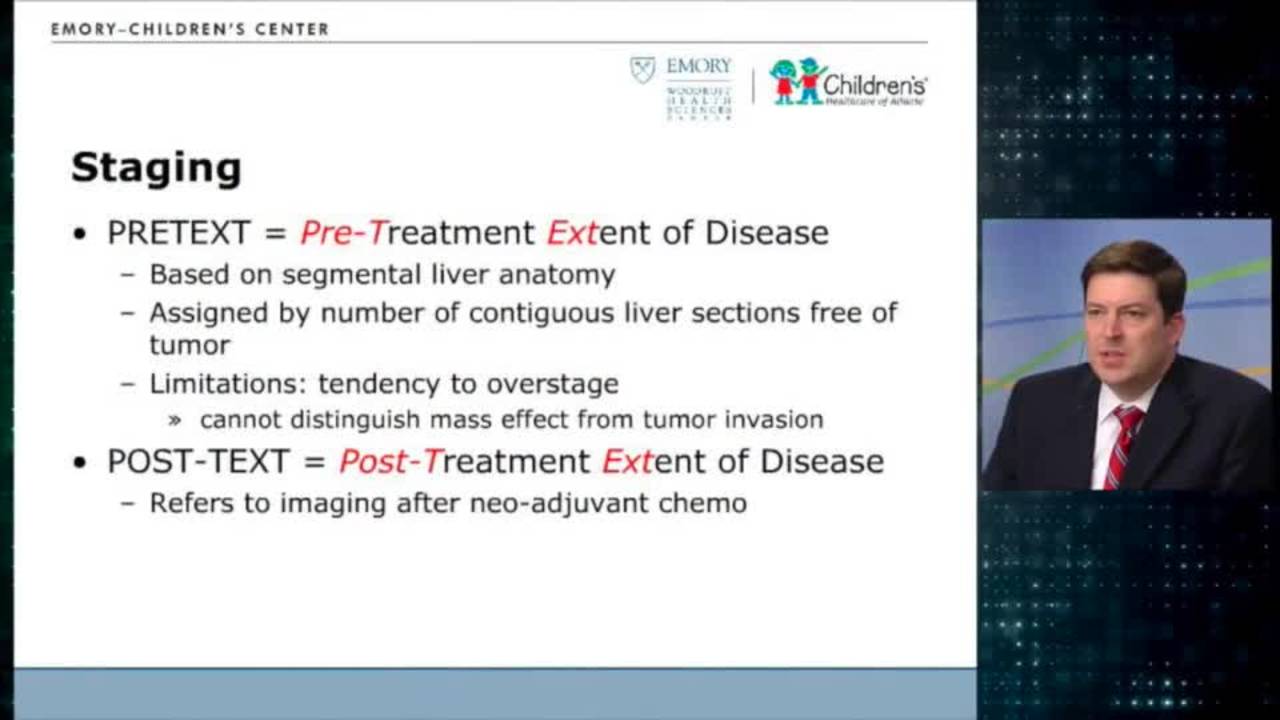
- Understanding Couinaud liver segmentation (segments 1-8) is essential for surgical planning and determining resectability based on pre-text staging.
Keywords
Hashtags
Transcript
Hepatoblastoma is the most common malignant liver tumor in the pediatric population. But treatment strategies have changed dramatically over the past 25 years. That's why today, we're going to talk about the basics. With an expert. So hepatoblastoma, there's around 250 new cases a year, huge changes in terms of the treatment algorithm over the last 20 years. That's Dr. Greg Tiao. He is a pediatric transplant surgeon at Cincinnati Children's Hospital. He's going to walk us through some of the basics. So stick around, this is the Stay Current in Pediatric Surgery Podcast. Okay, so I'll start by setting the scene. A child comes into the hospital with an abdominal mass. We're talking specifically about hepatoblastoma today, but we should still have a very wide differential diagnosis. That's right. Hepatoblastoma is the most common malignant liver tumor in children, but it's nowhere near the most common liver tumor or the most common abdominal tumor. When I'm recalling the most common abdominal malignancy in children, I recall this being somewhat controversial. But most would consider it to be neuroblastoma. It's a toss up between neuroblastoma and Wilms, depending on who you talk to. Now, neuroblastoma is the most common solid malignancy in the pediatric population, but that's because they're tumors everywhere in the body. So, you you could make an argument that Wilms is the most common. So we get imaging and we figure out that the tumor is coming from the liver. So on our differential diagnosis, we should have hepatoblastoma, hemangioma, hamartomas, focal nodular hyperplasia, and hepatocellular carcinoma. Common things being common, hemangioma should be pretty high on the list. It would fortunately I don't know sure if it originally jumped on or not, but you know, she'll see many kids with liver lesions and they're hemangiomas. The most common lesion is a hemangioma. Even though hepatoblastoma is the most common malignant liver tumor in children, it's still pretty rare. There's about 250 cases per year. So you got to be pretty in tune with the wide range of presentations and have a high index of suspicion. Like Fred said, neuroblastoma has a wide spectrum of presentations. It can present as an asymptomatic abdominal mass, but on the other end of the spectrum, Dr. Tiao has seen it present as a tumor rupture, or as a patient in respiratory distress due to the tumor size. It can also present as a paraneoplastic syndrome like precocious puberty. But keep in mind that in any situation, an elevated alpha fetoprotein or AFP is a key component in the workup. AFP is critical for the diagnostic algorithm and it's a guide for treatment response. Okay, so to summarize, I see a kid and I'm suspicious because he has a large abdominal mass and he has an AFP in the 10,000s. Next, we need to get axial imaging. Most experts are relying on MRI to delineate the anatomy and to evaluate the extent of liver involvement. MRI with Eovist that we got today. What was that? What's Eovist? Eovist is an MRI contrast agent that is taken up by the hepatocytes and then excreted. It can provide the best definition when looking at the liver on imaging. If you're listening in the Stay Current app, scroll down under the media player. We're going to give you some images of Eovist, so you can take a look. I mean, it really does distinguish biliary anatomy. So to establish a diagnosis of hepatoblastoma, we need four things. We need to start with the history, then we need to get our abdominal imaging, then we need to check an AFP, and finally, we need to get a liver biopsy. The most important intervention for survival is to achieve complete resection. The way you get there can be varied. Primary goal is to achieve complete tumor removal. There's conventional resection and then there's more aggressive resections. Aggressive resections are when you're starting to think about a trisectionectomy, a mesohepatectomy, a resection with an additional procedure in the remnant liver, and of course, liver transplantation. As you're probably starting to figure out, a lot of the resection algorithms are based on liver anatomy and the pre-text system. But before we get to that, Dr. Tiao, can you walk us through how to find all eight liver segments on axial imaging? That was correct. One is caudate, two and three are left lateral segments, superior and inferior. 4A, 4B is left medial segment, 5, 6, 7, 8 are, you know, the the right side of the liver. Do you guys know how um Connaut labeled them in this counterclockwise circle? Injecting them in the portal vessels. And so that's really how these are labeled. But he I mean, he labeled them in a this counterclockwise fashion after, I can never pronounce this, but the the districts of Paris are done in the same fashion. Hmm, that actually makes sense in a strange way. When we look at the right side of the liver here, do you guys see this here is the vena cava right here. So Al, how do we differentiate five and eight versus six and seven? What's the anatomic marker that allows us to differentiate between the anterior and posterior sections of the liver of the right liver? That looks like the right hepatic vein there. You see this right hepatic vein coming out here? And so what we're actually seeing that track out and then how do we separate between um uh superior and inferior? That looks like the right portal vein coming in there. So right anterior is going to be segment eight and that is going to be anterior to the right um hepatic vein and superior to the right portal vein. Five is right inferior and that's based off the right board of portal vein, inferior and anterior to the to the right hepatic vein. Six and seven in that same fashion, seven superior and comes six inferior. Okay, now would be a really good time for a diagram of the anatomy. Conveniently, we've put one in the media player for you, so scroll all the way down in the app and you'll find it. And the reason that all matters is because there's something called the pre-text staging system. We need to classify our tumors in a more anatomically understandable fashion. And so the sections of the liver, the right the right posterior section is six and seven and the right anterior is of five and of five and eight, is considered the right sections of the liver and segment four is considered the left medial segment and section and left segment two and three is a left lateral. And depending on if you had tumor in those stages in those sections, the number of free sections without tumor is a minus four is your pretext stage. We've also included a table of the pre-text system for you. So pre-text one has three contiguous sections free of disease. Pre-text two has two contiguous sections free of disease. Pre-text three has one free section and pre-text four has no free sections or diffuse tumor burden in all sections of the liver. Additionally, this staging system is the framework for the treatment algorithm. Pretext one and two tumor, if there was greater than a centimeter margin from the middle hepatic vein and the portal bifurcation, you could offer or you should be considered for resection at diagnosis. Patients with bigger tumors that did not get resected would then be wrist stratified to intermediate low risk or intermediate risk um and and and then depending ontion factors, if they had a positive, they could be in high risk. Pretext three and four is the big game changer. This change in practice is what improved survival rates for patients with hepatoblastoma from less than 30% in the 70s and 80s to between 80 and 90% today. And we had surgical guidelines for pretext three tumors and these patients should generally be biopsied at diagnosis and then started on neovent chemotherapy and then depending on how they responded, be ready to send them to a transplant center or center that has expertise to do more advanced liver resections. And then pretext four um pretext four patients had a much more complicated schema. And the reason we had to do that was some of these patients needed to be transplant. So, if you have pretext three or four liver disease, there are specific indications to transplant. Mainly if it's unresectable disease, whether it's unsafe to resect or a resection would leave the patient with an inadequate liver remnant. But the main thing to get out of this is it's important to consult a transplant center and the earlier the better. You refer these patients to liver transplant programs much earlier. And this is why we see so many more patients nowadays than perhaps when Fred and Maria were running the program, uh 15 years ago because teams are are trained to recognize the tumors and send them to a center that offers transplant um um or or can and can do aggressive resection. And if you'd like more information on the survival benefits of liver transplantation, you guessed it, it's in the link below. After clarifying the pretext stages, you're not quite done. There's an ongoing trial to better delineate the treatment algorithms for each of the stages of hepatoblastoma. Shika is responsible for an ongoing multinational trial called Fit or the pediatric hepatic International tumor trial. Their aim is to identify high and low risk features for each of the pretext stages. The FIT study has been going on now for three years. Um we've had the privilege of contributing to it um in terms of its development. That's why we see a lot of tumors here. The treatment for hepatoblastoma has really evolved significantly. This is the schema for the study. This is the schema for hepatoblastoma and we'll break down this down a little bit more in just a second here. No worries. Details for this study and others can be found in the links below. Management of these malignant liver tumors continues to improve through improved treatment, multidisciplinary teams, international collaborative efforts and research. Thank you for joining us for this update on pediatric hepatoblastoma. And remember to check out the link below for the full lecture. Follow us on social media, subscribe to our YouTube page. Download the Stay Current Pediatric Surgery app. It's in the Apple App store, it's in the Google Play Store. Or if you're listening to us on an audio podcast, leave us a comment, a suggestion or rating. It helps with the algorithm. And remember, knowledge should be free.