


From
StayCurrentMD
Update Course Rewind: Spontaneous Pneumothorax 2021
With Dr. Shawn St. Peter · hosted by Dr. Em Gootee & Dr. Todd Ponsky
Chapter 1 of 5 · Case-Based Learning
Case presentation
Introduction and Case Presentation
Expert statements on this page
No expert statements were drawn from this page.
Host summaries · secondary, not cited in answers
Educational content from recorded physician discussions — not medical advice. Talk to your (or your child's) care team about your situation.
Video
Aspiration Test Predicts Need for Operation in Pediatric Spontaneous...
Published Feb 2020
Video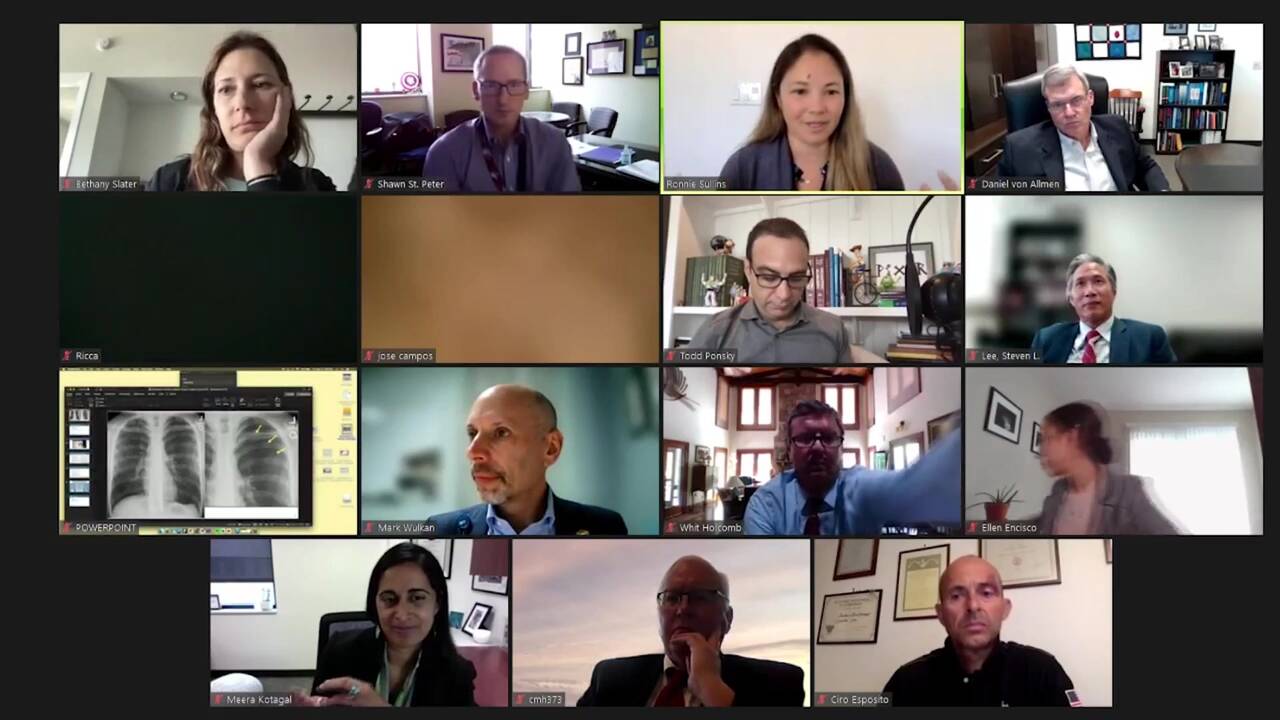
Update Course 2021: PNEUMOTHORAX
Published May 2022
Video
Manejo del neumotórax primario espontáneo en niños
Published Sep 2023
Video
Management of Primary Spontaneous Pneumothorax in Children
Published Sep 2023
Video
Spontaneous Pneumothorax Rapid Fire: Update Course 2015
9 min · Published Nov 2015
Video
Update Course Rewind: 2021 Top Ten Key Takeaways
Dr. Todd Ponsky · 16 min · Published Oct 2021
Video
Update Course 2023 - Updates in Pancreatitis
32 min · Published Aug 2023
Video
Update Course Rewind 2021 - Updates in Pectus
61 min · Published May 2022
Podcast
Update Course Rewind: 2020 Colorectal Part 2
11 min · Published Mar 2021
Video
Colorectal - Clinical Practice Updates
52 min · Published Sep 2020
Podcast
Empyema with Dr. Shawn St. Peter
36 min · Published Apr 2017
Video
Intestinal Atresia Types Explained: Grossfeld Classification for Pediatric Surgery
1 min · Published Sep 2026
Video
Derivation and validation of the Pediatric Community-Acquired Pneumonia Severity (PedCAPS) score: A prospective cohort study
50 s · Published Sep 2026
Video
FETO for Late-Diagnosed Severe Congenital Diaphragmatic Hernia (CDH) at Cincinnati Children's with Dr. Beth Rymeski
4 min · Published Sep 2026
Video
Severe Congenital Diaphragmatic Hernia (CDH) Case: FETO Management & Unexpected Findings with Dr. Beth Rymeski
3 min · Published Sep 2026
Video
Fetoscopic Endoluminal Tracheal Occlusion (FETO) Procedure: Step-by-Step Guide with Dr. Beth Rymeski
4 min · Published Sep 2026
Video
Choledochal Cyst Types Explained: Pediatric Surgery Fundamentals
1 min · Published Sep 2026
What the experts said
At Children's Mercy Kansas City, the approach was modified so that if aspiration doesn't work perfectly, they proceed straight to VATS that same day to avoid prolonged hospital stays of 5-6 days.
The Children's Mercy approach of proceeding directly to VATS after failed aspiration turns cases into a maximum 2-3 day hospital stay instead of 4-5-6 days with back-and-forth management between water seal and suction.
If a bleb ruptures and then doesn't continue to leak, it may scar down and never require intervention.
Using a needle for aspiration is risky because as the lung expands, you risk poking a hole in it; an angiocath is preferred.
One approach is to put in a pigtail catheter and leave it in (rather than using an angiocath), then aspirate, clamp, and obtain an X-ray.
Spontaneous pneumothorax is a different disease than traumatic pneumothorax, and patients are never seen in extremis from spontaneous pneumothorax.
Despite a 44% recurrence rate after successful aspiration, most patients choose conservative management rather than immediate definitive surgery because the chance of a problem from spontaneous pneumothorax is low.
Aspiration can be performed with a needle or with a pigtail catheter less than 12 French.
Conservative management definitions vary: some consider tube thoracostomy as conservative, while current literature defines it as observation with oxygen and pain management without any invasive intervention including needle aspiration or tube thoracostomy.
The Midwest Pediatric Surgery Consortium conducted a multi-center prospective study enrolling 33 children with first presentation of spontaneous pneumothorax, managed with aspiration through a pigtail catheter ≤12 French followed by 6-hour observation with the tube clamped.
In the Midwest Consortium study, 48% of patients were successfully managed with aspiration alone and the rest failed.
Among patients who failed initial aspiration in the Midwest Consortium study, recurrence was 83%.
Of patients successfully managed with aspiration in the Midwest Consortium study, 44% had recurrence.
The Midwest Consortium study authors proposed changing the algorithm to proceed directly to VATS if initial aspiration fails.
The Australia/New Zealand study was a multi-center non-inferiority trial that enrolled 316 patients aged 14-50 years old with moderate to large pneumothoraces (approximately 32% collapse).
In the Australia/New Zealand trial, the success rate was 98.5% in the intervention group versus 94.4% in the observation group.
In the Australia/New Zealand trial, the observation group had lower rates of both adverse events and one-year recurrence compared to the intervention group.
The Australia/New Zealand study demonstrates that even patients with moderate to large spontaneous pneumothoraces can be managed with observation alone.