Perforated Appendicitis
Timestops (7)
Tools Used
Topic Overview
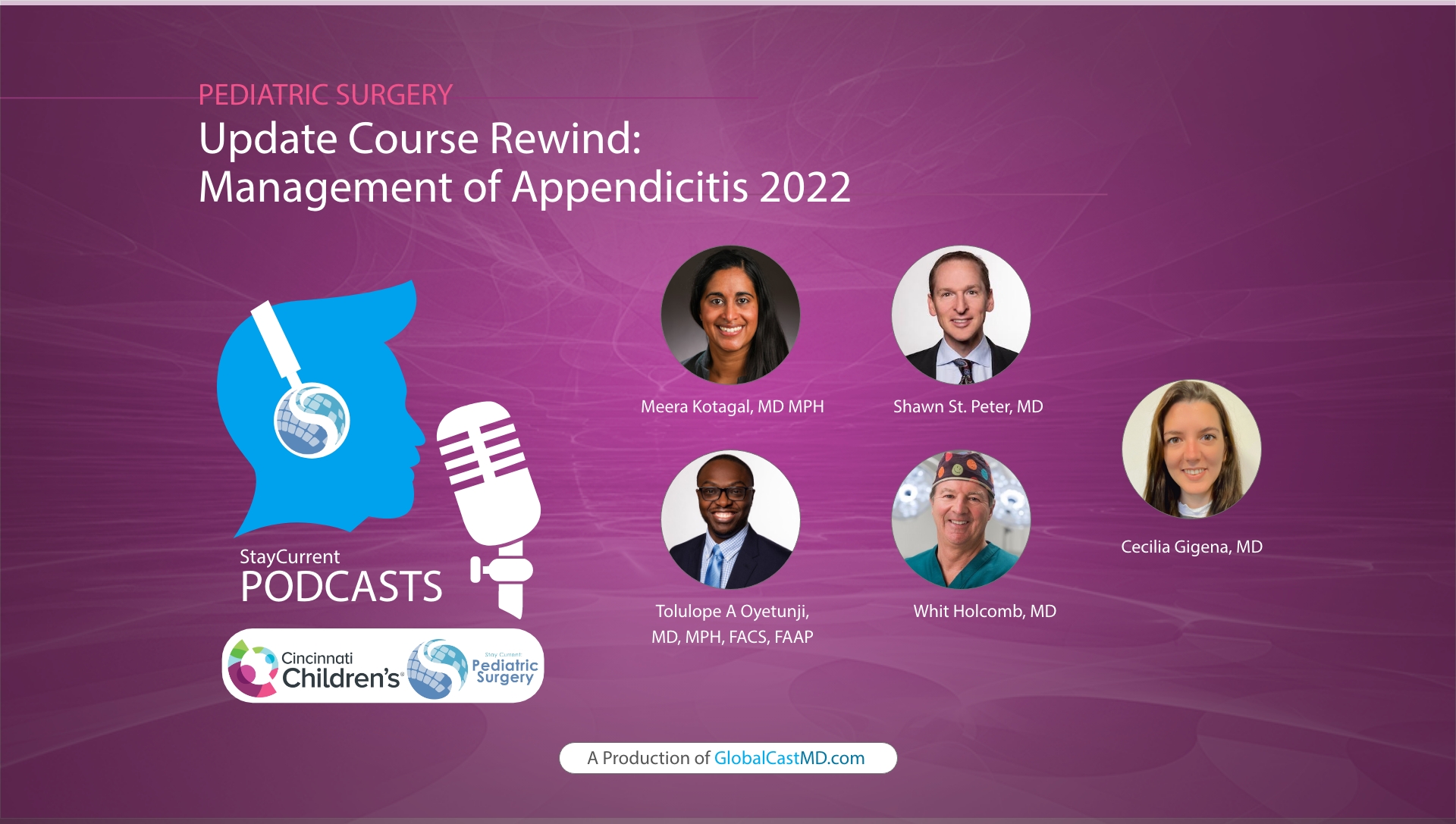
At the 7th Annual Pediatric Surgery Update Course, Dr. George "Whit" Holcomb discusses management of perforated appendicitis.
Keywords
Hashtags
Transcript
So I'm gonna present on the uh mundane topic of perforated appendicitis. Um, and I'm gonna, uh, go through a few articles, some from our place and, uh, some from, um, other institutions. And so here's the first question, um, and I realized that, uh, in reading this question we don't do a lot of CT scans, but I just sort of thought the information was, was kind of interesting so I developed a slide around the uh the information in the in the paper and so you see a 12 year old child with signs and symptoms of appendicitis, uh, he's been symptomatic for 36 hours you think his appendix. May have perforated and and decide to order a CT scan. So the question is how accurate is the CT scan in diagnosing perforated appendicitis? There was this uh paper that came from, uh, uh, our place. Uh, I was not, uh, part of it, uh, but, uh, my colleagues were, and I just thought it was interesting information, uh, and it was in the Journal of Pediatric Surgery in 2010. And so what the paper's about is there were 200 CT scans who were reviewed uh by um 6 surgeons, 2 of whom were fellows, and 2 radiologists, so 8 people, uh, the reviewers were blinded as to the diagnosis. Uh, there was a lot of experience among those viewing the, uh, scans, and you could argue that the, the fellows probably had the most experience because they're looking at those every day. Uh, and the reviewers were then asked to diagnose perforated or non-perforated appendicitis, and on these scans, there were no abscesses. And so what was found was that the reviewers were correct in 72% of the CT scans, which I thought was, was a pretty interesting figure. Uh, the sensitivity and specificity are, as you see, and the positive predictive value and negative predictive value are also seen. But anyway, I just thought that was kind of interesting because on first glance, gee, I would have thought it was 90%. Uh, but it's really a little better than 2 out of 3 or 2/3, so you said there were no abscesses, or did you eliminate cases that had abscesses? Yeah, there were no abscess. Yeah, cases were excluded, were excluded if they had an abscess. So anyway, I just thought that was kind of a, an interesting, um. Interesting information. All right. So, um, you operate on this child and think he has perforated appendicitis. In the operating room, how accurate is your visualization of the appendix in determining if it has perforated or not? OK, so I think this is important because this, this sort of gets is gonna get to the idea of, of papers in the literature on perforated uh appendicitis versus non perforated versus suppurative uh versus gangrenous, uh, because most of the papers, um, they just mentioned that the patient has perforated appendicitis and I. I always wonder that that the that the uh there's no real definition of perforated appendicitis and a lot of us have differing uh ideas of what a perforated appendix looks like. So in this paper, this is from, uh, Doctor Ponsky was the, uh, lead, uh, author inner uh inner observer variation in the assessment of appendiceal perforation. Uh, and this was in 2009. And so what, uh, Doctor Ponsky and his group did was, uh, there were 110 surgeons, uh, involved, 62 attendings and 48 fellows. These were adult surgeons as well as pediatric surgeons. Um, there was a cross section of surgeons that were, uh, you know from university hospitals, community hospitals, and children's hospitals, and among the attendings, the agreement in defining an image, uh, as to whether the appendix was perforated or not was 27%. So, uh, if you notice the, um, the, uh, answers, I think they were either 90 or 70%. And, and in point of fact, there's a wide variation what each of us thinks is perforated appendicitis. So I thought, I've, I've always thought this was a great, uh, you know, one of the great paper. So we, we took one image, we showed people images and some, and there was the agreement among surgeons was no different than. Chance alone, and whether or not was this perforated or not, they were not agreeing. But the funniest is we took one of the images, turned it upside down and flipped it to the left, and even people didn't agree with themselves when they saw the same picture later on in the study. So inter and intra-observer variability was close to chance alone. Yeah, and I think that this is a, uh, I, I personally think this is a real problem and, uh, when we talk about perforated appendicitis because we can't come up with a, a definition. So, um. At our hospital, uh, we identify a perforated appendicitis as a hole in the appendix or afecolith in the abdomen, and, and that's it. Uh, if we don't see the hole or we don't see the fecolith, uh, then it's not perforated. And Doctor, um, Saint Peter came up with this, um, definition for one of our prospective, uh, trials, uh, in the early 2000s, and I, and we still use it today. Uh, and I think it's, I think it's a nice definition that I, I would like or I would hope that, uh, we all might be able to use when we're talking about perforated appendicitis. So we all think we're talking about the same disease process. I think that because of your paper, I do think that at least of the places I've seen have adopted what you, what you all have shown, um, but what's controversy is, is, is everything else in the acute appendicitis group, or is there a middle bucket? It's one or the other, right. Uh, and there are a lot of people who would put gangrenous into something else. So what, what we're gonna get into that, right, the way Sean explained it to me is in the it when they grouped stool in the abdomen or a hole in the appendix, when they took all of those patients that didn't have either of those, the incidence of abscess was less than 5%. That's the way Sean explained to me and why, why that grouping happened is that, and, and that's why we, why we, that's what we care, why we care about is who develops a postoperative abscess. So the data from this, uh, paper. Uh, are right is right here. So in that paper I just showed, for the two years before a definition was used, we did 292, uh, non-perforated appendicitises and had an abscess development of 1.7%. And we did 131 perforated appendicitises and we had an abscess development of 14%. And then we apply the definition for 2 years, uh, and the abscess rate actually dropped for the non-perforated appendicitis, uh, and it rose for the perforated appendicitis and so what that tells you is in the 2 years before, uh, we were, uh, treating some of the non-perforateds that were probably perforated, uh, and the perf some of the non-perforateds were perforated, uh, in the, uh, in the 2 years before. And then you got those out of the denominator and so the abscess rate went from 14 to 18% after the definition. So anyway, I think, uh, this is the only paper that I know of talking about definition of uh perfor appendicitis and I would just, uh, I just think it's a really, uh, simple and easy definition to use and it's, uh, at least been validated in this one paper. All right. Um, Uh, and as Todd said, uh, it really identifies those patients at risk or not at risk for developing a postoperative, uh, abscess. All right, next, uh, uh, question is, you find a patient has perforated appendicitis and your resident asked you if irrigation of the abdominal cavity is beneficial. Well, I think there's uh probably a lot of uh controversy, uh, out there on this uh on this topic and I'll just show you, um, uh, from our, uh, hospital, uh, that, uh, Doctor Saint Peter was the principal investigator on this particular study, um, uh, comparing patients undergoing irrigation, uh, and suction versus suction alone, uh, during a laparoscopic appendectomy for perforated appendicitis. And, uh, we use that standardized definition of perforation, uh, in this trial. There were 110 patients in each arm. Uh, the surgeon in the arm in which irrigation was used, the surgeon had to use 500 cc's of irrigation as a, a minimum. The average, uh, was about 850 cc's that was used. Uh, there were no differences in the patient characteristics at presentation. And the results found that there was no difference in the abscess rate between the two groups, the length of hospitalization, hospital charges, or operative time. Uh, and so our conclusion was there was no advantage to using irrigation at the time of laparoscopic appendectomy for perforated appendicitis. Now what that doesn't say is that there's no necessarily disadvantage to using it. So if you still believe that you want to irrigate. Um, it's probably fine to do that. There's just no advantage to, uh, to irrigating. Can I stop you for a second? Some of the criticism that that report has been that the both of the incidences of. Abscess formation are higher than some other studies, the 18 and the 19%. So any, any thought about that? I'm sure you've heard that before. Yeah, so I would say that's because of the definition that we used. It was a standardized definition. So all 6 or 7 surgeons were using the same criteria for perforation, and we were, we were not putting non-perforated appendicitis patients. In the cohort who were listed as perforated, so therefore the abscess rate is truly reflective of perforated appendicitis and that's why, that's why I brought up the idea of the definition. Was there a debate about how much irrigation, because there are surgeons who do liters and liters and liters and liters, say that makes a difference, right? So I've got a, a recent paper on that, um. So here's a um a paper from um our uh colleagues and um. Minneapolis. At the University of, uh, Minnesota that just came out this year on standardized irrigation technique reduces abscess formation after appendectomy. So in, in, in reading this study, um, I would say there are a couple of problems that I've identified. It's a retrospective study, but there was no definition of perforation mentioned in the paper and there was no standard antibiotic usage over the study period, which was 10 years from 2007 to, um, 2017, uh, 432 patients. Now, of those 432 patients, 105 of them were perforated, which is about 10 patients per year with perforated appendicitis. Um, and so the study was about a standardized large volume irrigation by one of the surgeons, uh, somewhere between 3 and 12 L, uh, in small focus directed aloquats. Uh, comparing that to surgeon preference for the other surgeons for the irrigation, uh, and the results were that, uh, patients with perforated appendicitis, if you use this, uh, standardized large volume irrigation, the rate of abscess development was 0, versus, uh, about 19%. If, um, if it was surgeon discretion or surgeon preference used, uh, so although it's an interesting study, I, I would say that there are a couple of problems, uh, with the study design. So I think you ought, you need to take the information with a little grain of salt. 0 verses 18. It changed my practice, the study, and I maybe, did you have comments about it or no? Yeah, more just, um, for, uh, in general, I think one of the issues is that no matter how good your data are, you can't beat a good rhyme. Um, so the solution to pollution's dilution, you have to come up with something different. So, uh, my idea was, um, potentially, uh, the inoculation for contamination is aspiration. So yeah, let's put that out there. So I, I, be sure to interview at our place. Uh, there you go. So I, um, I don't do nearly as much as he did, you know, the way this study happened is apparently that they were all teasing him that he uses so much irrigation, so they studied it to show him how crazy it was. oops, their studies showed his abscess rate was much I could do the same study at my place. What's that? I could do the same study at my place, yeah, yeah. So, um, so anyway, I think, I think there's a lot of, uh, focus on this, uh, particular paper, and, um. Just wanted to try to present the, the details of it, um, for what it's worth, there's a meta-analysis, uh, that came out last year, uh, looking at irrigation versus suction alone for, um, laparoscopic, uh, uh, appendectomy. The, uh, there are a few problems with this meta-analysis, and I hope everyone realizes that just because it's a meta, a meta-analysis doesn't mean. It's necessarily a higher level of study because the, the meta-analysis is only as good as the component uh studies, uh, which are being analyzed, but there were 3 randomized trials and 2 retrospective observational studies, uh, 2500 patients, most of them were adults though, 4/5 of them were adults. Uh, and the authors did not find any difference regarding development of an abscess, wound infection, or length of hospitalization. So the authors came to the conclusion that there was no advantage to irrigation when compared, uh, to suction alone. It's a good topic that we could do every year, right? We can keep doing this. This, so, uh, any comments or questions from anyone who does something different than what Doctor Holcomb recommended. Uh, I mean, there's a lot here. Do we, so do we irrigate or not? Uh, the answer is we don't have an answer. The, the best quality study said no difference. The more recent study that was, uh, uh, not as a well-designed study did show a difference. I think we can go by and see. Uh, so Alex, in your practice, when you're in a, when you're a pediatric surgeon, what are you gonna do, irrigate or not? I don't know. Don't know. You don't deal with it. I don't deal with it, OK, Liz. No irrigation, but, but do suction out visible pus. So, so Alex's aspiration rhyme, right? Same aspiration, yeah, localized aspiration, localized aspiration. That's different. I'm talking about localized pus too, not, not four quadrant. So let me make one point about that study that disagreed with, with yours is that this person did a tiny amount of irrigation. Push suck, push, suck, push suck, so we never irrigated the whole belly. It was a focused push suck, push suck, push, suck, so. 100 cc's at a time. So I have modified since that study. I never irrigated after yours for years. And then when this came out, now I'm, now I'm irrigating. So, uh, I don't know, do you irrigate? No, no, for von Alman, Fred, selectively, yeah, so the, the comment from Doctor Bill Meyer is that it, it, it, there's different situations if the appendix has been sort of walled off and protected by the omentum, uh, that's a different situation when there's pus everywhere. Um, one interesting about pus everywhere is that in, in their study, um, that was one of the findings that was in the group of no, of very low abscess. The pus everywhere didn't seem to correlate, you know, when we see the exudate. But not actually a hole or not actually stool, that exudate did not seem to pose a risk for abscess, which was probably one of the biggest changes for me. Do you irrigate or not? No. Mira, no. So, it's a mix here. Sorry, we can't give you a definite answer. There's a comment here about a study from Montreal that grades the degree of contamination and correlates that to the abscess rate. So it's not all perforated, perforations are created equally. Uh, interesting from Doctor Baird, but I think, I think that Baird, Rob Baird, Robert Beard, OK, I, I do think it's, it really would behoove all of us if we came up with some standardized definitions. So we're all talking about the, the same disease process. Yeah, well, we'll get there eventually in the next 30 years, OK.