Intussusception
Timestops (7)
Tools Used
Topic Overview
At the 7th Annual Pediatric Surgery Update Course, Dr. Daniel von Allmen discusses the latest in management of intussusception.
Keywords
Hashtags
Transcript
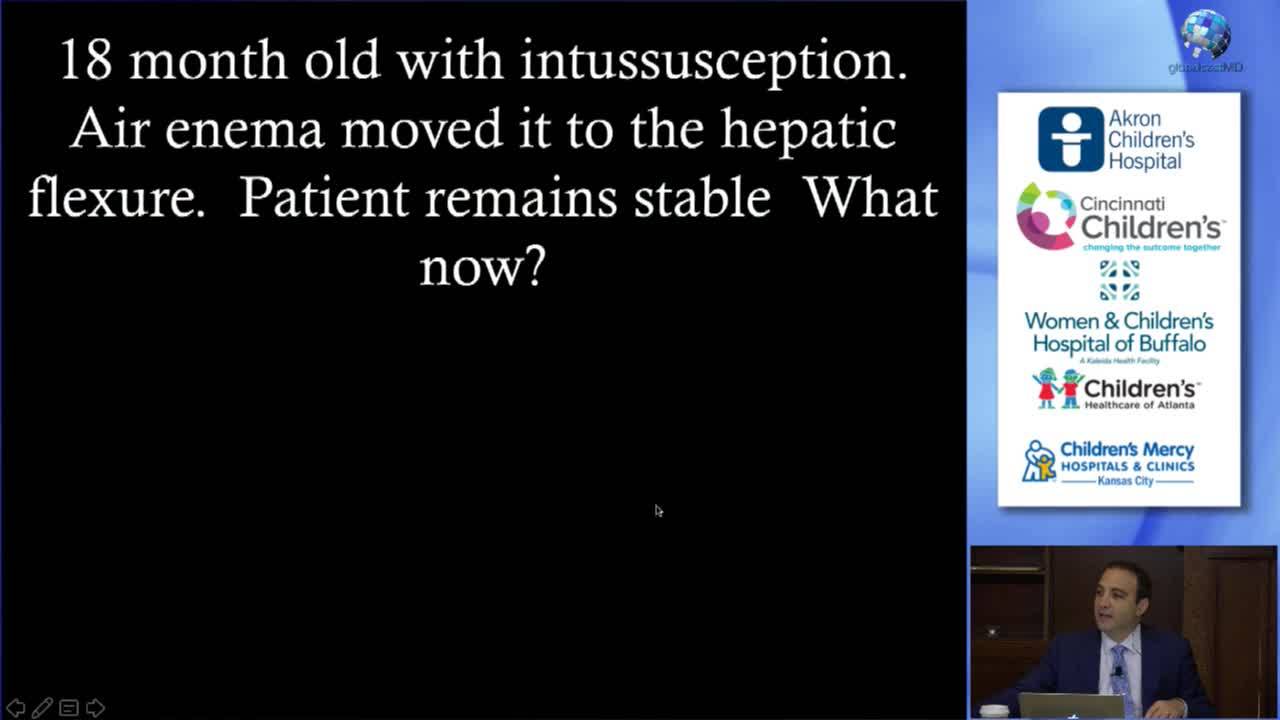
We're going to move on now to Dr. Von Almann, who's going to talk to us about inusception. Great thanks Todd. So Dr. Volkin and I are going to bang through a few quick hit topics. Um this one in particular uh talking about inusception. I was at a apps uh case presentation session several years ago that Dr. Harman was doing and uh presented a case of inusception and I was really struck by the heterogeneity of the practice patterns for how we actually treat inusception and it's something that I think is trained certainly dramatically since I was a fellow, which was way way too long ago, but even just in the past uh several years there've been this ongoing change in how we manage inusception. So I'll be very interested to hear from our colleagues across the country but also internationally, uh how they manage this relatively common problem. So if you start with a standard case, a two-year-old who presents to the emergency department with coy abdominal pain, a little bit of bloody stool and a palpable mass in the left upper quadrant. On exam, hemodynamically stable, actually relatively comfortable with no peritoneal signs. So how how would you work that patient up? And how do people what's the next test that you would get? Or conceivably would you take that patient? He's kid with classic inusception? Would anybody take them directly to the operating room? So who here would Who gets plain films? What's that? Who would get a plain film? Who would get a plain film? Right, I it's a good question because I've never had a patient that didn't have one. Right. But the question is you can't rule out inusception on a plain film. So does it help you or not? And I guess that's one of my pet peeves is we get lots of tests that don't really help us, but we get it just because we get it and I'm as guilty as anybody else. In in our place, um the radiologists will refuse to do an enema without a plain film to rule out free air. So there you go. So so our our our faculty here, our radiologist will just take them for the enema and they shoot they shoot a flat plate basically in flora right before they start. And they use that as their substitution. In in the in the floris sweet. But now let's have to say it. Did I miss that you got an ultrasound? So that was exactly my next question is you're saying going for the enema, but how many people how how many people would get an ultrasound to confirm the diagnosis? What test are you going to use to confirm the diagnosis? So who here would not get an ultrasound? Would anyone not get an ultrasound to confirm the diagnosis? Looks like looks like you're going to get those two. So most people are going to get an ultrasound, which is what we would do for sure is get an ultrasound in a uh in a patient with a great history and all the classic physical findings would still get an ultrasound to confirm the diagnosis before then going to radiology for a therapeutic intervention. And I'd be very interested to know from our international colleagues, uh, in particular, uh, do people do ultrasound, uh, saline reductions under ultrasound? Or do either contrast or I think in most places here, uh, at least in our institution use air as the contrast to do uh reductions uh with air. So Alex, tell us what we found when we asked that question online. What were we? Yeah, so this was kind of sparked by a randomized control trial that came out of China uh within the past couple of years where they compared directly the uh ultrasound guided sailing enema versus the air contrast enema. Um and found that the ultrasound guided had like a 96% success rate compared to like 83% for air contrast enema. So just asked why we weren't doing these ultrasound guided ones and um posted it to our Facebook group and everywhere that wasn't the United States said, we are doing these ultrasound guided sailingemas. What are you talking about? So um it seems like it's pretty much just a a US specific thing that we're still doing the air contrast. Yeah. And it sort of so maybe that plays into the next question, which is being answered here as we speak, which is how many attempts at reduction do people allow the patient to have uh before proceeding to something more invasive like surgery. And in that study that you quoted, how many attempts were made to get that 90 whatever percent reduction rate. I don't recall how many they had made, but I know that their the sailing group had um a lower intraluminal pressure compared to the uh air contrast animal group. It was like 88 millimeters of mercury compared to 120 of the air contrast. 120 is what we use uh which Dr. Godagle just informed me before uh our radiologist use 120 as their pressure limit. But how many I'd be curious from the people here, how many the poll says 62% say three attempts, uh two attempts in a quarter of them and 10% would only do one attempt. Let me hit even while we're waiting for that on the basic assumption that uh three years ago, uh we presented whether or not you do that at all. Um a few years ago, our institution in Akron, I work at two institutions. Uh in Akron, they would not repeat it. If it did not reduce, I was going to the operating room. And after this being presented multiple times on this forum, we now repeat it and I think I would say we do it about three times. Is there anyone here that is in an institution that does not do us an another attempt. At least one other. At least one other attempt. Our protocol in Cincinnati is three attempts. Three attempts, Mac? Just a a comment there, uh two two ways the first reduction fails. One is you move the inusceptum all the way over mid right colon, they can't go farther, they're not going to go farther and you know there's still an inusceptum there. The second way they fail is they actually reduce the whole thing but it doesn't reflux up through the ical valve. So the patient is completely reduced but that doesn't meet their criteria criteria for being able to say it's reduced. And so when you repeat the anma one time, you're trying to really reduce what was left, and another time you're just trying to confirm that they actually did what they uh didn't confess to do in the first place. Because you need the edema to to settle out. Wait I also think that you've got to see progress with the attempted reduction before you would persist on with another one or two. That is if if you try the reduction and it doesn't really move, then there's no in my mind at least there's not a real indication for trying it again. Just to add what uh Mac was saying is if you do reduce it all the way and don't get reflux, um those patients will typically their symptoms will go away. So you you know that you've actually clinically you can safely watch those patients or you can just get another ultrasound and confirm that. So I think that radiographic criteria of a reflux in the terminal ilium for full reduction doesn't really need to. So I want to challenge you on that. So I just I'm not challenging you but make sure I understand you. Keep on, keep. So uh so if the child, if they do a contrast enema, an air enema and it gets to the ical valve but no air reflux into the small bowel. You would just follow symptoms. You would not need a confirmation other than that or ultrasound that they've successfully reduced the child. That's correct. We actually studied that and initially in our early series, we repeated all those um contrast anemas and they were all normal at that time the next day. Um what we found was really the symptoms. If you bring them back, they they continue to have that crampy abdominal pain was the key. Now it's easier with the ultrasound that you can check. So the key statement you made is you bring it before you would bring them back the next day. For a. So how long did they have to be symptom free? Because patients with inusceptions, as I presented this child can be essentially symptom-free and still have their inusception. What we found in our study was that they continue to have very similar recurrent coy pain, um as if we didn't do anything to the inusception. We did reduce it partly but we didn't get it all the way. Those that we reduced all the way uh and didn't see the reflux, those patients were completely asymptomatic. So um Chuck Bro from um Grand Junction, Colorado um has a question, are the three attempts all like they do it, it doesn't go and then they do it again right then or are you talking about like a time lapse between the reductions and how long is that time lapse? We usually have a time lapse so we let them for an hour or two. An hour or two. And then redo the study. Yeah, we do. I think the time lapse is it depends on what time the first one was done. If it's 3:00 a.m., the next one will be at 6:00. Yeah. And and Todd, I have one other just true confession. I think early on in the laparoscopic approach to inusception, I think many of our early successes, I certainly remember in my own experience, you'd go in and you'd sort of grab the terminal ilium and sort of pull it towards yourself and go, oh, it was reduced. That was look at that. That was easy. But instead those all fall into that second category I mentioned. It was already reduced. They wouldn't call it reduced so we operated on them and wrote papers about how great laparoscopic surgery was for inusception. In Singapore they say, in Singapore they say they give another shot if it's progressing. So um you were going to say something. I was just going to say to Dr. Harman's point, how many people would do this laparoscopically and how many people do it open? And that's the next poll question. Oh, okay. So, wow. While people are answering this, uh we did have a question from the audience, is there any role for an an enema under laparoscopic like direct lapras or laparoscopic like view. So would you ever. I know I know someone who does that. Jeffrey Lukesh describes it what he'll go in he does laparoscope. See when you do it laparoscopically, you have to sometimes pull, which is what we've always been taught not to do. So what he does is he has him doing he does an on table air enema laparoscopically and that helps the operation substantially get it to almost to where you need and then he can pull a little bit rest of the way. So it's a combined combined lap. It's not just to look and see whether it's reduced. Because if you're going to do that, we should learn how to do ultrasound like everybody else in the world and do them with ultrasound guides. Right. No, this is that they failed. He's going into do it and he uses the push to help him laparoscopically reduce it, which is I thought a really smart idea. Um what I have found I do it laparoscopically, but what I have found is my success has gone way down since the success of radiology has increased. So as they've gotten better, these cases of going in and going are over. That by the if if if I'm going to the operating room, they have given it the old college try and these are often ones that are are pretty challenging to do. So. Yeah, the only comment I would make is that if you I still think it's worth putting a scope in and trying laparoscopically because if you open everyone then everyone gets an open operation. Right. True. True. There's the wisdom. No, because I I think it's worth trying. But I agree with you. I think that radiology's gotten a lot better. So the easy ones uh they took call the easy ones away from from us. Sounds like Nanwin and Arthur Aranda both use on table air enema during their laparoscopic reduction. Really? Interesting. I was just saying, Dan, like I wonder if the laparoscopy versus laparotomy is also about access to laparoscopy that many of the people who are doing laparotomies are probably maybe in places that don't have access to laparoscopy. Good point. From someone who just came from a location like that. Okay. And I think Todd, you alluded to the technique laparoscopically if it's a pull instead of a push and I think it's an interesting concept to do both with on table uh. Yeah. Okay. Or or maybe sailing, we should be using sounds like sailing may work better. Yeah. Yeah. I wonder. And that study I just looked up they it was three attempts for for. Three attempts, so good. All right. So now to the to the last real issue I wanted to discuss because I think there's probably been the biggest change in practice at least for us and for me is what do you do if you reduce this? Do you admit the patient overnight? Uh observe them for 12 hours, observe them for six hours, uh observe them for four hours or discharge them immediately. And this was I think one of the points at the session I mentioned early where I was really struck by we were at that point still admitting everybody for uh at least overnight and uh keeping them NPO. Okay. So, so we know what you do. What do you do in Indiana? Do you admit them overnight or send them home from the emergency room? So I think there's some variability and um there's not only variability among the partners, but one thing we have to cope with is that we have most of our kids come from another place, two to four hours away having had a CT scan as the initial study. And if they have any symptoms when they go home, they will go back and they will have another CT scan at that outside facility. So sometimes our reason to admit is because of the local resources available to them. And I I think that since we've gone to air reduction rather than uh contrast reduction, they actually have more crampy pain in the first few hours after we do the enema. I think they're more distended with gas than they previously were and so there's a little bit more symptoms. And the third thing I would take into account is how symptomatic were they before they came in and how challenging was it. So I think there are some good candidates, local kids, not too bad, easy transportation back, they're great to go home. I'm so glad you made that point. Uh just like sounds like this is the theme of today is that it's a tailored approach, uh that you can do one or the other, but it's a patient by patient uh plan. Fred, you'd agree with that or? I would pretty much observe four hours on almost everybody. Okay. Um and let them go. I think the. In the ER. You keep them in the. In in the ER. Yeah. And then don't admit them. Okay. Um but I think Dave has a good point that you have to have a tailored approach to some children so. What are you doing in Atlanta? Yeah, we we observe them for a little bit in the ED and PO challenge them and send them home. Okay. Anyone here have other comments to make? Does does anyone admit them overnight routinely here? Okay. Yeah. Huh? Not anymore. And if I did, I'm not admitting anymore because I'm. So our protocol is is that a four-hour observation, um followed by a PO challenge and then discharge home. I think the one the it can be a challenge sometimes because that requires that there's capacity in the ED to have the patients sit there for four hours. That's right. That's another. And that has been a if if we run into a barrier to that, it's a capacity issue in the ED not because we don't want to use that as our plan. So I want to do another variability assessment. We're we're definitely behind as now it's always the way these courses usually go. Uh what number do you? Well actually let me start with you, Alex, because you're the ones that see them in the ED before. What number do you quote the parents and we're going to go down here is their chance of recurrence? Um say uh 10%, 10 to 15%. What do you say? I'm going to show you two slides so I won't say anything. Oh man, all right, fine. Well, we'll sorry, this is a pretest. This is a pretest. I'd say 5 to 10%. 5 to 10. About 10%. Everyone here in that range? 10, I see 10, I see 6%. Definitely you're right. 55. So yeah. 5%. Okay. All right. All right. So just to move along uh to talk about a couple of studies that looked at the four-hour observation primarily. Uh this was a study that where they looked at 51 patients. I think 52 patients and bottom line uh is there was no difference in recurrence rates. However, that their recurrence rate was 15 and 16% respectively for patients admitted overnight and patients observed. So a little bit higher than most people suggested here. I think that's actually a little bit higher than most people would quote. Um there was no difference in the time to uh recurrence, no difference in adverse outcomes uh and that was with a four-hour observation. Obviously if you do that, your length of stay is going to be a lot shorter than if you admit the patient overnight. So their conclusion was there was no increase in adverse outcomes with a short observation uh for an uncomplicated hydrostatic reduction. The other and this was their protocol, which we won't go through, but basically it's just that if you're able to reduce it and confident that it's reduced, observe for four hours and PO challenge and discharge. This other study was a systematic uh review with a meta analysis. Um it looked at there were 10 papers where there were they had enough data to compare the two. They also found that there was essentially no statistical difference in recurrence rates or return to the ED or need for operative intervention or mortality and obviously again a decrease length of stay. The recurrence rate in this study was 6 to 8%. So much more in line with what uh most most folks had suggested in the room. So the key points are outpatient management uh after an inusception after a reduction is safe. Uh there's no difference in most of the outcomes that we measure but you significantly reduce their length of stay and cost and everything else. Do you do with um like a small bowel, small bowel inusception that uh you see incidentally? If it's incidental, I would observe it. If it's a patient who's postop, I would operate. I would put a laparoscope in or operate on them. But we see them all the time. I mean it's not uncommon with a CT scan or something for them to call that and I wouldn't do anything with that because I've never found that I had to do anything about that. could probably give gastrograf. We can talk about that later. Okay. All right. Um so that was great. Um of course, the uh things we all deal with the most get the most discussions, that was great.