


From
Dr. Michael Helmrath
Enhanced Piezoelectric Performance of PVDF-TrFE Nanofibers through Annealing for Tissue Engineering Applications
pubmed.ncbi.nlm.nih.gov shows its articles on its own site.
Read the article on pubmed.ncbi.nlm.nih.gov ↗Article · Aug 2024 · 1 min read
In brief
In brief
This study optimizes piezoelectric PVDF-TrFE nanofiber scaffolds through thermal annealing to enhance bioelectric stimulation for tissue regeneration. Annealing at 140°C maximized crystallinity, piezoelectric response, and mechanical properties matching soft tissue, while promoting Schwann cell proliferation and extracellular matrix production without adverse foreign body response in mice.
Written by the GCMD Library team from the article.
This study investigates bioelectric stimulation's role in tissue regeneration by enhancing the piezoelectric properties of tissue-engineered grafts using annealed poly(vinylidene fluoride-trifluoroethylene) (PVDF-TrFE) scaffolds. Annealing at temperatures of 80°C, 100°C, 120°C, and 140°C was assessed for its impact on material properties and physiological utility. Analytical techniques such as Differential Scanning Calorimetry (DSC), Fourier-Transform Infrared Spectroscopy (FTIR), and X-ray Diffraction (XRD) revealed increased crystallinity with higher annealing temperatures, peaking in β-phase content and crystallinity at 140°C. Scanning Electron Microscopy (SEM) showed that 140°C annealed scaffolds had enhanced lamellar structures, increased porosity, and maximum piezoelectric response. Mechanical tests indicated that 140°C annealing improved elastic modulus, tensile strength, and substrate stiffness, aligning these properties with physiological soft tissues. In vitro assessments in Schwann cells demonstrated favorable responses, with increased cell proliferation, contraction, and extracellular matrix attachment. Additionally, genes linked to extracellular matrix production, vascularization, and calcium signaling were upregulated. The foreign body response in C57BL/6 mice, evaluated through Hematoxylin and Eosin (H&E) and Picrosirius Red staining, showed no differences between scaffold groups, supporting the potential for future functional evaluation of the annealed group i
Educational content from recorded physician discussions — not medical advice. Talk to your (or your child's) care team about your situation.
Article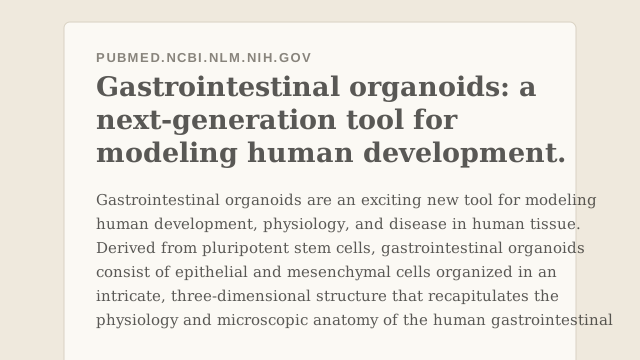
Gastrointestinal organoids: a next-generation tool for modeling human development.
Michael Helmrath · Published Nov 2026
Article
Mechanical stimulation promotes human intestinal villus morphogenesis in vivo
Michael Helmrath · Published Nov 2026
Article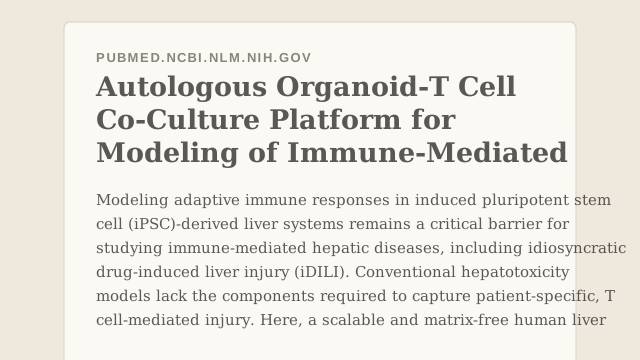
Autologous Organoid-T Cell Co-Culture Platform for Modeling of Immune-Mediated Drug-Induced Liver Injury.
Michael Helmrath · Published Nov 2026
Article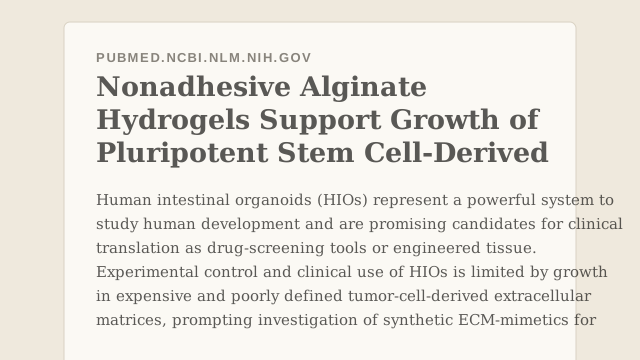
Nonadhesive Alginate Hydrogels Support Growth of Pluripotent Stem Cell-Derived Intestinal Organoids.
Michael Helmrath · Published Nov 2026
Article
Differentiation of Human Pluripotent Stem Cells into Colonic Organoids via Transient Activation of BMP Signaling.
Michael Helmrath · Published Nov 2026
Article
Transplantation of human intestinal organoids into the mouse mesentery: A more physiologic and anatomic engraftment site.
Michael Helmrath · Published Nov 2026
Article
Increased Programmed Death-Ligand 1 is an Early Epithelial Cell Response to Helicobacter pylori Infection.
Michael Helmrath · Published Nov 2026
Article
Obesity in the adolescent female
Michael Helmrath · Published Nov 2026
Article
Bariatric surgery for severely overweight adolescents: concerns and recommendations
Michael Helmrath · Published Nov 2026
Article
Predictors of Preoperative Program Non-Completion in Adolescents Referred for Bariatric Surgery.
Michael Helmrath · Published Nov 2026
Article
Five-Year Outcomes of Gastric Bypass in Adolescents as Compared with Adults
Michael Helmrath · Published Nov 2026
Article
Musculoskeletal Pain, Self-reported Physical Function, and Quality of Life in the Teen-Longitudinal Assessment of Bariatric Surgery (Teen-LABS) Cohort.
Michael Helmrath · Published Nov 2026