


From
StayCurrentMD
Multi-Institutional Analysis of Choledocholithiasis in Pediatric vs Adult Patients
hosted by Dr. Alex Halpern
Chapter 1 of 1 · Evidence & Research
Surgery-First Approach for Pediatric Choledocholithiasis
Expert statements on this page
No expert statements were drawn from this page.
Host summaries · secondary, not cited in answers
Educational content from recorded physician discussions — not medical advice. Talk to your (or your child's) care team about your situation.
Podcast
Case-Based Journal Review: Cholelithiasis 2024
18 min · Published Jul 2024
Video
Quick Literature Updates Episode 12
Published Aug 2023
Podcast
Choledocholithiasis with Drs. David Vitale & Lucas Neff
15 min · Published Jul 2024
Video
SAGES/ALACE Symposium: Integrating New Technologies, Old Tricks, and Operative Approaches
Jeffrey Ponsky · 12 min · Published Mar 2012
Video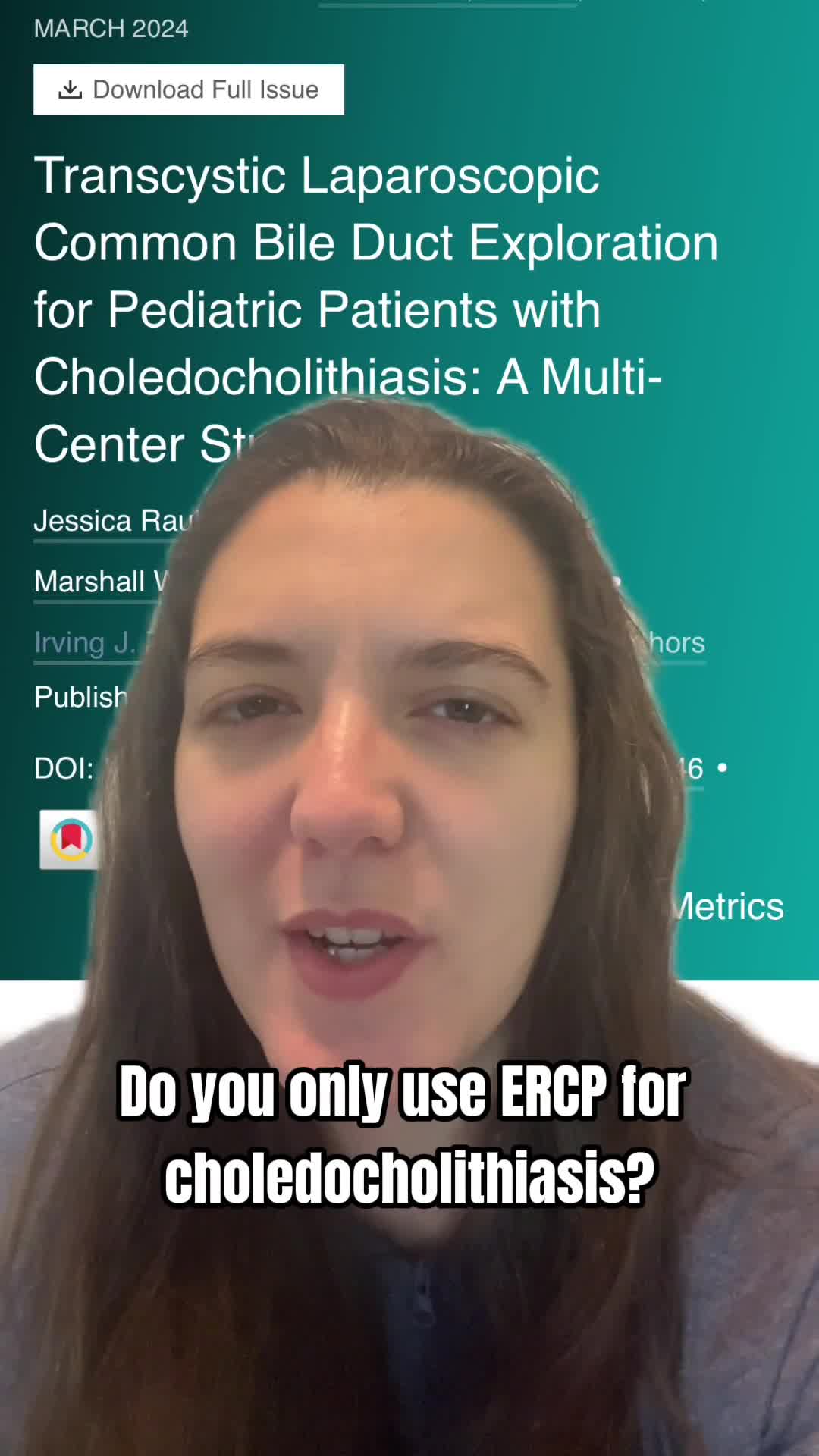
Transcystic Laparoscopic Common Bile Duct Exploration for Pediatric Patients with Choledocholithiasis
1 min · Published May 2024
Video
Acute Cholecystitis
Todd Ponsky · 32 min · Published Jul 2026
Video
Overview of the Surgical Management of Acute and Chronic Pancreatitis in Children with Dr. Juan Gurria
66 min · Published Apr 2026
Video
Pancreatitis in pediatric patients with pancreatic solid pseudopapillary neoplasms- a single center experience
59 s · Published Apr 2026
Podcast
Update Course Rewind: Pediatric Biliary Stones - Preventing Gallstone Pancreatitis 2024
Jeffrey Ponsky · 3 min · Published Aug 2025
Video
Update Course Rewind: Pediatric Biliary Stones - Surgery First Mindset 2024
Dr. Todd Ponsky · 7 min · Published Jul 2025
Video
Total pancreatectomy with islet autotransplantation (TPIAT) - Cincinnati Children's Pancreas Care Center
CCHMC Pediatric Surgery · 10 min · Published Dec 2024
Video
Chronic Pancreatitis - Pancreatic Pathologies by Cincinnati Children's Pancreas Care Center
CCHMC Pediatric Surgery · 8 min · Published Nov 2024
Video
Intestinal Atresia Types Explained: Grossfeld Classification for Pediatric Surgery
1 min · Published Sep 2026
Video
Derivation and validation of the Pediatric Community-Acquired Pneumonia Severity (PedCAPS) score: A prospective cohort study
50 s · Published Sep 2026
Video
FETO for Late-Diagnosed Severe Congenital Diaphragmatic Hernia (CDH) at Cincinnati Children's with Dr. Beth Rymeski
4 min · Published Sep 2026
Video
Severe Congenital Diaphragmatic Hernia (CDH) Case: FETO Management & Unexpected Findings with Dr. Beth Rymeski
3 min · Published Sep 2026
Video
Fetoscopic Endoluminal Tracheal Occlusion (FETO) Procedure: Step-by-Step Guide with Dr. Beth Rymeski
4 min · Published Sep 2026
Video
Choledochal Cyst Types Explained: Pediatric Surgery Fundamentals
1 min · Published Sep 2026
What the experts said
Dantes et al. performed a multi-center retrospective review of pediatric and adult patients treated for choledocholithiasis between 2018 and 2024
724 patients were included in the study
Surgery first approach with upfront laparoscopic cholecystectomy with intraoperative cholangiogram was performed in 201 pediatric patients and 169 adult patients
Laparoscopic common bile duct exploration was attempted in 84 children and 140 adults in the surgery first group
Common bile duct exploration success was higher in pediatric than adult patients
Complication rates were similar between pediatric and adult patients in the surgery first approach
A surgery first approach can be a safe and effective tool for managing choledocholithiasis in pediatric patients