


From
StayCurrentMD
Quick Literature Updates Episode 18
With Dr. Alex Halpern · hosted by Dr. Em Gootee & Dr. Lizzie Lee & Dr. Cecilia Gigena
Chapter 1 of 4 · Evidence & Research
ERAS neonatal care
ERAS Society Recommendations for Neonatal Perioperative Care
Expert statements on this page
No expert statements were drawn from this page.
Host summaries · secondary, not cited in answers
Educational content from recorded physician discussions — not medical advice. Talk to your (or your child's) care team about your situation.
Video
Finnish Pediatric Surgery Hub - From Centralization to Collective Learning and Sharing of Expertise
48 s · Published Feb 2025
Video
Safety and utility of long-acting steroid injection for management of post-operative stricture...
1 min · Published Jun 2026
Video
Transition From Pediatric to Adult Healthcare for Colorectal Conditions: A Systematic Review
58 s · Published Sep 2024
Video
Cuidado de transición en malformación anorrectal y enfermedad de Hirschsprung
1 min · Published Jul 2024
Video
Enterocolitis in Hirschsprung Disease: Update Course 2015
CCHMC Pediatric Surgery · 5 min · Published Nov 2015
Video
Colorectal Surgery: What does the anesthesia provider need to know?
24 min · Published Oct 2023
Video
Validation of an anorectal malformation trainer - Can a high-fidelity model simulate real life?
1 min · Published Jun 2026
Video
Complications and Long-Term Outcomes of Patients With Cloacal Malformation After Bowel Neovagina...
1 min · Published Jun 2026
Video
Association Between Social Determinants of Health and Choice of Urinary Reconstruction in Children
1 min · Published Jun 2026
Video
The Perineal Body Preserving PSARP (PPP)
11 min · Published Jun 2026
Video
Update Course Rewind 2025: Hirschsprung + ARM: Rare but Real
1 min · Published May 2026
Video
Update Course Rewind 2025: Botox for Hirschsprung’s: Where, When, and Why
1 min · Published May 2026
Video
Quick Literature Updates Ep 27
4 min · Published Feb 2026
Video
Quick Literature Updates Ep 26
4 min · Published Jan 2026
Video
Quick Literature Updates Ep 23
4 min · Published Oct 2025
Video
Quick Literature Updates Ep 22
4 min · Published Oct 2025
Video
Quick Literature Updates Ep 21
4 min · Published Sep 2025
Video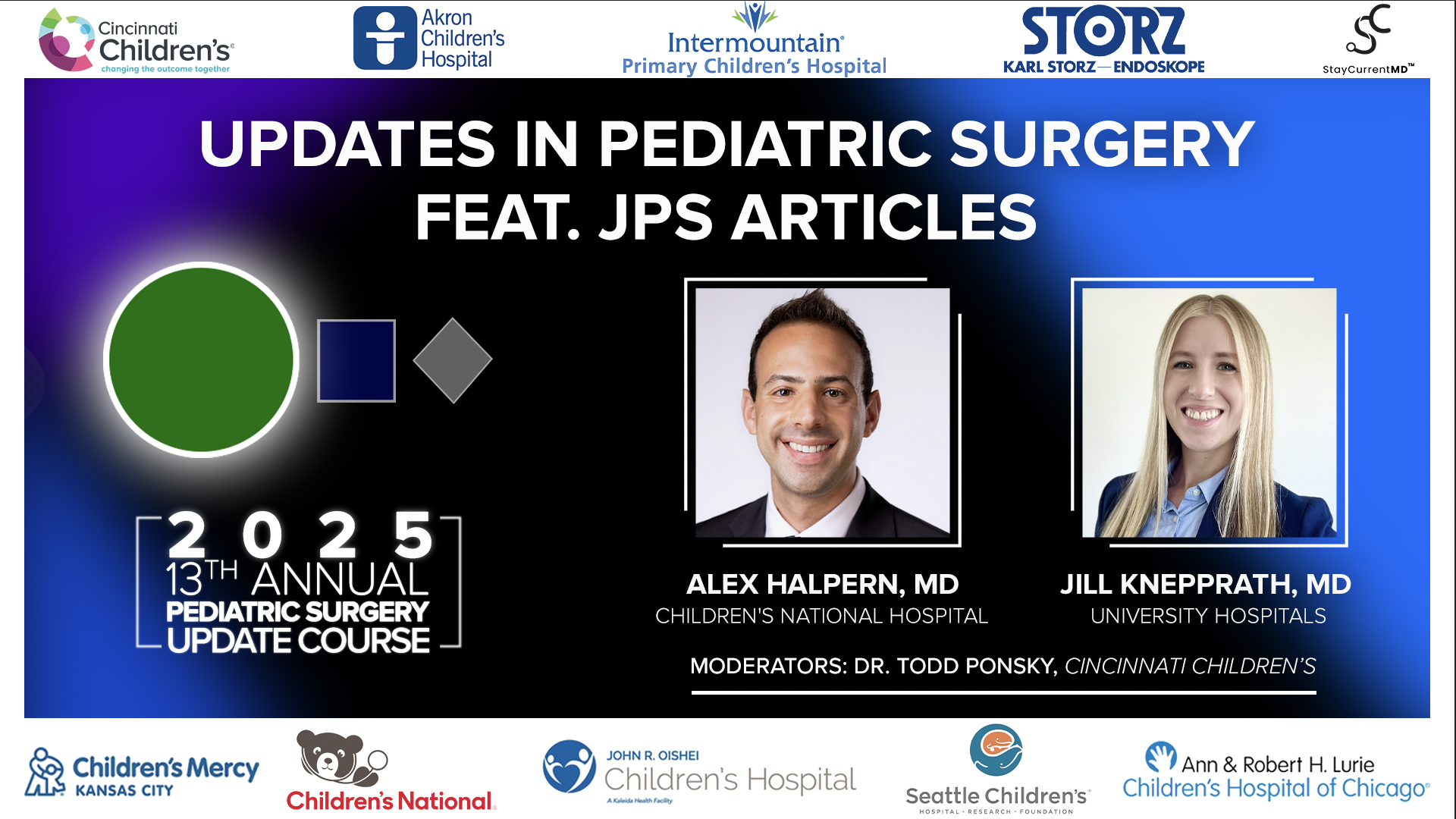
2025 Pediatric Surgery Update Course - Updates in Pediatric Surgery feat. JPS Articles
Dr. Todd Ponsky · 15 min · Published Aug 2025
Video
Intestinal Atresia Types Explained: Grossfeld Classification for Pediatric Surgery
1 min · Published Sep 2026
Video
Derivation and validation of the Pediatric Community-Acquired Pneumonia Severity (PedCAPS) score: A prospective cohort study
50 s · Published Sep 2026
Video
FETO for Late-Diagnosed Severe Congenital Diaphragmatic Hernia (CDH) at Cincinnati Children's with Dr. Beth Rymeski
4 min · Published Sep 2026
Video
Severe Congenital Diaphragmatic Hernia (CDH) Case: FETO Management & Unexpected Findings with Dr. Beth Rymeski
3 min · Published Sep 2026
Video
Fetoscopic Endoluminal Tracheal Occlusion (FETO) Procedure: Step-by-Step Guide with Dr. Beth Rymeski
4 min · Published Sep 2026
Video
Choledochal Cyst Types Explained: Pediatric Surgery Fundamentals
1 min · Published Sep 2026
What the experts said
The ERAS Society used a modified Delphi technique to develop recommendations for neonatal perioperative care, requiring more than 70% consensus from a multidisciplinary group of experts.
The ERAS Society agreed on 16 recommendations covering 11 topics including team communication, pre-surgery fasting, temperature control, and antibiotic use for neonatal surgical patients.
The ERAS Society did not have enough data to make recommendations about nasogastric tubes and central lines in neonatal surgical care.
A systematic review found 8 studies examining transition from pediatric to adult healthcare for colorectal conditions.
Studies on transition care for colorectal conditions agreed that transitional care should start early in adolescence.
Studies found little evidence that transfer from pediatric to adult care for colorectal conditions is happening in a coordinated or timely fashion.
No models of transition care were identified for children with anorectal malformations and Hirschsprung disease transitioning to adult care.
A retrospective cohort study of CPAM included 110 patients comparing outcomes based on timing of surgery relative to symptom onset.
Patients with CPAM who underwent surgery before becoming symptomatic had shorter length of stay compared to those operated after symptom onset.
Patients with CPAM who underwent surgery before becoming symptomatic had shorter mechanical ventilation time after surgery compared to those operated after symptom onset.
Patients with CPAM who underwent surgery before becoming symptomatic had shorter operating times compared to those operated after symptom onset.
In the CPAM study, there was no significant difference in conversion rates or post-operative complications between patients operated before versus after symptom onset.
The CPAM study findings suggest it is safer to operate these patients before they become symptomatic.