
 StayCurrentMD
Congenital Esophageal Stenosis
Everything in the library about congenital esophageal stenosis — built automatically from the recorded discussions that name it
Educational content from recorded physician discussions — not medical advice. Always talk to your child's care team about your child's situation.
Content of this collection
Evidence & Research
2 items
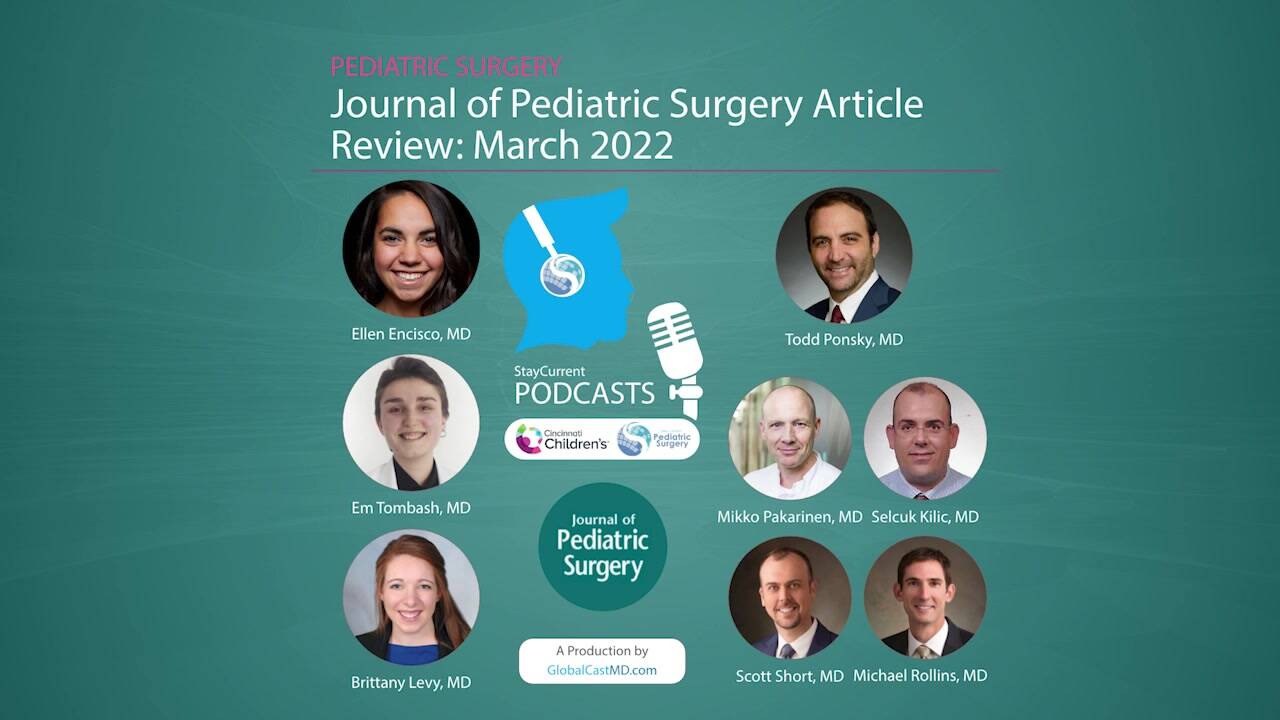

Journal of Pediatric Surgery Article Review: March 2022
Watch →
We're back with the March issue of JPS article highlights. This time we're talking to editor Dr.Mikko Pakarinen and authors Drs. Selcuk Kilic, Scott Short and Michael Rollins with Dr. Todd Ponsky. Hosts: Ellen Encisco, Em Tombash & Brittany
video · Apr 2022
Journal of Pediatric Surgery Article Review: March 2022
Listen →
We're back with the March issue of JPS article highlights. This time we're talking to editor Dr.Mikko Pakarinen and authors Drs. Selcuk Kilic, Scott Short and Michael Rollins with Dr. Todd Ponsky. Hosts: Ellen Encisco, Em Tombash & Brittany
podcast10:47 · Apr 2022
In-Depth Reviews
1 item

Update Course Rewind: 2022 Top Ten Key Takeaways
Watch →
The 10th annual Pediatric Surgery Update Course was held as a webinar on August 30, 2022. We had a lot of lively discussion and engaging presentations on the latest updates in pediatric surgery. In this video we are reviewing the top ten ke
video · Jun 2023
Summaries and takeaways+ Show
The doctors in this collection+ Show
All expert statements+ Show
Every expert statement below comes from the recorded discussions, with its speaker and moment.
Update Course Rewind: 2022 Top Ten Key Takeaways
Infants with gastroschisis often require prolonged hospitalization for surgical repair and initiation and advancement of feeds.
host_summaryEm Tombash1:00 ↗
Based on recently updated protocols from Cincinnati Children's Hospital and Children's Mercy Kansas City, feeds can be started immediately after sutureless abdominal closure for uncomplicated gastroschisis, beginning with 10-20 mL/kg/day and advancing by 20 mL/kg/day if tolerated.
host_summaryEm Tombash2:00 ↗
Immediate feeding after gastroschisis closure has been shown to be associated with shorter length of stay and faster attainment of goal feeds.
host_summaryEm Tombash2:30 ↗
For babies with uncomplicated gastroschisis tolerating feeds for a few days, it is okay to continue the feeding protocol even after one bout of emesis.
host_summaryEm Tombash2:45 ↗
High resolution esophageal manometry, esophagography, and endoscopy can help determine the diagnosis of congenital esophageal stenosis.
host_summaryEm Tombash4:00 ↗
Serial dilations may be used to manage congenital esophageal stenosis if there is no cartilage component suspected in the stenotic area.
host_summaryEm Tombash4:15 ↗
Surgical resection for congenital esophageal stenosis can be reserved for patients where serial dilation is unsuccessful or there is concern for a cartilaginous component.
host_summaryEm Tombash4:30 ↗
Initial conservative management should be considered for patients with congenital esophageal stenosis, especially if a cartilaginous component is not suspected.
host_summaryEm Tombash4:45 ↗
Management of intussusception after enema reduction varies in practice, with historically recommended inpatient observation lacking evidence-based guidelines.
host_summaryEm Tombash5:45 ↗
A systematic review and meta-analysis found that overall recurrence rates and recurrences within 24 and 48 hours were similar between inpatient and outpatient management groups after intussusception enema reduction.
host_summaryEm Tombash6:00 ↗
There was no significant difference in the rate of return to the emergency department between inpatient and outpatient management after intussusception reduction, and both groups had similar rates of requiring operative intervention.
host_summaryEm Tombash6:30 ↗
Outpatient management of intussusception after air enema reduction results in shorter hospital stay with no difference in rate of ED returns, recurrence, need for operation, or mortality.
host_summaryEm Tombash6:45 ↗
There is no compelling evidence in pediatric or adult literature to support mechanical bowel preparation reducing surgical site infections in colorectal surgery.
host_summaryEm Tombash7:30 ↗
Recent adult studies have shown no benefit from mechanical bowel preparation in reducing surgical site infections, with some studies showing an increase in wound infections.
host_summaryEm Tombash7:45 ↗
Adult studies suggest a possible benefit of oral and IV antibiotics to reduce surgical site infections in colorectal surgery.
host_summaryEm Tombash8:00 ↗
Recent retrospective studies have not shown the importance of oral antibiotics for pediatric colorectal operations.
host_summaryEm Tombash8:15 ↗
Case-appropriate preoperative IV antibiotics may reduce surgical site infection incidence in colorectal surgery.
host_summaryEm Tombash8:45 ↗
Firearms are now the leading cause of death in all children and adolescents in the United States, overtaking motor vehicle crashes in 2019.
host_summaryEm Tombash9:45 ↗
There are controversies about whether pediatric surgeons should be involved in firearm violence prevention efforts and advocacy across the country.
host_summaryEm Tombash10:00 ↗
As pediatric surgeons, we need to advocate for protecting children's health and well-being, no matter what the topic is.
host_summaryEm Tombash10:15 ↗
Pediatric surgeons can play key roles for patients affected by firearms, including direct patient care and advocacy.
host_summaryEm Tombash10:45 ↗
Unwitnessed foreign body aspiration can be challenging to manage, and many items are not radiopaque so cannot be seen on plain x-ray.
host_summaryEm Tombash11:45 ↗
The gold standard for airway evaluation has been rigid or flexible bronchoscopy, but there are risks of negative bronchoscopy with subsequent airway compromise.
host_summaryEm Tombash12:00 ↗
CT bronchoscopy has been proposed as an adjunct in cases of children without obvious respiratory distress.
host_summaryEm Tombash12:15 ↗
Low-dose non-contrast CT of the chest has high sensitivity and specificity for identification of airway foreign bodies.
host_summaryEm Tombash12:30 ↗
CT can avoid the cost and resources of taking a child to the operating room for a non-therapeutic bronchoscopy procedure.
host_summaryEm Tombash12:45 ↗
The largest study looking at initial laparotomy versus peritoneal drainage for necrotizing enterocolitis was conducted at 20 US centers and examined combined death or neurodevelopmental impairment at corrected age 18-22 months.
host_summaryEm Tombash13:30 ↗
Death or neurodevelopmental impairment occurred in 69% of patients with preoperative diagnosis of NEC who underwent initial laparotomy versus 85% of those who underwent initial peritoneal drainage.
host_summaryEm Tombash14:00 ↗
The prospective randomized cohort study from the National Institute of Child Health and Human Development showed no difference in overall survival but did show improved long-term neurodevelopmental outcomes with initial laparotomy for NEC.
host_summaryEm Tombash14:15 ↗
For infants with necrotizing enterocolitis, initial laparotomy may be associated with less neurodevelopmental impairment and improved outcomes for extremely low birth weight babies.
host_summaryEm Tombash14:45 ↗
What's new+ Show