11
Views
0
Likes
0
Shares
0
Comments
StayCurrentMD
View profile →
Congenital Diaphragmatic Hernia with Dr. Charlie Stolar
Published:
Topic overview
Dr. Charlie Stolar discusses the comprehensive approach to congenital diaphragmatic hernia, emphasizing prenatal counseling with cautious optimism rather than doom and gloom. He covers diagnostic timing, associated anomalies, delivery planning, and the critical concept that CDH is a physiologic emergency requiring medical stabilization, not immediate surgery.
Timestops
0:05
Antenatal Consultation and Diagnosis
7:00
Delivery Planning and Prognostic Indicators
14:42
Initial Stabilization and ECMO Criteria
21:58
Ventilation Strategies and Permissive Hypercapnia
30:23
ECMO Management and Weaning Protocol
40:17
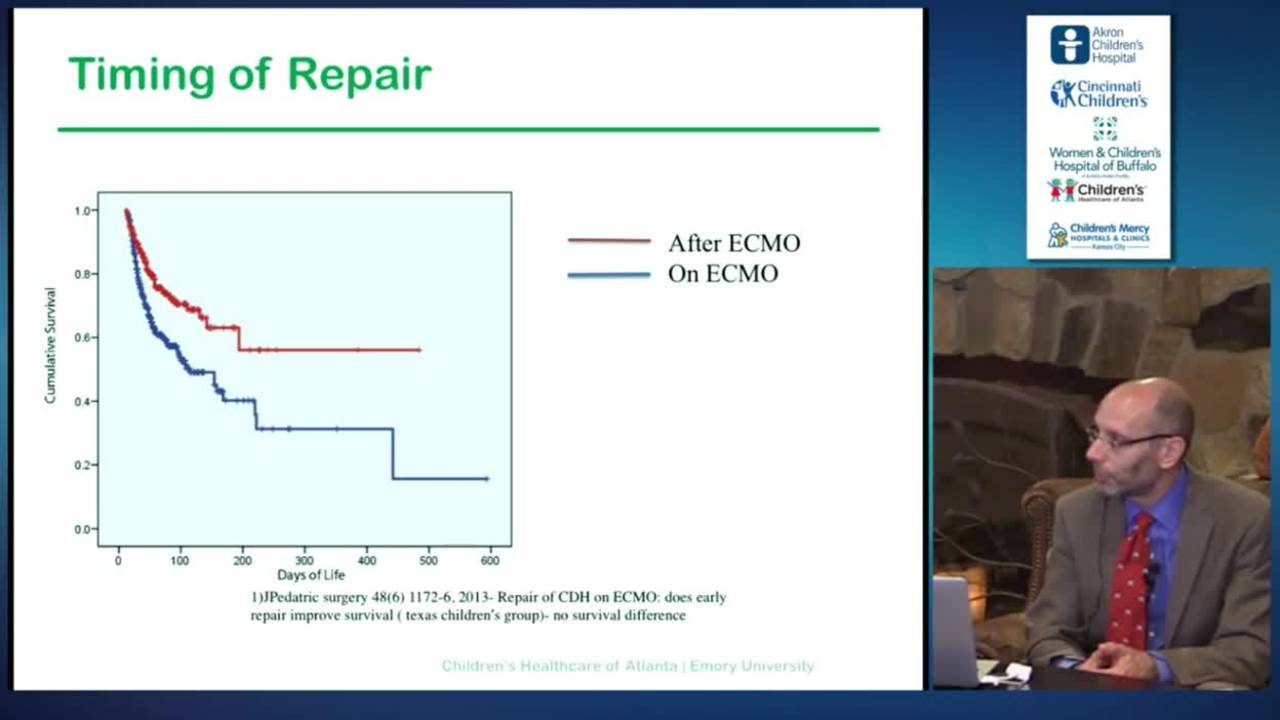
Surgical Timing and Repair Techniques
58:03
Recurrence and Long-term Complications
72:12
Multidisciplinary Follow-up and Outcomes
Key takeaways
- CDH antenatal consults should emphasize cautious optimism—most patients will 'raise an obnoxious teenager'—to counter misinformation.
- CDH is a physiologic emergency, not a surgical one; initial management focuses on respiratory stabilization, not immediate operation.
- Elective vaginal delivery is appropriate for isolated CDH; the diagnosis alone does not mandate cesarean section.
- CDH represents a field defect causing bilateral pulmonary hypoplasia (ipsilateral > contralateral) and altered pulmonary vascular resistance.
- Foregut dysmotility is the most common neonatal comorbidity; differential diagnosis includes CCAM and congenital lobar emphysema on imaging.
Keywords
Hashtags
Transcript
Click "Show Transcript" to view the full text (83327 characters)
Stay Current is a multimedia publication designed to keep healthcare professionals up to date with standards of care and new emerging ideas. Stay Current is created and edited by Todd Ponsky, Abby Schlager, Nicholas Bruns, and Ian Glenn in partnership with Globalcast MD and is recorded and produced at Akron Children's Hospital in Akron, Ohio. Welcome to Stay Current in Pediatric Surgery. This is Todd Ponsky recording from Akron Children's Hospital. And today we're gonna talk about congenital diaphragmatic hernias. This is something that a lot of people have asked us to address. Not only because this is a common thing we deal with, but there are so many elements to CDH that are controversial and not very well understood by everyone. So, with us today, we have Doctor Charlie Stoller, who everyone recognizes as really the, the leader and the expert in this, in this field. And Dr. Stoller is the Rudolph N. Schulinger Emeritus Professor of Surgery and Pediatrics at the Columbia University College of Physicians and Surgeons. He's also a senior attending surgeon at the California Pediatric Surgery Group and Cottage Healthcare Systems. Dr. Stoller, thank you for joining us today. It's my pleasure. Glad to be with you, Todd. Today I'd like to introduce a special co-moderator, Doctor Avi Schlager, who's one of our newer colleagues here at Akron Children's Hospital. He was trained. Uh, down in Atlanta, at Emory and uh Children's Hospital of Atlanta, and he's here now as assistant professor of surgery, and he is gonna be helping me because, uh, Doctor Stoller, I need, I need backup help when uh asking questions to Doctor Stoller, so he's gonna be here today to be helping us. So let's jump right into it. So you get, you're in the office and there's a mom that comes in. She's pregnant and it's an antenatal consultation, and all you know is that she has a baby who has a suspected left congenital diaphragmma hernia. How do you consult these mothers? So this is a very important question you're asking, Todd. I'm always reminded that the most important understanding of the word doctor means to teach. It has nothing to do with healing, means to teach, and the antenatal consultation is an opportunity to teach prospective parents of what the algorithm might be once their as yet unborn child comes to bear. So this is a fabulous opportunity to to educate. Often the parents will come to see us misinformed because the information that's that's given to them by their obstetricians is often out of date or misinterpreted. The fact of the matter is a community obstetrician will see this diagnosis in about 1 out of every 3 or 4000 pregnancies that he'll manage, and so they may not be familiar with it. So it's a chance to correct the misinformation. Not infrequently prospective parents will come to see us anticipating terminating a pregnancy because of the amount of misinformation that's either given to them by their other healthcare professionals or that's out there on the web, so this is a great opportunity. The discussion begins with telling parents that the chances are they're going to raise an obnoxious teenager. That's sort of how this story usually ends. Instead of doom and gloom, I hope that the conversation ends with parents leaving with a sense of cautious optimism, not doom and gloom. Of course we can't guarantee an outcome, but I expect parents to leave with a sense of cautious optimism. The diagnosis is usually made at about the 20 week with the usual routine anatomy scan. The ultrasonographers will see the stomach in the same cross sectional plane as the heart. That's usually how the diagnosis is made. It may or may not be associated with polyhydramias at that time, but usually they'll see the stomach in the same cross sectional plane as the heart. There may or may not be associated congenital heart disease. There may or may not be associated central nervous system anomalies, but most of the time it's an isolated anomaly. And most of the time it's on the left side and sometimes on the right. So the discussion with the antenatal diagnosis is, you know, how this comes to pass. We discuss it as a growth arrest of the of both lungs with the ipsilateral side being more severely affected than the contralateral side. The lungs are affected at the time of birth by a mix of some degree of pulmonary hypoplasia and some degree of altered pulmonary vascular resistance and altered transitional circulation, and we discussed that in, you know, non-medical terms. We also talk about the concept of a diaphragmatic hernia as a field defect that if we get into long term consequences, this comes out at that point, but we talk about how often these kids will have some difficulty with their fore gut motility. That's the most common, at least neonatal comorbidity with diaphragmatic hernia. We talk about the various treatment algorithms about how this is not a surgical emergency, it's a medical physiologic emergency but not a surgical emergency. The initial treatment begins in the labor and delivery area at the time of birth. We recommend an elective, uh, spontaneous vaginal delivery, assuming there's no obstetric issues. The diagnosis of diaphragmatic hernia alone is not NOT, not an indication for a cesarean section. It's not unreasonable to provoke labor near term. So it's the baby hopefully will be delivered on a Monday morning when everybody's around, but that almost never works out. But the point being that there's just having this diagnosis alone is not an indication for a cesarean section in my view. Once the baby's born, the babies are usually intubated. And then a respiratory care strategy is begun. The other thing, and I'll come back to that in a minute if you like, the other thing we tell parents is that the diagnosis is probably diaphragmatic hernia because on ultrasound and even on a neonatal chest X-ray there's other things that can be confused, such as a multicystic adenomatoid malformation, a large ventation. There's other things that can be confused with diaphragmatic hernia, so I tell parents that. The diagnosis is probably diaphragmatic hernia, and this will be confirmed at the time of birth. So it's a long way of answering your question, but as I said, the antenatal opportunity is a chance to educate parents. Often we're asked about antenatal interventions. In my view, they are no better than investigational and experimental at best. The open operations for diaphragmatic hernia have been largely tabled. The operations to obstruct the fetal trachea by one way or another. Have largely been tabled, although there is a trial being suggested by our European friends and there are some centers in the United States beginning to look into participating in that in one of these trials to disturb fetal breathing. But for the most part this is the treatment begins the diaphragmatic current begins after birth, not before birth. So I have a few questions for you. Um, so number one, where do you tell them where they should deliver? So that's a very important question. In my view, the babies with diaphragmatic hernia should be born at a full service children's facility. Full service means the ability, having the availability of extracorporeal life support, ECMO. Maybe, maybe 10 or 15% of the babies with diagnosed will benefit from ECMO, but you're much better off being born in a center where that can be offered as opposed to transporting an unstable baby to such a center. And yes, that's sometimes very disruptive for families because they may not live near a full service neonatal center, but in my view, the ideal environment is where there's labor delivery is intimately related to a neonatal intensive care unit in a full service children's facility that features extracorporeal life support. What do you tell them about prognosis number one, what is the prognosis, and then what are prognostic indicators? So this is a huge area of discussion, and by and large it's almost impossible to identify prognosis. Almost impossible, if for no other reason that the measurements are very dependent on the person taking the measurements. When you look at single center experiences, the presence of the liver in the chest or not is of no prognostic value. The presence of the stomach and the chest is of no prognostic value. The one number that gets bandied about is this lung to head ratio, where there's a ratio between the size of the head and the size of the chest. And by and large that is of no better than limited value except in the circumstance where there are it's a very low number, less than say 0.8. These are fetuses where you worry about the prognosis, but again it's not enough to justify a fetal intervention. It's very difficult to say this is a poor prognosis. The one thing that does augur for a poor prognosis is if there's associated congenital heart disease and certainly if there's associated central nervous system abnormalities, but using these various measurements, the lung head ratio, the observed to expected ratios, and so forth, these MRI calculations and lung volume, they're very user dependent and institution specific. And unless they're severely abnormal, you know, less than the 10th percentile, they're a very limited prognostic value, and I personally have a hard time recommending any sort of antenatal intervention based on those measurements. And you said that, uh, you know, which I love that you said how you paint a good picture or a promising picture to the parents, but if they ask you what are the chances of my child surviving, what do you tell them? So the short answer is, first of all, the word I use is cautious optimism, and if people ask me what's the chances of any one individual baby surviving, the answer is I don't know. But if you show me 100 children with diaphragmatic hernia, 80 to 85% are going to turn into obnoxious teenagers, and that's what I tell them. That's great. I love that. And definitely the numbers have improved over time. Exactly. And so what about you talked about prenatal and I, I, I wanna just touch on that for two seconds before we move on, um, what, what about steroids? So steroids had a tremendous value for preterm labor for the threatened premature baby, you know, under 35 weeks, say it's a very important treatment for to mature the type 2 surfactants and type 2 pneumocytes rather. Most of the babies with diaphragmatic hernia are near term. They're usually 37, 38, 39 weeks gestation in general. And the role of steroids in the near term baby with or without diaphragmatic hernia in the neonatology literature is arguable. There is no downside to it. I don't see a real downside to it. I would not be opposed to it, but the data are iffy. It is true that because there's often polyhydramnios associated with diaphragmatic hernia because the esophagus gets obstructed, these babies can be born at early gestational ages 33, 34, 35 weeks. So in that circumstance, especially with associated poly where threatened preterm labor is a real concern, I have no problem with with the antenatal steroids. I don't see a downside to it. Any ultrasound findings that would push you to do it? Yeah, polyhydramnios, just the polyhydramnios, yeah, OK. You know, the size of the lung and all that stuff, that doesn't drive it, but I would say in the setting of progressive and significant polyhydramnios where you're especially concerned about preterm labor, I don't see any reason not to give him the steroids. OK, what about Exit to ECMO. The short answer is I think that's nonsense. I don't want to be too categorical about it, but I think that the idea would be to, if you can identify, um, you know, severely affected diaphragmatic hernias, the idea would be to use the transitional circulation, you know, intrapartum circulation to immediately put the kid on ECMO and then do whatever you're going to, you're going to do. Um, first of all, as I said already, it's really hard to identify the most severely affected diaphragmatic hernias. Number one, let's just say you identify a fetus that has, uh, you know, LHR of, you know, 0.4, 0.6, where the mortality really is quite high. What you're now doing is putting what in my view is almost certainly a non-viable baby on a heart lung machine and basically moving the goalposts and moving the deck chairs around on the Titanic. So I have a very jaded view of that approach. The one circumstance where I think it would be interesting, although this hasn't been done very much yet, um, if you understand that the the the that we're born with about maybe 12 to 2/3 of our full complement of alveoli. And we can grow the balance in some time after birth. If you could identify a high risk fetus, use exit 2 ECMO, and then fill the lungs with perfluorocarbons, that's liquid ventilation, use that as a trophic agent to provoke lung growth. That's an investigational protocol that I personally would find very interesting. I know that Ron Herschel's been toying with that, but I don't know if that's come to a clinical trial yet for a lot of reasons. Um, but I don't, other than that, I don't see it as a reasonable thing to do for a diaphragmatic hernia. OK. And you, you already alluded to the fact that a lot of the fetal interventions that are being tried, don't have any sound basis yet for it to be standard of care, including tracheal occlusion or anything like that. That is right. I had a chance to, I've had a chance to review a couple of papers recently about collections of patients where they've used exit to ECMO. And you know, I'm not, you know, these, these data are all embargoed, but I can suffice it to say that the data were nowhere approached convincing. All right, so, uh, Doctor Stoller, you, you know, a lot of the people that listen to this are, are trainees, people that, uh, may be nurses in the NICU, uh, or neonatologists. Tell me how you evaluate this baby. The baby's born. They are, they call you and they say we have this, uh, this baby that was born with a diaphragmatic hernia. What do you look for? What are the things you evaluate right when you see the baby? So I'm looking for morphology of the baby, I'm looking for associated anomalies. I'm looking for respiratory distress. As I said, ordinarily these kids are born. We know about it, and they're intubated, you know, right at birth. And then I'm looking at what their pre and post ductal gradients are. I have a pulse oximeter on the right arm and on the left foot. I'm very interested in an early cardiac echo to look at the right heart function. I'm looking at the cardiac anatomy. And then I'm looking at their respiratory effort because I guess we'll get into this, but the respiratory care strategy requires that they be breathing spontaneously. So that's what I'm looking at. I'm going to be placing a nasogastric tube. I'll be putting an umbilical artery line in, I'll be putting an umbilical vein line in, you know, vascular access, and then pulse oximetry pre and post ductal locations. And so you chest X-ray, of course, OK. And let's say you evaluate the baby before we get into the details of all the things you just mentioned. What would be the timing of ECMO for a baby like this? That's a complicated question because it depends. Again, this is an area of some controversy, but not every baby with diaphragmuria either needs extracorporeal life support, ECMO, or is a candidate for it. You know, very early in the early ECMO days in the 1818, 1985, 1986, Peter Gyllenhaim wrote this paper for which we've been pilloried ever since about selective use of ECMO for diaphragmatic hernia, and we took the view. That based on preductal oximetry, if the baby in the face of best respiratory care strategy, however you wanted to define that, they were unable to fully saturate their preductal blood and clear the PCO2 below 60 or 70 tor, we interpreted that as not enough lung to support life and did not offer ECMO to those patients, and that represented about 5% of the patients. On the other hand, if you have a baby that's doing well, in other words, is maintaining preductal saturation in excess of 90% with an appropriate respiratory respiratory care support, they're not going to need ECMO. So the indication of ECMO depends on, you know, what the what the clinical course is and how they do. The way we decide who needs ECMO really has to do with how you think about ECMO. It's a drug delivery system for oxygen. So if the end organs are getting enough oxygen, then you're doing fine. In other words, if the baby's making urine, if, if the heart is not failing, if the brain is working, if the end organs are working, then you're doing fine. If the kid's in uric CNS is depressed, and the cardiac function is depressed despite best care, then you need another way to get oxygen to the baby. So that's how we think about it is it's a drug delivery system for oxygen and are the end organs functioning. And the best way to look at it, they're making urine. That's the best way to look at it. Let's go through this then. So what are the indicators for ECMO? So the indications are not meeting tissue oxygen requirements despite best medical management, and there's all sorts of ways to try to create indices and measurements around this. You come to this, you know, this oxygenation index where you get points for being hypoxic and high airway pressures. There's ventilatory indexes where you get, you know, a certain amount of points for how much work the ventilator is doing. There's AADO2 gradients. The most commonly used is the oxygenation index, and generally speaking, once the index is in excess of 40 for 4 hours or more, that's a good ECMO candidate. That's predicated on having demonstrated previously some evidence of adequate lung parenchyma to support life. So you, you looked at, uh, actually, hold on, you have a question, so Abby has a question for you, sure. Hi there. So if we could go back to the um The uh the parameters ahead of ECMO, how would you use the parameters like the preductal and postductal oxygen gradient as well as the the different, you know, different SATs and the results of ABGs to guide your ventilator management? So that's an important question, Avi. We almost don't care what's going on post ductal. All the therapy is guided by preductal oximetry. If you start because they all have some degree of pulmonary hypertension, there's almost always some gradient. If they're not shunting at the ductal level, they're gonna be shunting at the ASD or the PFO. So if you guide your therapy by post ductal oximetry, you're going to do stuff prematurely and precipitously. All you want to make sure is the brains get plenty of oxygen. So if you're fully saturated, if you've got a preductile saturation of 90%, a PAO2 of what's 90%, 65 tor. The brain's doing fine because remember this is fetal hemoglobin you're dealing with. So if you can maintain preductal saturation, the brain's seeing plenty of oxidation. That's how you guide your therapy. The difference between preductal, the preductal to postductal gradient, it's nice to look at that because it tells you how the pulmonary hypertension is getting better, worse, or the same. Um, AADO2 gradients, similar thing, but the main thing is what's the preductal oximetry look like. In the older days we actually had arterial lines in, but now you just put a pulse oximeter on. It's easy. So let's say that um, Your oxygen saturation, your preductile oxygen saturation is dropping. Um, what's your first, uh, move managing him physiologically? So, you know, you know what drives the, uh, first of all, remember that when you measure, uh, saturation, you're assuming you've got a normal hemoglobin. So step one is make sure you've got enough hemoglobin to carry the oxygen around because you're just measuring the partial pressure, right? So you want to make sure you have enough hemoglobin. You want to make sure you have enough volume circulating, and then you start manipulating the ways of increasing the amount of hemoglobin, the amount of, I'm sorry, increasing the amount of oxygen that's in the hemoglobin, so you turn up your FIO2 or you turn up the ventilating pressure up to a point. Now if your FIO2 is already 1, you can't do much more than that. You can turn up your ventilator pressure a bit to try to force oxygen into the he more hemoglobin more, but there's a limit to that too. What you don't want to do is to start driving your ventilator to control the PCO2. You have to largely ignore that. Because if you start trying to blow off CO2, you're going to destroy the lungs. So if we um start down this road and we're uh what's called increasing the pressures, how high would uh would you be able to increase the pressures is uh I guess the the PIP in this case and uh before you start getting uh concerned for barrel trauma and things like that. So first of all, I think it was Ted Klobo said if you ever wanted to find out if somebody tried to invent a neonatal ventilator today, they would throw it out as a lethal device because they will trash in the lungs in a heartbeat. So just keep that in mind that the ventilators are really dangerous in a baby. That's number one. When we configure the ventilator, first of all, the babies are not paralyzed. NOT not. There's no, no paralysis. There's minimal sedation. We want these kids awake, breathing spontaneously, so there's no paralysis. The initial configuration of the ventilator is very similar to what you see every day. It'll be, you know, the rate, the IMV will be a maximum of about 40. The peak pressure will be about 25, maybe 28, maybe 5 centimeters of peak, and a gas flow rate to support that, about equal inspiratory to expiratory time. Most of the babies with diaphragmatic hernia don't tolerate that, and you know it, that they're not tolerating it because their preductal saturation falls off, their breathing becomes especially labored, or their saturation gets very labile. Very few will not tolerate conventional ventilator settings. So what we would favor is permissive hypercapnia and spontaneous ventilation, and we Discontinuously switch the ventilator to what we call an unconventional mode where now they're ventilated at 100 breaths per minute. Because of that high rate, you don't, you turn the peak down to zero because there's a little bit of stacking, and then you can, you have to turn the gas flow rate up because of the high rate. And this is how most, almost all the babies die from her end up at this high rate, low pressure, and it's enough to keep their preductal blood saturated, and we don't really care too much about the PCO2. And this is usually how they're ventilated over time, and they will, as they, as their pulmonary vascular resistance improves, as their compliance improves after 3 or 4 days, sometimes we can switch them back to the more conventional setting, but usually the initial setting is a high rate, low pressure. Uh, a setting like that. So does the pH as a function of the CO2 play any role in management? Not really. I mean, they will get a little bit acidotic, but if you're familiar, if you remember your oxygen hemoglobin dissociation curve, a little bit of acidosis is sometimes good for oxygen delivery. Understood. At what point do you switch from this, um, high rate ventilation to technical HFOVOV or oscillator ventilation? So, um, that's a, you know, that this goes on a lot. So the HFOV is, um, sort of the next step from the high rate, low pressure, you know, conventional settings we just talked about. I often joke that when people say, how do you know when to set up an ECMO circuit with a diaphragmatic hernia, it's when they get out the oscillator. Because the ability of the oscillator used as a rescue therapy for diaphragmatic hernia is very limited. There's very few infants that have been rescued, say, you know, spared ECMO once they get onto an oscillator. Very few. It'll happen, but it's it's unusual. So when I see them getting out the oscillator, I'll go prime a circuit. That's just how I think about it. But the, but the indications for oscillating ventilation are when the unconventional mode is not working. They're still desaturating the preductal blood. The work of breathing is too high. They're much too labile, so the oscillator, you know, they're they're breathing, you know, 800 times a second, you know, and hopefully at much lower airway pressures. But that generally doesn't salvage, doesn't spare the diaphragmatic hernia kids from ECMO as we use it as a rescue therapy. Now if you remember the work by Des Bone at Toronto Sick Kids where they use it as a front end therapy, in that setting, it might be a more appropriate use and a greater value, but as most people use oscillating ventilation as a rescue therapy, it's not a high value therapy for diaphragmatic hernia. And would you include nitric oxide and some other things? Nitric oxide is a waste of money. I mean there's all sorts of meta-analysis showing that NO is a terrific drug for premature babies with immature lung disease. It's of no value in the babies that diaphragmatic hernia. You might get a response, but they generally become tachyphylactic to it, so it's a very expensive agent that generally doesn't work for diaphragmatic hernia. Understood. The best drug for diaphragmatic hernia is oxygen. So Dr. Stoller, can you tell us what would be some of the contraindications when you would decide that a baby's not a good candidate for ECMO? So this is a, it's a bit of a of a moving target. When we first began using extracorporeal life support, we wouldn't touch a kid under 36 weeks gestational age for concern about intracranial hemorrhage. This number has been pushed down certainly to 35 weeks, maybe 34 weeks. We're seeing reports of gestational ages as small as 32 weeks, but when you start doing that, the intracranial hemorrhage rate really takes off and the neurologic outcomes become really poor. And so if you're going to do that, you really need to have a very candid discussion with the family. The problem for the pediatric surgeon is that very few pediatric surgeons these days are hands-on, intimately involved in the minute to minute. Management of the baby on ECMO, specifically diaphragmatic hernia, and often you're called by the neonatologist to come put a baby on ECMO, and the dye has already been cast. They've told the family that they're going to have them, they're going to have the surgeons come put this baby on ECMO, and then now you have to come and explain why you will or won't do that, and you're really up a creek without a paddle when that when that happens. So I would encourage pediatric surgeons to be much more intimately involved in these patients from the get-go. The other problem you run into with the low gestational age is the cannulas don't fit. The smallest we have is about an 8 arterial profusion cannula. We don't really have a good venous cannula, and when you get down to 8 fronts, remember that resistance is related to the length as well as it is to the diameter. So getting adequate flow out of a small cannula is a problem. So some technical issues that your neonatology friends aren't going to understand, uh, just in terms of, even if you wanted to put a kid that small on ECMO. Um, the, uh, sometimes you run into a kid who's small for gestational age but is actually 36, 35, 36, 37 weeks gestation. That's OK because the real risk for intracranial hemorrhage is the germinal matrix, and that usually is OK. By the time they're 35, 36 weeks gestation, so it's not the size, it's the gestational age. The size becomes an issue when you can't find a cannule that fits. The other contraindications are somewhat moving. In the early days, we would never put a kid with a trisomy 21 on. Today it would be, of course, you'd put a kid with trisomy 21 on. The real issue around who gets ECMO and who doesn't is do you have a reversible condition. Because what you don't want to be is in a situation where you have a baby on a bunch of artificial organs that you can't get off, and now you're faced with a situation turning off an a nominally intact baby who has a non-viable circumstance who either his lungs won't support life or has a brain injury, and that's terrible. So the time to face that decision is before you start. Don't start something you can't finish. So the real, the broad way of thinking about who's an ECMO candidate is if I get into this, can I get out with some reasonable confidence? Can I get out? The ethical issues, as I said, around Trisomy 21, I think that's largely gone away, you know, the driver's fed is if there's, how bad is the congenital heart disease. Um, other, other, other trisomies, 1813, I would take a very dim view. Babies who are suffering cardiac arrest, who've had intractable cardiac arrest, I don't think are candidates because the neurologic outcome is poor. Kids who are actively bleeding, they're not going to tolerate anticoagulation very well. Um, these are all just sort of common sense things. What you get into though is, well, if you don't put the kid on ECMO, the baby's going to die. Well, sometimes they do. There are some situations where you're doing harm and not good, and you really have to think about this. Am I starting something I can't finish, right? That's a great point. Let's get into the common question. So they call you to that or you make the decision that the baby would be a good ECMO candidate. The VA versus VVECO. How do you decide? So the VV is terrific if the heart works. Because you need a pump. So if the heart works, VV is terrific, especially like meconium aspiration, it's terrific. The problem with VV in a diaphragmatic hernia is twofold. Number one, often the heart function is depressed. And number 2, with the mediastinum mole shifted around, it's often hard to get the cannula in. So not infrequently if you put a baby on VV, you'll need to convert it to VA. I've often said, I mean, the other thing is that veno venous support is for not only circumstances where the heart works, it's where they're not also not in extremists. They're not arresting. They're not severely hypoxic, so the less sick ECMO candidates can do really well with VV. But there's then there's the problem with most of the babies with dramaturia are more sick and it's really hard to get those big veno venous cannula in. So that's, so I, I say that there is a role for it, but I say it's limited, as my friend Jay Swishenberg used to say, there ain't nothing like VA bypass. So I, I find that a lot of the times when you are asked to do VV that you'll end up converting it to VA, um, yeah, especially in diaphragmatic hernia, and the management of a veno venous patient in general is more nuanced and complicated than VA bypass. VA bypass is basically dire itself a dial in a PAO2. On VV there's this mixing, the canal position, there's this, there's that. It's much more annoying, and these diaphragmatic hernia kids are generally so unstable by the time you put them on ECMO that they do better on VA. Any tricks, any tricks that you have for optimal placement of knowing where the tip of the cannule is? Yes, this is a good. Question. I'm glad you asked me that. It's really helpful to have your echocardiography friends in the, in the operative field with you with their echo probe on the chest because with the mediastinum shifted and you're in, you're working through the baby's right neck, it's not unusual that you'll drive, especially the arterial cannule right out the subclavian artery or the venous cannule will go right into the innominate vein. So if you can have echo guidance as you advance your cannule, it's really, really helpful. So I have done that one time and I loved it and I thought, I don't understand why we don't always do that. And if people do this, so you do this routinely, routinely, routinely. It means you've got to get your cardiac friends in there in the middle of the night, but you know they're generally very helpful and they're interested. But it's really helpful. We actually wrote a paper about doing this, because if you drive it out the subclavian artery, you're going to have a very well perfused hand, and you think your preductal sats are looking really good, but the baby's not seeing the oxygen, OK. And other than that, I don't know if there's any technical ECMO tips before we move on. So the other is the venous cannula, especially if the mediastinum is very distorted. Um, it's sometimes helpful to thread to get a guide wire down into the right atrium and then pass your venous cannula over that. It's messy because there's blood all over the place, uh, but sometimes a guide wire well positioned, they can see the guide wire on the echo and then use that to, to steer your. Your cannula, any kind of image guided cannulation in this setting is really helpful. That's really interesting. That also helps you probably get the tip of the catheter into the small venotomy. Exactly. Do you use stay sutures to help open up your vein or arteries? Yes, I use 3 stay sutures, 5 oprolees, rubber shod, lift the venotomy open, and I lift the arteriotomy open also, and that's really important because you don't want to shear off the intimate and end up with a false passage. Great point, yeah. OK, that gets ugly if that happens, then you have to divide the clavicle to get proximal control. So now you've got the child on. VA ECMO and now what? So how do you wean this child from ECMO? Well, first is to get them on and you know, the first, you know, the first few hours are often can be unstable because all of a sudden you're exposing blood to plastic and often, first of all, the first thing you get is hyperkalemia if you haven't washed the blood and they'll have a hyperkalemia cardiac arrest, no problem, just perfuse them right through it, it'll go away, maybe give them a little calcium. Often they'll get tachycardia and hypertensive because the blood is exposed to a nonpacified plastic surface, surface of the circuit. Um, you get through that and you slowly, and if you, you have to slowly dial them into ECM support because if you do it too rapidly you'll increase the incidence of intracranial hemorrhage. So you spend the next, you know, 45 minutes to an hour and a half slowly weaning up, bringing up your, your flow. The goal is about on VA is about 100 to 125 cc's per kilo per minute, and that's about 80% of the cardiac output, generally speaking, assuming they have a duct that's open. And by that time, once you get up to about 100 to 125 ccs per kilo per minute, you're going to have a preductal saturation that's quite good. You're going to have, and you can, you can follow your mixed venous also from your venous drainage. You can follow your mixed venous, and that'll come up into 65, 70%, and everything will be just great. So you're going to settle in like that for some period of time until you're going to diurese the baby, return the lung, the body compliance, the lung compliance, the urine output will recover over the next several days, and as you see the compliance improving and all your other variables improving, you'll slowly begin to wean the kid, you know, a few cc's an hour, slowly wean them, wean them back to biologic support. OK. The other thing, as you wean them, it's very important to do regular cardiac echoes because you want to know how is the right heart functioning because remember this is a, you know, pulmonary hypertension is a big deal here. So you want to have regular cardiac echoes as you're weaning. Is the right heart getting dilated? What's the tricuspid regurg look like? What does the jet look like in the pulmonary outflow tract? You want to stay on top of that as well. All right, now let's talk about how do you finally decide when it's safe to try to wean them off ECMO. So this is, this is a clinical judgment. When the baby is diuresed and the body is soft and compliant, we will do something like we call it a hyperoxxia test. We'll turn the FIO2 up on the ventilator because remember we've turned the ventilator down to very low settings while they're on ECMO. So when we think they're getting better as a test, that had a clinical impression we turn the FIO2 on the ventilator up to 1. If we see the PAO2 rise, it tells us that they're able to use their lungs now. That gives us the courage to begin to wean. That plus the way the right heart is functioning, both the entire heart functioning for that matter, so the echocardiograph information, the response to supplemental oxygen, then we'll slowly begin to wean, you know, a number of ccs per kilo per hour over the next day, 2 or 3. OK, remember we're talking this is how it goes when it goes well, which is often the case, not always, but often the case. So let's talk about that. So now. Let's say it's been 2 weeks. Do you go that long, and at what point do you decide enough's enough? I leave town after 2 weeks. OK, so what are your partners going to do? But that's you're, you're the question of what to do about the kid that the baby that you're not able to wean from ECMO, and this is a regular phone call I get because it's a really tough problem, and there's no easy answer. Uh, you know, because then the question will go, well, just operate on them, and that what you would like to do is, you know, operate on the baby electively when you're just about to come off ECMO. That's just, I know there's some controversy about that, but that's been my practice. But what about the circumstance that you're asking about where you've had a baby on ACO for a couple of weeks, you're still stuck on, you know, 100 ccs per kilo per minute, you're on a lot of flow and just is not weanable. Every time you try to wean the baby, the pulse ox falls off, the urine output falls off, it gets acidotic. You're stuck in that circumstance, you know, look at this baby. Have I done everything I can to get him in the best possible condition? That means he's bone dry. You've got his eyes sucked into the back of his head. You've turned this baby into a prune. He's maximally dried out. He's making good urine. His electrolytes are good. He's got plenty of circulating, uh, hemoglobin. All his labs look perfect. Um, his chest x-ray looks as good as it's going to look. Um, there's no other problems. The only thing left to do is to fix the hernia. Sometimes you're forced to do that. And so you'll take the baby to the OR on ECMO. We can talk about what, you know, how you do that and repair the hernia. It's unusual that's going to get you out of dodge. It's unusual that's going to all of a sudden miraculously because this is, remember this begins with the antenatal discussion. This is a condition that began at about, you know, 14 to 15 weeks gestation. It didn't happen at birth. The growth arrests of these lungs happen very early in gestation, and the problem is not that the bowel is up in the chest. The problem is that there's been a growth arrest of the lungs. And just there's nothing miraculous about getting the bowel out of the chest. That's not going to dramatically make things better. You know, unless you know there's a lot of bowel distention that really is compressing things, and you know, OK, that happens, but This is not a space. The space occupying lesion is not the problem here, by the way, that, that I've gotten that call a couple of times where they say, yeah, we do think there is some compression element to here, that there's so much stuff up there, um, and sometimes there is, Todd, and that's why you say, OK, we'll do, we'll do the hernia repair and maybe we'll get fortune, and that turns out to be part of the problem, and that, that's correct. That does happen, but it's not something you can hang your hat on. Mhm So, you alluded to the controversy about, uh, the timing of the, of the diaphragm repair. Why do you choose to to, to do the repair just before coming off of ECMO, I guess. What are the benefits from that part, from that perspective? So here's why I favor that, and again, this is not necessarily evidence-based, but this is an opinion. So this is level zero data. So the fact of the matter is, if you think how does heparin work, it inhibits the conversion of fibrinogen to fibrin. So all you have making clot is platelets, and they're pretty beat up platelets at that. And so if you have a platelet thrombus, the lifespan of a platelet thrombus is about 72 hours, something like that, 48 to 72 hours, and that's a time when ordinarily you'd be converting fibrinogen to fibrin and turning it into a more substantial clot. So if you do an operation, you've got about 48 to 72 hours to get out of dodge before things start bleeding. So if you can wean them down to, you know, 20 ccs per kilo per minute just that you're actually thinking about decanulating. You go do the operation, you know they're going to get crummy for about 1 day. They're going to get edematous and all the usual post-op stuff that surgeons know all about, and then they're going to dry out again. You've got about 2 or 3 days to get them off ECMO. If they fall apart, you've still got them on ECMO as a safety net. Um, but after 3 days, they're going to start to bleed, and that's why you've got about 3 days to get them off. So you get them as close as possible, do the operation, then you've got 3 days to get them off. That's why I do that. If you, if you take them off ECMO and then you do the operation, you know they're going to get stiff. Every patient gets stiff after an operation. So you do the operation off ECMO, they get stiff, and then their pulmonary hypertension relapses, and now you're talking about all this second ECMO run nonsense. So I'd rather have, in my view, I would rather still have the ECMOS safety net when I do the surgery in case they're unable to wean them. And I mean the bigger concern of people is obviously the bleeding. Let's say you know you're more than 3 days out, you're a week out, and the patient, uh, you know, is borderline, and you know, are you going to have a tremendous amount of bleeding because you're doing this on a patient on ECMO? Well, you might, and that's why when you do the surgery on ECMO, there's some special considerations. We all load them with with Amicar preoperatively. When we do the surgery, we do it as an abdominal operation, and when we close the abdomen, very low threshold for just putting a patch in so we don't have to stretch and pull on things, and we put a small Jackson Pratt drain under the patch so if any blood accumulates, it'll drain, and we put in a chest tube because those mesothelial surfaces will bleed also, so that will drain. So when we do the surgery on ECMO, there's some special considerations with a patch, a drain in the abdomen, and a chest tube. That's about the only time you put a chest tube in. Oh, well, we'll get to that. What about, you know, you mentioned I had it before that certain patients just, you have to decide up front. They're just, their mortality is so high, you have to know when to stop. What about on ECMO? Do you ever decide, you know, this baby's just not gonna make it? So we all know that, you know, you know, we've been doing this long enough, all of us know, know what that smells like. And once you're on ECMO, um, it, it's really hard to withdraw therapy. Without some major event. And the major event is usually something happens to the central nervous system. And this all has to do with how you manage parents' expectations through this. I mean, if you, again, this is why we pediatric surgeons have to be very involved because often unrealistic expectations are created by the neonatologists, you know, and they're changing every 8 hours. So you really have to be involved in this process because often parents know when things are futile before we're willing to say they are. They often know that if you spend time talking to them. Um, but Once you have the kid on ECMO, um, futility starts to rear its head after about 2 or 3 weeks. That's when it begins to rear its head. Certainly it becomes easier, if you will, if there's been a central nervous system event, a bleed into the brain, then you have to take them off because they're not heparin's not good for that. You can imagine a circumstance where you've been on for 23, and pushing on 4 weeks, and you say to the family, we have to get off ECMO because now it's doing harm. It's not helping the baby, it's hurting the baby, and you have to get off onto, you know, maximum ventilator settings and drug settings and understanding that this baby is unlikely to survive, and we've all been through that and we know what it looks like. So you've, you've determined that there's likely futility. It's been 2 or 3 weeks they've been on ECMO. Do you do just try to do your repair and see if they get better, or do you decanulate? I would, if they haven't been repaired, I think we owe them that because it's possible that the bowel's overdistended and there is some issue, as I said earlier. So I would, I would do my best to repair the hernia. But a patient who's had the operation and has still not improved, you know, you know, a substantial amount of time after the operation, it's time to hang some crepe. OK, so if we get back, let's say, to the other 85% of the patients, the patients who don't require ECMO, um, what parameters do you use to, uh, choose the optimal timing for the repair? So when they're on minimal ventilator settings, you know, they'll they'll wean their FIO2 down to 0.4. They're on conventional settings, and that takes the typical baby takes 23 or 4 days. I think that's what we published. And they're on just modest ventilator settings and you go do an operation. Does the echo findings play a role like the um yes, thank you very much, and the echo findings, what's the heart doing is very important. Let me go back to something, another intraoperative thing is we use the infant ventilator instead of an anesthesia machine. That's a very important component. Even the infant anesthesia machines, they have fairly high dead spaces and they're not very compliant. And so if you use the infant ventilator, you can continue your respiratory care strategy right through the surgery. Plus the anesthetic, it's all intravenous. It's all, you know, muscle relaxants and narcotics. So you can use, you don't need an anesthesia machine really to do the anesthetics. That's an important, I think that's an important thing to remember. Oh yeah, could you just elaborate a little bit more on, um, on what the heart is doing and the status of the pulmonary hypertension as a parameter to choose your timing. So the three variables are, when you even before you echo the heart, what is your pre and post octal gradient. Look at your pulse ox. That's number 1. Number 2. Um, what does the heart look like? Is the right ventricle dilated? Uh, what are the, what's the RV pressure versus the LV pressure? If, if the RV still has super systemic pressures, then you've still got work to do. Um, and the, the fallout from that is you look at the regurgitation across the tricuspid valve and then you look at the acceleration times in the pulmonary artery, in the pulmonary outflow tract. And generally speaking, if your, if your right ventricular pressures are no more than systemic, you're going to have OK tricuspid and OK pulmonary outflow tract evaluations too, and then you can feel confident going ahead with going ahead with the surgery. It's not going to be normal, but it should be heading in the right direction and less than super systemic. All right, so you, you've gotten to the point where we feel it's time to go to the operating room. Before we get into how we do this repair. Is there anything to mention as far as preoperative preparation for these patients? Um, preoperative preparation, informed consent, type and cross. Do you do anything? Antibiotics? OK, you mean intraoperatively? Yeah, perioperative antibiotics, because you may be putting a patch in that's a newborn. Most newborns get some sort of perioperative antibiotics no matter what you do, and the usual drug is ampicillin gentamicin, although everybody have an opinion about that, OK. So here's the question, Dr. Stoller, open or laparoscopic or thoracoscopic? So, um, I knew you were going to ask me about this. And you probably know pretty much what I'm going to say. The thoracoscopic approach is gorgeous. It is just a gorgeous view. I mean, there's no question about what the anatomy is. You can put, you turn the kid to right angles to the long axis of the table. You have to set him up to get the kid's head out of the way. You can do it with 3 millimeter instruments. You insufflate the chest, and you actually often when you insufflate the chest, the bowel a lot of times will reduce just from that pressure. If you're going to do this, keep in mind you're basically creating, you know, a tension pneumothorax in a baby with diaphragmatic hernia that may be already hypercapnic, so only the kids that are really rock stable are candidates for the thoracoscopic approach. I would never even think about it for a kid on ECMO because they're they're by definition not stable. Um, So in a very stable kid with diaphragmatic hernia, you can put a scope in. You can, you can put a patch in, so in a patch for the chest, you can repair it. It's, it's gorgeous, and the images are just sparkling, and you can really see it's a posterolateralal defect. It's just sparkling. The problem is the data that we published, and then if you look at the meta-analysis that came from the outcomes committee from ABSA, is the recurrence rate is really high, and I don't know why. And you know, Todd, you're an expert at minimal access stuff, and you may have some ideas. But in our series of about 35 of these kids, the recurrence rate in the best diaphragmatic occurrence, the kids totally rock stable, was about 25% in less in under a year. And I, you know, it's awesome. So that was the problem. And then when they did the meta-analysis that the outcomes committee did, they came to a very similar conclusion. So I became, as much as I loved the view and I loved doing it, I became very uncomfortable with the recurrence rate. So I've been very skeptical about that. If you try to put a scope in the abdomen, remember this is a scaphoid abdomen. There's already loss of abdominal domain. So I'm not sure. I've never done that, and Todd, you may have an opinion about that, but trying to insufflate a scaphoid abdomen when there's loss of abdominal domain, other than putting air up on the chest, I'm not sure how that would go. I guess somebody tried that, but I would be skeptical. So, so I, I favor, you know, a subcostal incision. You reduce it, um, unroll the posterior window shade and sew it up however you want to sew it up, put whatever kind of patch you want to put in and close it how wherever you want to close it. I, um, I want to get into that in a second to, to address what you stated. I certainly, uh, in no way claim to be an expert in this. Um, my opinion, um, I do, I do, uh, approach these thoracoscopically. Um, to answer your question, by the way, about laparoscopy, I know Steve Rothenberg used to do these laparoscopically, and he was an adamant proponent of laparoscopy, but has switched to thoracoscopy. Uh, now he thinks it's a better approach. So other than him, I don't know many others that that were doing it laparoscopically. Thoracoscopically, I have to tell you, I was, and many of us were very jarred by your paper. I mean it really, yeah, I mean we were, I'm sure you weren't expecting such a big difference. Um, so you, no matter what anyone says, that can't be taken lightly, whatever their opinion is, that's very concerning numbers, and I tell you that I tell every family that I mention your article. um, I then tell them anecdotes, uh, truthfully, that, that there are some concerns are, you know, this is a was it a new sort of procedure you may have been caught early on the learning curve, um. Maybe there's not enough scar form, you know, in the inguinal hernias we showed that causing irritation and injury may help a repair. Maybe the same thing's true. Maybe lap thoracoscopically people aren't causing enough injury. Maybe they're putting too many or too few stitches in. Maybe they're putting them all within the same exact muscle fiber level, so it's almost tearing it away. Who knows? Um, I have heard others mention that they are in the process of. Uh, publishing papers that refute that data that show that there's equivalency, um, and until that comes out, I think we all need to be very cautious, you know, with, with biliary atresia, we saw that the failure rates were higher with laparoscopy, and most of us have agreed not to be doing that until we get new data. Maybe the same thing's true with diaragmatic hernia. That might be. I mean, I, you know, I have an open mind about it, and I was, I was very disappointed at our own data because I thought the scope approach was gorgeous. I mean it was it was a beautiful I didn't have to fight to close the abdomen so much, so I thought it was gorgeous, but when those data came out and we had an, I remember I had one of my patients had a cardiac arrest from a recurrence driving to see us on the Long Island Expressway, ended up at LIJ. That was embarrassing. Wow. So have you found a high rate of small bowel obstructions from the adhesions after the laparotomy? No, I don't, I don't think it's any different than after any other operation. That's a, that's a talking point. And these kids all have a non-rotated midgut. It's not malrotation, but it's some degree of non-rotation. It's more common with the left side. The right sided diaphragm hernias, not so much. But I think the incidence of adhesive small bowel obstruction is part of having an abdominal operation, not unique to diaphragmatic hernia. By the way, total side question, do you for this or for abdominal wall defects ever repair or do a lads procedure for the non-rotation? So the answer is absolutely not. First of all, There are no lads bands. It's an unfixed gut. It's not, you know, the cecum trapping, the duodenum in the right upper quadrant. It's not that. So there aren't any lads bands immobilize. But more importantly, if you remember that about 15% of the diaphragm kids are going to end up on ECMO and need to be anticoagulated, the less dissection you do, the better, which is one of the beauties of the thoracoscopic approach because there's almost no dissection. So the less, the less cut surface, the better. So you know we are, and no, we don't do an appendectomy either. OK, good. I know you, you mentioned that you, you do this through a, uh, subcostal incision. Can you go through maybe key pearls that you've learned that make a good repair, uh, for let's say a non-patch repair and then maybe the patch repair. So the key is an adequate incision. This is not the time to do a little incision, get two fingers in. So you need a real subcostal incision, and it's very helpful. The liver, if it's in the chest to reduce it out of the chest, it's very helpful to rotate the liver out of the abdomen, and you just have to be careful when you do that because there's some things with names up there. Um, but you want to rotate the liver out of the abdomen. You want to, you want to the chest, out of the chest, and out of the abdomen also. You want to eviscerate the bowel so you can really see because the critical points for operating are all medial. That's where the things with names are. So once you can see the defect, the next step is to mobilize the posterior sheath. The posterior leaflet, rather, you unroll that like a window shade. You have to, the kidney will be right there. You're going to see the upper pole of the kidney and the adrenal gland are going to be sitting right there. Pull them south, open the peritoneum, and unroll that window shade all the way down to the chest to the body wall till you feel rib. Unroll that maximally. And then you have to start sewing from medial to lateral and hopefully you've got something to sew to. The medial part of the repair, I think, is the, is the hardest because sometimes you're looking at the esophagus hanging out in the breeze or the aorta hanging out in the breeze, and there's nothing to sew to. And that's a real problem. And what we've done because you need to find something to put a stitch into. So because there's no diaphragm on that side, or very little, nobody cares about the phrenic nerve. It's irrelevant on that side. So what we've done is we take an upside down flap of the pericardium and rotate that down to where the diaphragm would be, and that's where we begin our repair. So if you find nothing to sew to, just make an upside down U-shaped incision on the pericardium and roll that and let that come down. And then you can start to sew there. I love that. That's a great tip. OK, so, so that actually is, that can be successful. It will eventuate over time and you may have to go back and do fundopliccations, but at least you're getting the chest separated from the abdomen so you can use the pericardium. You need someplace to start and then you begin. To close, close the defect and hopefully you can get a primary repair. I favor using, I used to use nothing but monofilament, non-absorbable suture. Today things like PDS are terrific because they hang around for a long time. Why do you like monofilament? Because it doesn't saw the tissue when you pull it through, OK. The same reason I don't like uh Vicryl for thoracoscopic TEF repairs. It saws the tissue. It's just style points, but I favor some kind of monofilament. The PDS is terrific. If it's purple, you can see it better. And just start sewing it up. In the older days we often would do thoracoplasty to collapse the chest. Today I would sew it until we had, you know, we could no longer sew things and then put a patch in of some kind, and there's a million different kinds of materials. They all do the same thing. I favor uh non-biologic material. I favor Gore-Tex, a 1 millimeter Gore-Tex, although there's other things that are quite acceptable. Um, when you come laterally, does some technical points laterally, um, it's really helpful to sew it to the ribs. You anchor the patch to the ribs. There's no diaphragm out there, the posterolateal part, and you actually have to get a needle around the rib and then into the patch. That's great. Um, when you're doing the patch, people oftentimes talk about the contour of the diaphragm you're recreating or the contour of the patch. Is there an, did you include an extra length as you're measuring out the patch in order to create that or recreate that contour? Yeah, so you can't put a, you know, an adult sized diaphragm in there, but I do make it somewhat like a little balloons some because I don't want the kid taking a deep breath and ripping the sutures out. You know what, if you look at you, as you know, any time you've had a chance to re-operate on these patches, as all of us have, it actually gets incorporated into a bunch of fibrous tissue and that becomes less relevant over time. But you want to put some redundancy into the patch so it can balloon out. You're not going to compromise the ipsilateral lung. You don't have to worry about that. But you don't want it like a drum head because that'll, that's a setup, I think, a setup for being for pulling away and recurring. I, I want to just talk, just to have it a little inclusive and, and like I said, I don't claim to be an expert, but I want to give two seconds about how I would do it thoracoscopically for those who want to try it that way. Um, I do position the baby to my side of the bed, um, actually sometimes even at the very top left corner of the bed, so I'm standing at the end of the bed. We put them at the end of the bed, so at the foot of the bed. Yeah, I put them at the foot of the bed, bring the anesthesia, hoses all the way down, and then I put them at the foot of the bed at right angles to the long axis of the bed so that the head and my belly are against each other. What you're talking about when you, when you do this thoracoscopically, yes, and then it almost, and we actually oblique them over a bit almost like you do a TEF, you so oblique them over, OK, uh, but the key thing is that both of us have, uh, the baby's, we're operating from behind the baby's head, so we're operating towards the feet. Correct. Um, and so, so if you do it thoracoscopically, tell us your technique for that, for when you do it thoracoscopically. So it's, uh, it's 33 ports, you know, it's a 4 millimeter camera with a 30 degree lens, and then the 3 millimeter neonatal instruments, and you know, they all do the same things, and you try to with the with the insufflation, uh, the peak pressure insufflation is about 5 to 7 centimeters, no more than that. That's about all it takes. And then you push the bowel back in. Often the spleen is harder to get back in than anything else because it sometimes like a, it's like the head come through a turtleneck and you have to tip the spleen up to get one pole or the other through the hole first. But once it goes through, and I always put the spleen in last because if he wants to, if you get the spleen in last, it'll obterate the hole and keep the bowel in the belly. It sort of stays there. You just have to watch out. Don't hit it with a stitch. Yeah, that's a good, actually that's a good trick. So we use that and sometimes the left lobe of the liver will do the same thing for you, but you put the solid, whatever solid organ, if you have one that you're reducing, put that in last, and that'll help keep things down there like a little natural retractor for you. And then the suture material, uh, usually use, you know, a 5 centimeter, uh, piece of etha bond, you know, 3040 etha bond, and you stick that needle in and start sewing it up. The thing that we struggle with is mobilizing the posterior leaflet because it's rolled into the abdomen and I have a hard time seeing around the corner, seeing over the edge to mobilize it. It's just hard. Um, I haven't done the thing with the pericardium thoracoscopically that I haven't done, although, which would be easy because you're looking right at it. Yeah, I'm just thinking about it. And then you can put a patch in. You can stuff a patch in right through a port, you can, you know, roll it up like a cigarette and stuff it in. And then when we sew the patch in, it's interesting what we'll do is we'll go, actually it's an extracorporeal intracorporeal suture. We come from outside the body into the body around the rib, into the patch up back through the body, and then make a little a little 1111 millimeter, 11 blade dots in the skin, tie it and stuff the needle under the stuff the knot under the skin. So we actually tie the patch to the body wall excorporeally if you know what I mean. Am I making sense? Yeah, anteriorly, all the way around if necessary. So you do the posterior wall that way as well if it, if it's a way to get it out, you know, the posterior, the medial part, that all has to be inside. But as you come around laterally and up anteriorly, you can actually bring the tie it outside and then bury the knots under the skin, and then you're sure you're around the rib. Right, and some we've anchored the Gore-Tex that way, and some people use the uh the Albanese sort of seal technique that he was using for his inguinal hernias. I don't actually know who who described that, where you use like a big CT1 or a CT2 needle. Uh, and drive it from the outside with an open needle driver. Drive it through to the tip comes out through the skin, and then back up the back of the needle under the sub Q to come out where your initial entrance site was. It's sort of like when you do a peg, do a gastroscopy, the same concept, although the knots buried under the skin, and you can do that with a, with a tissue to tissue repair or with a piece of Gore-Tex. Right, right, and all these other things, surgisis and all these other materials, there's probably nothing wrong with them. I, I just don't have any experience with it. OK, I was just curious on, uh, on something as you related sort of unfurling the, the posterior, uh, leafs of the diaphragm, um. Just getting back to sometimes when you're dealing with a sort of a thin wall diaphragm where it's almost hard to differentiate whether or not it's a sac versus almost a knee ventation, and I guess how to differentiate, and the only reason why I would say it is even relevant is just that obviously we fix these two pathologies very differently. Yeah, it's very relevant because first of all, it's not unusual that a traditional diaphragm has a true hernia sac. You know, there's a, yes, there's some muscle here and there, but there's also a mesothelial sandwich of pleura and peritoneum that's herniated up into the chest that has to be resected. If you don't resect the see-through stuff, the sac, you're set up for a recurrence. Almost a guaranteed recurrence, so you have to resect the placating it. I would, I would frown upon that. I would take a dim view of that. So why is that that you have to resect it? Because you need a fresh edge to sew together. The same reason you have to create some inflammation when you do the laparoscopic hernia repair. Same reason you need a fresh edge to sew it up. Same, same concept. So I would feel very strongly that even ration or a true hernia s, you need to resect it back to something that looks like muscle and then sew it up, and you may end up resecting so much you have to put a patch in, but if you don't resect the see-through stuff, you're going to have a recurrence. So I want to make sure I think I'm understanding you because, so if you get called for a baby with a knee ventation and you go in and it looks thin to you. Even though you went in to do a cation, you might resect that diagram I can see through it if there's no muscle there, if I can see through it, I'm gonna resect it, OK. It's usually the central tendon. I'm going to resect it. I'm going to put it together and I may buttress it with a piece of Gore-Tex or something like that and do something creative, but if I can see through it, it's nothing but pleura and peritoneum, uh, your placation's going to fail. Which they often do anyway, as you know, right, and I think thoracoscopically that just to get finished on that, that that lateral stitch is the hardest one, and uh a lot of people have cool tricks for that. Um, well, that's another circumstance if you can bring it, you know, start incorporally, bring that out up on the body wall, and then back in again over a rib like we just talked about. Great, perfect, um. So you said something that is controversial, so that's unusual, never, no, no, no, everything you say is never discussed by anyone else, so. What do you, you, you said that you don't put in a chest tube, correct? And I applaud you for that. I think that a lot of us do it for the nursery. Tell me, who's in charge. You were the, I know, I know, I'm a wimp. You know, neonatal nurses, they pee around their isolate to mark their territory. Do you ever, how often do you have to go back in and put it in a chest tube because there's concern? So here's the discussion. So the ipsilateral lung is small. It's not as big as the pleural space. That's how God made this lung. So you're not going to, it's a mistake to think you're going to inflate that lung to fill the chest. And so the pleural space is driven to be obliterated. It's going to be either slowly obliterated by the lung as it slowly grows over the next 3 or 4 years, or it's going to fill up with fluid. It's not a pneumothorax like there's air under pressure. It's a pneumothorax x vacuo. So putting it in a chest tube does nothing, especially if you put it on water sealed suction. All you're going to do is distort the mediastinum and precipitate pulmonary, a pulmonary hypertensive crisis. So there's no reason to put it in a chest tube. You're not helping the lung reinflate. The stuff that you're draining, you're just going to be chasing your tail. The fluid's supposed to be in the chest, and I can show you any number, thousands of chest X-rays where it fills up with fluid, and that's that. The only indication for a chest tube is if there's an active air leak or you're anticipating bleeding or there's active bleeding. So like I said, if you operate on ECMO, yeah, the chest is highly that mesothelial surface, pericardium tube for that matter, is going to start to bleed. There's some likelihood. You can anticipate that. Put in a chest tube. You've got an air leak, put in a chest tube, but otherwise there's no indication for it, none. OK, that's great having you, uh, saying that, uh, in this podcast will actually, you know, that's always good to have that, uh, to show our NICU how this is done around the country, and, uh, I agree with you. I think we're trying to move towards not using them as well. Yeah, it's nothing but aggravating anyway. It's just aggravating. It's another mark on the kid's body that you don't need. I know, put it in a port site, right. OK, you said it, not me. Well, if you're gonna do, if you're gonna do a thoracoscopic operation, we've had that discussion, but if that's what you're gonna do, you put a chest tube in there. But you don't need to put a, yeah, don't do it. I got it. All right, let's talk about postoperatively. Any things to mention regarding postoperative management of these patients? Well, there's all kinds of stuff. I mean, it depends on how the kid's doing. I mean, the typical kid that's stable is going to get unstable for about a day like any postoperative patient. Your ventilator requirements are gonna go up. You want to make sure all the usual supportive care things are going, doing the way you want to do it. Make sure you monitor your postoperative care based on preductal oximetry, not postductal. And the typical kids are going to be crummy for about a day or two and then get better and get extubated in 4 or 5 days and go home. That's what's usually going to happen. There's no special tricks for the postoperative management other than any other major postoperative surgical patient. Mhm, OK. And a lot of them get some dysmotility. Well, that's the thing that keeps them in the hospital because remember I told you at the beginning of this discussion, this is a field defect. The whole foregut, remember the lung is part of the foregut. That's how, that's where it comes from. So everything from the pharynx to the ligament or trites is part of this problem. So they have very disordered motility. If you do a GI series on these kids, which I think they all should have. It's going to be a very dilated, ecstatic, abnormal looking esophagus. The motility, if you do manometry, and impedance manometry, it's, it's abnormal. The gastric motility is abnormal. The gastric emptying is abnormal. It's not really reflux, and this, this business about calling it reflux has suckered all kinds of surgeons into doing fundoplications and pyloroplasties and all kinds of stuff in these kids that basically is torture. So these kids, generally speaking, you have to settle in for the long haul. They do well with continuous feedings. They're slowly condensed down to a bolus. It's unusual that you have to do a surgical intervention for this. When you do, you have to approach it as a palliation. The palliation is some sort of fundo placation. I think the Nissan is a poor operation for these kids because it's fully competent on an esophagus, just like with esophageal atresia. Then this is not such a great operation for those kids either because their motility is abnormal, but some sort of an anti-reflux operation, this should be combined with a gastrostomy and some sort of a drainage procedure. You know, a Heineke Niculus is a lousy drainage procedure. So if you're going to do this, a real old fashioned Jabelat Finney type drainage procedure, if that's what you're going to do. So I, you know, I, we work hard not to do that, but there are kids who are going to need that. They just have totally, you know, dismodal fore guts, and you're going to be forced into doing that. We've had kids that have failed that too and end up needing feeding jejunostomy or gastrojejunostomy. So this can be real torture. But you really want to be really circumspect before you start doing surgical stuff for their foregut because it's very frustrating, right? Send them to me. I'll do gastric stimulation on them. I'd think the great population to do that, and I'd like to learn about that. I'd like to know where their gastric pacemaker is. Yeah, I know a great population. We don't have any really good prokinetic agents that are reliable. These are the, are the real populations in need of understanding their fore gut motility. Let's talk, yeah. What about, um, how you follow them? Do they come to your clinic? Do you have a multidisciplinary clinic? So we have a very broad multidisciplinary clinic for these kids because, as I said again, it sounds like a bit of a mantra. This is a field defect. So these kids have issues with their heart, with their lungs, their foregut, uh, their nutrition, their neurodevelopmental outcome, and their axial skeleton. And these things all emerge over time. So we have almost, I think, close to 450, 500 kids in our multidisciplinary clinic. This is part of an NIH funded activity that we do, and they're seen, depending on how far they are from birth, you know, and what the problem is at varying intervals for life. They'll see Peed's GI, Ped's neuro, Ped's ortho, Ped's surgery, the neuropsychiatry people, so forth and so on. And depending on what the issue is, depends, you know, how they're followed and what the, what the interventions are, but they're followed regularly. I mean, for example, Um, I, I, I got this idea almost 20 plus years ago, uh, one of my, uh, Diphragmatic hernia girls was a teenager and had dysphagia. We scoped her. She had a stricture of her dismodal esophagus and had Barrett's esophagitis. And that I now have 4 kids, 4 teenagers with Barrett's esophagitis, and you know that's a long discussion, but that's not a good thing to have. And so that we began by recommending that these kids be on prokinetic agents, rather on proton pump inhibitors for life. and that they get scoped and whatnot on a regular basis. Um, the neurodevelopmental stuff, we wrote that paper in 1989 or 1990 about how most of these kids turned out OK unless your mother had an 8th grade education and you're a boy. Uh, so we started following these kids. There's an incidence of attention deficit disorders, um, there's an incidence of autism, so we started following these kids with early intervention for their neuropsychiatry stuff. And then we started seeing kids with, because it's a field defect, there's asymmetric chest growth, and they start having, you know, pectus-like, it's not really a pectus, but, you know, distorted chest wall growth. And we started finding kids that needed the NUS type operation to rebuild their chest wall, and we started seeing girls as teenagers who had no breast development on the side of the hernia. So we have a collection of kids. We've done the NUS operation and a breast implant. We've had kids who developed scoliosis, not idiopathic scoliosis like you see in girls because this is mostly in boys. So we have a program for early bracing to try to minimize the axial, you know, the the thocal lumbar scoliosis that they can get. So a lot of these things emerge if you follow them very carefully with a multidisciplinary program, you can see all kinds of stuff that needs help. OK. So if we turn, turn the conversation to things like recurrence, are there any principles of uh of surgery for recurrence? I send all my recurrences to Ponsky. That's a principle. No, it's this is a tough problem because it's just a tough problem. I mean, and you can have recurrences whether you have tissue to tissue repairs or if you have a prosthetic in there, and I don't know if the recurrence rate's related to the prosthetic or not. I don't know because there's just not enough evidence, but you know it has to do with, you know, tension on the tissues, um, the quality of the tissues you're sewing to, uh, and you have to re-operate on them because you got to keep the chest separated from the belly. I know the group in Salt Lake City had a really good paper, ABSA, 2 or 3 years ago where they rotated a flap of the abdominal wall as a neurovascular flap to repair the hernia. You know, maybe that's a better way to do it. I have no experience with that. In order to do that, you have to anticipate and make your abdominal incision much lower. Or maybe do a thoracoscopic and you realize you've got a problem and you have a virgin abdominal wall to work with. I don't know. I don't have any experience with that. Um, but the recurrent stuff is really annoying, and you'd approach through the same incision. That's what I've done. That's what I've done, although that's not true. There's two kids we've done the recurrence through the chest. You know, it's virgin territory and that, that was very pretty. I think Avi has been very interested in what the general population's attitude are towards how they approach a recurrence if it's done through the attitude. I think that's a bit of a moving target, you know, I had the idea when I started, when we started seeing we weren't quite yet into doing laparoscopic hernia repairs. But we've had kids who had recurrent, you know, open guinal hernia repairs. It's really a cool way to deal with a recurrence is put a scope in and do it from inside. So then we saw a kid with a recurrent diaphragm matter occurring. I said, put a scope in the chest, even though we sort of embargoed that approach. Put it in the chest, and now we've got a virgin space to work on, and that was sort of interesting. We had two kids like that. We'd repaired. When we put a new patch in, we'd see where the patch had separated, and we augmented the separated patch and redid that. These are all anecdotal stories. There's no, I can't tell you about a series of patients. They're all anecdotal. Right? And that's, that's the problem, and that's why, um, you know, we wanted to hear, uh, I know Avi did a survey asking surgeons all over the country how they approached those, so it's not very easy, um. Yeah, no two are alike, and they're really frustrating. And the recurrence, the recurrence is more common with the left sided hernia than the right. And the reason I think is because the liver plugs up the hole. That's, and that's exact. I agree with that. And now that you mention right side, any special considerations for a right-sided hernia? Yeah, there's one really important one, a couple of really important ones. The most important is make sure you ask your echocardiographers where do the hepatic veins drain, because not infrequently the right sided diaphragmatic hernia, the hepatic veins enter directly into the right atrium, not into the suprahepatic cava. And if you stumble into that and don't know that and try to reduce the liver into the chest and it's attached directly to the heart, you're going to have a troublesome moment. Wow, that's a great, yeah, you want to know where are the hepatic veins because if they enter into the right atrium, you're not going to get that. You should not try to put that liver into the abdomen. OK. The other is that, I'm sorry, the other important thing is there's this condition called hepatic or hepatopulmonary fusion. It actually exists. I've been through this. And when you run into this, the liver and the lung are fused. We just had this case two weeks ago. Yeah, you cannot separate them. It is not a surgical problem. You cannot solve that. Unless you put the lung in the abdomen, it's a huge problem. I'm curious. So that's what this was my partner Dr. Bollinger and Garrison did this case. They, you know, they tried their best to get things separated, but it just, yeah. Not happening. Not happening. So yeah, I'm very familiar with that, and that's, that, that's a hard diagnosis to make by echo. If you're able to do an MR, you can see it on MR or CT sometimes, but you may stumble into that. If you do, don't try to separate. You can't fix it, right? Wow, fantastic. And most of those patients don't survive either, by the way. And the reason they don't survive is they often have associated severe congenital heart disease and they often have cess continuation of the inferior vena cava. OK, well, I'll have to ask him about that. Yeah, so that's a tough problem, but the most important thing is where are the hepatic veins, because if they're entering into the heart, you've got a problem. Don't try. And for that reason, do you approach it any differently, or do you still use a subcostal incision? So that I'm glad you asked that question. So when we do right-sided diaphragmatic hernias, the baby's prepped so we can do both a thoracic and an abdominal incision because often you need to be on both sides to figure out what's going on. You know, we'll start in the abdomen, but usually the livers in the way if you make a counter incision in the chest, you can see on both sides and have a much better idea of what you're doing. Well, the other thing to do is, because it's often hard to see around in the back where the liver might come up against the heart, you just put, even with an open thoracotomy, put a scope in there and just look, get something that sees around a corner. That's a great point you just made, by the way, is you don't have to, you can put a scope in sometimes, yep, through an open incision. Yeah, yep, it's just a way to see around a corner that you can't see without putting a bunch of ugly retractors in. Yeah, yeah. Um, Doctor Stoller, yes sir, this has been awesome. Um, I love, uh, I love talking to you. I love hearing you talk about this, especially, and, um, I know that there are going to be lots of comments and questions about this afterwards. Um, I, uh, this is people can post their comments on the, on the app, the stay current app, and, uh, if Doctor Stoller doesn't see it, I'll make sure he does. Um, and, uh, Doctor Stoller, is there a way, uh, do, do you have a diaphragmatic hernia center or a place where people can send questions or difficult, send difficult cases to? Uh, CJS3 at columbia.edu. Perfect. CJS3 at columbia.edu for any questions my email, yeah, yeah, and uh you can also send uh any questions to stay current podcast@gmail.com, so. Dr. Storer, thank you so much for spending time with us and clarifying this challenging topic, and hopefully we'll be talking to you again in another topic. All right, good talking to you, Avi. You too, Todd. Best to your family. OK, thanks. OK, stay warm. Bye bye. All right, bye bye. We hope you enjoyed this episode of Stay Current in Pediatric Surgery. You can listen, watch, or read all content by downloading the Stay Current and Surgery app. Please send questions or comments to us at staycurrent podcast@gmail.com. We'll see you next time.
Comments