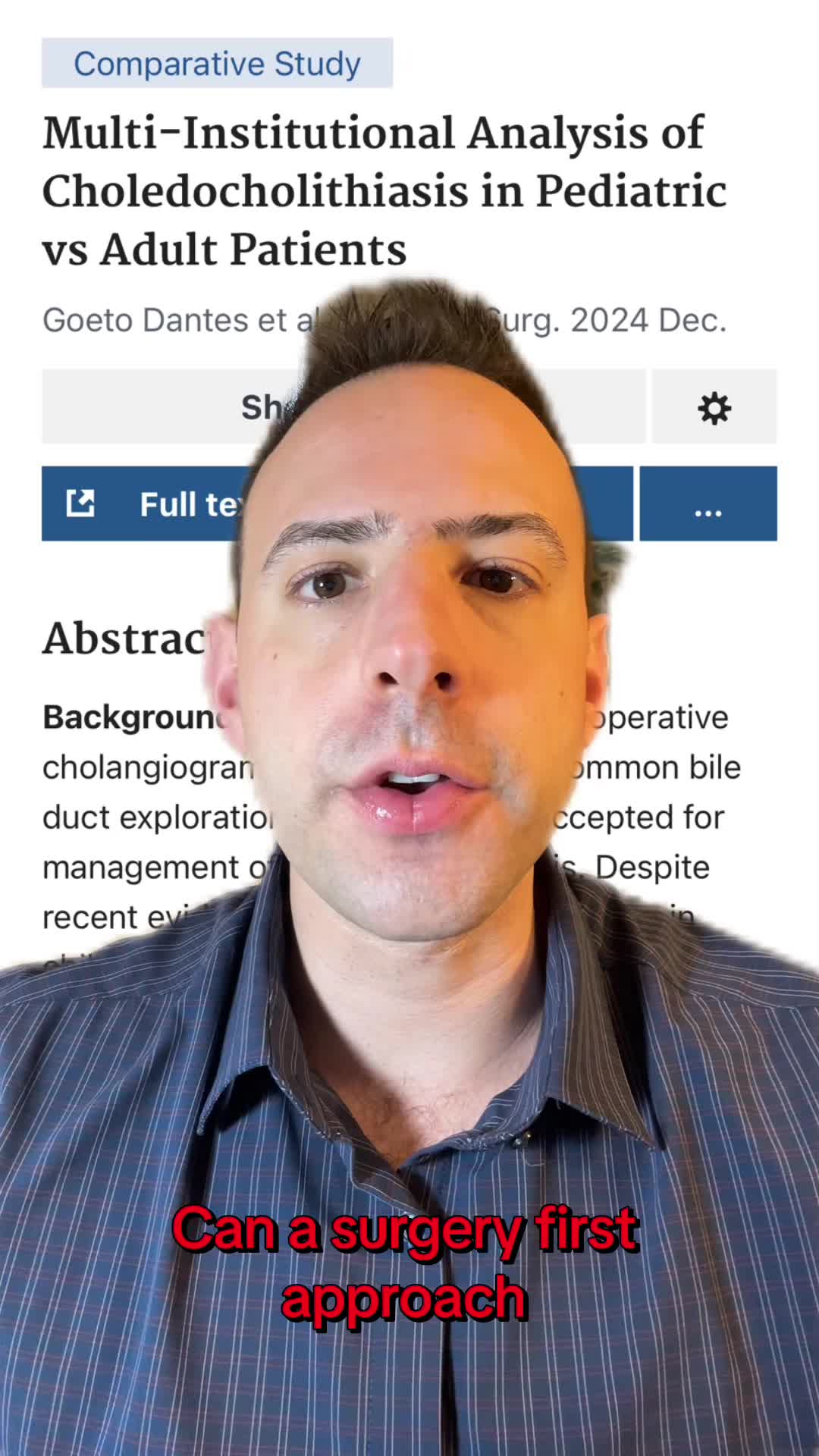
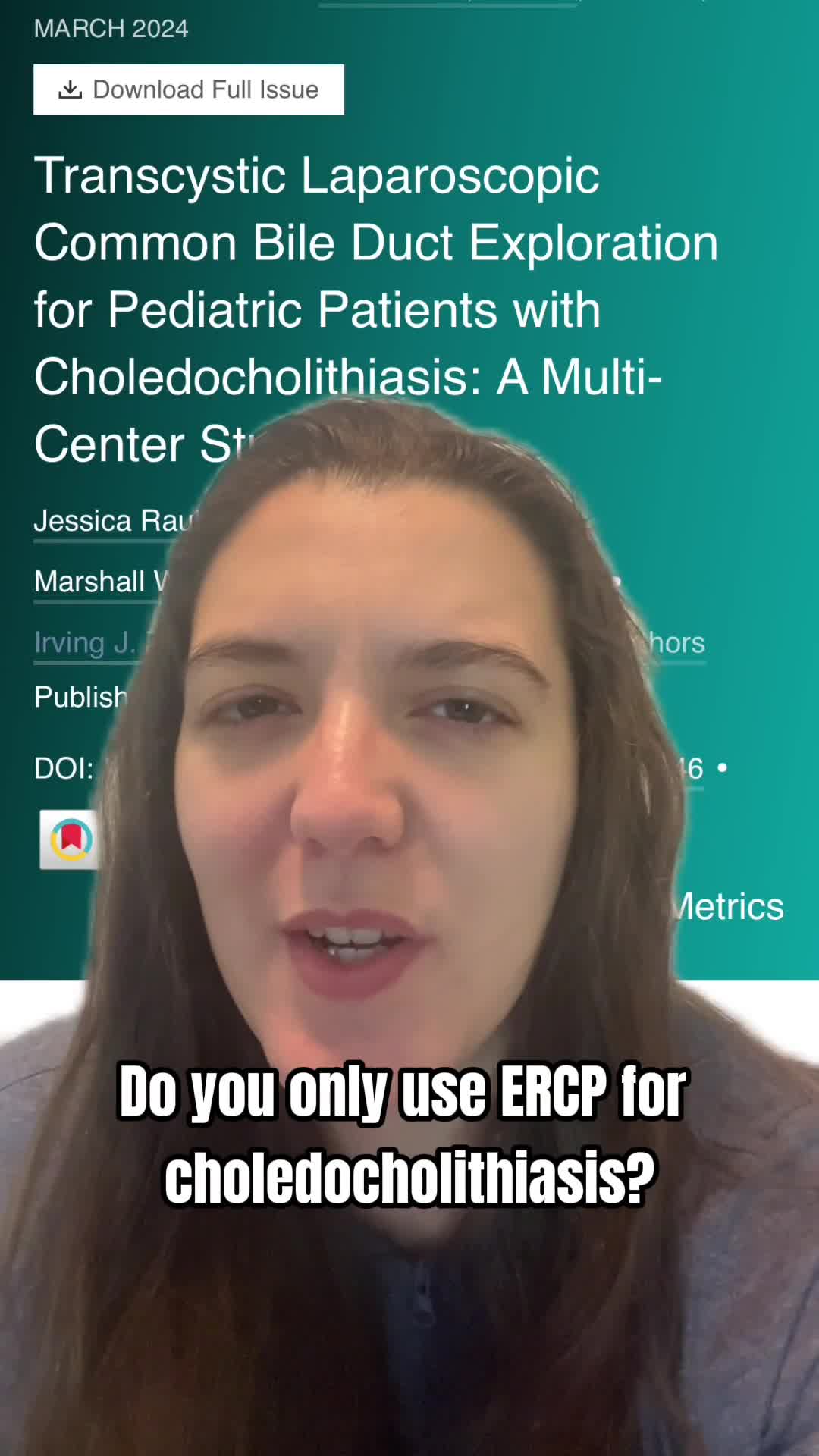
Hello, everyone. Welcome back to another episode of the Stay Current podcast. I'm Cecilia Gigena, a research fellow at Cincinnati Children's Hospital, and along with Stay Current, we are sharing knowledge to improve child health around the globe. Today we are talking about treatment for common bile duct pathology, and for that we have Doctor David Vitale, a pediatric gastroenterologist, director of the Interventional Endoscopy Center here at Cincinnati Children's Hospital, and Doctor Luke Neff, a pediatric surgeon at Atrion Health at Wake Forest Baptist. As we know, cholelithiasis is the presence of at least one gallstone in the common bile duct. The stone may be made up of bio pigments or calcium and cholesterol salts. We know that there are metabolic risk factors, uh, hemolysis such as sickle cell, congenital and biliary anomalies like colloidal cysts. It's more common in older children, children with higher BMI, and patients of Hispanic ethnicity. So, risk factors include metabolic diseases, hemolysis, and biliary anomalies. Now, let's start with a case. Uh, so the case of a 14 year old. Who came in presenting with right upper quadrant pain, and her initial exam and evaluation was relatively unremarkable other than some right upper quadrant tenderness. She had elevated AST and ALT with total bilirubin of 1.8 and the right bilirubin of 1.3. She had an abdominal ultrasound done, and the common bile duct was about 5 millimeters. Uh, she did have gallbladder stones on the imaging, but they could not see the distal common bile duct. BMI was in the 98th percentile. So, what do we do next? This slide is actually taken from ASGE, uh, which is the Adult Endoscopy Society for GI. So patients with a high probability, uh, would have things like common bile ducts seen on ultrasound, ascending cholangitis, or quite high bilirubin. And recommendation in those patients really is to go straight to ERCP. Patients with intermediate risk include those who have abnormal liver biochemical tests or dilated common bile ducts. We can do an endoscopic ultrasound to look for a stone. We can do an MRCP, a laparoscopic cholangiogram, or an intraoperative ultrasound. This intermediate category is where our patient falls. And in patients that have no predictors present, obviously, will just go on to potentially cholecystectomy. What about in children? So there's a few publications related to this, and they found that direct bilirubin or conjugated um bilirubin, more than 2 was the most predictive factor. And secondarily, a common bile duct diameter greater than 6 millimeters, although they didn't find a statistical difference, was most sensitive for predicting common bile duct stones. And there is a pediatric duct score, and this was published in the Journal of American College of Surgeons with 10 centers that participated, and they found that patients with ducts greater than 6 millimeters, common bile duct stones on ultrasound, or a total bilirubin greater than 1.8 were the most predictive risk factors. So if patients had 3 risk factors, it was. Very high predictability. If they have 2, it was high predictability, and if they only have 1, they fall in this intermediate category. So how do we continue treating this patient? We did an MRCP that showed stone in the common bile ducts. The patient had an ERCP that was done in a subsequent lab coli. There's some pretty good pediatric literature out there and a small sample pot size that show that doing same anesthesia, the laparoscopic cholecystectomy with ERCP and stone disease led to less anesthesia time and lower length of stay. And what about ERCP versus laparoscopic common bile duct exploration? There's a lot of retrospective data that's out there. I looked through a lot of the studies and the data is really conflicted. I really think again it gets back to institution dependent expertise and it's probably provider dependent and the institution's experience with this. There are a few randomized trials from 2013. But they show no significant difference in morbidity, mortality, retained stones, or failure rates between the two groups. But what about real-world experience? What are the considerations we have to know when approaching one of these patients? Stones above the cystic duct obviously pose a big problem, and even with attempted laparoscopic removal, these stones can float up there. And make a pretty straightforward EP a much more difficult one. so when there's one stone, and it's pretty easy to flush out, uh, doing this laparoscopically is not that big of a deal as if there's 4 or 5 stones there or a larger stone. I think, uh, local expertise and availability is probably the most important thing in this decision tree. Now that we covered this view from a gastroenterologist's point of view with Doctor Vitale, let's move to the surgical side with Doctor Luke Neff. We know the dominant paradigm across the country is an MRCP very often followed by an ERCP, but surgeons should be comfortable dealing with issues in the common bile duct, and resource utilization is a real thing. And then length of stay in the hospital is an important issue. So. To avoid this longer length of stay and reduced resource utilization, Doctor Neff is proposing a different approach for those centers that doesn't have a pediatric endoscopist available. The paradigm that we are presenting is a surgery first presentation. Go to the operating room, you are comfortable doing IOC. In case you were wondering, IOC means intraoperative cholangiogram. And there's essentially kind of 3 different things that could come out of that, right? You shoot it and it's negative, that's great. You send them home. So if you have a negative IUC, you can finish your laparoscopic cholecystectomy and send them home. The other two scenarios are if you have a positive IUC. So if it is positive but you don't feel comfortable with a common bile duct exploration, they can get what they would have had in the first place, an ERCP. And then, obviously, something that would be an ideal scenario, they go to the operating room, they get their conduct exploration, and you're able to, to avoid all these other things, particularly a second general anesthetic. So, in a superficial way, how can we approach to laparoscopically remove common bile duct stones? Um, so we, our mantra is all stones go forward. And so we use balloons to dilate up the sphincter and uh then flush them integrate into the duodenum. Great. So perform an IOC. And first, try to flush the stone forward to the duodenum using wire or catheters. Second, we'll try to dilate the ampulla with balloons and then flush the stones. What's next? Uh, there's more exotic things like the spyglass, uh, lithotripsy as well for these big stones. And again, this is probably more on the adult side. I've not seen any massive, massive stones in children. You can place biliary stents laparoscopically, transcystically, uh, and then choloidochotomy, which is, you know, something that I think would be mentioned. Only to be condemned. And when do you say, OK, I couldn't do it laparoscopically, let's do an ERCP. If you're having to open up the common bile duct to extract the stone and you had ERCP capability, I think that that's probably in most cases, not the right thing to do. Now, let's go into deeper detail. What kind of equipment are you using to do all this? We've created a card and actually, we want to keep this as cheap as possible, 5 or 6 French urethral stent, $7. 035 Glide wire, that's 50 bucks. Uh, and that gets you started. That, that can do a lot for you actually. So you can not only shoot your initial gram. In case you were wondering, shooting grams is the cool way of saying, doing an IOC. You can traverse the duct, just use the simplest, cheapest stuff you've got, and it's actually really effective. If you want to see the full list of the equipment they use, go to the description to find a link with all the necessary things that you'll need to fill your common bile. That exploration car. And everything we do is over a guide wire so that it makes that next step, if you, that step up approach that I talked about, your kit is already designed to help you take the next step, um, especially if you're using balloons at some point to dilate the ampula and flush through. And in patients that you couldn't address them surgically, and they need to go to a new CP, do you do something to the cystic duct? I put an endo loop on there, just a little belt and suspenders. I mean, maybe I've already put a clip, but I'll try to get an endo loop uh more proximal to that and You know, with our cholangiogram, we have an idea of how much uh cystic duct we have, so I like that little extra bit of security, don't typically leave a drain. So, ERCP and laparoscopic common biled exploration in the hands of an expert have similar outcomes, but you have to be aware of the resources your place have to make the better choice for the patients. For example, most free-standing children's hospitals do not have ERCP capabilities, which is something that Cincinnati Children's counts with. Yeah, I will completely agree with that. You're the unicorn, right? Not everybody has a unicorn. OK, so now that we discussed the pros and cons of the different approaches, let's talk about how is that Doctor Neff does the common bile duct exploration. We just use a 12 gauge angio cath, which may be hard to find in a pediatric hospital, but you could order them. We don't use existing ports because we want our angle of entry into the cystic ductotomy to be as flat as possible. Great. Make a new incision to pass the instruments at a better angle through the cystic duct, and what type of catheter do you use? This is just a little 6 French ureteral stent that we cut down. Uh, we make it a lot smaller or shorter for better flow. And we put a, uh, we put the glide wire in there. We almost use like a cylinder technique to get it into the duct so that we can navigate all those valves. So 6 French urethral catheter, pass it through the cystic duct, and then the one thing we would do next is we would get, uh, using the guide wire to help us direct in, we would get that, uh, catheter actually parked into the uh The common duct and get it right at the point of obstruction and really push hard. And if it doesn't work. And then you can even push that catheter over the wire to kind of ream out the sphincter a little bit. And then through that 12 French angie cath over the wire, we pass an angioplasty balloon and I typically will use either a 6 millimeter or 8 millimeter, but definitely not more than that. Perfect. So pass the wire up to the duodenum and then grab an angioplasty balloon of. 6 to 8 millimeters and dilate. But do you dilate in the duct, the sphincter, or both? So what we do is we blow up the balloon in the duct and we actually pull back on it. We give a little tactile feedback to know exactly where that sphincter is, and then we partially deflate and we straddle the ampulla. And then we go to full profile under fluoro, seeing the balloon come up to its full diameter, and then we hold that for about 5 minutes. And Doctor Vitale had some advice for us too. I think your point there, uh, never use a balloon that's larger than the dilated comet bile duct, which is really important, uh, cause we know that there is some USP literature out there with people looking at, uh, doing dilations of the ampula without doing a sphincterotomy, and there's definitely a higher rate of pancreatitis in those patients. Perfect. So 6 to 8 millimeter balloons that are smaller than the dilated common bile duct. Watch for possible pancreatitis post procedure. And what do we do with the stones after dilating the sphincter? We keep our guide wire axis in the duodenum. And then I'll actually pull back and I generally actually will straddle the cystic duct common duct, but I won't fully inflate. I'll inflate a little bit cause I want to create a seal on that uh distal common duct so that everything I flush through the guide bar aluminum gets pressurized downstream. And what happens if it fails? And you know, at that point, if, if we're not getting the job done, then we quit, you know, and we'll throw an inner loop on and, and call GIs. Doctor Vitale also recommended that if we start seeing the pancreatic duct in the flora, we should stop since that has a higher risk for pancreatitis. Uh, stone disease is not going anywhere. If anything, it's, the prevalence is increasing. So it's just nice to have some tools in your toolkit, even if you don't go to the point of balloons, knowing that, thinking about how to, to navigate across the ampulla with a wire and using your little catheter to ream it out and get some really good flushes right at the point of obstruction. I think those things are just helpful. Awesome. And is there any advice on how to get comfortable and learn the skills among surgeons? I think number one is getting familiar with the kit. And, and if you put together a cart or have something like that where somebody can purchase those items, just playing around with it and getting familiar with it. So first step, getting to know the equipment we are going to need to work with. Have a plan, uh, have the equipment at your disposal and just start shooting grams. Maybe even on elected cases, uh, just to get a feel for it. And truly, the position of that twelve-gauge angioca is really important. Uh, your ability to, to manipulate. The catheter and the wire in the duct is, is all about your initial setup and how flat your angle of entry is into the cystic duct. What's the learning curve on this? So that's a very person-specific question, but I would say around 5 to 10. Awesome. So now it's time to summarize. Risk factors for common bile duct stones include metabolic diseases, hemolysis, and biliary anomalies. Within the diagnostic tools we have endoscopic ultrasound, MRCP, or laparoscopic cholangiogram. ERCP and laparoscopic common bile duct exploration are both useful in the treatment. Of this pathology with few differences in outcomes, though ERCP may represent longer length of stay and two procedures with anesthesia in the majority of the establishments. Important tools for laparoroscopic common bile duct exploration include urethral stents, glide wire, and balloons for dilating the sphincter and flashing stones. It is very important to be familiarized with the equipment prior to using it in a patient. Proper set up and angle of entry are crucial for successful catheter and wire navigation during procedures. A statewise approach for treating common bile duct stones is key, knowing that if we fail, patients can always have an ERCP post-op. And that was Goletalaiasis with Doctors Vitale and Neff. I hope you enjoy it. Don't forget to subscribe to the Stay Current MD YouTube channel. Follow our social media channels and download the Stay Current MD app for tons of content in pediatric surgery. Globalcast MD along with Cincinnati Children's Hospital, sharing knowledge to improve child health around the globe.
Comments