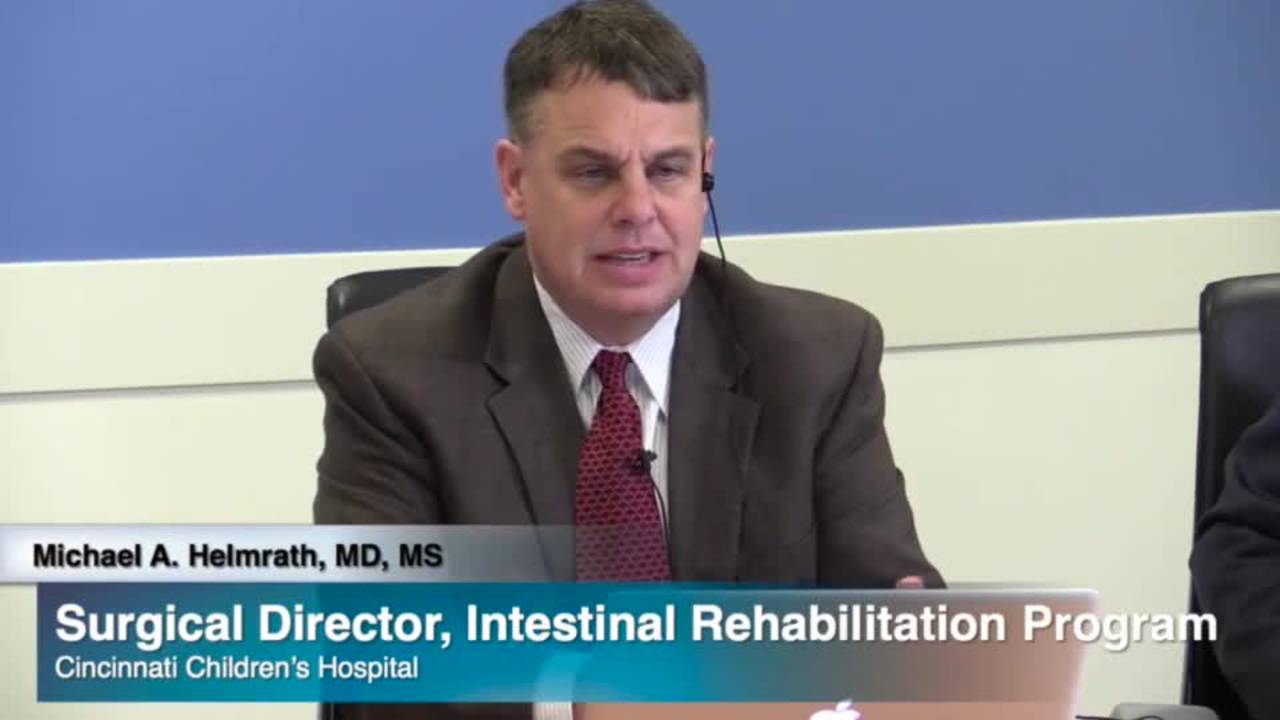
All right. Hi, everyone. We're back with another episode of a series we started before on intestinal rehabilitation. I'm Ellen Ancisco and I'm I'm Tom Bash. We're research fellows at Cincinnati Children's Hospital Medical Center. And we're doing this series with two of the surgical experts in intestinal rehabilitation at Cincinnati Children's Hospital. Medical Center. We have the surgical director of the intestinal rehab program. I'm Paul Wales. I'm a pediatric surgeon here at Cincinnati Children's Hospital, and we have the former surgical director of the intestinal rehab program. I'm Michael Helmrath. I'm a pediatric surgeon also doing intestinal failure surgery and research here at Cincinnati Children. So, today's topic took some buildup to get here, to get to talk about the operative steps of the lengthening procedures. But that's what we're gonna talk about today. We're gonna talk about the operative management for patients with intestinal failure. Um, so to start out, we asked Doctor Helmrath and Doctor Wales what are some of the preoperative considerations or things that we should think about when we're planning an operation for a patient with intestinal failure. I think it's important. As a surgeon to understand history. A lot of our history with intestinal failures go back, I think, to Adrian Bianchi, who first reported doing what he called a Bianchi procedure, but it's a longitudinal intestinal lengthening procedure that he would use to divide the bowel, given the opportunity that the bowel has two leaves to it. He would tubularize it, and we can talk a lot about that a little bit more. I think it's really important to understand the natural history of why that was being done. And so in the 80s and 90s, babies with intestinal failure really weren't making it, mostly because the liver was progressing to a state of inflammation and fibrosis associated with the way that we were Providing nutrition through parenteral uh nutrition, lipids, and phytosterols, according to Doctor Helmrath. And the rest of the time was to avoid that liver failure, but maybe bridge to a transplantation and to buy time. One of the first things that he and many others recognized that a rising direct bilirubin was a sign for these kids who are not going to do well. And so the goal there was to try to do interventions that would prevent that from happening. Adrian Bianchi recognized that the 1st 4 months of life is when care for these kids is most uncoordinated, and decisions made by surgeons are the most profound effect in the long-term outcome, and this is what really led to our understanding of multidisciplinary teams. And Doctor Helmrath mentioned a review that Bianchi did in the past. It's linked below in the media player. I want. People to go back and to recognize what we talked about before. The gut doubles in length the last trimester in the first year of life. That maturation process occurs when you feed the baby. Healthy growth of the intestine requires nutrition. Anything you do to disrupt that affects the maturation, not of the ability only of the intestine to absorb and digest, but the peristals and to function. Overall, the decision to operate is a multidisciplinary question, and it's patients. Specific. The outcome is one that should benefit the child for 80, 90 years, not just the next 2 months. And so Doctor Helmer's question is, do you do these innovative procedures initially at birth? That takes discussion. Doctor Halma says the intestine is like the ocean. It's the waves coming in and out over the villa that give you absorptive surface area, not the length, exposed area of the bowel that gets these kids off of nutrition of TPN. The better the waves going over the villa, The more exposure of nutrients and removal of waste that you have is not increased by lengthening the bowel that doesn't peristals. That's just more static water. So, that's why we see very short bowel kids sometimes come off a TPM because their motility is so good. So, we don't want to affect this developmental motility, which happens in the first year of life by undergoing procedures or having recurrent infections or other things that can be detrimental to the developmental process of the. Intestine. The point of intake for the majority of this population talking about short bowel syndrome is at birth because the etiologies for pediatrics are usually neonatal causes. That was Dr. Paul Well. He's the current surgical director of the intestinal rehabilitation program at Cincinnati Children's. So congenital anomalies of the GI tract or acquired conditions like necrotizing enterocolitis. So, the surgeon is involved at time 0 like that. Many times those procedures are done under their emergencies. So making rational decisions at that initial surgery will set that baby up for success or failure. These kids, as they adapt and evolve, will often require adjunctive procedures to optimize their anatomy to try to maximize their abortive potential. So we have a role to intervene at the right time to try to optimize things so that they continue to progress in a positive way. And then at the end of the road, if they happen to fail, then the surgeon has a role as well in the consideration for transplantation. So the surgeon has a vital presence in the natural history of these patients. So what Operating on a new baby, do we lengthen that bowel at that time and do a primary anastomosis of the colon? Do we bring out a stoma? Does it matter if that was a kid that had, what is the considerations that you make, or should we taper it? If you are thinking of reestablishing continuity, I feel very strongly that you have to deal with the size discrepancy. So you can put the two ends of the bowel together, but if they're quite disparate in diameter, then even if it's patent, it won't work. They'll end up with a functional obstruction. I approached the question, how do you deal with the size discrepancy. In very simplistic terms, if the person feels that they have adequate length overall, then your way of dealing with the size discrepancy could involve resection. And back to an area that is more caliber, that's more appropriate to the distal end, or you could taper the proximal end either with a tapering enteroplasty and then do an anastomosis, for instance. Or in the case of what you consider to be short, you could deal with the disparity in diameter by doing a serial transverse enteroplasty. That way, you're not resecting any mucosa, but you're dealing with the size discrepancy. So, in other words, how you deal with the size discrepancy Ends of bowel that you're trying to put back together depends on how much bowel you have. If you have enough bowel, you might reset to the point that the two ends match better and maybe taper the proximal end. Or if there's not enough bowel, a lengthening procedure such as the step procedure may be used. Take a look at the image below the media player to see an illustration of the step procedure. Talk to me about diagnosis. Difference between atresia and gastroschisis. How does that play in your decision? In general, gastroschisis, they don't tend to do as well regardless. If, and if I look at the step procedures that I've done over the years, the ones that tend to not do as well or tend to always be the gastroschisis. Patients with gastroschisis seems to just have this inherent dysmotility. The gastroschisis ones with or without aresia. So I find that the operation just doesn't work as well anyway. I think it goes back that the enteric nervous system is damaged to the extent in gastroschisis from the exposure to amniotic fluid and Has to go through a healing and a recovery phase which is different than some of the other populations of kids that we, we see. And I think when exposed to more dysmotility and more stasis, that regeneration and healing is attenuated, is not enhanced. Whereas on the other side, a baby that just has a straight up atricia, that bowel may have really good peristalsis and has been working against an obstruction, and that when done correctly and oriented, a longitudinal. Stapling a procedure may actually benefit that child very well. The question that Doctor Helmuth has, does that have to be done at birth or can it be done after their first year of life? I have seen many a child with a first operation at that time that included steps that have just never gone forward and then have been labeled a poor motility child and accepted to not be able to tolerate enteral feeds, which I have challenges with. If Doctor Helmuth. had to pick a child with a limited amount of gut to take care of. His first choice would be a baby with necrotizing enterocolitis. They just do better when they heal. Most of them because they've been fed before. They already have geo immertility starting. That maturation phase has already been turned on because they didn't get neck the day they were born. Tresia's 2, and I run from gastroschisis. Anything that creates a potential worsening of motility and gastroschisis, especially in the first year of. Life should be something you should strongly think about before doing. As far as decision making, and I don't usually do that operation anyway unless the bowel is an adequate diameter to make it worthwhile, and in my head over the years, it's always been about 5 centimeters anyway. The whole thing about gaining length is really dependent on the diameter of the bowel that you start with, and the width at which you make the cuts with the stapler. And if someone's not dilated enough, the procedure won't really be possible. Usually at birth, they're just not dilated enough to apply the step procedure. I would tend to either resect the bulbs and do a tapering enteroplasty. And if I can establish continuity at that time, I will. But there are scenarios where it may be more prudent to not connect it and to get access to the distal bowel, especially if it's really small, with a feeding tube to provide access for distal feeding and come back another day to establish continuity and use that time to grow the distal. Bowel and caliber to make that next operation better. So I want you, Paul, to describe to the listeners how you do a step, because there's different orientations that people use, and I think that they've contributed to some of the complications. And I also want you to talk about the difference between a non-rotated child where people will do a step all the way up on the duodenum, and it's even written that you can step the duodenum, which I think is fraught with problems and. Gives us a huge amount of issues later in life versus the kid that is normally rotated, how you approach the duodenum when it's non-rotated and when do you stop. I basically performed the operation the way it was originally described by HP Kim and Tom Jackson, and they really deserve all the credit. Basically, for a standard neonatal approach for me for an exploratory laparotomy is a transverse abdominal incision, super umbilical. So first, Doctor Wells gets into the abdomen and lics any adhesions. I like to lay out the whole intestinal tract from top to bottom. I find that it helps me understand exactly what we're dealing with and gives me sort of maximum mobility. And I also find it easier that way rather than just exposing the limited part that you think you want to work with. He measures the whole bowel before and after because it's critical to record and on the. you're dealing with. So I like to lay out the whole intestine. Once all the adhesions are liced, I use a surgical pen to mark the anti-mesenteric surface of the bowel after, with a lap sponge, dry it, and it usually takes 2 people to hold the bowel because the key here is there's a risk of the bowel twisting in longitudinal orientation if you don't maintain alignment. So that pen line on the anti-mesenteric surface. This helps you maintain alignment, so you don't start to spiral the bowel with your staple lines. Once the bowel is marked, I measure the intestine. He usually uses a 30 silk that's been dipped in mineral oil to make it nice and soft, and he measures so he knows what the starting bowel length is. And I also measure the caliber, and I usually don't enter this operation unless they're 5 centimeters dilated just for, to make it worthwhile. I also record the length of the dilated segment that's going to be stepped, so I have those numbers pre. Dr. Rails usually uses an endo GII stapler rather than an open GII stapler for the step procedure. I just find the size of the head of the cartridge to be more amenable in a smaller person. With a hemostat, make a mesenteric window and apply. The stapler across the bowel and I go perpendicular to the mesentery at 90 and 270 degrees. If zero is the mesenteric vessels coming in on the mesenteric side, I come across the bowel perpendicular to the mesentery at 3 o'clock and 9 o'clock. Again, there's an illustration below the media player to help you with visualization. Doctor Well uses a vascular cartridge or a white load with the end of GIA stapler, which is a 2.5 millimeter that crimps down to a 1 millimeter. And originally when I first started doing this back in 2003, early on, I had a couple of leaks that were related to the classic blue load. And ever since then, I switched to the vascular load and I haven't had a problem. I think it's more appropriate for a younger person's bowel thickness. He makes sure to use a surgical ruler to measure everything. If I was doing this in a baby, I would make the caliber about 1.5 centimeters and For an older infant or child, usually about 2 to 2.5 centimeter caliber. The last thing you want to do is make it too narrow and then you end up obstructing the patient. And especially in the setting of someone who has borderline motility, then you just make the problem worse. So, I cut that white ruler with pre-cut it with a pair of scissors to the right length. And I put it on the end of a straight hemostat. Then I use the staple cartridge. I come across the bowel with the purple line straight up to the sky so that you're not twisting the bowel, and I apply the stapler, and then I measure it with the ruler to the end of the bowel. And as you get going, you measure it to the end and to the side. So before firing, he makes sure to measure what he's cutting both the sides of the stapler and to the side of the bowl. One of the proposed advantages of the step is that the surgeon can maintain. The caliber all the way down from top to bottom by these measurements. When I'm happy with the measurement, I fire the stapler and then I place a suture in the crotch of that stapler. If you were to open that staple line, you could potentially have a leak in the crotch. So, I do a U stitch, usually with a 40PDS to close off that little crotch to prevent a leak there. And then he comes from the alternate side of the bowel. So, working with a partner, one person works from one side of the bowel and the other person works from the other side, and together you work your way down. The most versatile cartridge is the 45 millimeter cartridge, but you might need a few 30s and you might need a few 60s depending on whether you're at the beginning or the most dilated part of the bowel as you go along. One nuance that I started to do subsequently that wasn't originally described is right at the top of the step, And right at the bottom of the step where you transition in and out of the step, you could end up with a dog ear there, a blind loop that over time can dilate up. So what I do at the top and the bottom of the step is I will fire another cartridge, uh, that tapers that bowel coming into the step segment. That way you avoid having this kind of blind-ended thing that can grow over. Time. In other words, if you look at the image we've included, you'll see a corner right at the first staple line. Dr. Wales is saying that this part can dilate and form a blind loop, so he comes across that corner obliquely so you don't have that sharp angle. It is more tangential from proximal to distal to taper into the step, and Dr. Helmroth pointed out that if you have one part become dilated, then the step segments are able to rotate. Away from each other separately, and when they twist, this can form a functional obstruction. So that's a reason to avoid a dog ear, to avoid one part getting dilated and then the bowel twisting and obstructing. So once he's done stepping, he records the length of the bowel that was stepped, the new total length of the bowel there, and the caliber of the bowel, which is now 2 to 2.5 centimeters. Michael has a lot of experience with this, but Orientation like the operation was originally described going back and forth perpendicular to the mesentery, and that's how I've always done it. And some people do like to do it the opposite orientation. So coming in anti-mesenteric, which would be 180 degrees from the mesentery on the anti-mesenteric side and the mesenteric side, so up and down. But Dr. Whales doesn't do it that way. And I want to talk about how proximal, where do you start the step procedure first? I don't step the duodenum. I start where the bowel starts to dilate. That's usually in the duodenum. And I guess if the whole thing fell apart and the person leaked, I do like to be able to get proximal to the staple line if I ever had to go back in an emergency. So, I don't like to have the staple line going right up into the duodenum. So he tapers a bit coming into the step segment, but not usually the duodenum. If I was going to narrow the duodenum, I would use a stapler to partially narrow it on the lateral side away from the bile duct and the ampula, and I don't usually placate the duodenum because I find Those sutures usually fail. So remember, the duodenum doesn't have a mesentery. And so when we see these kids that have had step procedures, they have no way of orienting 3 and 9 o'clock because there is no mesentery to bring it up. And so they're basically diving into the bowel in different areas. OK, we've covered a lot so far here. To summarize, Doctor Helmrath reviewed some of the history behind the lengthening procedures. We reviewed some of the considerations before proceeding with the lengthening procedure, including the size discrepancy between bowel segments and what the underlying diagnosis for the patient is. Then we reviewed in detail how Doctor Wells' step procedure. Important points include remembering to measure the ball before and after, measure the segments as you're proceeding, consider putting a stitch in the crotch of the staple lines, and try not to end up with a dog ear at the start or end of the whole stepped segment. Next time, we'll review discussions with the family, additional pre-op considerations, and post-op outcomes with complications. So be sure to stay tuned for part 2 of this episode on the lengthening procedures for intestinal failure patients. Thanks so much for listening. If you liked what you heard, don't forget to subscribe to our YouTube channel. Leave us a like or a comment on Apple Podcasts, Spotify. wherever you're listening. And as always, don't forget to download the Stay Current in pediatric surgery app. It's on the Apple App Store or in the Google Play Store. Until next time, I'm Ellen. And I am. And remember, knowledge should be free.
Comments