
Hepatoblastoma with Dr. Greg Tiao
With Dr. Greg Tiao · Grand Rounds
Educational content from recorded physician discussions — not medical advice. Talk to your (or your child's) care team about your situation.
Video
Hepatoblastoma with Dr. Greg Tiao
CCHMC Pediatric Surgery · Published Mar 2022
Video
Social Determinants of Health Influence on Survival in Wilms Tumor, Neuroblastoma, and Hepatoblastoma
1 min · Published Jan 2026
Podcast
Hepatoblastoma
54 min · Published Nov 2017
Video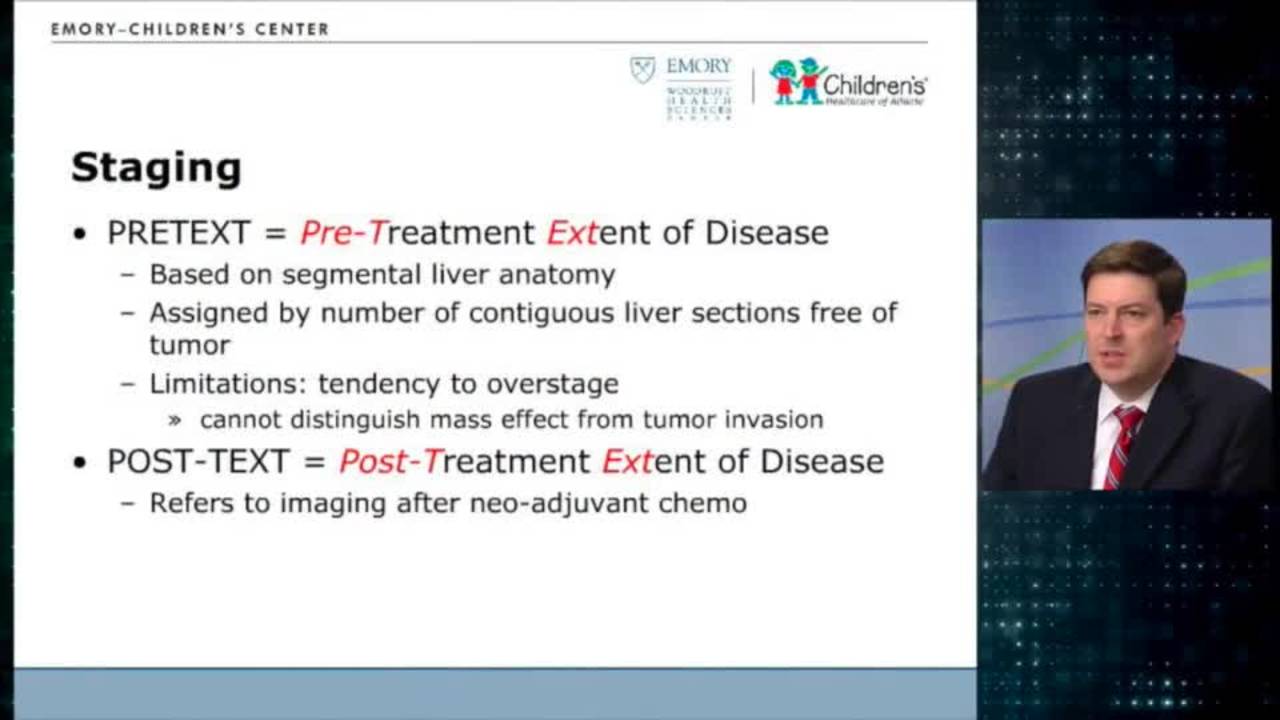
Hepatoblastoma: Update Course 2014
24 min · Published Nov 2018
Video
Quality of Life Outcomes for Patients Who Underwent Conventional Resection and Liver Transplantation for Locally Advanced Hepatoblastoma
1 min · Published Jan 2026
Video
Clinical & Research Update: Pediatric Liver Tumors - A Case-Based Discussion with Drs. Katherine Somers & Alex Bondoc
69 min · Published Apr 2026
Video
Update Course Rewind: MMP-7 & Biliary Atresia Diagnosis 2024
CCHMC Pediatric Surgery · 6 min · Published Mar 2025
Video
Biliary Atresia with Dr. Greg Tiao
CCHMC Pediatric Surgery · 11 min · Published Jun 2022
Podcast
Biliary Atresia Part II
42 min · Published Feb 2022
Podcast
Biliary Atresia Part I
31 min · Published Jan 2022
Video
Biliary Atresia
CCHMC Pediatric Surgery · 20 min · Published Nov 2018
Video
Compiled Sandler Rapid Fire Sessions: Update Course 2015
29 min · Published Nov 2015
Video
GYN #4 Management of Tubal Torsion: When to Consider Salpingectomy with Dr. Lesley Breech
CCHMC Pediatric Surgery · Published Oct 2024
Podcast
Pyloric Stenosis with Dr. Alex Bondoc
16 min · Published Jun 2024
Video
GYN #3 Management of an Adnexal Torsion with a Healthy Appearing Ovary with Dr. Lesley Breech
CCHMC Pediatric Surgery · Published May 2024
Video
GYN #2 Oophoropexy in Adnexal Torsion with Dr. Lesley Breech
CCHMC Pediatric Surgery · Published May 2024
Video
GYN #1 Importance of Documenting Reproductive Anatomy with Dr. Lesley Breech
CCHMC Pediatric Surgery · Published Feb 2024
Podcast
Esophageal Replacement with Dr. Dan von Allmen
13 min · Published Nov 2023
What the experts said
There are around 250 new cases of hepatoblastoma per year.
Hemangioma is the most common liver lesion in children.
EOVIST is an MRI contrast agent that is taken up by hepatocytes and then excreted, providing the best definition when looking at the liver on imaging and distinguishing biliary anatomy.
Couinaud labeled the liver segments in a counterclockwise fashion after the districts of Paris, by injecting portal vessels.
The right hepatic vein differentiates the anterior sections (segments 5 and 8) from the posterior sections (segments 6 and 7) of the right liver.
The right portal vein separates superior segments (7 and 8) from inferior segments (5 and 6) in the right liver.
The change in practice for PRETEXT 3 and 4 tumors improved survival rates for patients with hepatoblastoma from less than 30% in the 1970s and 1980s to between 80 and 90% today.
PRETEXT 3 tumors should generally be biopsied at diagnosis and then started on neoadjuvant chemotherapy, with readiness to send patients to a transplant center or a center with expertise in advanced liver resections depending on response.
For PRETEXT 3 or 4 liver disease, specific indications for transplant include unresectable disease, unsafe resection, or resection that would leave the patient with an inadequate liver remnant.
Teams are now trained to recognize hepatoblastoma tumors and send them to centers that offer transplant or can do aggressive resection, resulting in more patient referrals than 15 years ago.
The FIT study has been ongoing for three years.
Hepatoblastoma is the most common malignant liver tumor in the pediatric population.
Neuroblastoma is the most common solid malignancy in the pediatric population.
The differential diagnosis for a liver mass should include hepatoblastoma, hemangioma, hematomas, focal nodular hyperplasia, and hepatocellular carcinoma.
Hepatoblastoma can present as an asymptomatic abdominal mass, tumor rupture, respiratory distress due to tumor size, or as a paraneoplastic syndrome like precocious puberty.
An elevated alpha-fetoprotein (AFP) is a key component in the workup of hepatoblastoma and is critical for the diagnostic algorithm and as a guide for treatment response.
MRI is relied upon by most experts to delineate the anatomy and evaluate the extent of liver involvement in hepatoblastoma.
To establish a diagnosis of hepatoblastoma, four things are needed: history, abdominal imaging, AFP check, and liver biopsy.
The most important intervention for survival in hepatoblastoma is to achieve complete resection.
Aggressive resections for hepatoblastoma include trisectionectomy, mesohepatectomy, resection with an additional procedure in the remnant liver, and liver transplantation.
In the PRETEXT staging system, PRETEXT 1 has 3 contiguous sections free of disease, PRETEXT 2 has 2 contiguous sections free, PRETEXT 3 has 1 free section, and PRETEXT 4 has no free sections or diffuse tumor burden in all sections.
PRETEXT 1 and 2 tumors with greater than a centimeter margin from the middle hepatic vein and the portal bifurcation should be considered for resection at diagnosis.
It is important to consult a transplant center early for PRETEXT 3 and 4 tumors.
The Pediatric Hepatic International Tumor Trial (FIT) is an ongoing multinational trial aimed at identifying high and low risk features for each of the PRETEXT stages of hepatoblastoma.