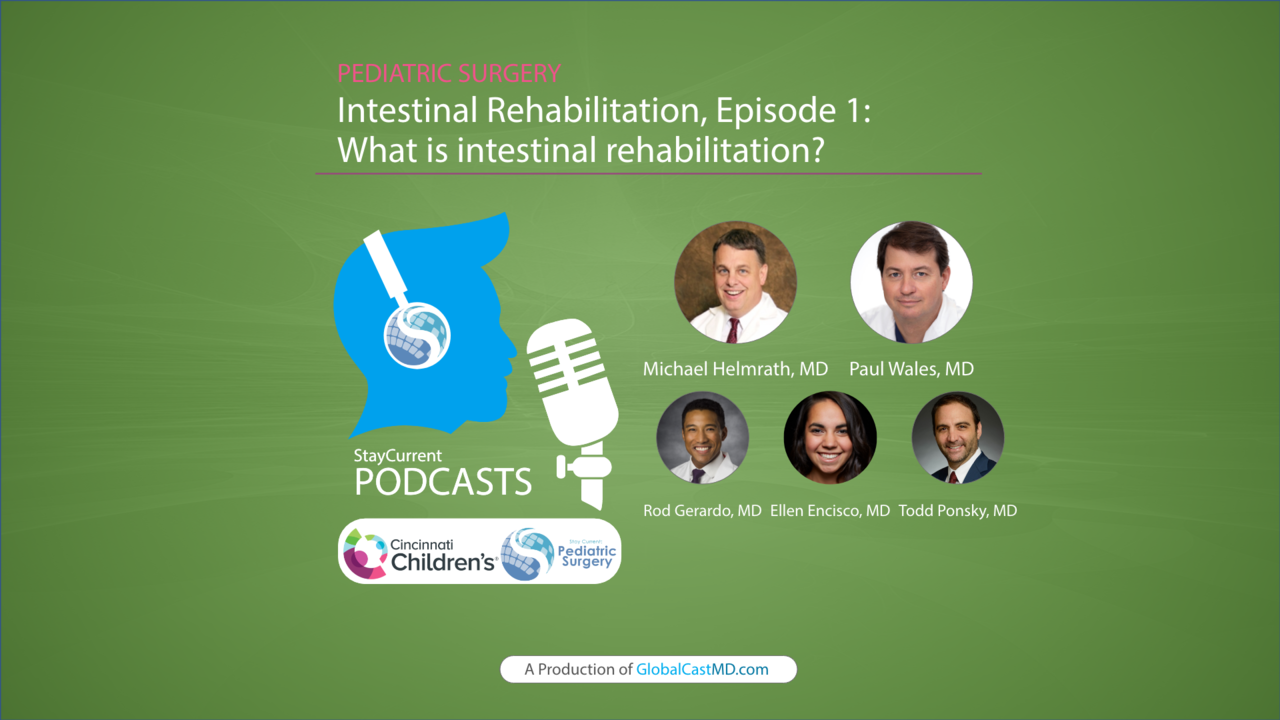
Hey there, listeners, this is Rod Gerardo from Cincinnati Children's, and I'm Go ahead. Sorry. We never have a script for this. This is Ellen and Cisco also from Cincinnati Children's. To continue with our Journal of Pediatric Surgery Journal Club article review monthly, we have 3 new articles that were sent to us from the September issue by My name is Mick Kakaran, and I'm a professor of. Pediatric surgery in, in Helsinki Children's University Hospital, and of course, I'm also editor for Europe in JPS. Which one should we start with? I don't know, ERAS, that's just the one that the PDF that has opened on my computer now. So this one is called Early internal feeding versus traditional feeding in neonatal congenital gastrointestinal malformation undergoing intestinal anastomosis, a randomized multi-center controlled trial of an enhanced recovery after surgery component. It's a mouthful, but if you scroll down on the media player, we linked it, we linked all the articles, so you can go ahead and click on it and you could read along with us. So this one is coming from researchers in China, described in the title, a randomized multi-center controlled trial of neonate who underwent surgery for a gastrointestinal malformation and had an anastomosis, an intestinal anastomosis. They divided 100. 56 into two groups, they're randomized to either early internal feeds or traditional feeding. What was traditional feeding? In this case, that meant that they had an NG tube in place for decompression after surgery until the output was low enough that they could remove, remove the NG tube. Yeah, pretty much like a standard, I feel like rule of thumb for most. Surgeons around the world probably, just to play it safely. They're comparing these two groups, early feeding versus kind of like what, you know, is common practice, I would say. And they found between the two groups, they found that, you know, as one might expect from early annual feeds in one group, that group had earlier start of feeding, 2 days compared to 6 days for the traditionally fed group. And in all of the other comparisons they made on length of stay, time to full feeds, and postoperative complications, um, 30 day mortality, 30 day readmissions, all of those other comparisons, there was no significant difference between the two groups. Kind of like what you were pointing out there is then there were really no differences between the other outcome measures that they had. Um, here's Doctor Pekkinen talking about it. I think it's a very interesting study because it addresses very Common issue in everyday practice when they start feeding newborns after intestinal anastomosis. Children are, are not small adults. And although there is a lot of evidence that early feeding in adult patients after intestinal surgery is beneficial, perhaps It's not that surprisingly, the authors didn't find any benefit in neonates. So the other take that Todd had, uh, that we, I don't think was directly addressed in the article. In the group that got early feeds, they also did not have a decompressing nasogastric tube. So, a summary point there is you don't need nasogastric decompression after an anastomosis. Forget the feeds. Like, that's huge, like to, to say that we don't need NG tubes anymore after an anastomosis is a big deal. And if the two groups really had the same, that's an unintended data point that they really weren't looking at. They were looking at feeds versus not. But really what I'm learning from this is we don't need NG tubes. They did, yeah, they did feed. I was just looking back, they did feed to the NG tube, and they, you know, left it to gravity, but yeah, they, they were feeding, they weren't decompressing. You can't do both. So what that tells me is the tube might have been in place, but they were not decompressing the stomach after the anastomosis, which tells me That it made no difference. So we do not need NG tubes after a baby anastomosis. That's a big practice change. Change of practice or no? Yeah, change of practice. I would stop leaving NG tubes, I think. Is there anything else with this one? I wish we could have talked to them. Yeah. Should we say that? If you're out there. I'm just kidding. Actually, that's not a bad, so Doctor, let's say, uh, Doctor Peng, Doctor Pen, if you're listening to this podcast, like tweet at us or something, we'd love to hear from you. Let's move on to the Meckel one. OK. All right, so the next one, it's called Clinical Diagnostic Predictive score for Meckel diverticulum. A 5-year retrospective review out of Utah, all patients less than the age of. 18 who presented with hematochesia and then they found of those patients, which ones had a diagnosis of mele diverticulum and then they, they wondered, you know, what presenting factors are more predictive of mele diverticulum in patients who present with hematochezia, and from those, they created a risk score. Babies with the blood in their stool. Enough to cause a decrease in, in hemoglobin, based on my experience being always been sort of a, a red flag sign in these children and want and, and those children who you want to make sure you rule out Meckel's diverticulum and, and this paper just confirms the fact quite nicely. I thought that our boss Todd was not going to like this article, but he actually really liked this, so here's what he said. My argument is Why do we need to get a Mchel scan at all? Yeah, so here's how I would use that score. So for me, I would create an algorithm from this and say, OK, if the score is high, I would go straight to laparoscopy because even with a negative Mechel scan, I'm going to be thinking it's likely a Meckel's diverticulum. So actually, I'm surprised, Todd, because I was going into this thinking you were gonna say what you said to us before is, I don't like scoring systems. I don't like predictive. I thought you were gonna come in and trash it. I said that before we talked about about appendicitis. You said that you don't use scoring systems. The reason this score helps is because we're all kind of on the fence about one or the other, and this tips the scales. So then this one, change your practice. This would change my practice in that it would help me potentially tip the scale of skipping the mechel scan in certain subset of patients. So you would be, sorry, you would go through calculating the score and deciding. I would have you guys calculate the score for me, as I say. All right, should we do the last one? Let's do the last one. So this one is called A Child Presents with perianal symptoms. How often is this Crohn's Disease? And this one is out of Cincinnati Children's Hospital, which is where we're coming from. Yeah, which made it easy to get a hold of some of the authors. My name is Julian Goddard. I am a general surgery resident at Boston Medical Center. I was previously a research resident at Cincinnati Children's. Hi, I'm Iris Lim Butel. I'm the senior pediatric surgery fellow at Cincinnati Children's. Um, I was a previous pediatric colorectal surgery fellow here at Cincinnati as well, um, and focused a lot on Crohn's, um, disease as well as congenital anorectal malformations. I think the conversation between Doctor Fisher and Iris was, uh, regarding perianal Crohn's and just how Um, you know, how it initially manifests and the like overall outcomes of those kids. You know, we deal with butt pus and perianal abscesses all the time in eds, and it made us wonder, you know, what are the kind of defining things in those children? Should we be led to working them up for Crohn's? Because perianal abscesses are so common. There wasn't really a ton of research on, you know, at least in children regarding how, you know, someone presents with a fistula or an abscess. Thankfully, here at Cincinnati Children's, we have a collaborative relationship with our inflammatory bowel disease specialists in the GI. So we're a big multidisciplinary team, so we keep a database in there. For this study, we performed a retrospective review of all children from 0 to 18 years, who lives within a 15 mile radius of Cincinnati children's and then using that, we took all of them that presented with perianal disease. And then with EPIC, we are able to kind of define the patients that present with some sort of symptom, perianal symptoms. So was it an abscess, was it a fissure? And then also got a second list where we did a retrospective review of all the children. Um, within a 50 mile radius who were diagnosed with Crohn's disease. If you had to guess, what percent of those kids would you say ended up getting diagnosed with Crohn's disease? 10%. That's what I would, that's what I would have thought, right? I would have thought something like 10%. It was actually 3%, you know, like overall, yes, 3%, but, you know, if you have a baby that has a rectal abscess, perirectal abscess, like they never got Crohn's, and no kids under the age of 1 had ended up having Crohn's disease within our study period. I personally thought that it was gonna be higher. You see higher rates of Crohn's disease in the older children. So when you're getting to the adolescent age, over the age of 10 is um what we saw, um, that kind of goes more in line with as these patients get older and they present with the perianal symptoms, then there is a, uh, stronger incidence, a larger incidence of Crohn's. Uh, me too, we're I would have expected a little bit higher overall incidence, but on the other hand, there was a lot, quite a lot of the, of the patients had fissure, which is uh very common in children. But it's also because that involves patients who were diagnosed or who were who had their perianal symptoms dealt with as an outpatient, so they may not have ever seen me or my team. So my conclusion from that is under the age of 10. You do not need to worry about doing a workup for Crohn's disease. And over the age of 10, you should. I always thought that most commonly it presented with GI symptoms, you know, abdominal pain, diarrhea, but actually, quite a few kids present with a perirectal abscess. And uh I remember when I first found that out, I, I felt like I was, it was way overkill to be sending them to GI for a colonoscopy. But in fact, that's what I've been doing. And surprisingly, we keep finding Crohn's disease. This paper, change your practice or no? Yes. Awesome. So, that was the September highlights for potentially practice changing journal articles out of the Journal of Pediatric Surgery. Super interesting and and practical information, I think. If you want to read them, they're all linked below. If you want more articles like this, you can download the state current pediatric surgery app and you can hear Ellen and I talk about more articles. But until next time, I'm Rod Gerardo. I'm Ellen and Cisco. We're research residents at Cincinnati Children's. And remember, knowledge should be free. There we go. Perfect.
Comments